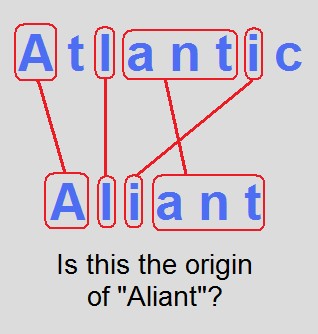
Bell Aliant Inc. was incorporated on 30 April 2010
under the Canada Business Corporations Act
carrying on business as
Ref:
Bell Aliant Regional Communications Limited Partnership
(formerly Aliant Telecom Inc.) CRTC
Ref: Broadcasting Decision CRTC 2012-702 CRTC
Also see: Maritime Telegraph & Telephone Company
|
How to use your browser to |
#
2012 Oct: Area code 902 to be overlaid by 782
# 2012 Oct: Ten-digit telephone numbers coming to Nova Scotia
#
2013 Aug: Bell Aliant network equipment is converted for 10-digit local dialing
For all local calls, business and residential customers can now start 10-digit dialing.
For all local calls, business and residential customers can now use either 7- or 10-digit dialing.
Both 7- and 10-digit local dialed calls will be connected without interruption.
#
2014 Aug 23: 10-digit dialing for all local calls becomes mandatory
For all local calls, business and residential customers must use 10-digit dialing.
7-digit local dialed calls will no longer be connected.
Aliant Inc., the parent corporation of Aliant Telecom Inc., was incorporated on March 9, 1999 as 3595641 Canada Inc. under the Canada Business Corporations Act for the purpose of participating in a series of transactions (more particularly described in the Joint Management Information Circular).
Joint Management Information Circular, 21 Oct 1999
Aliant Inc. 1999 Annual Information Form April 2000
Aliant 1999 Annual Report
In early 1999, the four principal telecommunications companies operating in Atlantic Canada, Bruncor Inc., Island Tel, Maritime Telegraph and Telephone Company Limited and NewTel Enterprises Limited, determined that by combining their personnel, financial and technological resources they could create a stronger and more vibrant enterprise, with the potential to take advantage of the opportunities for growth available in the telecommunications industry.
Aliant Inc. is the public management holding company which resulted from that combination and has interests primarily in telecommunications (through Aliant Telecom Inc.), information technology, mobile satellite communications services and certain emerging businesses, many of which have a telecommunications focus. Aliant Inc.'s common shares are listed and posted for trading on The Toronto Stock Exchange under the ticker symbol “AIT”...
Aliant Telecom Inc. was incorporated on August 4, 1999 under the Canada Business Corporations Act to become the telecommunications arm of Aliant Inc. Aliant Inc. currently owns 79.4% of Aliant Telecom Inc.'s issued and outstanding shares and NewTel Enterprises Limited, a subsidiary of Aliant Inc., holds the remaining 20.6%. NewTel Enterprises Limited will be wound up at December 31, 1999 and, at that time, Aliant Telecom Inc. will become a 100% owned subsidiary of Aliant Inc. Aliant Telecom Inc. owns directly or indirectly 100% of the common shares of the Telcos, MT&T Mobility Inc. and NewTel Mobility Ltd. Aliant Telecom Inc. also indirectly owns an interest in MITI Information Technology Inc. (“MITI”) of Saint John, New Brunswick, an interest in Xwave Solutions Inc. (“Xwave”) of St. John's, Newfoundland, ImagicTV Inc. (“ImagicTV”) of Saint John, New Brunswick, and MediaLinx Interactive Limited Partnership of Toronto, Ontario (“MediaLinx”)...; however, it is Aliant Telecom Inc.'s intention to transfer all of these holdings except the interest in MediaLinx to other wholly-owned subsidiaries of Aliant Inc. by March 31, 2000. On the completion of these transfers, substantially all of Aliant Telecom Inc.'s operations will be in the telecommunications business...
[boldface emphasis added]
– Excerpted from Aliant Telecom Inc., Preliminary Short Form Shelf Prospectus dated September 29, 1999
– Source: SEDAR website
http://www.sedar.com/homepage.htm
Wednesday, May 19, 1999
Atlantic merger approved, creating new $3B growth company
ST. JOHN'S, HALIFAX, CHARLOTTETOWN, SAINT JOHN, May 19 /CNW/ – Bruncor Inc., Island Telecom Inc., Maritime Telegraph and Telephone Company Limited, and NewTel Enterprises Limited, owners of the major IT and provincial telecommunications companies in Atlantic Canada, announced today that shareholders at their respective annual and special general meetings approved the merger of their four entities. Over 99% of shareholders voted in favour of the resolution to form one company with the working name of AtlanticCo.
Speaking on behalf of the chairpersons of each company, Bruncor's chairman, Lino Celeste, said; “Merger approval by such a high number of shareholders clearly demonstrates that the creation of a new holding company makes sound business sense. This is an historic moment for our companies and for all of Atlantic Canada. We're very pleased that shareholders supported the findings of our recommendations.”
The merger will create a new entity, structured as a holding company, owning 100 per cent of each of the four regional telecommunications companies, as well as the current ownership positions of the other, non-telecommunications businesses of Bruncor, NewTel and MTT. It will operate with a virtual head office; all of the current offices in Atlantic Canada will continue to play an important role.
“By uniting, we will capitalize on our strengths and become the largest publicly traded company in Atlantic Canada,” said Stephen Wetmore, president and CEO of AtlanticCo. “But it's not our size and our growth prospects that matter most; it's the fact that we'll be forming a company that can safeguard our futures.
“Our new company has a solid financial foundation, the size, scope and growth strategies to become a significant player in North America's communications and information technology industries,” Mr. Wetmore said. “It will deliver superior services to our customers; it will provide satisfying careers for our employees; it will offer rewards for shareholders; and it will be a positive force supporting Atlantic Canada's economy.”
The merged company, at an initial market capitalization of $3 billion, will be one of the largest private-sector employers in Atlantic Canada with 9,000 employees. AtlanticCo will be the third-largest incumbent telecommunications company in Canada, the second-largest Canadian-owned IT group, and one of the largest mobile satellite services companies in North America.
The new company will be launched as a growth company with four core lines of business: telecommunications, information technology (IT), mobile satellite communications, and emerging business.
The senior management team of AtlanticCo will include: Stephen Wetmore, President and CEO of NewTel Enterprises who becomes President and CEO of AtlanticCo; Colin Latham, President and CEO of MTT, who becomes Executive Vice-President, AtlanticCo, and President, AtlanticCo Telecommunications, overseeing the operations of the four telecommunications companies – NBTel, MTT, Island Tel, and NewTel Communications; Gerry Pond, President and CEO of Bruncor and NBTel, who becomes Executive Vice-President, AtlanticCo, and President of Information Technology and Emerging Business, AtlanticCo; Bob Benson, Executive Vice-President and CFO, NewTel, who becomes Executive Vice-President and Chief Financial Officer, AtlanticCo; Bill Steeves, Vice-President and CFO, Bruncor and NBTel, who becomes Vice-President, Corporate Services, AtlanticCo, heading up a transition team to manage the organizational integration. Fred Morash, President of Island Tel and Frank Fagan, President of NewTel Communications will continue in their respective leadership positions. Gerry Pond and Colin Latham will remain in their positions as president and CEO of NBTel and MTT, respectively. Lino Celeste, Chairman of Bruncor, will become the non-executive chairman of AtlanticCo.
To approve the merger, 66 2/3 per cent of votes cast had to be in favour of the special resolution at Bruncor and NewTel Enterprises. Island Telecom's shareholders needed to approve the resolution with 75 per cent of all votes cast and MTT's shareholders had to agree with 50 per cent by number and 75 per cent by value of votes cast.
The formal launch of AtlanticCo – with a new name – will take place by early June. Over the course of the next two weeks, all four companies will concentrate on completing legal and stock exchange requirements.
AtlanticCo is the current working name of the management holding company. Its operations will provide advanced communications services and integrated solutions to customers worldwide. With 9,000 employees throughout Canada and the US, it will deliver expertise in the areas of local, long-distance, wireless, data, Internet, information technology, managed network services, and mobile satellite communications. Its customers include public and private enterprises, governments, businesses and consumers. AtlanticCo's structure will include four lines of business.
[boldface emphasis added]
NBTel, MTT, Island Tel, NewTel Communications, NBTel Mobility, MTT Mobility, Island Tel Mobility, NewTel Mobility.
MITI Information Technology Inc., (MITI), xwave solutions, Island Tel Advanced Solutions (ITAS), NBTel's IT division.
Stratos Global Corporation
AMI Offshore, Salter New Media, Brooklyn North, ConneCTIvity, iMagicTV, NBTel Global, New North Media, NewTech Instruments, MTT Holdings Inc., and MTT Leasing Inc.
– Source: (BellAliant archive)
AtlanticCo press release, 19 May 1999
http://bellaliant.ca/english/news/news2.asp?YYYY=1999¤tPage=7&Keyword=&BU1=&BU2=&BU3=&BU4=&BU5=&BU6=&BU7=&BU8=&FromDay=1&FromMonth=1&FromYear=1999&ToDay=31&ToMonth=12&ToYear=1999&frompage=news&id=18
– Source: (BellAliant archive)
AtlanticCo press release, 22 May 1999
http://bellaliant.ca/english/news/news2.asp?YYYY=1999¤tPage=7&Keyword=&BU1=&BU2=&BU3=&BU4=&BU5=&BU6=&BU7=&BU8=&FromDay=1&FromMonth=1&FromYear=1999&ToDay=31&ToMonth=12&ToYear=1999&frompage=news&id=17
On May 31, 1999, 3588378 Canada Inc. acquired 52,540,265 common shares of Aliant (the company under which Bruncor Inc. (“Bruncor”), Maritime Telegraph and Telephone Company Limited (“MT&T”) and NewTel Enterprises Limited (“NewTel”) were combined on May 31, 1999), representing approximately 41.6% of the outstanding common shares of Aliant from BCE Inc. (“BCE”), the parent company of Bell Canada. Previously on May 28, 1999, 3588378 Canada Inc. had acquired all of BCE's interests in Bruncor, MT&T and NewTel, which interests were exchanged for the shares of Aliant. Bell Canada now holds 52,540,265 common shares of Aliant.
– Source: SEDAR website
http://www.sedar.com/homepage.htm
The share exchange resulted in a total of 126,437,484 Aliant common shares being issued, with the shareholders of the Predecessor Companies holding the following shares:
                                Number of Aliant      % of
Shareholder group                common shares       shares
                                                   outstanding

Bruncor former shareholders         44,151,541       34.92%
MTT former shareholders             49,889,477       39.46%
NEL former shareholders             28,862,997       22.83%
Island former shareholders           3,533,469        2.79%
   (other than Maritime Holdings)
          Total                    126,437,484      100.00%
– Source:
At the close of business on June 30th, 1999, the market price of a share of Aliant stock was $22.45. This values the 126,437,484 shares of Aliant Inc. at $2,838,521,516. This is known as the market capitalization (or the “market cap” ) of the company at that time. At that moment in time, this was the total market value of the company. [boldface emphasis added]
This day, Monday, 31 May 1999, was the last business day for the venerable Maritime Telegraph & Telephone Company, the dominant telephone company in Nova Scotia since 1910.
May 31, 1999
Atlantic merger approved, creating new $3B growth company
ST. JOHN'S, HALIFAX, CHARLOTTETOWN, SAINT JOHN, May 31 – A new name will enter the TSE tomorrow with the launch of Aliant Inc., a $3 billion growth company with annual revenues of $1.7 billion, 9,000 employees, and interests in telecommunications, information technology, mobile satellite communications, and emerging business.
Trading under the symbol "AIT", Aliant has emerged onto the Canadian technology scene from the business combination of Bruncor Inc., Island Telecom Inc., Maritime Telegraph and Telephone Company Limited, and NewTel Enterprises Limited, owners of the major IT and provincial telecommunications companies in Atlantic Canada. Over 99% of voting shareholders were in favour of the resolution to form one company in Shareholder Meetings which were held on May 18 and 19. BCE Inc. will beneficially own 41.6% of Aliant. As a result of this combination, the shares of Bruncor (BRR), Island Tel (IT), MTT (MTT), and NewTel Enterprises (NEL) will no longer be traded on the stock exchanges as of the opening of business tomorrow...
|
The Wayback Machine has archived copies
Archived: 2000 Feb 26 Launch of Aliant Inc.
Archived: 2000 Aug 23 Launch of Aliant Inc.
These links were accessed and found to be valid on 07 July 2010. |
|
The Wayback Machine has archived copies of this website:
Archived: 1996 Oct 19 Bruncor Inc. Home Page
Archived: 1996 Oct 19 Bruncor Inc. – What We Do
Archived: 1996 Oct 19 Bruncor Inc. Directors 1995
Archived: 1996 Oct 19 Bruncor Inc. year-end report 1995
Archived: 1998 Dec 05 Frank McKenna appointed a Bruncor director
Archived: 1998 Apr 24 Bruncor buys MITI
These links were accessed and found to be valid on 03 July 2010. |
|
The Wayback Machine has archived copies of this website:
Archived: 1996 Nov 11 Home page
They got the company's name wrong: Maritime Telephone and Telegraph Company Limited (“Telegraph” after “Telephone”)
Archived: 1996 Nov 11 Colin Latham speech to shareholders
Maritime Telegraph and Telephone Company Limited (“Telegraph” before “Telephone”)
Archived: 1997 Jan 25 Home page
Two different versions appear on this one page, with “Telegraph” before and after “Telephone”
Archived: 1996 Nov 11 MT&T reports results for 1995
Archived: 1996 Nov 11 MT&T reports results for first quarter 1996
Archived: 1996 Nov 11 MT&T reports results for third quarter 1996
Archived: 1996 Nov 11 Comments re MT&T results for third quarter 1996
These links were accessed and found to be valid on 05 July 2010. |
|
The Wayback Machine has archived copies of this website:
Archived: 1997 May 31 Island Telephone Company Limited
Archived: 1998 Jan 19 Island Telephone Company Limited
Archived: 1998 Jan 19 Welcome to Call Minder
Archived: 1998 Jan 19 Island Tel's Top Free Stuff
Archived: 1998 Jan 19 Online services now available
Archived: 1998 Jan 19 Digital switching conversion completed
Archived: 1998 Jan 19 Letter to shareholders
Archived: 1998 Dec 06 Island Tel Advanced Solutions
Archived: 2000 Feb 29 About Island Tel
Archived: 2000 Aug 23 Island Tel Advanced Solutions
These links were accessed and found to be valid on 03 July 2010. |
|
The Wayback Machine has archived copies of this website:
Archived: 1998 Dec 12 NewTel Enterprises
Archived: 1999 Mar 02 NewTel Enterprises
Archived: 1998 Dec 12 NewTech Instruments
Archived: 1998 Dec 12 Stratos Global Corporation
These links were accessed and found to be valid on 03 July 2010. |
Effective May 31, 1999, Bruncor Inc., Island Telecom Inc., Maritime Telegraph and Telephone Company Limited and NewTel Enterprises Limited combined their businesses to form Aliant Inc., which began operations on June 1, 1999. Aliant Inc. operates four reportable segments:
– provides a full range of telecommunications services in New Brunswick, Nova Scotia, Prince Edward Island and Newfoundland and Labrador. Included in this line of business are NBTel Inc., Maritime Tel & Tel Limited, Maritime Tel & Tel Mobility Limited, Island Telecom Inc., NewTel Communications Inc. and NewTel Mobility Limited.
– provides systems integration, application development, local area network installation, wide area network management, data center operations, VAR and information technology planning services. Included in this line of business are Xwave Solutions Inc., MITI Information Technologies Inc., IT division of NB Tel and Island Tel Advanced Solutions Inc.
– provides a full range of satellite communications services to clients in the domestic and international marketplace. Included in this line of business is Stratos Global Corporation.
– focused on developing and nurturing new technology-based products and services such as;
(1) computer telephony integration, TV over copper, high-speed e-commerce, and new media. This includes New North Media, iMagicTV, NBTel VideoActive Networks Ltd., and NBTel Global;
(2) electronics manufacturing carried out by NewTech Instruments Limited; and
(3) Supply and service of the east coast oil and gas industry as conducted by AMI Offshore Limited.
Aliant Telecom Inc. holds 100 per cent of Aliant Inc.'s interests in Island Tel, MTT, NBTel, NewTel Communications, MTT Mobility and NewTel Mobility.
– Excerpted from Aliant news release 28 July 1999
– Source: SEDAR website
http://www.sedar.com/homepage.htm
Aliant Inc., began operations on June 1, 1999 from
the combination of Bruncor Inc., Island Telecom Inc., Maritime Telegraph and Telephone Company Limited, and NewTel Enterprises Limited. The third party costs of effecting the merger arrangement were to be charged to retained earnings. These costs included financial advisor fees, regulatory filing fees, legal and accounting fees and printing and mailing costs. A total of $14.2 million ($8.1 million after income taxes) of these costs were recorded in the second quarter (ended June 30, 1999). As previously reported, the Company had estimated restructuring costs associated with the merger at $56.0 million ($31.9 million after tax). The Company is actively working on its restructuring plans. The restructuring cost will be recorded as a one time charge against income when completed, currently anticipated for the third quarter...
– Excerpted from Aliant news release 28 July 1999
– Source: SEDAR website
http://www.sedar.com/homepage.htm
At December 31,1999, the principal subsidiaries of Aliant Inc. include:
• Aliant Telecom Inc.
• Island Telecom Inc.
• Maritime Tel & Tel Limited
• MT&T Mobility Incorporated
• NBTel Inc.
• NewTel Communications Inc.
• NewTel Mobility Limited
• Aliant Information Technology Inc.
• xwave solutions inc.
• MITI Information Technology Inc.
• Aliant Horizons Inc.
• Stratos Global Corporation
• AMI Offshore Inc.
• NBTel Global Inc.
• ConneCTIvity Contact Centre Solutions Inc.
• Aliant Internet, LLC
• Aliant Properties Inc.
– Source: SEDAR website
http://www.sedar.com/homepage.htm
Many shareholders in Aliant Inc., Atlantic Canada's brand-new telecommunication company, have decided to sell their shares to industry giant BCE Inc. of Montreal. BCE, which already owns 41 per cent of Aliant Inc., announced yesterday shareholders have tendered almost double the number of shares BCE needed to gain control of Aliant. Jean-Charles Robillard, a spokesperson for BCE, said BCE needs majority ownership to include Aliant's financial numbers in its own annual report. "Aliant is a company that is growing pretty fast... a reason for increasing the ownership is to be able to report the revenues — and growing revenues — into the BCE results," he said from Montreal.
BCE Inc. today announced that an estimated 31,200,000 common shares have been tendered by shareholders of Aliant Inc. under BCE's offer to purchase up to 15,800,000 of the outstanding common shares of Aliant at a price of $27.50 per share made 21 December 1999, which expired on 21 January 2000 at 5:00pm. Approximately 50.6% of the shares tendered by each shareholder will be taken up under the offer. Once the precise number of shares validly tendered under the offer has been established, BCE will announce the final prorata factor and will buy that proportion of the shares offered by each shareholder. Official acceptance of shares tendered is expected to occur on 27 January 2000, with payment occurring no later than 31 January 2000. The total cost will be about C$434,500,000. The shares to be acquired by BCE, together with the shares now owned by Bell Canada, will be about 53% of the outstanding common shares of Aliant.
Aliant was formed in mid-1999 by the merger of the provincial telephone companies in New Brunswick, Nova Scotia, P.E.I. and Newfoundland in a bid to improve the chance of survival in the rapidly consolidating industry. BCE's plan will give it a seamless telecommunications presence from the Atlantic to the Ontario-Manitoba border.
Sources:
Halifax Daily News, 25 January 2000
Halifax Chronicle-Herald, 25 January 2000
and the BCE media release
http://www.newswire.ca/releases/January2000/24/c2276.html
On October 4, 1999, Bell Canada announced its intention to make a cash offer to purchase up to 15.8 million outstanding common shares of Aliant at $27 per share for a total consideration of up to $427 million. On December 20, 1999, the offer was increased to $27.50 per share and was made by BCE rather than by Bell Canada. On January 27, 2000, BCE announced that 30,580,538 common shares of Aliant were validly tendered under the offer and that it had taken up and accepted for purchase its previously announced allotment of 15.8 million shares, representing a proration factor of 51.21 per cent. Following this purchase, BCE's direct ownership interest in Aliant was approximately 12.4 per cent. Certain put and call options have been put in place, which if exercised, will transfer the shares acquired by BCE to Bell Canada, thereby bringing Bell Canada's ownership of the common shares of Aliant to approximately 54 per cent (53 per cent on a fully-diluted basis)...
– Excerpted from BCE Inc. Annual Information Form 1999 for the year ended December 31, 1999
– Source: SEDAR website
http://www.sedar.com/homepage.htm
In January 2000, BCE Inc. successfully completed the acquisition of 15.8 million outstanding common shares, for $27.50 per share, of Aliant Inc. (Aliant) (the company under which, on May 31, 1999, Bruncor Inc. (Bruncor), Maritime Telegraph and Telephone Company Limited (MT&T) and NewTel Enterprises Limited (NewTel) were combined). This brings BCE Inc.'s and Bell Canada's total ownership in Aliant to 54% (approximately 41% held by Bell Canada and approximately 13% held by BCE Inc.), or approximately 53% on a fully diluted basis...
– Excerpted from BCE Inc. Annual Report 1999
– Source: SEDAR website
http://www.sedar.com/homepage.htm
Halifax, NS March 15, 2000 — Aliant (TSE: AIT) and NS Power Holdings (TSE: NSH), the parent companies of MTT and Nova Scotia Power respectively, have signed a memorandum of understanding that will see these companies working together to grow their respective businesses in Nova Scotia and explore national and international opportunities. Each company will now continue to focus on its core business while pursuing other joint initiatives.
“This is an exciting growth opportunity for both companies,” says Chuck Hartlen, Vice President Customer Services, MTT. “A joint steering committee has immediately begun to identify new opportunities. We will focus on doing more for our customers and it won't be long before they see real benefits from this relationship.”
“Outside Canada, several telecommunications and energy companies have adopted similar strategies in order to succeed and grow in today's rapidly evolving business environment,” continued Hartlen.
Jay Forbes, Senior Vice President and CFO, NS Power Holdings says, “This relationship is a great example of Atlantic Canadians working together and working smarter to compete with the best in the world. We can accomplish much more together than we can alone, including joint initiatives to deliver innovative products and services to customers and opportunities for employees.”
So far, three transactions have been identified. First, NS Power Holdings will sell Enercom Communications and its fibre optic network surrounding Halifax and linking Halifax with Sydney, to MTT. Second, MTT will be the preferred supplier of telecommunications and related services to NS Power Holdings, and Nova Scotia Power will be the preferred energy supplier to MTT. Third, maintenance of all utility poles in Nova Scotia will be consolidated and managed by Nova Scotia Power which will also install, own and maintain all new utility pole infrastructure.
“These first transactions are only the beginning,” adds Forbes. “As our joint steering committee further explores the potential of this relationship, we expect to have more initiatives to announce in the weeks and months ahead. Completion of these transactions will be subject to approval by the regulators.”
NS Power Holdings Inc. is a diversified energy and services company, with 440,000 customers and $2.8 billion in assets. Its main operating subsidiary, Nova Scotia Power, is the primary electricity supplier in Nova Scotia...
[boldface emphasis added]
— Source: (BellAliant archive)
Aliant press release, 15 March 2000
http://bellaliant.ca/english/news/news2.asp?YYYY=2000¤tPage=12&Keyword=&BU1=&BU2=&BU3=&BU4=&BU5=&BU6=&BU7=&BU8=&FromDay=1&FromMonth=1&FromYear=2000&ToDay=31&ToMonth=12&ToYear=2000&frompage=news&id=202
One of the most difficult things when you're small is that your innovation has a difficult time getting to market. If you can develop your distribution channels, you can take good products and get them presented and in the door.
– Stephen Wetmore, CEO of Aliant Inc.
April 24, 2002 — Jean Monty, Chairman of the Board and Chief Executive Officer of Bell Canada Enterprises (BCE Inc.), today announced that BCE (nyse: BCE), the parent of Bell Canada, will no longer provide long-term funding to Teleglobe, the long-distance voice and data network that Monty acquired only two years ago. Without continued support from BCE, the moneylosing Teleglobe seems headed for a bankruptcy filing. “It's obvious that BCE has gone through a difficult period with Teleglobe, but it is important that we turn the page in all respects,” said Monty, as quoted by Reuters. That includes the firm's top leadership. Monty, 54, tendered his resignation to his board last week; he announced his departure on Wednesday, April 24. His successor as chief executive of the Montreal-based firm is Michael Sabia, the chief operating officer, who seems likely to lead BCE on an orderly retreat from the further reaches of Monty's convergence strategy... [boldface emphasis added]
– Source: (Forbes archive)
Forbes, 25 April 2002
http://www.forbes.com/2002/04/25/0425monty.html
– Reference:
In Conversation: Jean Monty
Jean Monty's New New Media and Almost New Company
Ivey Business Journal September-October 2001
Richard Ivey School of Business, The University of Western Ontario
http://www.iveybusinessjournal.com/view_article.asp?intArticle_ID=307
§268. Aliant Telecom stated that it planned to discontinue residential two-party, four-party and multi-party service within the next year in areas where facilities exist to upgrade to individual line service. According to Aliant Telecom, fewer than 20 of its party lines could not be upgraded. Aliant Telecom did not request the flexibility to implement rate increases for these services in the next price cap period.
– Source:
Telecom Decision CRTC 2002-34, 30 May 2002
http://www.crtc.gc.ca/eng/archive/2002/dt2002-34.htm
SAINT JOHN, NB, September 18, 2003 – Aliant Inc. (TSX: AIT) announced today that it has entered into an agreement to sell to a syndicate of underwriters, led by RBC Capital Markets, 26,141,024 Subscription Receipts, each of which entitles the holder to acquire one Common Share of Stratos Global Corporation, upon receipt of regulatory approval. Each Subscription Receipt will be sold at a price of $13 per share, payable on an installment basis. The gross proceeds to Aliant from the offering will be $339,800,000.
The first installment of $6.50 is payable on closing of the offering and the final installment of $6.50 is payable shortly following receipt of regulatory approval. The Subscription Receipts will be issued in Canada by way of a short-form prospectus, which Aliant will file with the securities regulatory authorities in all of the Canadian provinces.
Closing of the offering is expected to occur on or about October 6, 2003 and is subject to customary closing conditions, including approval by securities regulators and listing of the Installment Receipts on the Toronto Stock Exchange. Completion of the sale of the underlying Stratos Common Shares is subject to approval by the United States Federal Communications Commission (FCC) which is anticipated on or before December 31, 2003. The Subscription Receipts will be automatically exchanged for common shares upon receipt of FCC approval. If approval by the FCC is not granted on or before February 1, 2004, the proceeds of the offering will be returned to the purchasers, along with interest earned thereon, of the Subscription Receipts, the disposition of Aliant's investment in Stratos will not be completed, and Aliant will assess its alternatives for disposition of this investment. Upon completion of this transaction Aliant will have sold its entire 53.2% ownership interest in Stratos.
“The disposition of this investment is an important step for Aliant, one which will enable us to focus on our core telecommunications operations in Atlantic Canada,” said Jay Forbes, President and CEO of Aliant. “Stratos has become increasingly independent of Aliant and, with its formidable market presence and strong operating capability, is well positioned to successfully continue with its evolution and growth.”
Mr. Forbes continued, “The cash proceeds to be received from this disposition will add to Aliant's already-strong free cash flow generation from operations this year. These funds will be deployed in a manner consistent with our objective to maximize shareholder value. We will reflect the impact of this transaction on Aliant's 2003 guidance when we disclose our third quarter results...”
– Source: (BellAliant archive)
Aliant press release, 18 September 2003
http://bellaliant.ca/english/news/news2.asp?YYYY=2003¤tPage=21&Keyword=&BU1=&BU2=&BU3=&BU4=&BU5=&BU6=&BU7=&BU8=&FromDay=1&FromMonth=1&FromYear=2003&ToDay=31&ToMonth=12&ToYear=2005&frompage=news&id=1010
SAINT JOHN, NB, October 6, 2003 – Aliant Inc. (TSX: AIT) announced today that it has completed the previously announced sale of 26,141,024 Subscription Receipts, each of which entitles the holder to acquire one Common Share of Stratos Global Corporation, upon receipt of U.S. Federal Communications Commission approval. The Subscription Receipts were sold to a syndicate of underwriters led by RBC Capital Markets at a price of $13.00 per Subscription Receipt. The purchase price is payable on an instalment basis and this first instalment was paid today. Instalment Receipts evidencing ownership of the Subscription Receipts will commence trading on the Toronto Stock Exchange effective today, October 6, 2003.
– Source: (BellAliant archive)
Aliant press release, 6 October 2003
http://bellaliant.ca/english/news/news2.asp?YYYY=2003¤tPage=20&Keyword=&BU1=&BU2=&BU3=&BU4=&BU5=&BU6=&BU7=&BU8=&FromDay=1&FromMonth=1&FromYear=2003&ToDay=31&ToMonth=12&ToYear=2005&frompage=news&id=1019
Halifax, NS, October 31, 2003 – Aliant (TSX: AIT) and its partner DownEast Communications are officially opening the first store featuring the Aliant brand at the Mic Mac Mall in Dartmouth on Saturday, November 1 at 9:30 a.m.
This is one of two stores Aliant and DownEast Communications have joined forces to open in the Halifax Regional Municipality. The Aliant store in the Halifax Shopping Centre is already open for customers and will be officially opened on Saturday, November 8.
“It is important that our customers have a clear understanding of where they can go to find Aliant products and services,” said Jay Forbes, Aliant President and CEO. “With Aliant's logo on the storefront, a new, leading-edge design and Aliant's full suite of products and services available, these new stores will provide customers with a superior shopping experience.” ...The opening also marks the start of Aliant's retail transformation, as a common store environment will be established across the region. Additional Aliant stores with the same look and feel will open across Atlantic Canada in the coming year...
– Source: (BellAliant archive)
Aliant press release, 31 October 2003
http://bellaliant.ca/english/news/news2.asp?YYYY=2003¤tPage=20&Keyword=&BU1=&BU2=&BU3=&BU4=&BU5=&BU6=&BU7=&BU8=&FromDay=1&FromMonth=1&FromYear=2003&ToDay=31&ToMonth=12&ToYear=2005&frompage=news&id=1024
Aliant Inc. announced today that the United States Federal Communications Commission (FCC) has granted approval to permit the transfer of common shares of Stratos Global Corporation to holders of Aliant's Subscription Receipts. Aliant also announced that the State approvals required in order to permit the transfer have been granted. Aliant will be taking the steps necessary to complete the sale and intends to announce next week the date on which the final instalment is required to be paid...
– Source: (BellAliant archive)
Aliant press release, 5 December 2003
http://bellaliant.ca/english/news/news2.asp?YYYY=2003¤tPage=19&Keyword=&BU1=&BU2=&BU3=&BU4=&BU5=&BU6=&BU7=&BU8=&FromDay=1&FromMonth=1&FromYear=2003&ToDay=31&ToMonth=12&ToYear=2005&frompage=news&id=1036
SAINT JOHN, NB, December 11, 2003 – Aliant Inc. (TSX:AIT) announced today that it has received the necessary U.S. Federal Communications Commission and state approvals and all other approval conditions have been satisfied for the transfer of Common Shares of Stratos Global Corporation to holders of Aliant's Subscription Receipts. As previously announced, on October 6, 2003, Aliant had sold 26,141,024 Subscription Receipts, each of which entitles the holder to acquire one Common Share of Stratos. The Subscription Receipts were sold to a syndicate of underwriters led by RBC Capital Markets at a price of $13.00 per Subscription Receipt. The purchase price for the Subscription Receipts was payable on an instalment basis and the first instalment of $6.50 was paid on October 6, 2003. The final instalment of $6.50 is due at 4:00 p.m. (local time at place of payment) on December 29, 2003. Since the instalment receipts are traded through the book-entry only system of The Canadian Depository for Securities Limited, holders need to contact their broker to make arrangements to pay the Final Instalment.
Pursuant to the terms of the instalment receipt agreement, if payment of the final instalment is not duly received in full from a holder of instalment receipts when due, the Common Shares of Stratos which are held as security under the instalment receipt agreement may, at the option of Aliant and to the extent permitted by law, be reacquired by Aliant in satisfaction of all obligations of a holder of the instalment receipts or may be liquidated with the holder remaining liable for any deficiency. It is expected that the instalment receipts (representing the Subscription Receipts) will be delisted from the Toronto Stock Exchange at the close of trading on or about December 29, 2003...
– Source: (BellAliant archive)
Aliant press release, 11 December 2003
http://bellaliant.ca/english/news/news2.asp?YYYY=2003¤tPage=19&Keyword=&BU1=&BU2=&BU3=&BU4=&BU5=&BU6=&BU7=&BU8=&FromDay=1&FromMonth=1&FromYear=2003&ToDay=31&ToMonth=12&ToYear=2005&frompage=news&id=1038
Working with customers and partners to deliver innovative solutions to Atlantic Canada – Aliant, Atlantic Canada's leading communications provider, today announced a trial launch of five Wireless Internet Access Zones commonly known as “Wi-Fi” service. The name “Wi-Fi” comes from “Wireless Fidelity” and this service will provide Atlantic Canadians with wireless high-speed access to the Internet. This provides travelers with another convenient option to access the Internet, e-mail and corporate networks in public locations without the need for a physical connection.
During the six-month trial, which begins today, customers with wireless cards in their laptops, commonly known as 802.11-enabled, will have free unlimited access at the following Atlantic Canadian locations:
• Halifax International Airport
• Halifax World Trade and Convention Centre
• St. John's International Airport
• Greater Moncton International Airport
• Atlantic Technology Centre in Charlottetown
“Aliant takes great pride in our history of working directly with Atlantic Canadians to better understand their needs and deliver the latest communications services our customers require,” said Chuck Hartlen, Vice President, Aliant Mobility. “These are key high-traffic areas in major cities across our region, and we are pleased to be working with all of these locations to offer additional value to their clients. Our collaboration with them and industry-leading equipment providers such as Nortel Networks and Cisco Systems, help make it possible for Atlantic Canadians to do business where they want and access information when they need it.”
Each location has select areas, known as hotspots, which allow customers access to high-speed Internet without the need for a physical connection. As long as customers are within a 50 to 100 metre radius of the hotspot, they can access Aliant's network and its services.
“The investments we have made in our networks allow us to continue to provide our customers with the new, cutting-edge products and services they want, like camera phones, expanded access to our 1X network, and now Wireless Internet Access locations,” said Mr. Hartlen...
– Source: (BellAliant archive)
Aliant press release, 17 February 2004
http://bellaliant.ca/english/news/news2.asp?YYYY=2003¤tPage=17&Keyword=&BU1=&BU2=&BU3=&BU4=&BU5=&BU6=&BU7=&BU8=&FromDay=1&FromMonth=1&FromYear=2003&ToDay=31&ToMonth=12&ToYear=2005&frompage=news&id=1055
These zones or locations are commonly referred to as “Wi-Fi” areas. “Wi-Fi”, short for Wireless Fidelity, is a wireless technology used to connect to the Internet or transmit data at high speed over wireless local area networks (WLANs) in offices, homes and public spaces. Wi-Fi operates in an unlicensed and unregulated spectrum, or radio frequency, similar to that used for cordless telephones.
Wi-Fi is accessed through hotspots, which are high-traffic public areas such as airports, hotels, conference centres and restaurants, where customers can gain high-speed wireless Internet access by simply launching a web browser on a laptop or handheld device that is Wi-Fi enabled.
It allows customers to send and receive e-mails, access the Web and log on to corporate intranet sites in convenient locations where they may otherwise be disconnected or not have wireless access.
A Wi-Fi network consists of wireless access points (antennas) that are accessed by customers with a Wi-Fi enabled laptop or PDA (those with a Wi-Fi network card – built into the device or purchased separately). The wireless access points are connected to a LAN server or an Internet connection.
There are three main versions of Wi-Fi in the market today: 802.11a, 802.11b and 802.11g. All three standards use the Ethernet protocol and CSMA/CA for path sharing and all operate in an unlicensed and unregulated spectrum. Aliant's free Wi-Fi trial is based on the 802.11b industry standard – the most pervasive and widely used protocol for wireless connectivity.
802.11b operates in the 2.4 MHz range at speeds of up to 11 Mbps, 802.11a operates in the 5 GHz range at speeds of up to 54 Mbps and 802.11g in the 2.4 GHz range with speeds of up to 54 Mbps. 802.11g is also compatible with 802.11b networks.
Public hotspots are those locations that are made available to the general public in high-traffic areas such as airports, hotels, convention centers, etc. Generally, customer access is granted through either a monthly subscription fee or a pay-per-use model (customer gives a credit card number for metered access).
The term private hotspot is sometimes used to denote a private business or organization, such as a restaurant, that owns and offers their own Wi-Fi hotspot access in their location. However, the term most commonly refers to a remote private Wi-Fi network with restricted access by members only, such as the police.
Industry analysts have estimated significant growth in the total number of business hotspots and hotspot service revenues in the next five years in the U.S. Allied Business World states that “Wireless hotspots that enable handheld and laptop users to connect to the Internet from public places such as airports, cafes and public libraries will grow rapidly in the next few years ...subscriber revenue for access to hotspots will increase to $868 million by 2006 from a negligible $1.1 million in 2000.”
According to BWCS, a U.K. based research company, by 2006 there will be almost 17 million WLAN hotspot users worldwide generating annual revenues of US$7.3 billion, and ARC Group estimates that by 2005, people in metropolitan areas may spend up to 80% of their time in WLAN hotpsots where they will have wireless Internet access without needing to roam onto 3G services.
According to industry research, billions of dollars in research and development and manufacturing capacity are now directed at developing 802.11 products. A November 2001 study conducted by Analysys, a U.S. research company, suggests that 21 million people will use public Wi-Fi access by 2007, via 41,000 hotspots, generating $3 billion dollars in revenue. Research conducted in 2002 by Alexander Resources, states that the largest portion of worldwide service revenues, reaching $9.5 billion by 2007, will be generated from WLAN systems deployed in public areas.
Canada is in a strong position to leverage the benefits of the high-speed Internet market and extend its reach to the wireless arena. NFO Interactive Canada says that the United States and Canada are the two global leaders in 'broadband readiness', with Canada having a much higher broadband penetration rate. According to Kinetic Strategies, Canada's broadband penetration (22%) far surpasses that in the U.S. (10%).
Aliant is actively participating in the growth and development of the industry. With its existing network infrastructure, Aliant is strongly positioned to provide Wi-Fi solutions to fit the needs of Atlantic Canadians, and is working with its customers and industry partners to develop a comprehensive hotspot offering to the Atlantic Canadian marketplace.
– Source: (BellAliant archive)
Aliant press release, 17 February 2004
http://bellaliant.ca/media/wifi_backgrounder.pdf
– Reference:
In Depth Technology: Wi-Fi hotspots
CBC News, 25 September 2007
http://www.cbc.ca/news/background/tech/how-it-works/wifi.html
Halifax, Nova Scotia, February 7, 2005 – Aliant, Atlantic Canada's largest information and communications technology company, is launching two innovative, fibre optic-based broadband services to consumers: 10 megabit Internet service and Atlantic Canada's first Fibre-to-the-Home trial.
“At Aliant, we take pride in our track record of innovation and providing customers with world-leading communications, information and entertainment solutions,” said Heather Tulk, Vice President Broadband and Marketing, Aliant. “Our latest advancements in the use of fibre optic technology allow us to deliver Atlantic Canada's fastest broadband connection and the region's first Fibre-to-the-Home trial.”
Using fibre optic technology, Aliant can now deliver a 10 megabit Internet service – one of the fastest broadband connection speeds in Canada, to apartment building residents. By July, approximately 30 apartment buildings in the Halifax Regional Municipality will be equipped for fibre delivered Internet. Aliant High Speed Ultra customers living in these buildings will enjoy the 10 megabit download speed, giving them an even better online experience, whether they are playing online video games, downloading music, surfing the Web, emailing, or sharing files and pictures with friends and family.
To further test the capabilities of fibre technology, Aliant is also conducting Atlantic Canada's first Fibre-to-the-Home (FTTH) trial. Thirty-two participants in the Royale Hemlocks community in Bedford, Nova Scotia will take part in the 12-month trial.
For the trial, Aliant is installing a fibre optic network that will provide more than 30 megabits of bandwidth to individual residences. Through a combination of wired and wireless applications, trial participants will be provided with the newest and fastest Aliant service offerings – via fibre optic cable connected directly to their homes. Trial services will initially include 10 megabit Internet, TV on my PC, Music on my PC and Aliant Security Services (anti-virus, parental control, and personal firewall).
To receive fibre delivered Internet, apartment buildings will be wired via a central switch that allows every data jack in the building to be pre-wired for high-speed Internet while delivering dedicated bandwidth to each individual unit. This network design removes the need for a modem, giving tenants the convenience to move their computer around their apartment and to log-on to the Internet in any room with a data jack using an Ethernet cord.
As development on new Internet Protocol (IP) based applications such as video and Voice over IP (VoIP) progress, Aliant will add these to its suite of products and services available over fibre...
– Source: (BellAliant archive)
Aliant press release, 7 February 2005
http://bellaliant.ca/english/news/news2.asp?YYYY=2003¤tPage=11&Keyword=&BU1=&BU2=&BU3=&BU4=&BU5=&BU6=&BU7=&BU8=&FromDay=1&FromMonth=1&FromYear=2003&ToDay=31&ToMonth=12&ToYear=2005&frompage=news&id=1167
Halifax, N.S. – Aliant TV, a value-packed digital television service, today launches in Bedford, Nova Scotia. The new, IP-based television service delivers digital picture and sound quality and features over 150 television and over 70 music channels.
“Aliant is pleased to offer our 100 per cent digital television service to our Aliant High Speed Value Package customers in the Bedford area – a great television alternative and a great value,” says Heather Tulk, Vice-President, Residential Markets, Aliant. “With more channels and features than full-tier analog cable – combining phone, cell, Internet and television on one bill from Aliant is a convenient and cost-effective choice for our customers.”
The digital television service is now available to Aliant High-Speed Internet customers in Clayton Park, Wedgewood, Rockingham, Fairview and Bedford. Aliant intends to extend the television service to other areas in the Halifax Regional Municipality and to additional urban centres throughout Atlantic Canada.
Since Aliant TV launched in Halifax last June, the company has received positive customer feedback about the new digital television service. Feedback indicates that many customers are satisfied with Aliant TV and are very likely to recommend the service to others.
“Aliant TV is a great value,” says Cathy Todd, Aliant TV customer. “The installation was very straightforward and the digital channel selection – including the music channels – is remarkable.“
Aliant TV delivers value, quality and choice to High-Speed Value Package customers starting at $29 per month for the first 12 months. The television service delivers high quality picture and sound, on up to two television sets. Over 150 fully digital television channels are available, including all four local channels; over 70 digital music channels (including 30 Atlantic Canadian radio stations); and a host of other features including an easy-to-use electronic (on-screen) program guide, free time-shifting that allows customers to watch their favourite shows from other time zones and access to pay-per-view movies and events.
Customers subscribing to Aliant TV do not have to pay for any additional equipment or installation. With the Bell ExpressVu satellite television solution, and Aliant TV, Aliant will ensure that as many customers as possible have access to leading edge entertainment solutions...
– Source: (BellAliant archive)
Aliant press release, 11 May 2006
http://bellaliant.ca/english/news/news2.asp?YYYY=2006¤tPage=9&Keyword=&BU1=&BU2=&BU3=&BU4=&BU5=&BU6=&BU7=&BU8=&FromDay=1&FromMonth=1&FromYear=2006&ToDay=31&ToMonth=12&ToYear=2006&frompage=news&id=1368
Saint John, (NB), July 7, 2006 – Aliant Inc. (TSX: AIT) announced today that the Plan of Arrangement creating the new Bell Aliant Regional Communications Income Fund (Bell Aliant) has been completed. The transaction has received all shareholder, board, court and regulatory approvals, and all other closing conditions have been satisfied or waived.
The new income trust combines Aliant's wireline operation in Atlantic Canada, its information technology and other operations with Bell Canada's wireline operation in its regional territories in Ontario and Quebec as well as its indirect 63.4 per cent interest in Bell Nordiq Income Fund. Bell Aliant is one of North America's largest regional telecommunications service providers with over 3.4 million local access lines and over 400,000 high-speed Internet subscribers in six provinces.
As a result of the Arrangement, Aliant common shares held by the public have been automatically exchanged for Bell Aliant units, effective at the close of business today. A letter of transmittal will be sent to Aliant shareholders shortly requesting the return of Aliant share certificates in return for a certificate representing the applicable number of Bell Aliant units. The Bell Aliant units will begin trading on the Toronto Stock Exchange at the commencement of trading on July 10, 2006 with the trading symbol “BA.UN”.
The completion of the Plan of Arrangement, which was described in the management information circular of Aliant dated April 14, 2006, has resulted in the acquisition by Bell Aliant of 100 per cent of the common shares of Aliant and 100 per cent of the common shares of Bell Nordiq Group Inc., which holds a 63.4 percent interest (56,575,000 units) in Bell Nordiq Income Fund (assuming the exchange of the units of Télébec Limited Partnership and Northern Telephone Limited Partnership into units of Bell Nordiq Income Fund).
Also effective today, Bell Aliant has in place a $3.5 billion credit facility with a syndicate of financial institutions co-led by The Bank of Nova Scotia and Royal Bank of Canada. The new facility will be used by Bell Aliant to finance the Plan of Arrangement transactions, refinance existing long-term debt, support an anticipated commercial paper program and for general working capital purposes...
– Source: (BellAliant archive)
Aliant press release, 11 May 2006
http://bellaliant.ca/english/news/news2.asp?YYYY=2006¤tPage=5&Keyword=&BU1=&BU2=&BU3=&BU4=&BU5=&BU6=&BU7=&BU8=&FromDay=1&FromMonth=1&FromYear=2006&ToDay=31&ToMonth=12&ToYear=2006&frompage=news&id=1436
– Another source: (BCE Inc. archive)
Aliant press release, 7 July 2006
http://www.bce.ca/en/news/releases/aliant/2006/07/07/73723.html
Saint John, NB: July 10, 2006 – The Bell Aliant Regional Communications Income Fund (Bell Aliant), North America's second largest regional telecommunications service provider, begins trading today on the Toronto Stock Exchange under the symbol “BA.UN”. Today's trading of Bell Aliant units signals the successful closing of the income trust transaction previously announced by BCE Inc. and Aliant Inc. on March 7, 2006.
Bell Aliant is the largest business trust in Canada, with an enterprise value of approximately $10 billion. The organization's telecommunications operations extend through six Canadian provinces, serving a population of more than 5.3 million from the Ontario/Manitoba border to the eastern tip of Newfoundland and Labrador. Headquartered in Atlantic Canada, Bell Aliant will maintain and build strong customer relationships and ties with the communities it serves in Atlantic Canada, Ontario and Quebec. By combining the skills of Bell and Aliant, and with regional offices across the territory, customers will benefit from an organization focused on their specific needs. In addition, Bell Aliant provides IT professional services through xwave's offices in Canada, the US and Ireland.
“Bell Aliant is uniquely positioned to deliver on the needs of our regional customers and to build strong relationships in the communities we serve,” said Stephen Wetmore, President and Chief Executive Officer of Bell Aliant. “We now have a dedicated, experienced and diverse team of more than 10,500 employees who will work hard to ensure that our 3.4 million customers continue to have access to the highest quality networks and the latest products and services. This transaction will be seamless to our customers and they will continue to be served by the brands they know and trust.”
Mr. Wetmore continued, “While our first priority is to combine our operations and uphold excellent customer service, we now have the scale and geographic reach to seize new growth opportunities and continue to deliver integrated IT and telecom solutions for key verticals including healthcare, public safety and policing, defense and aerospace, government and the public sector...”
On July 7, 2006, Aliant and BCE Inc. created a new organization by combining Aliant's wireline telecommunications operations in Atlantic Canada, information technology operation and other operations with Bell Canada's wireline telecommunications operations in its regional territories in Ontario and Quebec and its indirect 63.4 per cent interest in NorthernTel Limited Partnership and Telebec Limited Partnership, to form the Bell Aliant Regional Communications Income Fund. As part of the transaction, Aliant's wireless telecommunications operation and its ownership of DownEast Ltd. has been transferred to Bell Canada. The new trust, which has 3.4 million local access lines and over 400,000 high-speed Internet subscribers in the Atlantic Provinces, Ontario and Quebec, is headquartered in Atlantic Canada... [boldface emphasis added]
– Source: (BellAliant archive)
Bell Aliant press release, 11 May 2006
http://bellaliant.ca/english/news/news2.asp?YYYY=2006¤tPage=5&Keyword=&BU1=&BU2=&BU3=&BU4=&BU5=&BU6=&BU7=&BU8=&FromDay=1&FromMonth=1&FromYear=2006&ToDay=31&ToMonth=12&ToYear=2006&frompage=news&id=1439
– Another source: (BCE Inc. archive)
Bell Aliant press release, 10 July 2006
http://www.bce.ca/en/news/releases/bellaliant/2006/07/10/73728.html
Reference:
Bell Aliant corporate profile at the SEDAR website
http://www.sedar.com/homepage.htm
Bell Aliant Regional Communications Income Fund
Bell Aliant Regional Communications Limited Partnership
Bell Aliant Regional Communications Holdings Inc.
Bell Aliant Holdings Trust
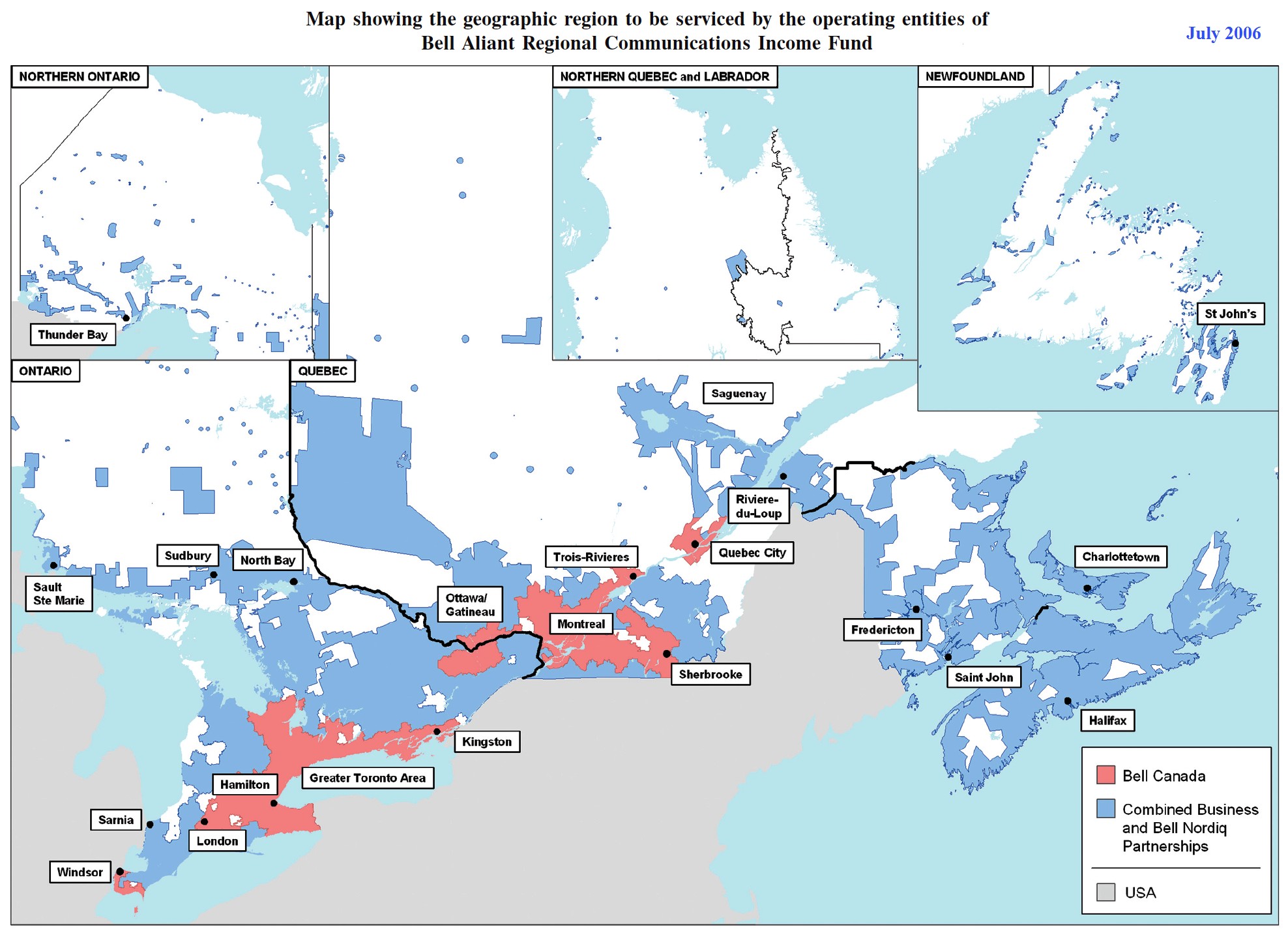
– Source: Aliant Inc. Notice of Meeting and Management Information Circular for an Annual and Special Meeting of shareholders to consider a plan of arrangement to create Bell Aliant Regional Communications Income Fund, dated April 14, 2006
– Management Information Circular
Date of filing with SEDAR: July 11, 2006
SEDAR website
http://www.sedar.com/homepage.htm
Reference: Map of the regions served by Bell Aliant
http://bellaliant.ca/english/about/region_map.html
Reference: Bell Aliant Region Map
http://www.aliant.ca/english/about/pdf/Bell_Aliant_Region_Map.pdf
MONTREAL, QC and HALIFAX, NS, January 22, 2007 – Bell Nordiq Group Inc. in its capacity as administrator of the Bell Nordiq Income Fund (“Bell Nordiq”) (TSX: BNQ.UN) and Bell Aliant Regional Communications Income Fund (“Bell Aliant”) (TSX:BA.UN) announced today that all conditions precedent to the privatization of Bell Nordiq Income Fund (“Bell Nordiq”) by Bell Aliant have been satisfied or waived and that the privatization of Bell Nordiq will proceed as planned. As previously announced, at a special meeting of Bell Nordiq unitholders held on January 16, 2007, 99.8% of all votes cast and 99.3% of the votes cast by minority unitholders were voted in favour of the
privatization.
Under the Transaction Agreement for the privatization, Bell Nordiq unitholders will be paid a Special Distribution of $4.00 per unit in cash on January 29, 2007 and receive 0.4113 of a Bell Aliant unit in exchange for each Bell Nordiq unit on January 30, 2007. Unitholders of record at the close of business on January 26, 2007 will be entitled to the Special Distribution. Bell Nordiq units will cease to trade on the TSX as of the close of business on January 29, 2007 and will be delisted effective at the close of business on January 30, 2007.
Bell Nordiq Group Inc. holds a 63.3% interest in and is the general partner of both Télébec and NorthernTel. Bell Nordiq Group Inc. manages the business and affairs of Télébec and NorthernTel, as well as those of Bell Nordiq Income Fund and Bell Nordiq Trust. Bell Aliant Regional Communications Income Fund indirectly owns 100% of the common shares of Bell Nordiq Group Inc.
Bell Nordiq Income Fund is an unincorporated limited purpose trust created to indirectly acquire and hold the outstanding partnership units of Télébec and NorthernTel. Currently, the Fund indirectly holds a 36.7% interest in both Télébec and NorthernTel, while Bell Aliant Regional Communications Income Fund, indirectly through Bell Nordiq Group Inc., holds the remaining 63.3%...
Bell Aliant (TSX: BA.UN) is one of North America's largest regional communications providers. Through its operating entities it serves customers in six Canadian provinces with innovative information, communication and technology services including voice, data, Internet, video and value-added business solutions. Through its xwave offices, Bell Aliant also provides IT professional services in Canada and the US. Bell Aliant's 10,000 employees are committed to deliver the highest quality of customer service, choice and convenience...
– Source: (BCE Inc. archive)
Bell Aliant press release, 22 January 2007
http://www.bce.ca/en/news/releases/bn/2007/01/22/74120.html
Since January 30, 2007, Télébec has been a wholly owned subsidiary of Bell Aliant.
HALIFAX, NS and MONTREAL, QC, January 30, 2007 – Bell Aliant Regional Communications Income Fund (“Bell Aliant”) (TSX: BA.UN) and Bell Nordiq Group Inc., in its capacity as administrator of Bell Nordiq Income Fund (“Bell Nordiq”) announced today that the privatization of Bell Nordiq by Bell Aliant has been completed.
As part of the transaction, Bell Nordiq unitholders of record on January 26, 2007 were paid a Special Distribution of $4.00 per unit in cash on January 29, 2007 and received 0.4113 of a Bell Aliant unit in exchange for each Bell Nordiq unit on January 30, 2007. Bell Nordiq units ceased to trade on the TSX as of the close of business on January 29, 2007 and were delisted effective at the close of business on January 30, 2007.
Bell Aliant (TSX: BA.UN) is one of North America's largest regional communications providers. Through its operating entities it serves customers in six Canadian provinces with innovative information, communication and technology services including voice, data, Internet, video and value-added business solutions. Through its xwave offices, Bell Aliant also provides IT professional services in Canada and the U.S. Bell Aliant's 10,000 employees are committed to deliver the highest quality of customer service, choice and convenience.
Bell Nordiq Group Inc. is the general partner and manages the business and affairs of Télébec Limited Partnership and NorthernTel Limited Partnership. Bell Aliant Regional Communications Income Fund indirectly owns 100% of the common shares of Bell Nordiq Group Inc.
Télébec Limited Partnership and its subsidiaries provide innovative integrated telecommunications solutions to customers in 300 municipalities across Québec. Its territory, which spans 750,000 square kilometres, extends North as far as James Bay, South to Venise-en-Québec near the U.S. border, West to Shawville in the Outaouais, and East to the Magdalen Islands. For more information about Télébec Limited Partnership and its subsidiaries, visit www.telebec.com
NorthernTel Limited Partnership provides innovative integrated telecommunications solutions to customers across Northeastern Ontario. Its territory, which spans 83,000 square kilometres, stretches from Calstock to Latchford and from Virginiatown to Timmins. For more information about NorthernTel Limited Partnership, visit www.northerntel.ca [boldface emphasis added]
– Source: (BCE Inc. archive)
Bell Aliant press release, 30 January 2007
http://www.bce.ca/en/news/releases/bn/2007/01/30/74128.html
MONTREAL, Quebec, June 30, 2007 — BCE (TSX/NYSE: BCE) today announced that the company has entered into a definitive agreement for BCE to be acquired by an investor group led by Teachers Private Capital, the private investment arm of the Ontario Teachers Pension Plan, Providence Equity Partners Inc. and Madison Dearborn Partners LLC. The all-cash transaction is valued at C$51.7 billion (US$48.5 billion), including C$16.9 billion (US$15.9 billion) of debt, preferred equity and minority interests. The BCE Board of Directors unanimously recommends that shareholders vote to accept the offer.
Under the terms of the transaction, the investor group will acquire all of the common shares of BCE not already owned by Teachers for an offer price of C$42.75 per common share and all preferred shares at the prices set forth in the attached schedule. Financing for the transaction is fully committed through a syndicate of banks acting on behalf of the purchaser. The purchase price represents a 40% premium over the undisturbed average trading price of BCE common shares in the first quarter of 2007, prior to the possibility of a privatization transaction surfacing publicly. The transaction values BCE at 7.8 times EBITDA (earnings before interest, taxes, depreciation and amortization) for the 12-month period ending March 31, 2007.
“This proposed transaction concludes a comprehensive and disciplined review of the company's strategic alternatives launched April 17,” said Richard J. Currie, Chairman of the Board of BCE. “It will deliver substantial value creation for our shareholders. In addition, a majority of the equity will be owned by Canadians.”
“The transaction delivers to our shareholders the economic benefit of the work done to focus on our core business and to strengthen Bell with a new cost structure and new competitive capabilities,” said Michael Sabia, President and CEO of BCE. “All members of the investor group have outstanding track records in building strong and resilient enterprises and they share our commitment to customers, our employees and the communities we serve.”
“It is gratifying to see that BCE's Board of Directors shares our vision for this initiative, and we are honoured to lead the largest buyout transaction in Canadian corporate history,” said Jim Leech, Senior Vice-President, Teachers' Private Capital, noting that Teachers has been a major BCE shareholder since the early 1990s. “The Board has recognized our commitment to BCE's ongoing growth potential, through our proposed investment strategy. We made it clear in our proposal that we have carefully considered the potential for BCE and its ongoing status as a Canadian icon. We strongly believe that all BCE shareholders, Canadian consumers, and employees, including senior management, who will continue to direct the company from its headquarters in Montreal, will benefit from this transaction. We look forward to working together with BCE to make this a reality.”
“This is a unique opportunity to contribute to and participate in the growth of one of the world's most significant communications companies,” said Jonathan M. Nelson, Chief Executive Officer of Providence Equity Partners. “BCE offers state of the art services through its sophisticated network that extends throughout Canada. We look forward to working with BCE's talented management and employees and our partners to build on the strong platform that is in place for the benefit of all of the company's stakeholders.”
The equity ownership of BCE would be as follows: Teachers Private Capital 52%, Providence 32%, Madison Dearborn 9% and other Canadian investors 7%.
The purchaser has obtained a debt commitment to finance the transaction subject to usual terms for these types of financings. The purchaser anticipates requiring BCE, Bell Canada and Bell Mobility to redeem outstanding redeemable debentures maturing up to August 2010 pursuant to their terms as of and subject to the closing of the transaction. The acquisition debt financing would become an obligation of BCE and be guaranteed by BCE's then subsidiaries (other than Bell Aliant Regional Communications Income Fund and Northwestel Inc.). As to Bell Canada, the purchaser's financing would comply as to ranking and security with the then existing Bell Canada debentures and medium term notes issued under the 1976 and 1997 indentures. In addition, the purchaser has obtained commitments to make available a combination of facilities in order to support the ongoing liquidity needs for the company.
The transaction is subject to the customary approvals, including CRTC approval for the transfer of Bell's broadcast license, and Industry Canada with respect to the transfer of spectrum licenses.
The transaction includes a break-up fee of C$800 million (US$751 million), payable by BCE in certain circumstances and a reverse break-up fee of C$1 billion payable by the purchaser in certain circumstances. The transaction will be completed through a plan of arrangement, which will require the approval of two-thirds of outstanding common and preferred shares, voting as a class. Shareholders will be asked to vote on the transaction at a special meeting, the details of which will be announced in due course. The company anticipates that the transaction will be completed in the first quarter of next year.
A proxy circular will be prepared and mailed to shareholders over the coming months providing shareholders with important information about the transaction. A material change report, which provides more details on the transaction, will be filed with the Canadian securities commissions and with the U.S. Securities and Exchange Commission and will be available at www.sedar.com and at www.sec.gov.
Legal advisors to BCE are Davies, Ward Phillips & Vineberg, Stikeman Elliott, and Sullivan & Cromwell. The bid process was led by Goldman, Sachs and Co. BMO Capital Markets, CIBC Capital Markets and RBC Capital Markets also acted as financial advisors to the company. Greenhill and Co. provided independent advice to the Strategic Oversight Committee of the BCE Board of Directors. The Board received fairness opinions regarding the consideration to be paid for common and preferred shares from the company's financial advisors.
Legal advisors to the investor group are Weil, Gotshal & Manges and Goodmans. Citi is serving as lead mergers & acquisitions advisor to the consortium. Other financial advisors include Deutsche Banc, Royal Bank of Scotland and TD Securities...
BCE is Canada's largest communications company, providing the most comprehensive and innovative suite of communication services to residential and business customers in Canada. Under the Bell brand, the Company's services include local, long distance and wireless phone services, high-speed and wireless Internet access, IP-broadband services, information and communications technology services (or value-added services) and direct-to-home satellite and VDSL television services. Other BCE holdings include Telesat Canada, a pioneer and world leader in satellite operations and systems management, and an interest in CTVglobemedia, Canada's premier media company. BCE shares are listed in Canada and the United States.
With more than $16 billion in assets, Teachers' Private Capital is one of North America's largest private investors, providing equity and mezzanine debt capital for large and mid-sized companies, venture capital for developing industries, and financing for a growing portfolio of infrastructure and timberland assets worldwide. The C$106 billion Ontario Teachers' Pension Plan is the largest single-profession pension plan in Canada. It is an independent corporation responsible for investing the fund and administering the pensions of Ontario's 271,000 active and retired teachers.
Providence Equity Partners is the leading global private equity firm specializing in equity investments in media, entertainment, communications and information companies around the world. The principals of Providence manage funds with approximately $21 billion in equity commitments and have invested in more than 100 companies operating in over 20 countries since the firm's inception in 1989. Significant investments include Bresnan Broadband Holdings, Casema, Com Hem, Digiturk, Education Management Corporation, eircom, Freedom Communications, Idea Cellular, Kabel Deutschland, Metro-Goldwyn-Mayer, Ono, Open Solutions, PanAmSat, ProSiebenSat.1, Recoletos, TDC, Univision, VoiceStream Wireless, Warner Music Group, Western Wireless and Yankees Entertainment Sports Network. Providence is headquartered in Providence, RI (USA) and has offices in New York, London, Hong Kong and New Delhi.
Madison Dearborn Partners (“MDP”), based in Chicago, is one of the most experienced and successful private equity investment firms in the United States. MDP has more than US$14 billion of equity capital under management and makes new investments through its most recent fund, Madison Dearborn Capital Partners V, a US$6.5 billion investment fund raised in 2006. Over the past 20 years, MDP's principals have completed over 200 investments. MDP focuses on private equity transactions across a broad spectrum of industries, including basic industries, communications, consumer, energy and power, financial services, health care and real estate. Over the last decade, MDP has been an active investor in the communications sector, with investments in such wireless communications industry leaders as Nextel Communications, Nextel Partners, Clearnet Communications, Omnipoint Corporation, MetroPCS Communications, and other wireless and wireline telecom companies. MDP has also been an active investor in the media industry, with investments in such companies as Telemundo Communications Group, Intelsat Ltd., Univision Communications and XM Satellite Radio... [boldface emphasis added]
– Source: (SEC EDGAR database)
United States Securities and Exchange Commission
Form 6-k: Report of Foreign Private Issuer (BCE Inc.)
Pursuant to Rule 13a-16 or 15d-16 of the Securities Exchange Act of 1934
News release: June 30, 2007
http://www.sec.gov/Archives/edgar/data/718940/000120621207000197/m36918ore6vk.htm
Reference: Michael Sabia profile, by Maclean's
http://www.canadianencyclopedia.ca/index.cfm?PgNm=TCE&Params=M1ARTM0012291
When Bell Canada Inc. announced on June 30 (2007) that Teachers Private Capital had won the bidding war to take the telecommunications giant private for $51.7-billlion, it brought to an end three months hard slogging for more than 100 lawyers who played a role in the largest privatization deal in the country.
A transaction of this magnitude doesn't come together easily. It requires dozens of lawyers working on large teams to pull it off.
In this case, the key Canadian law firms involved were Stikeman & Elliott LLP, which acted for the special committee struck by Bell Canada's board of directors, Davies Ward Philips & Vineberg, which was Bell's corporate law firm, Goodmans LLP, which advised the winning bid team and, of course, the dozens of lawyers at Bell Canada who operate in-house.
Each team had five-star merger and acquisition generals leading the way: people like Ed Waitzer of Stikemans, Jon Lampe of Goodmans, William Ainley of Davies and, of course, Martine Turcotte, chief legal officer of Bell.
The private law firms each had 25 or more lawyers working on the file, spending thousands of hours, along with U.S. law firms, such as Sullivan & Cromwell, White & Case and Weil Gotshal, who had their own M&A (mergers and acquisitions) rock stars actively working on the file looking at U.S. issues. (Two of the private-equity partners, Madison Dearborn Partners LLC and Providence Equity Partners Inc, were from the United States and Bell shares trade on U.S. markets.)
But under those generals are the foot soldiers, often senior associates, younger partners or corporate counsel who shoulder the workload and are responsible for much of the heavy lifting.
They drive the deal forward, drafting first cuts of various legal contracts for their superiors to vet, putting together the data room for the due diligence and managing and overseeing the bid process.
They're the ones who often pull the all-nighters to get the deal done. Consider them the unsung heroes.
Among those unsung heroes, a few sergeants are given the responsibility of making a lot of it happen.
Someone has to carry the bucket from point A to B. In this case, a foursome in their 30s was cited by lawyers in the deal as some of the key behind-the-scenes players who helped bring the deal to fruition.
They include, Paul Beauregard, vice-president of mergers and acquisitions, with Bell, Sean Vanderpol of Stikemans, Alex Moore of Davies, and Jon Feldman of Goodmans.
“I had an incredibly lucky role here,” says Mr. Beauregard, 36. “I was able to have a lot of responsibility, a lot of exposure and get to go through a great learning curve – and work with some of the top talent in North America.”
He has had exposure to big deals before, and ran the Bell sale of Telesat, a $3.5-billion deal that was “much less complex.”
“When this deal started, obviously the stakes were much higher, the pressure was higher and the media scrutiny was largely unprecedented,“ says Mr. Beauregard, a former partner at a Toronto M&A firm.
“So many logistical operations had to come together in a really, really short time frame.”
Bell Canada was put into play back in April, when the Ontario Teachers' Pension Plan Board, Bell's largest shareholder, advised in a regulatory filing with the U.S. Securities and Exchange Commission, that it would no longer remain a passive investor in the telecommunications company, but would encourage its sale or privatization. After that these lawyers were working around the clock.
“It's been busy, 14-to 16-hour days on average,” Mr. Vanderpol notes nonchalantly from Vancouver, where he was taking a well-deserved rest. “There was not a lot of let-down.”
The lawyers involved in the transaction say that what struck them most about this deal was its complexity and the speed with which things came together, a span of three months. “The pace was quite something,” says Mr. Moore, 36. “It was such a short period of time to get such a big, complicated and highly regulated deal done.”
Then there was the size of the deal. Bell's “capital structure was bigger and more complicated,” says Mr. Vanderpol, 33. It had a lot of common shares, a lot of preferred equity outstanding and a lot of debt.
Then there was the whole issue of foreign ownership, which reduced the number of potential bidders and required creative financing solutions to find the billions of dollars needed to make the deal happen. “It made the auction and consortium process that much more complicated.”
Of course, the deal had its legal twist and turns. After Teachers lobbed its hand grenade, the Canada Pension Plan Investment board emerged as a front runner with the Caisse de depot et placement du Quebec, Kohlberg Kravis Roberts & Co., a large U.S. buyout firm, and Onex Corp. as partners. Caisse and Onex would drop out a few days before the bid was due.
Telus, Canada's second-largest telecommunications company, came to the table and abruptly left, complaining about inadequacies in the bid process and tight timelines, though this deal is far from done and despite the $800-million breakup fee, Telus could still take a run at Bell before the deal closes sometime in 2008.
Private-equity firm Cerberus Capital Management also showed up at the end, with an offer, but it was Teachers' bid that prevailed.
For Mr. Feldman, 36, whose firm represented Teachers, it meant a lot of ups and downs for his firm's bidding team. There was a call for the initial bid and then a round of discussions and a call for the final bid. In both cases it involves more than just a contract. It involves legal analysis from a regulatory and tax perspective. He says “often there is a bit more time to do due diligence.”
When Telus dropped out and the Canada Pension Plan bid “appeared to be in jeopardy, we had no idea what it meant; we had no idea what was going on,” says Mr. Feldman. However, it provided a ray of sunshine and gave the Goodmans legal team “a bit of a second wind. You get increasingly optimistic that there was a good chance.”
Mr. Beauregard says that in a deal of this size there is going to be a lot of noise. “The key was learning to keep your head down and work as hard as you can.” And drink a lot of coffee. “Sean and I spent many, many late nights and a lot of early mornings working together.”
That's the nature of an M&A practice for lawyers, he says. “Going home just isn't an option. Deals get a life of their own. As you add more and more parties to the process, everyone has high expectations. Deal rooms need to be up and running. You can't ask bidders – who have lined up their teams – you can't ask them to wait.”
Mr. Moore says Mr. Beauregard had “a Herculean task to manage negotiations with the three bidding groups.”
Once a process like this is underway, Mr. Feldman adds, it gets quite intensive. “The paper process required to be produced was quite significant.”
Mr. Beauregard notes that “the final stacked paper (which made up the agreement) probably came in at an inch and a half [4cm] but it's the small forest that you kill producing that inch and a half that is significant and all the drafts you go through.”
That's why deals like this are a team affair; you need input from so many legal experts on everything from competition to tax and regulatory law. Stikemans estimates it had 40 lawyers working on the deal while Davies and Goodmans had up to 25 to 30 each. Then much of Bell's in-house team would be involved, not to mention the U.S. and various counsel for the different players that made up the bidding teams. Overall, Mr. Beauregard says, from Bell's perspective alone there were “close to 100 lawyers in total whose fingers touched things...”
[boldface emphasis added] [hyperlinks added]
– Source: National Post, 11 July 2007
http://www.canada.com/story_print.html?id=dcb35ed1-f670-4490-9567-cfb00ba4ed07&sponsor=
Michael Sabia, the chairman and CEO of BCE, desperately wants you all to know something. In fact, he'll tell anyone who'll listen. You've heard all the nasty talk about how BCE's board of directors botched the auction and sale of the storied company. Well, says Sabia, phooey to that... It's become clear, looking back over Sabia's time at BCE, that more could have been done – and done faster – to make the company stronger, and therefore more impervious to a takeover. While Sabia did inherit a company bloodied by the failed empire-building of his predecessor Jean Monty, his plan to slash costs and spin off assets only took it so far. For all his financial wizardry, he presided over a time when his business changed from copper land lines to cellphones and the Internet, yet BCE failed to keep pace... [boldface emphasis added]
– Source: (Maclean's archive)
Maclean's, 23 July 2007
http://www.macleans.ca/business/companies/article.jsp?content=20070723_107257_107257
HALIFAX, December 4, 2007 – Aliant, Atlantic Canada's leading information and communications technology provider, today announced an injection of $5 million in Nova Scotia's broadband network and Aliant Hotspots. This announcement includes Aliant's planned expansion of High Speed to customers in 24 communities across the province in early 2008. Aliant High Speed will be available to 86.4 per cent of Nova Scotia customers by the end of 2008. Overall investment in Nova Scotia's broadband network since 2005 surpasses $30 million.
“Aliant is making it easier for more Nova Scotians to access High Speed — delivering more value and more convenience than ever before,” says Heather Tulk, Senior Vice President, Marketing, Aliant. “In addition to expanding our Nova Scotia broadband network we are providing access to 80 Aliant Hotspots at no additional charge to our customers.”
– Expanding High Speed to 24 communities across Nova Scotia in early 2008. (Specific communities to receive High Speed will be announced in the coming weeks.)
– Launched 80 Aliant Hotspots in Nova Scotia. Aliant Hotspots offer customers the convenience of Internet connectivity while away from home or work using their Wi-Fi enabled wireless device such as a laptop computer or PDA.
[boldface emphasis added]
– Expanding High Speed to rural Halifax Regional Municipality (HRM). Aliant was selected by HRM and government funding partners to provide High Speed to residents in the Eastern Shore area of HRM. To date, Aliant has completed over 90 per cent of this important project. These communities include:
West Jeddore, Myers Point, Oyster Pond, Hartlin Settlement, West Quoddy, East Quoddy and Moser River.
– Source: (BCE Inc. archive)
Aliant press release, 4 December 2007
http://www.bce.ca/en/news/releases/bellaliant/2007/12/04/74550.html
The proposed $52-billion takeover of Bell Canada parent BCE Inc. (TSX: BCE) came under scrutiny from Canada's broadcast regulator and critics of the sale who raised concerns today that it may not meet rules about Canadian ownership and control.
At the first day of hearings in Gatineau, Que., the CRTC sought assurances that most of the directors of the country's largest telecommunications company will be Canadian after a takeover by the Ontario Teachers' Pension Plan and several U.S. private equity firms.
“I want to make sure the control is with Canadians and I'm not convinced of that the way you constructed it,” CRTC chairman Konrad von Finckenstein said.
Under Canadian law, foreigners can't control more than 46.7 per cent of a broadcaster or telecommunications company...
– Source: (Toronto Star archive)
"CRTC raises concerns about BCE takeover"
Toronto Star, 25 February 2008
http://www.thestar.com/Business/article/306744
MONTREAL, Quebec, March 7, 2008 – BCE Inc. (TSX, NYSE: BCE) today announced that the Québec Superior Court has approved BCE's plan of arrangement for the company's privatization transaction...
– Source: (BCE Inc. archive)
BCE Inc. press release, 7 March 2008
http://www.bce.ca/en/news/releases/corp/2008/03/07/74669.html
MONTREAL, Quebec, March 27, 2008 – BCE announced today that the proposed acquisition of BCE by an investor group led by Teachers' Private Capital, the private investment arm of the Ontario Teachers' Pension Plan, Providence Equity Partners Inc., Madison Dearborn Partners LLC, and Merrill Lynch Global Private Equity has received the approval of the Canadian Radio-television and Telecommunications Commission, subject to certain conditions being met.
The only remaining regulatory approval required in connection with the transactions is from Industry Canada. On March 7, 2008, the Québec Superior Court approved BCE's plan of arrangement for the transaction and dismissed all claims asserted by or on behalf of certain holders of Bell Canada debentures. As a result of an appeal of that decision by the debenture holders, BCE now expects the transaction to close before the end of the second quarter of 2008...
– Source: (BCE Inc. archive)
BCE Inc. press release, 27 March 2008
http://www.bce.ca/en/news/releases/corp/2008/03/27/74689.html
CRTC News release, March 27, 2008
CRTC approves BCE purchase with conditions
OTTAWA-GATINEAU – The Canadian Radio-television and Telecommunications Commission (CRTC) today approved, subject to certain conditions, the purchase of BCE Inc.'s (BCE) broadcasting assets by a group that includes the Ontario Teachers' Pension Plan (Teachers') and three American private-equity firms, Providence Equity Partners L.P., Madison Dearborn Capital Partners L.P. and Merrill Lynch Global Partners Inc.
“The application under review proposed to privatize the country's largest communications company and included significant foreign interest,” said Konrad von Finckenstein, Q.C., Chairman of the CRTC. “Consistent with previous decisions, we have imposed conditions to address our concerns relating to corporate governance. These conditions will ensure that control of BCE remains in Canadian hands once the transaction is completed.”
The transaction will receive the Commission's approval if the conditions are met. In particular, the Commission is requiring the group of investors to ensure the following changes in the governance structure are made:
• the number of directors on the Board of Directors must be fixed at 13;
• Canadian investors must at all times nominate six directors on the Board, one more than non-Canadian investors, who may designate five;
• the Chairman of the Board must be Canadian and cannot be the Chief Executive Officer or a director nominated by a non-Canadian investor;
• a second Teachers' representative must sit on the Executive Committee of the Board;
• the Independent Programming Committee must consist of Canadians who are not affiliated with non-Canadian investors; and
• the threshold for veto rights must be raised to $110 million, approximately 5 per cent of the value of the broadcasting assets.
In addition, the Commission clarified that for purposes of determining effective control, it will only consider directors to be Canadian who are both Canadian by citizenship or residency and who are designated by Canadian shareholders.
The proposed arrangement between Teachers' and one of its former executives, P. Morgan McCague, was another area of concern for the Commission. Under the proposal, Mr. McCague will hold 66.7 per cent of the class A voting shares and exercise his voting privileges according to Teachers' directions, thereby allowing Teachers' to exercise control over the majority of the company's voting shares.
The CRTC accepted this arrangement only after being provided with a letter from the Financial Services Commission of Ontario stating that this structure does not contravene the province's prohibition against pension funds directly or indirectly investing in more than 30 per cent of the voting shares of a company.
In accordance with its tangible benefits policy, the Commission revised the value of BCE's applicable broadcasting assets from $109.6 million to $219.1 million, which increases the tangible benefits package to $21.9 million. As part of this package, the Commission has directed that $10.5 million be placed in a fund whose annual revenues will support new media initiatives.
The broadcasting assets involved in this transaction include Bell ExpressVu, cable assets in the province of Quebec and a minority stake in CTVglobemedia Inc.
Today's decision follows a public process that included a public hearing, which began on February 25, 2008.
The CRTC is an independent, public authority that regulates and supervises broadcasting and telecommunications in Canada...
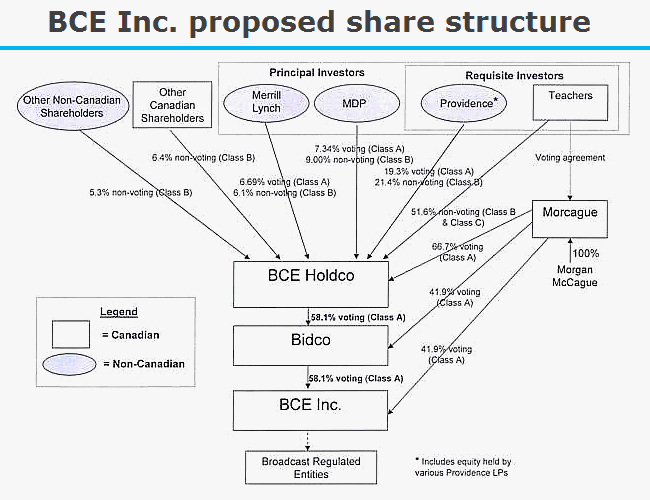
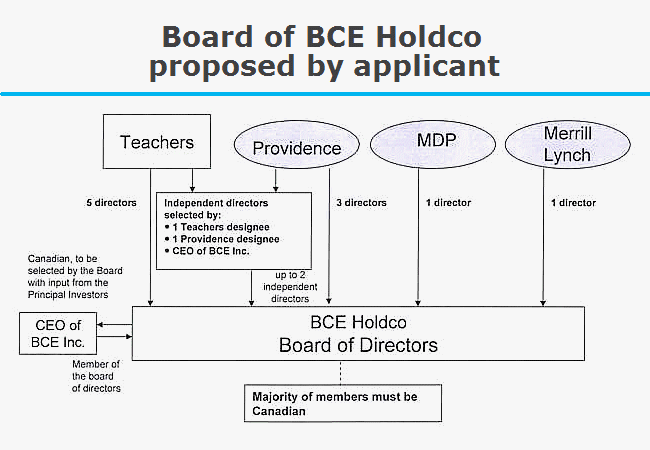

– Source: (CRTC archive)
CRTC news release, 27 March 2008
http://www.crtc.gc.ca/eng/com100/2008/r080327.htm
– Reference: (McCarthy Tétrault archive)
CRTC Approves Sale of BCE, March 27, 2008
http://www.mccarthy.ca/article_detail.aspx?id=3946
|
Note by I.C.S.: In July 2010, two years after the attempt to privatize BCE came to naught, I'm updating my History of Telephones in Nova Scotia – in particular the part that deals with Aliant, Bell Aliant, etc. – and I see that bit (above) about Morgan McCague. As I read it, it looks like an individual, Mr. McCague, “...will hold 66.7 per cent of the class A voting shares...“ (which, as I understand it, at that time were worth more than ten billion dollars).
Q: What's this about? There's lots about this to be found on the WWW. A few fragments follow: Peter Morgan McCague has served as Chairman of the Investment Committee of GCAN Insurance Company, Director of the Canadian Investors Holding Corporation, Director of the Morguard Mortgage Investment Corporation, and Director of the CCB Mortgage Investment Corporation. In addition, Mr. McCague has served as Vice President of Core Portfolio and Quantitative Investments with the Ontario Teachers' Pension Plan, Director of Equity Investments for the Workers' Compensation Board, and as Director of the Board of Administrators of Alberta Teachers Retirement Fund. He is the founding President and Director of the Buy-Side Investment Management Association, and Secretary and Director of the Pension Investment Association of Canada. – Source: Government of Ontario http://www.pas.gov.on.ca/scripts/en/bios.asp?minID=53&boardID=896&persID=152278 "Morgan McCague is the token shareholder that Teachers' ham-handedly used to get around its 30% investment limit under pension regulation whilst simultaneously (?) satisfying the 50%+ control provisions of the CRTC in acquiring BCE..." — comment, dated 26 June 2008, by Brent Fullard, executive managing director of Catalyst Management Inc. — Source: Canadian Association of Income Trust Investors Weblog http://caiti-online.blogspot.com/2008/06/who-needs-morgan-maccague-now-that-we_26.html ...Brent Fullard, executive managing director of Catalyst Management Inc., denounced the takeover, arguing it has too much non-Canadian content. Fullard, who complains that his own “superior” bid was never presented to shareholders, said Teachers' has attempted to circumvent the requirements of the Ontario Pension Benefits Act by contracting with Morcague Holdings Corp. Morgan McCague, a Canadian citizen and retired officer of Teachers will hold two-thirds of the voting shares and exercise its votes as directed by the Teachers. Fullard also argued that the structure of the holding company gives non-Canadian shareholders more control than their minority status because they have a veto right over fundamental changes... — Source: (Toronto Star archive) "CRTC raises concerns about BCE takeover" Toronto Star, 25 February 2008 http://www.thestar.com/Business/article/306744 |
Ottawa, 27 March 2008 — BCE Inc., on its behalf and on behalf of certain of its affiliates, licensees of broadcasting and distribution undertakings Across Canada
Application 2007-1117-8, received 3 August 2007
Public Hearing in the National Capital Region 25 February 2008
Transfer of effective control of BCE Inc. to a corporation to be incorporated and a consequential change in ownership of CTVglobemedia Inc.
The Commission approves, subject to certain conditions, an application for authority to transfer effective control of BCE Inc. and certain of its affiliates to a corporation to be incorporated. The Commission further approves a consequential change in ownership of CTVglobemedia Inc. The conditions of approval are set out in the appendix to this decision.
1. The Commission received an application by BCE Inc. (BCE), on its behalf and on behalf of certain of its affiliates, licensees of broadcasting and distribution undertakings (the applicant), for authority to transfer effective control of the applicant to a corporation to be incorporated (BCE Holdco). BCE Holdco would hold the shares of BCE through its subsidiary 6796508 Canada Inc. (Bidco).
2. BCE and Bidco entered into a definitive agreement, effective 29 June 2007, pursuant to which Bidco agreed to purchase all of BCE's issued and outstanding common and preferred shares (BCE proposal).
3. The BCE proposal was approved by a majority of BCE shareholders at a special shareholder meeting that took place on 21 September 2007 in Montréal.
4. The proposed transaction will be effected by way of a Plan of Arrangement under section 192 of the Canada Business Corporations Act. The applicant submitted that the final cost of the transaction would not be determined until closing, but the funds available at the time of the application were $7.8 billion in equity financing and $32 billion in debt financing.
5. Following the completion of the transaction, BCE Holdco will be privately owned, with share capital consisting of Class A voting, non-participating shares (Class A shares), Class B non-voting, participating shares (Class B shares) and Class C non-voting, participating shares (Class C shares). The Class B and Class C shares will be economically equivalent and will together represent the total equity value of BCE Holdco.
6. Morcague Holdings Corp. (Morcague), a Canadian, will hold 66.7% of the Class A shares of BCE Holdco, with the balance of 33.3% held by non-Canadians, namely Providence Equity Partners International VI L.P. and its affiliated investment funds (Providence), Madison Dearborn Capital Partners V L.P. and its affiliated investment funds (MDP), and Merrill Lynch Global Partners, Inc. (Merrill Lynch). The Class A shares will be subject to a voting agreement between Morcague and Teachers' Private Capital, a division of Ontario Teachers' Pension Plan Board (Teachers'), a Canadian.
7. The majority of the Class B shares and all of the Class C shares of BCE Holdco will be held by Canadians, with Teachers' holding the largest equity stake in the company at 51.6%. Non-Canadians will hold approximately 42% of the equity of BCE Holdco, with Providence (17.3%), MDP (9.0%) and Merrill Lynch (6.1%) being the largest non-Canadian shareholders.
8. Bidco and BCE will have Class A and Class B shares issued and outstanding. BCE Holdco will own 100% of the Class B shares and 58.1% of the Class A shares of Bidco, with the balance of 41.9% of the Class A shares held by Morcague. Similarly, Bidco will own 100% of the Class B shares and 58.1% of the Class A shares of BCE, with the balance of 41.9% of the Class A shares held by Morcague. A summary of the proposed equity structure can be found on the Commission's website at http://www.crtc.gc.ca/Broadcast/eng/HEARINGS/2007/ex2007-19.htm...
[boldface emphasis added]
– Source: (CRTC archive)
Broadcasting Decision CRTC 2008-69, 27 March 2008
http://www.crtc.gc.ca/eng/archive/2008/db2008-69.htm
MONTREAL, Quebec, July 4, 2008 — BCE today announced the company has entered into a final agreement with a company formed by an investor group led by Teachers' Private Capital, the private investment arm of the Ontario Teachers' Pension Plan, Providence Equity Partners Inc., Madison Dearborn Partners LLC, and Merrill Lynch Global Private Equity...
“The final agreement, with definitive financing now in place, preserves the $42.75 per common share price announced last June, which the Board believes is very much in the best interest of shareholders, the company and Bell Canada, particularly given current capital market conditions,” said BCE and Bell Canada Board Chair Richard J. Currie. “As previously announced, BCE secured all third party approvals prior to the June 30 deadline set out in the original agreement,” added Mr. Currie.
“The signing of the financing and credit agreements and the resolution of issues involved in funding this transaction are the essential milestones to closing with both the Purchaser and the Lenders,” said Michael J. Sabia, CEO of BCE...
– Source: (BCE Inc. archive)
BCE Inc. news release, 4 July 2008
http://prod05.bce.ca/en/news/releases/corp/2008/07/04/74793.html
Shares of telecommunications giant BCE Inc. remained deep under water early Wednesday afternoon, after plunging 40 per cent at the opening bell following a warning by the company that its massive planned privatization is in jeopardy.
The shares were trading at $25.09 on the Toronto Stock Exchange, down $13.26, or 34.6 per cent, from Tuesday's close, having earlier fallen as far as $23, or 46 per cent below the $42.75 price the would-be buyers, led by the Ontario Teachers' Pension Plan, agreed to pay in June 2007.
The rout followed a pre-opening warning from BCE that its planned $35-billion privatization was in doubt because it had failed a preliminary solvency test conducted for the would-be purchasers.
The Montreal-based company disclosed that that it had received a “preliminary view” from auditing firm KPMG that “based on current market conditions, its analysis to date and the amount of indebtedness involved,” it does not expect to be able to deliver an opinion on the closing date of December 11 that BCE “would meet the solvency tests as defined in the definitive agreement.”
Unless this changes by that date, BCE warned, “the transaction is unlikely to proceed...”
Under the terms of Teachers' credit agreement with its lenders, the banks required that BCE's auditors sign a certificate confirming that the value of BCE's total cash and assets exceeded all its liabilities, including the $32-billion of debt required to fund the takeover...
[boldface emphasis added]
– Source: Report on Business
Globe and Mail, 26 November 2008
http://www.theglobeandmail.com/report-on-business/article723775.ece
– Reference: (BCE Inc. archive)
Privatization of BCE: Frequently Asked Questions
http://www.bce.ca/data/documents/110284_Depliant-AN.pdf
TORONTO, NEW YORK — Shortly after markets closed on Tuesday (November 25th), a team of auditors in KPMG's Toronto offices ushered a trio of BCE Inc. executives into a meeting room to advise them that the world's largest leveraged takeover had effectively been killed. The culprit? A five-line clause that virtually no one had noticed in the company's much-scrutinized $35-billion sale agreement.
Over the course of more than two hours, the solemn auditors explained to BCE's stunned chief executive officer George Cope and two of his senior executives that the communications company had not passed a so-called solvency test, one of the last hurdles standing in the way of a Dec. 11 deadline to close the sale of the company to a group lead by the Ontario Teachers' Pension Fund. Now, barring a financial miracle, there is little hope that the deal will survive.
Normally solvency tests merit little more than a passing glance in takeover deals. But these are hardly normal times. In the wake of the global market meltdown, KPMG's auditing team had concluded BCE's asset values would be worth less than its liabilities after Teachers shovelled a crushing $32-billion debt load onto the company. Mr. Cope hastily convened a meeting of BCE's board at 9 p.m. that night and “all hell broke loose,” according to one person familiar with the meeting.
“There was a lot of finger pointing by the board last night. The directors wanted to know where this clause had come from,” the source said.
The awkward answer, the board learned, was that BCE had authored the killer clause. Although solvency clauses are rare in Canadian deals, sources said BCE opted to insert the requirement into the definitive takeover agreement in June 2007, in part, to fortify its legal defences against its bondholders.
Investors holding BCE's bonds and debentures ultimately sued the company for approving a deal that sent the company's bonds into a tailspin, but BCE successfully challenged its bondholders in a case that went all the way to Supreme Court.
The helpful little solvency clause, however, became the deal's Achilles heel in recent weeks as financial market carnage sharply lowered solvency thresholds, leaving the company vulnerable to KPMG's stunning decision.
The decision meant that the raucous 20-month quest to acquire Canada's largest communications company, a journey overshadowed by boardroom power struggles, a bitter takeover battle and a legal sparring match, had sputtered to a halt just days short of reaching the closing deadline.
“I think this is one of the most controversial calls in auditing history in Canada,” said Anthony Scilipoti, executive vice-president of Veritas Investment Research Corp., an independent research firm with expertise in accounting issues.
Indeed, the auditor's call was so unexpected that BCE's stock had been climbing in recent days to a close at $38.35 a share in trading on the Toronto Stock Exchange Tuesday as investors bet that the $42.75-a-share bid would successfully close.
All those bets fell off the cliff yesterday when early morning news of KPMG's decision sent BCE's stock into a deep swoon, wiping out $10.6-billion in market value as the company's stock fell 34 per cent to close at $25.25 yesterday after more than 47 million shares were traded.
While investors were caught off guard by the auditor's decision, it appears that BCE's executives knew for weeks that KPMG had concerns about BCE's solvency.
Sources said KPMG's auditors had been meeting with BCE and Teachers for weeks to gather data to test the company's solvency, or ability to pay all of its debts as they came due.
There are four tests that make up the solvency test. Two are the most important. One is a cash flow test, a measure of a company's ability to meet interest, debt and other obligations as they come due. The other is called an asset test, which measures whether the company would be able to fulfill its obligations if it were to sell all of its assets.
It's this latter test that BCE appears to have failed and sources described it as the key point of dispute between KPMG and the company.
KPMG, according to one person familiar with the matter, told BCE that "based on what we know, there just aren't enough assets to satisfy [BCE's] liabilities."
There are few ways to salvage the deal, and even those options appear untenable. Teachers and its partners, including Providence Equity, could commit more cash to the deal to lower the amount of debt BCE is taking on.
Analysts at Scotia Capital estimated the buyers might have to kick in an additional $3.5-billion to satisfy KPMG, but sources said there is little appetite to commit more money. Indeed they said neither the buyers or the bankers backing the bid hold out hope that the deal will be revived.
The banks, which stood to swallow billions of dollars in losses had the deal been consummated, given the sickly credit markets, will be off the hook if KPMG doesn't offer its approval.
Sources said that even if Teachers wanted to restructure the deal, the banks would use this as an excuse to extricate themselves from lending agreements.
Although the collapse of the largest ever private equity deal might cost Teachers some bragging rights, it has saved the pension giant from possibly overpaying for a company in a brutal market, where credit remains dry. In fact, the fund has already won many concessions it was lobbying for before it put BCE into play and jump-started an auction for the company.
[boldface emphasis added]
– Source: Globe and Mail, 27 November 2008
http://www.theglobeandmail.com/report-on-business/how-a-tiny-clause-spelled-the-end-of-the-biggest-deal/article1066388/
MONTREAL, Québec, December 11 2008 — BCE Inc. (TSX, NYSE: BCE) today announced that it received last evening from the Purchaser, a company formed by an investor group led by Teachers' Private Capital, the private investment arm of the Ontario Teachers' Pension Plan, and affiliates of Providence Equity Partners Inc., Madison Dearborn Partners LLC, and Merrill Lynch Global Private Equity, a notice purporting to terminate the Definitive Agreement dated June 29, 2007, as amended. BCE disputes that the Purchaser was entitled to terminate the Definitive Agreement, as such notice was delivered prematurely, prior to the outside date for closing of the transaction, and therefore invalid. Given the Purchaser's position, the BCE privatization transaction will not proceed.
As previously announced, the closing of the privatization transaction is contingent upon the fulfillment of several closing conditions, including, pursuant to Section 8.1(f) of the Definitive Agreement, the receipt at the effective time of a positive solvency opinion from KPMG. Earlier this morning, KPMG confirmed that it would not be able to deliver an opinion that BCE would meet, post transaction, the solvency tests set out in the Definitive Agreement.
In light of these developments, BCE will be terminating the Definitive Agreement in accordance with its terms, and will be demanding payment of the $1.2-billion break-up fee from the Purchaser. All closing conditions have been satisfied by BCE, other than the solvency opinion, a condition to closing that was to be satisfied by its nature at the effective time. Under such circumstances, the agreement provides that the break up fee will be owed to BCE by the Purchaser. The Purchaser has taken the position that it is not obligated to pay the break-up fee...
[boldface emphasis added]
– Source: (BCE Inc. archive)
BCE Inc. news release, 11 December 2008
http://prod05.bce.ca/en/news/releases/corp/2008/12/11/75065.html
– Another source: (SEC EDGAR database)
United States Securities and Exchange Commission
Form 6-k: Report of Foreign Private Issuer (BCE Inc.)
Pursuant to Rule 13a-16 or 15d-16 of the Securities Exchange Act of 1934
Material Change Report: December 19, 2008
BCE Inc. press releases were disseminated by CNW Telbec on December 11, 2008 and on December 12, 2008. The English versions of those press releases are annexed hereto and form an integral part hereof.
http://www.sec.gov/Archives/edgar/data/718940/000120621208000254/m42799ore6vk.htm
– Another source: (SEC EDGAR database)
United States Securities and Exchange Commission
Schedule 13D under the Securities Exchange Act of 1934
Amendment No. 2
Merrill Lynch, Pierce, Fenner & Smith Incorporated
Merrill Lynch Canada Inc.
...This Amendment No. 2 (this “Amendment”) amends the Statement of Beneficial Ownership on Schedule 13D originally filed with the Securities and Exchange Commission (the “SEC”) on October 30, 2007, as amended by Amendment No 1. thereto filed with the SEC on July 11, 2008 (the “Schedule 13D”) by Merrill Lynch, Pierce, Fenner & Smith Incorporated (“MLPF&S”), Merrill Lynch International (“MLI”), Merrill Lynch Canada Inc. (“MLCI”), Merrill Lynch Portfolio Managers Ltd. (“MLPM”), Merrill Lynch Bank & Trust Company, FSB (“MLBTC”), and Merrill Lynch & Co., Inc. (“ML&Co”) (MLPF&S, MLI, MLCI, MLPM, MLBTC and ML&Co, each a “Reporting Person,” and collectively, the “Reporting Persons”) with respect to the common shares, no par value (the “Common Shares”) of BCE Inc., a corporation incorporated under the laws of Canada (the “Company”)...
Item 5 is Amended to Add the Following: As of December 15, 2008, the Reporting Persons were the beneficial owners of approximately 1,050,686 shares of Common Shares, with respect to which they have shared voting and investment power, and which represent less than 1% of all Common Shares outstanding (based on 806,200,000 Common Shares reported to be outstanding by the Issuer as of September 30, 2008). The Reporting Persons acquired these Common Shares for investment purposes, and such purchases have been made in the Reporting Persons' ordinary course of business. As a result of the matters described in Item 4 above, it is no longer the case that the Reporting Persons may collectively be deemed to constitute a “group” with Teachers within the meaning of Section 13(d)(3) of the Act. As a consequence, none of the Reporting Persons, on the one hand, and Teachers, on the other hand, may be deemed to beneficially own any Common Shares beneficially owned by the other. Accordingly, as of December 11, 2008, the Reporting Persons may no longer be deemed to be the beneficial owners of more than five percent of the class of securities reported on herein, and they will therefore no longer file reports under Section 13(d) of the Act unless otherwise required to do so...
http://www.sec.gov/Archives/edgar/data/718940/000089882208001266/sc13dav2.htm
TORONTO (December 11, 2008): BCE Acquisition Inc. (“Purchaser”) today announced that the agreement to acquire BCE Inc. (TSX, NYSE: BCE) has been terminated in accordance with its terms.
Receipt of a solvency opinion from a nationally recognized valuation firm was included in the June 30, 2007 definitive agreement between the Purchaser and BCE as a mutual closing condition. The agreement of the Purchaser and BCE to both the selection of KPMG to serve as the valuation firm and the form of the solvency opinion was reflected in the July 4, 2008 amendment to the definitive agreement. Because KPMG has concluded that a required test for the solvency opinion was not met, this mutual condition to completion of the acquisition could not be, and was not, satisfied. Accordingly, the Purchaser terminated the agreement in accordance with its terms. Under these circumstances neither party owes a termination fee to the other...
[boldface emphasis added]
– Source: (OTPP archive)
Ontario Teachers' Pension Plan (OTPP) press release, 11 December 2008
http://www.otpp.com/wps/wcm/connect/otpp_en/home/newsroom/news+releases/2008/bce_agreement_terminated
BCE Inc. has launched a lawsuit against the Ontario Teachers' Pension Plan and U.S. private equity firms that seeks the payment of a $1.2 billion break fee after a proposed $52 billion privatization of the phone company collapsed last week.
The suit, filed in the Superior Court of Quebec, accuses Teachers' and its partners – Madison Dearborn Partners LLC and Providence Equity Partners Inc. – of “prematurely and invalidly” terminating the buyout agreement even though the deal failed to pass a so-called solvency test conducted by accounting firm KPMG that was a condition of the transaction.
A spokesperson for acquisition consortium said last night it is “disappointed” by the lawsuit, adding the group will “vigorously defend against BCE's claim,” and that “we are confident that we will prevail.”
In a statement of claim filed yesterday, the Bell Canada parent argued that the buyout consortium delivered its termination notice “as part of a pre-orchestrated move” at 11:48 p.m. on Dec. 10, which was before the deal's Dec. 11 deadline.
The company said it received KPMG's oral confirmation on Dec. 11, shortly after midnight, that it could not sign off on the deal's solvency test.
That confirmation followed a preliminary opinion delivered by KPMG on Nov. 25 that came to the same conclusion.
The test, which had been inserted into the deal's language by BCE's lawyers in a bid to protect the company from bondholder litigation, included demonstrating that the value of the company's “saleable assets” would exceed its liabilities once the leveraged buyout had been completed...
– Source: Toronto Star, 18 December 2008
http://www.thestar.com/Business/article/555609
Plain old telephone service
...Aliant is attracting notice, notably from Bell Canada parent BCE Inc., which has long said it could be a buyer of the portion of Aliant it doesn't already own. Since its creation with the March 1999, merger of Atlantic Canada's four local telephone companies, Aliant has garnered kudos for the speed at which it is emerging from the protective cocoon of a plain-old-telephone service, or POTS, into a diversified and innovative technology leader. "We don't want to be a telephone company that happens to sell internet products," says Aliant's CEO Stephen Wetmore. "We want to be an internet company that happens to sell telephony products."
And more. Aliant has expanded aggressively outside Atlantic Canada through its information technology (IT) and satellite communications units. It also has nurtured promising technology startups. Wetmore's plan is to reduce Aliant's dependence on the telecom business, which in 2000 accounted for about 78% of the company's $2.3 billion in revenues, to less than half by 2003 – while doubling revenues in the same period.
Already this very Atlantic-based company is a national player in IT, a global one in satellites. Yet it remains little known in the rest of Canada, which is used to thinking of Atlantic Canada as an economic backwater. It might be time to correct that blind spot: In its trajectory over the last couple of years, Aliant has suggested much about how companies competing in far-flung yet connected markets can be both global and local.
The seeds of Aliant's transformation were planted before the March, 1999, union of Newfoundland's NewTel Enterprises Ltd., Nova Scotia's Maritime Telegraph & Telephone Co. Ltd., Prince Edward Island's Island Telecom Inc. and New Brunswick's Bruncor Inc., parent of NBTel. Each of the three largest telcos – Island Telecom was controlled by MT&T and run as a subsidiary – had already started to diversify its operations. But under the 48-year-old Wetmore, who was CEO of NewTel before he was chosen to lead Aliant, the pace of change has been blistering. "He's a very forward-looking, entrepreneurial manager," BMO Nesbitt Burns analyst Doug Kirk says of Wetmore. "He's putting all the pieces together to create a very significant technology play."
The impetus for all this change is, of course, the unmoving prospects of the traditional voice and data-transmission business. Long-distance rates have descended so far since the market was opened to competition in 1992 that traditional telcos like Aliant, which as of early February was 53%-owned by BCE Inc., are reaping ever less revenue, even though their customers are spending longer than ever on the blower. To top it off, Aliant's remaining monopoly – local phone service – has been busted.
Hence, Wetmore's mission to turn Aliant into an internet company that happens to sell phone services, rather than the other way around. "It's an IP [internet protocol] world," he chimes, where everything in the house – from phones and PCs to TVs and appliances – will eventually connect through the internet. While lots of telcos talk of convergence, Aliant is walking the walk, especially with its interactive-TV push. "It could be that we're a guinea pig for the industry," Wetmore concedes. "But the product is right. There's no doubt about that."
...Just as the idea of a union of the four Atlantic provinces has been a recurring political theme in the region, the idea of a union of its four local telephone monopolies had been an economic refrain in the three decades before its realization. By the late 1990s, the companies had partially combined their back offices, and twice, in 1992 and 1995, had begun merger discussions. Both times, the political obstacles proved insurmountable. Each of the Atlantic provinces viewed its telco as an instrument of badly needed development. NBTel and its wildly successful bid to lure call centres to New Brunswick was, for instance, at the centre of former premier Frank McKenna's economic policy. And as far back as 1966, Nova Scotia Premier Robert Stanfield passed legislation to prevent Bell Canada from exercising its control stake in MT&T.
Within the companies themselves, the resistance to a merger stemmed from a feared customer and employee backlash. Each of the telcos had established deep local roots and enjoyed a rare degree of customer loyalty. Still, estimates showed they could easily slice about 8% off their combined operating costs by merging. "It was never a question of the economics. It was always a question of the politics," recalls Celeste, who was NBTel's CEO before becoming chairman of parent Bruncor in 1994. "Atlantic Canada is very tribal."
By late 1998, however, the CEOs of the four telcos – NewTel's Wetmore, NBTel's Pond, MT&T's Latham, and Island Tel's Fred Morash – had new and compelling reasons to renew the merger push. So did BCE, which remained the largest shareholder in each of MT&T (34.3%), Bruncor (44.8%) and NewTel (54.7%). The fall 1998 marriage of BC Telecom Inc. and Telus Corp., and disintegration of the Stentor alliance of Canadian telcos, sowed new threats and challenges. The creation, in Telus, of a powerful and aggressive rival to BCE underscored for the latter the need to consolidate Bell Canada's position in the East. The collapse of Stentor, the alliance through which Canada's local telcos did joint marketing and fed traffic to one another, deprived the four Atlantic telcos of their membership in a seamless national network.
BCE, meanwhile, had been preparing the sale of a 20% stake in Bell Canada to Chicago-based Ameritech Corp. – to raise cash, but also, many observers project, to prepare for the day when international boundaries are erased in telco ownership. Combining BCE's stake in the four Atlantic telcos into a single holding and transferring the holding to Bell proved a neat way of "selling Canada" to a U.S. acquisitor. BCE also saw an opportunity in the merger to spread the culture that had grown up in NBTel under Celeste. NBTel had been the first Canadian telco to go totally digital and to offer voice mail and internet access. Its call-centre strategy had proved a brilliant way to increase corporate long-distance traffic in a province where population growth was virtually stagnant.
The chairs of the three largest telcos – Bruncor's Celeste, MT&T's Ivan Duvar and NewTel's Charlie White – talked with BCE chief Jean Monty late in 1998. They agreed the merged Atlantic telco would have a "virtual" head office, with senior management spread throughout the region. Choosing one city over another for the company's headquarters "would have killed the thing right off," Celeste says. The group also decided the CEO would be one of the current telco chiefs, lest they create distrust among employees by going outside the companies or the region. Finally, they dispatched Pond, Wetmore, Latham and Morash to meet with their respective premiers to sell them on the merger. By the time a final proposal came to a vote, McKenna – who in office had half seriously referred to himself as NBTel's vice-president of sales – had joined parent Bruncor's board. "In the end," says Celeste of the four boards' vote, "we voted with our heads, not our hearts."
A selection committee that included Duvar, White, Celeste, then Bell Canada chief strategist John Macdonald, BCE executive vice-president Peter Nicholson, RBC Dominion Securities vice-chairman Michael Wilson and Anne Fawcett of Caldwell Partners (the last two as non-voting advisers) met to choose the new CEO. At first, each chairman backed the CEO from their telco. But eventually the committee settled on Wetmore.
Born in the northern New Brunswick town of Campbellton, Wetmore is descended from United Empire Loyalists. He graduated from Acadia University and joined the Saint John office of accountants Coopers & Lybrand in 1976. Within two years, he was leading the audit team on the firm's biggest account, McCain Foods Ltd. "Very early on you could tell he was a leader," remembers Wetmore's friend Mike Bishop, who worked with him at Coopers. "He was so driven. At Coopers, he set an overtime record for a student."
...Stephen Wetmore had just started his own venture-capital outfit when he was approached by Fawcett in late 1997 about the CEO's job at NewTel. It didn't seem like an obvious fit until he got a look inside. "It was pretty easy to get hooked. There are certain times in an industry that are fascinating. In telecommunications, with deregulation and the internet, this is one of them."
Wetmore had been CEO of NewTel for less than a year before he switched to the top job at Aliant with the March 22, 1999, announcement of the four-way merger. Three days later, BCE went public with its plan to sell 20% of Bell to Ameritech for $5.1 billion. Initial estimates pegged yearly savings from the merger at $130 million – $80 million in efficiency gains and $50 million in lower capital spending. The efficiency target has since been increased to $86 million and could rise further following the unforeseen amalgamation in December of the four telephone operating units into Aliant Telecom. Aliant's profit – excluding $78 million in pretax restructuring costs in 1999 – rose 19% in 2000 to $217 million. Revenues increased 12% to $2.3 billion.
No one, even Wetmore, predicted employees would warm so quickly to the merger as to permit the fusion of the operating units into a single entity. But now that it has been accomplished, NBTel, MT&T, NewTel and Island Tel are only Aliant brands, not separate legal entities. Employment, meanwhile, has risen to more than 10,000 from about 8,500 at the time of the merger, largely as a result of growth and acquisitions at xwave. The telecom business employs about 500 fewer people than it did in 1999...
[boldface emphasis added]
– Source: Globe and Mail ROB Magazine published 23 Feb 2001, last updated 21 Mar 2009
http://www.theglobeandmail.com/report-on-business/rob-magazine/no-more-pots/article542262/singlepage/

Corporate History of Bell Canada
Bell Canada
History of Bell Canada
Wikipedia
History of Northern Electric Company
Wikipedia
History of Nortel
Wikipedia
and
and
|
“BCE is entitled to elect a majority of the board of Bell Aliant Regional Communications Inc. and Bell Aliant Regional Communications Holdings Inc.” |
1. On July 7, 2006, the former Aliant Inc. (“Old Aliant”), BCE Inc. (“BCE”) and Bell Canada completed the implementation of a plan of arrangement (the “2006 Arrangement”), which involved an exchange of certain business operations between Bell Canada and Old Aliant and the conversion of Old Aliant to an income trust.
2. The 2006 Arrangement resulted in
(i) the combination of Old Aliant's wireline telecommunications operation in Atlantic Canada, information technology operation and other operations with Bell Canada's wireline telecommunications operation in certain of its regional territories in Ontario and Québec, now carried on by the Filer (such businesses, the “Bell Aliant Business”);
(ii) the transfer of Bell Canada's 63.4% indirect interest in NorthernTel Limited Partnership and Télébec Limited Partnership (collectively the “Bell Nordiq Partnerships”) to Bell Aliant Holdings LP (as defined below);
(iii) the transfer of Old Aliant's wireless operations and its interest in DownEast Ltd. to Bell Canada; and
(iv) the conversion of Old Aliant to an income trust, Bell Aliant Regional Communications Income Fund (the “Fund”), with the outstanding common shares of Old Aliant (other than a number of shares held by BCE) being exchanged for units of the Fund on a one for one basis.
3. Subsequently, in January 2007, the Fund acquired the remaining indirect interest in the Bell Nordiq Partnerships from the public. All but a nominal interest in the Bell Nordiq Partnerships is now held by Bell Aliant Regional Communications Holdings Limited Partnership (“Bell Aliant Holdings LP”).
4. The foregoing transactions resulted in the creation of a number of entities held directly and indirectly, in whole or in part by the Fund, each of which is a general partner or other holding entity created to facilitate the operation of the Bell Aliant Business by the Filer and the distribution of cash derived from the operations and activities of the Filer and the Bell Nordiq Partnerships to Fund unitholders.
5. The Fund is an unincorporated, open-ended trust governed by the laws of the Province of Ontario. The Fund was established on March 30, 2006 under a declaration of trust, as amended and restated on July 6, 2006 (the “Declaration of Trust”), in connection with the 2006 Arrangement...
9. The Units of the Fund are listed on the Toronto Stock Exchange under the symbol “BA.UN”. As of September 30, 2010, 127,384,917 Units were issued and outstanding representing a 55.93% voting interest in the Fund.
10. Pursuant to undertakings provided to the Decision Makers and other Canadian securities regulatory authorities, the Fund files on SEDAR and provides to holders of Units separate annual audited and interim unaudited financial statements and MD&A (Management's Discussion and Analysis) of Bell Aliant Holdings LP so long as generally accepted accounting principles prohibit the consolidation of financial information of Bell Aliant Holdings LP and the Fund and Bell Aliant Holdings LP (and any of its significant business interests) represents a significant asset of the Fund.
11. Bell Aliant Holdings LP is a limited partnership established under the laws of the Province of Québec on June 29, 2006. The head office of Bell Aliant Holdings LP is located at 6 South Maritime Centre, 1505 Barrington Street, P.O. Box 880 Central, Halifax, Nova Scotia...
14. Bell Aliant Regional Communications Holdings Inc. (“Bell Aliant Holdings GP”) is the general partner of Bell Aliant Holdings LP and holds the Holdings GP Interest...
19. Bell Aliant Regional Communications Inc. (“Bell Aliant GP”) is the general partner of the Filer and holds the Wireline GP Interest. Bell Aliant GP is a wholly-owned subsidiary of Bell Aliant Holdings LP...
34. Because BCE is entitled to elect a majority of the board of Bell Aliant GP and Bell Aliant Holdings GP, generally accepted accounting principles do not permit consolidation of the financial information regarding the Filer or Bell Aliant Holdings LP in the Fund's financial statements. Financial information concerning the Filer is consolidated with that of the Bell Nordiq Partnerships in the financial statements of Bell Aliant Holdings LP. Similarly, it is expected that, following completion of the Conversion Transaction, Bell Aliant Inc. will not be able to consolidate the financial information of Bell Aliant Amalco and the Filer due to BCE's continuing governance rights... [boldface emphasis added]
(Signed) Director, Corporate Finance
Nova Scotia Securities Commission
– Source:
National Policy 11-203 Process
for Exemptive Relief Applications
in Multiple Jurisdictions
Ontario Securities Commission
Bell Aliant General Tariff: 2011
containing Rates and Charges, Terms and Conditions, and Regulations
applicable to Service and Equipment furnished by the Company
Nova Scotia: pages 201.31 (112/645) to 201.43 (124/645)
Notice of 2012 annual meeting of shareholders
and management information circular
This information circular is for the annual meeting
of shareholders of Bell Aliant Inc. to be held at
The Lord Nelson Hotel, 1515 South Park Street,
Halifax, Nova Scotia, Canada, on April 26, 2012,
at 10:30 a.m. (Atlantic time)...
Bell Aliant Inc. was incorporated on April 30, 2010 under the Canada Business Corporations Act, to become the successor of Bell Aliant Regional Communications Income Fund. The head and principal office of Bell Aliant is located at 7 South Maritime Centre, 1505 Barrington Street, Halifax, Nova Scotia, B3J 3K5. BCE and Bell Canada have certain governance rights as outlined in an Amended and Restated Securityholders’ Agreement dated January 1, 2011 between, among others, Bell Aliant, Bell Aliant GP, BCE and Bell Canada (Securityholders’ Agreement). Under that agreement, so long as BCE and its affiliates directly or indirectly hold not less than 20 per cent of the shares, Bell Aliant and its subsidiaries must obtain BCE’s consent prior to entering into various transactions such as, among other things, certain mergers, joint ventures, asset sales and other material transactions. In addition, for so long as BCE directly or indirectly holds not less than 30 per cent of the shares and the significant commercial agreements between Bell Canada and Bell Aliant LP are in place, BCE is entitled to appoint up to a majority of the directors of Bell Aliant GP and annually direct us with respect to the nomination of up to a majority of the persons nominated to stand for election as our directors. If these commercial agreements are terminated by any of the parties in accordance with their terms (other than a termination as a result of a material uncured intentional breach by Bell Aliant LP), or if BCE and its affiliates directly or indirectly hold less than 30 per cent of the shares, then BCE will be entitled to appoint its proportionate share of the directors of Bell Aliant GP and to annually direct us with respect to the nomination of a proportionate share of the persons to stand for election as our directors (rounded up to the next whole number) based on its direct and indirect ownership of shares. In any event, BCE will be entitled to appoint two directors to the board of Bell Aliant GP and direct us with respect to the nomination of two persons to stand for election as our directors for as long as these commercial agreements are in place, irrespective of its ownership of shares. BCE has complete discretion in the exercise of these rights. The size of the boards of Bell Aliant and Bell Aliant GP is 10 directors... [boldface emphasis added]
CRTC Communications Monitoring Report: 2011
Canadian Radio-television and Telecommunications Commission
The Canadian telecommunications service industry is dominated by ten large companies that collectively, with their affiliates, account for 95% of Canadian telecommunications revenues. The vast majority of the remaining entities are small entities with annual revenues of less than $5 million.
In 2010, companies operating in all six markets of the telecommunications service industry (i.e. local and access, long distance, Internet, data, private line, and wireless) accounted for approximately 91% of Canadian telecommunications revenues. Companies operating in only one market sector accounted for 1% of revenues.
This section provides a broad overview of the financial performance of the telecommunications service industry and examines various financial indicators such as revenue trends by market sector and by type of service provider, profitability, market share, capital intensity, average revenues per line, and penetration rates...
Today, Canadians use many kinds of telecommunications services such as residential phones, cellphones, fax machines, and computer services. This has ignited explosive growth in the demand for additional telephone numbers. The quantity of telephone numbers within an area code is limited, and eventually the demand for them will cause an area code to run out of new telephone numbers.
As noted by the CRTC in March 2012, the supply of telephone numbers in area code 902 will soon be exhausted. Accordingly, the CRTC established an Interconnection Steering Committee (CISC) ad hoc committee for relief planning for area code 902 in Nova Scotia and Prince Edward Island.
The exhaust date for area code 902 is now estimated to be in April 2015. As a result, area code 902 is now in a jeopardy condition...
According to the Canadian NPA [Numbering Plan Area] Relief Planning Guidelines, a “jeopardy condition” is declared when the forecast and/or actual demand for central office (CO) codes exceeds the available supply of CO codes before relief is implemented, or the implementation time frame is shorter than 36 months and no relief plan is yet in place. The relief process will take three years. The result will be an area code overlay or split.
There are two basic ways to implement area code relief – that is, make additional telephone numbers available in a specific geographic area when the current supply of numbers is used up. These two basic alternatives are:
• a geographic split (publicly unpopular), or
• an overlay (slightly less unpopular).
There are several recognized variations in the ways that an overlay can be applied in a specific situation. All avaliable solutions are unpopular with the general public.
7. The CRTC notes that one of the benefits of area code relief by distributed overlay, as recommended by the Relief Planning Committee (RPC), is that it enables subscribers to retain their current telephone numbers when relief is provided. The Commission considers that, in comparison with other relief options evaluated by the RPC, such as geographic splits and concentrated overlays, a distributed overlay is less disruptive to subscribers. The Commission also notes that this method costs less to implement than other options evaluated by the RPC and provides long-term relief.
8. The CRTC determines that the area (Nova Scotia and Prince Edward Island) served by area code 902 is to be overlaid with a new area code 782, effective 30 November 2014.
9. The CRTC notes that area code overlays require the use of 10-digit local dialing to ensure proper local call routing between the overlaid area codes. The CRTC also notes that consumers require a permissive dialing period during which calls are completed regardless of whether they are dialed using 7 or 10 digits. During the permissive dialing period, when a consumer makes a local call using 7 digits, the call is first directed to a standard short recorded announcement about the change to 10-digit local dialing before it is automatically completed. (hyperlinks added)
10. With respect to the transition to 10-digit dialing for area code 902, the CRTC determines that
• (a) the permissive dialing period is to take place between 23 August and 16 November 2014, with (standard short recorded) announcements and automatic call completion for calls made using 7 digits being phased in between 23 and 30 August 2014;
• (b) mandatory 10-digit local dialing is to be implemented beginning on 16 November 2014, with (standard short recorded) announcements for calls dialed using 7 digits stating that the caller must hang up and dial the area code with the 7-digit number being phased in between 16 and 30 November 2014; and
• (c) standard (short recorded) announcements stating that calls made using 7 digits cannot be completed as dialed are to be phased in between 2 March and 2 April 2015.
– Source: Telecom Decision CRTC 2012-528, issued 1 October 2012 by the Canadian Radio-television and Telecommunications Commission (CRTC)
| Interpretation (ICS, 22 Dec 2012): Beginning in November 2014, new telephone numbers with the 782 area code will be issued to customers, anywhere in Nova Scotia and Prince Edward Island, requesting new telecommunication services. This means that, after November 2014, two adjacent units in an apartment building can – and often will – be in different area codes. In fact, if you have two telephones in your home, they can be in different area codes. It also means that, when dialing any telepone number, long-distance and local including your next-door neighbour, you will have to dial ten digits every time, no matter if the number you are calling is in the same area code as you. |
Bell Aliant media release
22 November 2012
Amherst, NS — Bell Aliant Inc. (TSX: BA) will connect Amherst, Nova Scotia to its fibre-to-the home (FTTH) network in December. The $2.7-million investment is the tenth community to be connected to Bell Aliant’s FTTH network in 2012. Approximately 5,400 Amherst and area residential and business customers will have access to the Atlantic region’s fastest Internet speeds and best TV service.
“Bell Aliant’s FibreOP™ connects right to homes and businesses and gives consumers and local industry access to the speed and data capabilities they need to remain competitive,” said Robert Small, Mayor of Amherst. “We want the world to know that our community is a thriving, connected place to live and work.”
Bell Aliant’s future-proof network is already available across Nova Scotia including Halifax, Truro, New Glasgow, Annapolis Valley, Sydney, Bridgewater, Digby, Antigonish and Yarmouth, and the company will soon start connecting customers in Lunenburg.
“Simply put, FibreOP offers customers the fastest Internet in the market, and the best TV experience that includes the most user-friendly guide, the best Whole Home PVR (Personal Video Recorder), more than 100 HD channels and the most HD video on demand content,” said Andre LeBlanc, Vice President, Residential Markets, Bell Aliant. “A fibre-optic network is the building block of great home entertainment. Amherst will soon experience the difference fibre directly to the home makes.”
[hyperlinks added]
FTTH dramatically increases connection speeds and data capability available to users. Bell Aliant’s FibreOP™ network offers the best TV experience with amazing features like the best Whole Home PVR, more than 100 HD (high definition) channels, the most HD movies on demand and the most amazing apps (applications). FibreOP™ offers Atlantic Canada’s fastest Internet speeds with up to 250 Mbps (megabits per second) download and 30 Mbps upload. With a FibreOP™ bundle, customers save on the best of everything.
Bell Aliant was the first in Canada to cover an entire city (Fredericton and Saint John, New Brunswick) with fibre-to-the-home. By the end of 2012, the company will have invested approximately half a billion dollars to extend fibre-optic technology to approximately 650,000 homes and businesses in its territory...
Bell Aliant Regional Communications Inc. (the general partner), as well as limited partner with 6583458 Canada Inc. (the limited partners), carrying on business as Bell Aliant Regional Communications, Limited Partnership at Fredericton and surrounding areas, Moncton and Saint John, New Brunswick; St. John's, Paradise and Mount Pearl, Newfoundland and Labrador; and Halifax, Dartmouth, Bedford and Sackville, Nova Scotia
Broadcasting Decision CRTC 2012-702, 21 December 2012
The CRTC renews the regional broadcasting licence for the terrestrial broadcasting distribution undertakings serving the above-noted locations, from 1 January 2013 to 31 March 2013, subject to the terms and conditions in effect under the current licence...
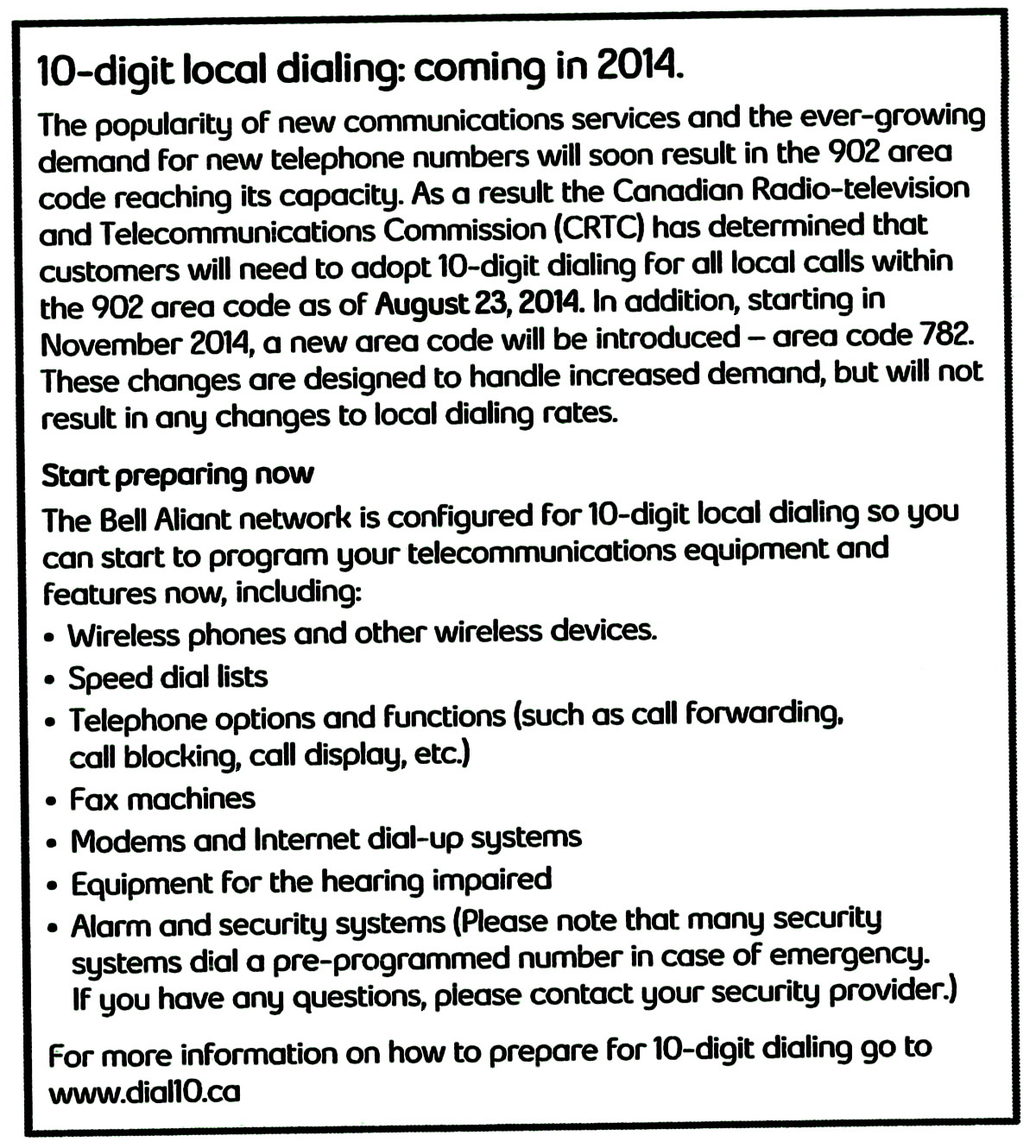
For your local calls, you will always enter
10 digits (area code + local number)
from 902 to 902
from 902 to 782
from 782 to 902
from 782 to 782
Anyone who already has a number with
area code 902 will keep the same number.
New area codes in Canada
Nova Scotia and Prince Edward Island
10-digit dialing will soon be mandatory
Bell Aliant Inc is expanding its fibre-to-the-home network on Nova Scotia's south shore to more than 4,000 homes and businesses in Liverpool and Shelburne. With the announcement of the $2.6-million investment, Bell Aliant's FibreOP coverage in the province extends to more than 325,000 premises and represents an investment of $121 million since 2010.
Shelburne County Coast Guard, Shelburne
For your local calls, you will always enter
10 digits (area code + local number)
from 902 to 902
from 902 to 782
from 782 to 902
from 782 to 782
Anyone who already has a number with
area code 902 will keep the same number.
New area codes in Canada
Nova Scotia and Prince Edward Island
10-digit dialing will soon be mandatory
|
Library and Archives Canada has an archived copy of this webpage:
Archived: 2007 April 09
This link was accessed and found to be valid on 01 January 2013. |
  Hits per calendar month
       2015 Jun     156
       2015 May     239
       2015 Apr     244
       2015 Mar     278
       2015 Feb     504
       2015 Jan     313

       2014 Dec     205
       2014 Nov     356
       2014 Oct     549
       2014 Sep     442   Ten-digit dialing mandatory for
       2014 Aug     831   all local calls in 902 area code
       2014 Jul     384   beginning 23 August 2014
       2014 Jun     200
       2014 May     211
       2014 Apr     175
       2014 Mar     186
       2014 Feb     128
       2014 Jan     250

       2013 Dec     227
       2013 Nov     132
       2013 Oct     133
       2013 Sep      99
       2013 Aug     102
       2013 Jul      74
       2013 Jun      67
       2013 May     111
       2013 Apr      99
       2013 Mar     120
       2013 Feb     100
       2013 Jan     135

       2012 Dec      96
       2012 Nov     171
       2012 Oct      70
       2012 Sep      74
 W3C HTML Validation Service http://validator.w3.org/ |
 W3C CSS Validation Service http://jigsaw.w3.org/css-validator/ |

First uploaded to the WWW: 2000 May 08
Moved to new hosting service: 2011 April 14
Latest update: 2015 July 18