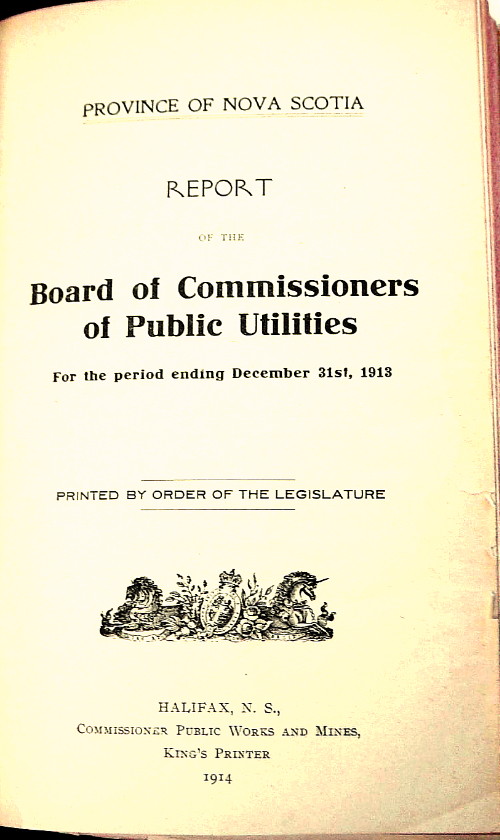
1913 Annual Report of the Public Utilities Board: Title page
Also see:
Bell Aliant Inc.
Nova Scotia Telephone Company
|
How to use your browser to |
In April 1910, Nova Scotia's largest telephone company, the Nova Scotia Telephone Company (NS Telco) was reorganized as the Maritime Telegraph & Telephone Company. The assets – including all property, pole lines, rights-of-way, equipment, and accounts receivable – and liabilities, including all bonded debt and accounts payable – were transferred to MT&T. The employees and management of NS Telco became employees and management of MT&T. The daily business continued uninterrupted.
For nine decades, from April 1910 until May 1999, MT&T was by far the dominant telephone company in Nova Scotia. MT&T was by no means the only telephone company here during that time. There were many others – more than 200 telephone companies served Nova Scotians in the 1920s through the 1950s – but MT&T was by far the largest both in the number of "subscribers" (paying customers) and in the geographical territory served.
For example, on 31st December 1965, the total number of telephones in Nova Scotia was 224,077. 218,533 were MT&T telephones (the monthly bills for these telephones were issued by and were paid to MT&T), and 5,544 were connected to other companies. MT&T had 97.5% of all telephones in the Province, while the remaining 2.5% were divided among the other 131 telephone companies then in business here. (These figures are found on page xxx of of the 1965 Annual Report of the Public Utilities Board.)
From 1910 into the mid-1990s, MT&T had a legal monopoly on telephone service in the territory it served. That is, if your residence or place of business was located in the territory legally reserved for MT&T then you had no choice; if you wanted to have a telephone you had to rent it (you could not buy your own telephone, and you had to rent, not buy, even if you wanted a telephone cord longer than the standard cord supplied by company) from MT&T at a rate approved by the Public Utilities Board. If your residence or place of business was located in a territory legally reserved for another telephone company, again you had no choice; if you wanted to have a telephone you were not allowed to obtain your telephone equipment or your telephone connection from MT&T; instead you had to arrange to get it from the telephone company that held the legal monopoly for your area, at a rate approved by the Public Utilities Board. From the beginning of the twentieth century into the mid-1990s, that was the way it was – in Nova Scotia and throughout North America.
One dollar per mile is equivalent to 62¢ per kilometre.
Section 28 prohibited the tapping of telephone lines, and section 29 specified that the penalty for illegally tapping a telephone line was $100 plus $40 per day during the time the tap remained in place.Chapter 156 of the Acts of 1910, "An Act to Incorporate the Maritime Telegraph and Telephone Company Limited", was passed by the Nova Scotia Legislature in April 1910. (There is a reference, from an apparently reliable source, to an earlier incorporation, in 1906, of a company with the same name – this will be tracked down ASAP.)
On this day, MT&T bought a large number of shares of The Prince Edward Island Telephone Company, which had been operating a public telephone service since 10 April 1885.
The following is excerpted from a long report in the Public Utility Board's 1913 Annual Report (which covered 1912 and 1913), printed under the heading "Re Petition of the Nova Scotia Carriage and Motor Car Company Limited For An All-Night Service in the Town of Kentville". In September 1912, the hours of service furnished by MT&T Co. at the Kentville Exchange, with 240 subscribers, was 7:30am - 9:00pm daily, except Sundays and holidays 9:00am - 10:00am and 1:30pm - 2:30pm. After extensive evidence was presented, the Public Utilities Board issued an Order that, on and after 10 October 1912, MT&T "will be required to provide" a continuous (24-hour) service at the Kentville Exchange, "excepting on Sundays and statutory holidays, on which days the Exchange may be closed from 7:00am to 9:00am, 10:00am to 1:30pm, and 2:30pm to 10:00pm". This did not end the matter. On 4 October 1912, the PUB issued a modification of the Order: Because of difficulty in securing a satisfactory operator to attend to night calls, and the necessity of having special equipment (audible signalling devices) made to order, the MT&T Co. asked for, and the Board granted, an extension of the time fixed for 24-hour service from 10 October 1912 to 1 November 1912.
|
Inventory of MT&T's lines in the Municipality of the County of Halifax April 1914
|
|---|
|
These copper wire sizes (#14 and #12) are defined as part of the Brown & Sharpe wire gauge system. Note (of special interest those interested in mathematics): The Brown & Sharpe wire gauge, which has been the standard method, in the U.S. and Canada, of measuring copper wire sizes for more than a century, uses the highest mathematical exponent or index of any industrial system. The legal definition of the Brown & Sharpe wire gauge defines the ratio between successive sizes to be the 39th root of 92. No other practical working industrial system includes an exponent or index anywhere near 39. 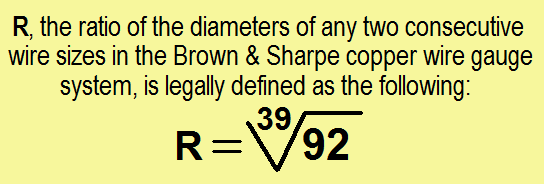
|
In 1922, the Directors of MT&T (listed alphabetically) were:
S.M. Brookfield, President, Halifax
O.E. Smith, Vice-President, Halifax
George E. Faulkner, Halifax
E.L. MacDonald, Halifax
L.B. McFarlane, Montreal
Andrew MacKinlay, Halifax
G. Fred Pearson, Halifax
C.F. Sise, Montreal
J.H. Winfield, Managing Director, Halifax
Source: MT&T Telephone Directories, 1922
Note: The two directors who lived in Montreal were the designated representatives of the Bell Telephone Company of Canada, which owned a substantial block of MT&T shares and was legally entitled to name two MT&T directors.
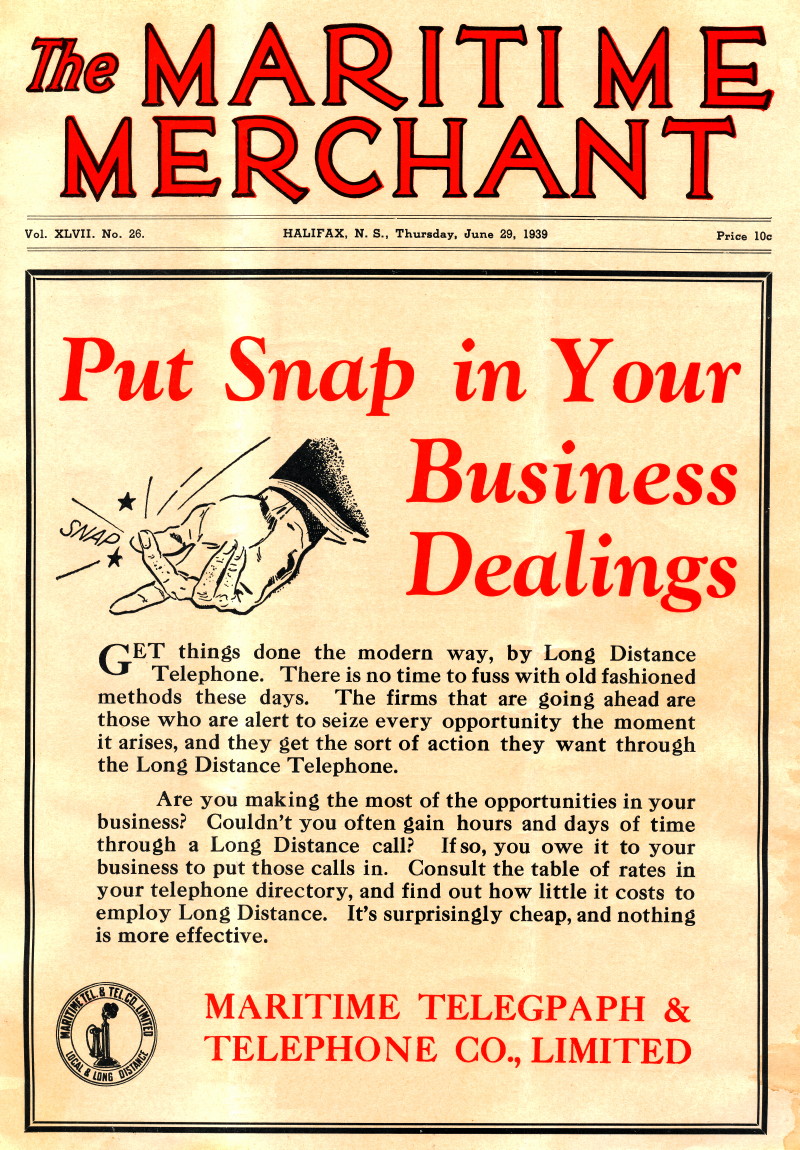
In 1950, the Directors of MT&T were:
W.A. Winfield, President, Halifax
C.A.B. Bullock, Halifax
M.R. Chappell, Sydney
Frederick Johnson, Montreal
George Killam, Yarmouth
R.V. Macaulay, Montreal
A. Murray MacKay, General Manager, Halifax
E.L. MacDonald, Vice-President, Halifax
John W. MacLeod, New Glasgow
C.J. Morrow, Lunenburg
Francis D. Smith, K.C., Halifax
Source: MT&T Telephone Directories, 1950
Note: The two directors who lived in Montreal were the designated representatives of the Bell Telephone Company of Canada, which owned a substantial block of MT&T shares and was legally entitled to name two MT&T directors.
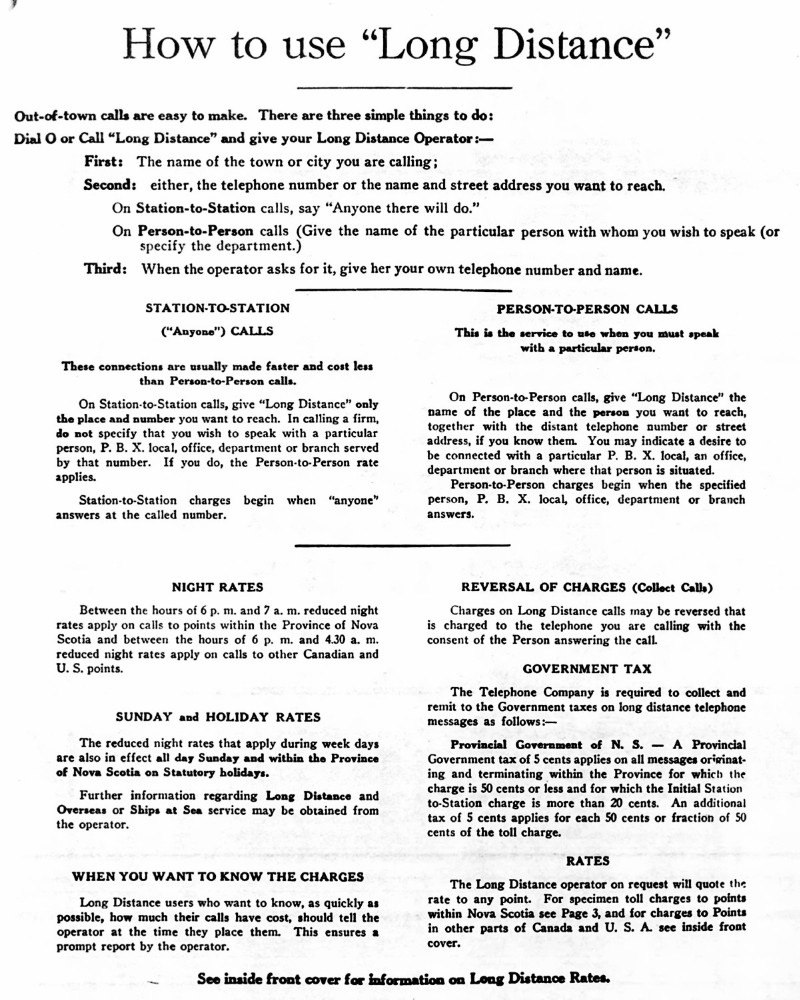
An 18-month campaign to convert the province's dial telephones to seven-digit numbers is nearly complete. Cornwallis and seven other exchanges in western Nova Scotia are about to be assigned numbers to complete the campaign. The Dominion Atlantic Railway station at Cornwallis, which until now has been reached at telephone number 759, would become 638-8759 (last three digits same as before) under the new plan.
[50 Years Ago in the Digby County Courier, 9 February 2012]
The conversion of all of Nova Scotia's dial telephone exchanges to a uniform seven-digit numbering system was an essential step in the preparations to implement Direct Distance Dialing (DDD). Before the introduction of DDD, all long-distance calls had to be set up by a switchboard operator, an employee of the telephone company whose job was to ask the caller the geographical location (anywhere in the world) of the person or company he/she wanted to speak to, and the local telephone number there, and then to make the necessary arrangements for the calling party and the called party to talk to each other.
Ten-digit telephone numbers throughout Nova Scotia
will become effective officially on 16 November 2014
This quote (above) appears on page 232 of the 1966 Annual Report of the Public Utilities Board.
MT&T is proceeding with the necessary work "to provide dial service in the Hubbards, St. Margaret's, and French Village Exchange Areas by July 10th, 1966, and to provide direct distance dialing in the general Halifax area by March 1967. This general Halifax area includes the Halifax-Dartmouth Metropolitan Area and the adjacent Exchange Areas of Bedford, Bay Road, and Sackville..." The Hubbards, St. Margaret's, and French Village Exchange Areas, currently being converted to dial operation, will be included in the direct distance dialing service. As part of this general upgrading of the telephone system in this area, Extended Area Service will be implemented "between Hubbards and St. Margaret's Exchange Areas, and between St. Margaret's and French Village Exchange Areas."| It is unclear what Mr. Myers, Vice-President and General Manager of MT&T, may have had in mind when he testified before the Public Utilities Board (see above) in June 1966 that one of the corporate objectives of MT&T was to “take over...as many of the remaining 144 rural telephone companies as possible...” My information (see list below) is that there were 132 telephone companies active in Nova Scotia as of 31 December 1965. This list of 132 includes MT&T, thus there were only 131 rural telephone companies “remaining” to be taken over by MT&T – not 144 as stated by Vice-President Myers. This list (below) appears as part of Schedule C on pages 497-500 of the 1965 Annual Report of the Public Utilities Board; it is the official list of telephone companies legally authorized to be in business in Nova Scotia as of 31 December 1965. There were no telephone companies added or eliminated between 31 December 1965 and 10 June 1966. That is, the PUB's list of 131 telephone companies (other than MT&T) is in direct contradiction to Mr. Myer's statement that there were 144 rural telephone companies “remaining” to be taken over. This was sworn testimony in a significant proceeding before an important government agency, and a Vice-President would be careful not to give inaccurate information in such a proceeding. It remains unclear what Mr. Myers may have had in mind. |
|
List of all telephone companies in Nova Scotia as of 31 December 1965 |
|---|
|
|
NOTE: In the above list, many of the companies have “Mutual” included in their corporate names. These companies were incorporated under special legislation known as the Rural Telephone Act. This provincial legislation was initially enacted about 1916, with the objective of making it possible for telephone service to be extended to rural areas in which the population was scattered, with only a very few potential customers for each mile of pole line – not enough for a private company such as MT&T to be able to install and maintain the lines and equipment with any hope of getting enough revenue to support the necessary investment. No major company would build a line into the rural sections since it wouldn't pay them to do so. The only way to get a telephone was to build your own line and have your own company.
These were “mutual” companies, meaning that they were owned by their customers. When several residents and small businesses in a particular area decided they wanted telephone service, each person or business that wanted telephone service would buy a share of the mutual company's stock. The money raised in this way was used to pay for the construction of the necessary pole lines and installation of a switchboard and other equipment. The switchboard often was installed in the home of one of the shareholders, and was attended by whoever happened to be handy when someone wanted to make a phone call. Each mutual company was connected to the North American telephone network at the nearest MT&T exchange. |
Special Session of the Legislature
On 18 August 1966, Bell Canada, the largest telephone company in the country, made a surprise offer to buy control of the telephone companies that served the three Maritime Provinces. On 24 July 1962, Bell Canada had acquired 99% of the shares of Avalon Telephone Company [later named the Newfoundland Telephone Company and in 1998 known as NewTel]. In 1966, Bell decided it wanted control of both Maritime Telegraph & Telephone (MT&T) of Halifax, which served most of Nova Scotia, and the New Brunswick Telephone Company [now NBTel, a subsidiary of Bruncor] of Saint John, which served New Brunswick. MT&T owned 56% of the Island Telephone Company of Charlottetown, which served Prince Edward Island. If Bell's offer to buy shares was approved, it would increase its stake in each of the two companies to 51%, from the 35% it already held in NBTel and the 6% it held in MT&T. That 51% share ownership would give Bell complete control of the telephone services in all three provinces (except for the insignificant territories then served by the 124 independent telephone companies then operating in Nova Scotia, all of which were tiny companies typically serving from 10 to 50 customers each). It was estimated the deal would cost about $60,000,000 and would require about 1,190,000 common shares of Bell; the proposal was to swap three Bell shares for five MT&T shares, and five for eleven of NBTel's shares.
This sudden decision, to buy control of the Maritimes telephone companies, was the result of Bell's humiliating failure, in its attempt to buy Quebec Telephone of Rimouski, which served 109,000 customers along both sides of the St. Lawrence River downriver from Quebec City, including the Gaspe Peninsula on the south shore, and the north shore up to the Labrador boundary. While it was deep in negotiations with Quebec Telephone, Bell was taken completely by surprise when, on 17 March 1966, Quebec Telephone signed a deal to sell control to Anglo-Canadian Telephone Company of Montreal, which was owned by General Telephone & Electronics Corporation (GTE) of Stamford, Connecticut, the second-largest telephone company in the United States. Through Anglo-Canadian, GTE then owned 50.3% of British Columbia Telephone Company, Canada's second-largest telephone company. [In 1998, GTE still controls BCTel]. Bell had been trying to buy control of Quebec Telephone, "to take them out of play for GTE," according to Robert Scrivener, then vice-president of finance at Bell, and later president and chairman of both Bell Canada and Northern Electric.
In a public statement made at the time of the offer to buy control of MT&T and NBTel, Marcel Vincent, Bell's president, said: "The directors of Bell Canada feel strongly that, in the best interests of the progressive development of this essential Canadian industry, we must do all we can to insure that as many as possible of the key elements of the telephone industry remain permanently under Canadian ownership and control." The offer to buy control of MT&T and NBTel was made on 18 August 1966, and was set to expire on 8 September. Bell did not expect any significant resistance.
But Robert Stanfield, then premier of Nova Scotia, was livid at Bell's attempt to acquire control of MT&T. Contrary to Stanfield's popular image as a meek politician known for his underwear business, he proved to be far more dangerous to Bell than anyone thought possible. With the Nova Scotia Legislature as his weapon, the premier was determined to use the force of law to stop Bell in its tracks.
Stanfield also had a second weapon which turned out to be even more potent in what became a bitter and intense campaign against Bell's scheme. In 1962 Bell had bought 100% of the shares of Northern Electric, the large Canadian telephone equipment manufacturer. Immediately following the announcement of Bell's bid for MT&T, the federal anti-combines watchdog D.W.H. Henry, Director of Investigation Research (DIR) under the Combines Investigation Act, received complaints about Bell's purchasing practices and relationship with Northern Electric. Henry used that complaint as the pretext for launching an extensive investigation. He obtained search warrants, and a team of investigators from the Royal Canadian Mounted Police raided Bell's executive offices on 29 November 1966. The investigators remained on the premises collecting and copying documents until 9 December. This raid marked the beginning of a legal battle that lasted sixteen years. The DIR's target was Bell's relationship with Northern Electric and the goal of the investigation was to force the breakup of the two companies. Henry's investigation was initiated on the grounds that he had "reason to believe" that Section 33 of the Combines Act was either being or was about to be violated. But the investigation was precipitated by the flurry of acquisitions of independent telephone companies, launched by Bell early in 1966 to expand its system. Bell's intent was to become dominant in the telephone business in Canada, and, except for Quebec Telephone, it had been successful in buying several independents.
Stanfield linked the two events — the DIR's investigation of Bell and Bell's offer to buy control of MT&T — in his statement released on 22 August 1966:
It is important that the Maritime Telegraph and Telephone Company Limited be free to acquire telephone equipment that is best suited to our needs and will give the best service. MT&T should be free to buy telephone equipment from any supplier. Clearly, therefore, MT&T should not be controlled by a company which manufactures telephone equipment, either directly or through a subsidiary... If the Bell company were to acquire control of MT&T, MT&T would not long be free to exercise any independence of decision in acquiring telephone equipment.
"They looked at it as... an invasion of Atlantic Canada," Jean de Grandpre said of the Nova Scotia government twenty-four years later. "You have no idea how vicious it was... You would think there was a war between Ottawa and Halifax," he said, referring to the front-page headlines of the Halifax Chronicle-Herald. De Grandpre was Bell's corporate counsel at the time, and did much of the legal work for all the acquisitions that summer. The souring of the MT&T deal led Scrivener and Vincent to turn to de Grandpre as a trouble-shooter in their abortive eleventh-hour attempt to get the deal pushed through. Out of anger, and believing they had no need to negotiate with the provincial government, Bell's officials spurned Stanfield's request for a meeting to work out a compromise, leading the premier to recall the Nova Scotia Legislature into session on Friday, 9 September 1966. He made good on his threat to introduce special legislation severely curtailing the voting rights of MT&T shareholders, which could be done legally because MT&T had been incorporated under an Act (chapter 156, 1910, 10 Edward VII) passed by the Legislature on 22 April 1910. MT&T was incorporated under provincial legislation, and the Legislature could revise that legislation as it saw fit. The amendment, to the Act to incorporate the Maritime Telegraph & Telephone Company Limited, was passed on Saturday, 10 September, and received royal assent the same day. The legislation allowed Bell to buy any number of MT&T shares, but it prevented Bell from voting more than one thousand shares. Outside the Legislature, Stanfield declared: "During my ten years as premier, I have never encountered men who pursue their own interests so ruthlessly while expressing patriotic sentiments."
After the dust settled, Bell had acquired 52.4% of MT&T's shares. De Grandpre threatened to challenge Stanfield's legislation in court, but this was never done. But the legal problems Bell encountered for years afterward, from the Combines Investigation and related developments, were enough to prompt Bell historian Lawrence Surtees to write: "Stanfield could not have exacted a harsher revenge on Bell. The complaints to the DIR over the MT&T acquisition not only provided ammunition for the combines inquiry, but also jeopardized Bell's objectives in Parliament."
[Excerpted from pages 109-111, Pa Bell: The Meteoric Rise of Bell Canada Enterprises by Lawrence Surtees, Random House, 1992, ISBN 0394221427.]
In February 1968, the telephone exchange at Tusket, in Yarmouth County, was converted to dial operation.
— "40 Years Ago" in The Yarmouth Vanguard, 5 February 2008
MT&T proposes to increase its local...directory assistance charge from $0.50 to $0.75. MT&T stated that the proposed increases will help to compensate for the cost of providing the service and will better reflect the value of the service to the customer. The company views billable directory assistance calls as a premium service that should provide maximum contribution to revenues.
The Atlantic Communications and Technical Workers Union (ACTWU) stated that directory assistance is a widely-used service and that, in the absence of costing support, the company has not demonstrated that the proposed increase is just and reasonable. In this regard, ACTWU argued that the proposed introduction of Automated Voice Response System should result in reduced costs.
Rural Dignity et al stated that customers perceive directory assistance as a valuable service. It further postulated that the size of the print in directories may be responsible for a portion of the calls, and that illiterate and visually-impaired subscribers might be reluctant to seek the available exemption.
In reply argument, MT&T submitted that the local directory assistance charge is avoidable, and that the disabled are entitled to an exemption.
At the hearing, the Commission (CRTC) sought clarification of the criteria for exempting certain subscribers from the local directory assistance charge. Mr. Farmer and Mr. G. Geldert, Vice-president, Operations, indicated that illiterate persons would be eligible for an exemption, in addition to those customers with a permanent disability. The company indicated that it would revise its tariffs accordingly, and is directed to file, by 21 January 1991, proposed tariff pages providing for that change.
The Commission approves the proposed directory assistance charges, in light of its determination regarding the company's revenue requirement for 1991. The Commission notes that local directory assistance, while a monopoly service, is also a discretionary service, and that up to 100 requests to long distance directory assistance in the U.S.A. may be made per NES (network exchange service) each month, without charge.
– Source: CRTC archive
http://www.crtc.gc.ca/eng/archive/1990/DT90-30.HTM
MT&T indicated in its annual construction program review (CPR) documentation that it intends to implement province-wide Enhanced 911 Service. 911 Service establishes a single number through which all emergency-related telephone calls are routed to the appropriate emergency agency. Enhanced 911 Service automatically identifies the location of the caller.
Currently, 911 Service is available in only one community in Nova Scotia. In that case, the community paid the company to implement the service and operates the service itself.
Province-wide Enhanced 911 Service is planned as a joint project with the Province of Nova Scotia. On 17 October 1990, MT&T filed the agreement between itself and the Province for the approval of the Commission (CRTC).
The responsibilities of MT&T include:
• (1) to design, operate and maintain a single province-wide 911 facilities network,
• (2) to assist in the design of the civic address program, and
• (3) to design, operate and maintain a customer record system and a 911 information system.
The responsibilities of the Province include:
• (1) to design, implement, operate, maintain and control a universal province-wide civic address number system, and
• (2) to design, implement, maintain and control a universal standard for the answering, dispatching and handling of emergency services.
Each party will assume responsibility for the operating expenses associated with the activities assigned to it under the agreement.
MT&T stated that Enhanced 911 is a new service that would be provided as part of basic telephone service, and that it would benefit the entire customer base. MT&T stated that its expenses associated with the project would be $328,800 in 1991.
MT&T's proposed approach for providing 911 Service differs from that taken in the operating territories of other telephone companies under the Commission's jurisdiction. The Province and MT&T have reached an agreement for the provision of Enhanced 911 Service in a comprehensive and cost-effective manner. However, MT&T is including some of the expenses associated with providing Enhanced 911 Service in its overall revenue requirement, rather than charging the Province for the total cost.
While the Commission has some concerns that MT&T proposes to include some of the expenses associated with Enhanced 911 Service in its revenue requirement, the Commission considers the cost per subscriber minimal, and therefore not unreasonable. The Commission notes that all subscribers will have access to Enhanced 911 and will therefore benefit from the service. Furthermore, the provincial government is responsible for a portion of the operating costs.
The Commission concludes that MT&T's proposed approach for the provision of Enhanced 911 Service with the province of Nova Scotia is in the public interest. Accordingly, the Commission approves MT&T's proposals for the provision of Enhanced 911 Service jointly with the Province of Nova Scotia, as set out in the agreement filed on 17 October 1990.
– Source: CRTC archive
http://www.crtc.gc.ca/eng/archive/1990/DT90-30.HTM
This Decision includes a long, detailed discussion of many complicated effects of the introduction of competition into the public long-distance telephone service. Most of these considerations will impact consumers directly. For example:
• Number Portability (including 800 and 900 Number Portability)
• Numbering Plan in Canada
• The provision of operator assistance for special services such as collect calls and calls charged to a third party (with the possibility that the billed-to number is serviced by a different company), or an account card (perhaps issued by a different company)...
• Directory Assistance. Who provides directory assistance for a customer of one company who wants the phone number of someone who is a customer of a different company? This could be further complicated if the inquirer does not know which phone company serves the intended destination...
• Pay telephones. For example, should two or more telephone companies competing in the same area be allowed to install their own pay telephones in the same area, possibly generating confusion among users?
• Providing 911 service to pay phones, especially if some pay phones do not have a telephone number...
The following brief excerpt from this CRTC document may give an indication of the knotty problems that arise when different companies are involved in the handling of a single long-distance call:
MT&T and Island Tel argued that Unitel must assume responsibility for billing all long distance calls carried over its facilities regardless of who places them. AGT, Bell, B.C. Tel, MT&T and Island Tel denied any obligation to bill and collect for a competitor. MT&T and Island Tel might voluntarily negotiate a billing services agreement; Bell and AGT do not consider it an attractive business opportunity, and Newfoundland Tel rejected it completely. AGT noted that, under Unitel's proposal, the non-respondent telephone companies would be providing such a service without direct compensation. B.C. Tel stated that it considers its billing and collection systems integral to its operations and public image. B.C. Tel stated that it would not wish to respond to queries and complaints resulting from use of its billing system by others. MT&T and Island Tel envisaged many problems with Unitel's proposal, citing several specific examples...
– Source: CRTC archive
http://www.crtc.gc.ca/eng/archive/1992/DT92-12.htm
Working with Black & McDonald and Nortel, as well as Acadia's other strategic partners, MT&T is wiring all university buildings, with fibre optic cable linked to digital switching equipment. This network will carry extensive voice and data services including MT&T's Sympatico Internet access service, voice mail and electronic mail. All university rooms will have telephone service, and MT&T is also offering special distance calling packages. Through this network, Acadia's staff and students will access global information as quickly and efficiently as they do each other. These services will strengthen both academic and technology skills, provide a more efficient operating environment and provide a foundation for more advanced services, for skills training and for collaborative research. MT&T is pleased to partner with Acadia and with IBM in this technology adventure. We salute Acadia's vision and we are proud to be part of the "Acadia Advantage"...
|
The Wayback Machine has an archived copy
Archived: 1997 January 25
This link was accessed and found to be valid on 19 April 2011. |
When the very first 800 number was given out back in the early 1960's, no one dreamed the we would ever run out of numbers. How could we possibly go through 7.6 million combinations? But now, to put it simply, we are running out of toll-free 800 numbers. By April 1996, virtually all of North America's 7.6 million 800 numbers will be in use. To avoid a possible toll-free number shortage, a new toll-free access code, 888, will be introduced across North America effective March 1, 1996...
In the last decade, the demand for 1-800 numbers has increased ten fold. The explosion of pagers, personal 800 numbers, the poularity of vanity numbers and the portability of 800 numbers have all contributed to the depletion of 800 numbers. Toll-free numbers have become such indespensible tools that the Industry Numbering Committee (INC) predicts all 7.6 million 800 numbers are likely to be assigned or in use by spring 1996.
So, the INC had to develop a contingency plan to deal with the dwindling stock of 800 numbers. 888 became the answer – it's easy to remember and was readily available. And if we run out again, the service access codes 877, 866, 855, 844, 833, 822 have been reserved for future use...
|
The Wayback Machine has an archived copy
Archived: 1997 January 25
|
|
Related information:
Archived: 1996 Nov 11 Introducing Toll-free 888
Archived: 1996 Nov 11 What is 888?
Archived: 1996 Nov 11 We have run out of 1-800 numbers?
Archived: 1996 Nov 11 888 and 800 numbers both Toll-Free
Archived: 1996 Nov 11 Not every 800 and 888 equivalent...
Archived: 1996 Nov 11 How Do I Get an 888 Number?
These links were accessed and found to be valid on 19 April 2011. |
Halifax, Nova Scotia, March 22, 1996 — The next major step in providing provincewide 911 service is only days away, as 911 becomes available to residents in the counties of Cumberland, Colchester and the Municipality of East Hants effective April 1st. 911 service is already in operation in Kings County, where the service was implemented for a three-year trial....
The schedule for completion of the 911 project is as follows:
• Region 1 - Colchester, Cumberland, East Hants: April 1, 1996
• Region 2 - Queens, Shelburne, Yarmouth, Digby, Annapolis: April-June 1996
• Region 3 - Pictou, Antigonish, Guysborough: April-June 1996
• Region 4 - Halifax, Hants West, Lunenburg: July-September 1996
• Region 5 - Inverness, Richmond, Victoria, Cape Breton: Oct.-Dec. 1996
* I'd particularly like to pay special tribute to a group that has been providing emergency services pretty much since the invention of the telephone – our operators.
* People have always dialed zero in times of trouble. Thanks to the quick efforts of operators, hundreds of lives have been saved.
* Take Gerri Moore, one of our operators. Last fall, she received letters within two months from two different customers crediting her with saving their lives. In both cases, she not only contacted ambulance services, in one case she also contacted the caller's daughter, and in both cases she stayed on the line with the callers to reassure them until help arrived.
* That kind of spirit of service is the legacy our operators have provided the 911 system. 911 calls placed from cell phones will still go to our operators and they are also an important part of our backup plans...
|
The Wayback Machine has archived copies
Archived: 1996 November 11
Archived: 1997 January 25
These links were accessed and found to be valid on 07 July 2010. |
News release: November 11, 1996
(HALIFAX, NS) – MT&T and the Bragg Cable Group announced today they have reached an agreement in principle to form a new company which would link the telephone company and cable company networks together.
At a meeting earlier today, the Board of Directors of MT&T unanimously approved the concept and established an independent committee of Directors to review and validate the proposal and make recommendations to the Board.
High speed, two-way telecommunications requires tremendous line capacity – commonly called 'broadband telecommunications'. Telephone companies and cable companies acting alone, are years away from being able to provide this technology down every street and into every home and workplace.
The MT&T/Bragg joint venture, would operate in new product areas only. Its first products and services are expected to be launched in 1997.
The first product to be offered by the new company would be internet service at speeds up to 20 times greater than available on regular telephone lines. This product would combine MT&T's popular Sympatico internet service delivered directly to homes and offices through the modern cable network serviced by the Bragg Cable Group. Amherst, Bridgewater, Halifax, New Glasgow, Sydney, and Truro would be among the earliest communities to receive this new service.
This is not a merger of MT&T and Bragg Cable Group. Each would continue to operate their traditional services independently and would compete with each other when appropriate.
The new agreement would result in MT&T and Bragg Cable Group exchanging a minority interest in each other. MT&T would acquire 29.9% of the shares of Bragg and in exchange, the Bragg organization would receive approximately 6% of the shares of MT&T.
The agreement is also subject to regulatory approvals and due diligence.
• Maritime Telegraph and Telephone Company Limited is an investor owned
telecommunications company, based in Halifax.
• The Company owns 100% of Maritime Tel and Tel Limited, (Nova Scotia's
telecommunications company,) and MT&T Mobility Incorporated.
• MT&T has an investment of 52% in the Island Telephone Company
Limited, (Prince Edward Island's major telecommunications utility.)
• At September 30, 1996, the Company had 711.4 thousand network access services (telephone lines in service.)
• Consolidated revenues were $568.4 million in 1995, up 4% over the previous year and $443 million, up 3.5%, for the first nine months of 1996.
• At September 30, 1996, the Company had $1.98 billion of telecommunications property and total shareholders equity of $538.1 million.
• There are approximately 29 million common shares outstanding
(excluding the agreement with the Bragg organization.)
• Bragg Cable Group is a private organization, based in Oxford, Nova Scotia, controlled by the Bragg family.
• Bragg Cable Group wholly owns cable companies in the following areas: Truro, Amherst, Springhill, Aylesford, Middleton, Berwick, Bridgewater, Lunenburg, Chester, Mahone Bay, Antigonish, Sydney, Windsor, New Glasgow (Nova Scotia); Summerside (PEI), Sackville (New Brunswick) - a total of 88,724 subscribers.
• The Group directly and indirectly owns 66.25% of the cable companies in Halifax, Shelburne, Liverpool and Yarmouth (Nova Scotia) - a total of 63,315 subscribers.
• The Company owns 25% of the cable companies serving Dartmouth, Kentville, Digby (Nova Scotia) and Sussex (New Brunswick.)
• About 60% of cable subscribers in Nova Scotia are located in areas served by the Bragg Cable Group.
• The Bragg Cable Group network includes a number of modern high technology systems. Halifax Cable for example, has virtually completed a 750 MHz system with two-way capability and 500 home nodes.
• New 450 MHz systems are in final construction stages in most other areas controlled by Bragg including Sydney, Bridgewater, Truro, New Glasgow, Springhill, Amherst, Aylesford, Middleton, Berwick, Blockhouse, Lunenburg, Chester, Mahone Bay and others.
• These state of the art platforms, combined with MT&T's switching capability and fibre optic/digital network will be exceptionally capable of providing broadband services to homes, institutions and businesses.
• MT&T would purchase 29.9% of the equity of Bragg Cable Group. In exchange, the Bragg organization would receive approximately 1,875,000 MT&T common shares, to be issued by the Company's treasury - valued at $24.15 per share – the TSE market price on November 1, 1996. There is no cash involved in the transaction.
• Purchase price is based on ten times 1996/1997 operating earnings less debt (29.9% share) of Bragg Cable Group. This is earnings before interest, tax, depreciation and amortization.
• The Bragg organization would receive an additional $4 million in MT&T stock if the stock reaches $28.00 per share within three years and a further $4 million in stock if it reaches $32.00 per share within five
years.
• The two companies agree to form a joint venture company, owned on a 50/50 basis, to deal with the deployment of internet and other interactive multimedia applications as mutually determined. MT&T would finance, on a commercial basis, $50 million over a five to ten year period to the joint venture, for expenditure on systems infrastructure. MT&T would be reimbursed by the new company for its financing costs.
• MT&T would appoint two representatives to the Board of Bragg Cable Group. The Bragg organization would nominate one representative to the
Board of MT&T.
• This agreement is unique in that it provides for an ongoing joint venture on new services between a telephony utility and a cable company in the same territory.
Through the success of the joint venture, the value of the agreement would be substantially in excess of a typical cable company purchase.
– Source:
http://web.archive.org/web/19970125131929/www.mtt.ca/announce.html
December 18, 1996
(HALIFAX, NS) – The Board of Directors of Maritime Telegraph and Telephone Company Limited today approved the previously announced joint venture with Bragg Cable Group. The approval follows a unanimous recommendation from an independent committee of the Board of Directors and is subject to due diligence, regulatory review and conclusion of the necessary legal agreements.
– Source:
http://web.archive.org/web/19970125131858/http://www.mtt.ca/
Number of exchanges – 175
Percentage of digital lines – 94%
Percentage of analog lines – 6%
Number of single party customers – 716,521
Number of multi party customers – 5,186
Number of customers converted to single party service in 1996 – 2,941
Total kilometres of fibre optic cable – 4,800
Number of cell sites – 90
[Source:
http://www.mtt.ca/AboutMTT/Profile/NetworkFacts/]
On 1 February 1997, MT&T introduced a "new free Call Minder service, called Call Guardian®", according to a bill stuffer sent out with the January 1997 bills. Depending on the options chosen by the subscriber, "Guardian® will prevent long distance or 1-900 calls from being placed" from, "and can prevent long distance calls from being billed" to, a subscriber's telephone. Call Guardian® includes, at the subscriber's option, any combination of one or more of these three services:
• Toll Restrict blocks outgoing calls beginning with the digit "1", except 1-800 and 1-888 calls, and can also block calls beginning with "0" (Operator and Calling Card calls);
• Collect & Third Number prevents Collect and Third Number calls from being charged to the subscriber's telephone number; and
• No-900 prevents calls to 1-900 services from being placed from the subscriber's telephone number.
"Call Guardian® service is ideal for parents wanting to manage their children's calling, people sharing accomodations, or for small businesses and social clubs concerned about calls being made from telephones located in publicly-accessible areas." The same stuffer announced that "MT&T is reducing the rate of interest charged on late-paid accounts from 1.25% per month (16.1% per year) to 1.00% per month (12.7% per year). Also, MT&T is increasing the unpaid amount threshold for this charge from $20 to $22. These changes will mean that fewer customers will have to pay, and/or those who pay may pay less. Note: the minimum charge of $1.25 remains in effect." [That last sentence was printed in a markedly smaller typeface than the rest of the announcement.]
"As of February 1, 1997, MT&T residence and single-line business customers are able to choose which company installs telephone wires and jacks inside their home or business... People can now hire MT&T, a private installation contractor, or even do the work themselves. Before this change, only MT&T had been authorized to carry out this type of work. MT&T will continue to offer this service. Charges will include the cost of a visit to the customer's location plus parts and labour. MT&T will also still provide repairs to inside telephone wiring and jacks associated with normal 'wear and tear' at no cost. However, any repairs which come as the result of customer action will continue to be charged, as they are today... Q: How can I be sure about getting the job done right? A: MT&T has produced an installation manual to ensure that all necessary standards are met. For the 'do it yourself person', MT&T offers a detailed wiring guide for assistance. Copies can be picked up at any Authorized MT&T Distributor in Nova Scotia..."
Comment (written 6 July 2010): Nowadays this may not sound like a big deal, but at the time this was a huge, wrenching departure from the way business had been done for the entire lifetime of everyone then working in the telephone industry. From time immemorial, it was unthinkable that anyone, other than a trained employee of the telephone company, would be allowed to do any kind of work that affected any telephone equipment, business or residential. “Before this change, only MT&T had been authorized to carry out this type of work.” This enormous change of a long-standing polcy was bitterly fought throughout the telephone industry, and was deeply resented among company managers who for many decades had been used to having the company's rules and policies put into effect without any need to consider what the company's customers might think.
MT&T estimated that it had about an 83% share of the long distance market (long distance calls originating in Nova Scotia) at 31 March 1997, compared to 84% at 31 December 1996.
— Source: Comments delivered 29 April 1997 by Ron Smith, MT&T Vice President Finance and Corporate Services, to financial analysts after release of financial results for first quarter 1997.
• Call Return (*69) Answers the question: "Who called me last?" Pick up the receiver, and press "*69" (star-six-nine). An automated voice will read to you the digits of the phone number from which the last call was made incoming to your telephone. This will be the last incoming call, whether the call was answered or not. After the digits have been read to you, if you like you can return the call be pressing "1" (one) when prompted. Call Return works on all incoming calls, both local and long distance.
• Ring Again (*66) "I need to reach that busy number." This feature will ensure you get through to that busy number as soon as it becomes free, without you having to do repeated redialling. If you reach a busy signal, hang up, then pick up the receiver and press "*66" (star-six-six), and hang up. You can program Ring Again for more than one number at a time, and you can place and receive calls as usual while Ring Again is activated. Ring Again will not interrupt you if you are on another call. If you want to cancel a Ring Again request, press "*86" (star-eight-six).
• Three Way Calling "Let's get Harry on the line, too." Planning a party? Need to discuss a business matter? Just want to talk to two friends at once? Three Way Calling lets you add a third party to your existing conversation. To do so, press your link, flash, or switch-hook button and wait for three tones. Then key in the number of the third party. When they answer, press the button again and you will be in a three-way conversation. If the third party does not answer or the line is busy, press the button again to return to the original caller. Either of the persons you called can hang up at any time without cancelling the remaining two connected phones. Any long distance charges incurred will be billed to your phone, that is to the phone which sets up the three-way call.
[ICS – I've no idea what the "link" or "flash" buttons may be, and the phone company's instructions do not explain them. It's just a guess, but I think the "switch-hook button" refers to what I've known for decades as the cradle switch.]
[Google found this lurking in a dusty corner of the Internet]: Almost all telephones have a button that says "Flash" but I don't know anyone who actually uses it. What does it mean? A: It's used for making conference calls. I use it all the time talking to all my friends on the phone all together. First you call somebody and have them stay on the line and then touch Flash and dial another number and that person would be included in the call. You could add as many people as you wanted to, pressing Flash for each one.
• Name That Number (1-902-555-1313, toll free) Have you ever wanted to find out the name associated with a telephone number? Name That Number does this for you, for any listed number in the Atlantic Provinces. Call 1-902-555-1313 toll free, any time. Voice prompts will guide you to enter the area code (three digits) followed by the phone number (seven digits), and then an automated voice will read to you the name as it is listed in the telephone directory. You can inquire about two numbers for each 35¢ call. You will not be charged if no information is available.
• TalkMail (*99) TalkMail is a voice messaging service that enables you to record a spoken message for later delivery to anyone you might make an ordinary telephone call to. It does not answer your phone – that is, it does not function as an answering machine. TalkMail is always available once you have set up your mailbox. You pay 35¢ when you send messages to phones within your local calling region, or applicable long distance rates when you send long distance messages. There is no charge to the receiving telephone. You can send messages to anyone with a voice mailbox – on their regular or cellular telephone – in Nova Scotia, Prince Edward Island, New Brunswick, and many other locations within Canada. TalkMail is often used to send a message when
— You don't want to disturb the other person (late at night, or dinner time...)
— The line is busy or they don't answer.
— You need to call several people at once to deliver the same message (organizing a meeting, or a team practice, changes in trip plans...)
How do you get a message that someone else has recorded to be delivered to you? When a message is waiting for you, you'll hear an interrupted dial tone when you pick up your phone. This sound won't prevent you from making or receiving phone calls before you check your messages. However, you will hear the interrupted tone each time you pick up your phone to dial out, until you review all your new messages. [There are several details about TalkMail that won't be described here – see any MT&T directory for more complete information.]
• Call Block In areas where Call Display is available, Call Block is provided automatically, free of charge. Press "*67" (star-six-seven) to block your telephone number, or "*87" (star-eight-seven) to block both your name and number, before placing your call. Call Block automatically cancels when you hang up your phone at the end of your call – it must be reactivated for each call you make. Even if you make a call with Call Block activated, Call Trace can still trace calls made from your telephone. If you have an unlisted (non-published) phone number, your number is already permanently blocked by MT&T – only your name will display when you call someone who has call Display. If you have a non-published phone number, do not use *67 or *87 – if you do use these codes, your phone number will be displayed at the receiving telephone.
• Call Trace (*57) If you receive an obscene or threatening phone call, follow these steps:
— 1. Hang up immediately.
— 2. Pick up the receiver and listen for the dial tone.
— 3. Dial "*57" (star-five-seven).
— 4. A recorded message will tell you whether or not the call was traced to the originating telephone.
— 5. Hang up.
— 6. Note the date and time of the call and contact the local police if you want to take action against the caller. Trace information will be released by MT&T only to law enforcement officials.
Call Trace is provided automatically free of charge, where Call Minder services are available.
The above is only a brief summary of the various "smart telephone" options available at this time in Nova Scotia. For more information, refer to any MT&T phone directory.
[Source: MT&T Telephone Directories, 1997]
Archived: 1998 January 27
http://replay.waybackmachine.org/19980127095014/http://www.mtt.ca/AtHome/
Products/Convenience/CallMinderServices.html
A proposal has been submitted to the Canadian Radio-television and Telecommunications Commission (CRTC) "that would make most 'local' calling areas bigger than ever before. If approved, every call you make to a neighbouring telephone exchange will be a local call. Long distance charges will no longer apply. The only requirement will be that the exchange (you are calling to) must border directly on your exchange. If approved, larger local calling areas will be introduced" one exchange at a time, "starting 1 October 1997. Conversion is expected to be complete by the end of 1998."
|
October 1997 List of All Telephone Exchanges in Nova Scotia At this time, all local telephone service was supplied by MT&T, thus all of these exchanges were owned and operated by MT&T.
Source: MT&T telephone directory "Annapolis Valley East" issued 24 November 1997. 284 exchanges, all told. |
MT&T launched a new local cellular prefix, 221, in metro Halifax yesterday. The move is in response to growing demand for new cell phone service with MT&T Mobility, the company said in a media release. "Every time we open another block of cellular telephone numbers, that's another 10,000 customers we can accommodate on our provincewide cellular network," said Chuck Hartlen, MT&T Mobility's network services director. At the current rate (of issuing of new cell phone numbers) we'll most likely have to launch another new cellular prefix by October 1998," Mr. Hartlen said. MT&T also announced cell phone users heading to Kejimkujik National Park this summer will have service in the area. New cellular sites have been installed in Kejimkujik and Caledonia, Queens County...
On 7 May 1998, the shareholders of the Island Telephone Company Limited (a subsidiary of Maritime Telegraph & Telephone Company – MT&T owns 52% of the shares of Island Telephone) approved a proposal to change the company's name to Island Telecom Incorporated. "The Island Telephone Company Limited is a name that has been in existence for most of this century," explained company president & CEO Fred Morash. "It was an accurate description of our business for most of that time, but we've been working for a long time to expand the business beyond providing just telephone services. We now offer customers a broad range of the most advanced telecommunications services, and we believe that our new name, Island Telecom Inc., better reflects the business of the company, " he said. In addition to approving the new name, shareholders previewed a new logo which will support the more modern and timely identity.
The change of name was approved by the CRTC and, on 15 June 1998, the company's name was legally changed to Island Telecom Incorporated.
In May 1998, the Chairman of the Board of Directors of The Island Telephone Company was Colin Latham, who also was President and Chief Executive Officer, Maritime Telegraph and Telephone Company, Limited and Maritime Tel & Tel Limited.
[Source: CRTC archive
http://www.crtc.gc.ca/eng/TELECOM/ORDER/1998/O98586_0.TXT]
|
The Wayback Machine has archived copies of:
Archived: 1999 October 04
Archived: 1999 November 10
These links were accessed and found to be valid on 07 July 2010. |
Merger of Maritime Telegraph and Telephone Company, Limited, Bruncor Inc., NewTel Enterprises Limited and Island Telecom Inc.
| Total Employees | 8,610 |
| Network Access Services | 1,620 |
| Long Distance Minutes | 2,152,200 |
| Mobility Subscribers | 230,600 |
| Internet Subscribers | 126,900 |
| Long Distance Market Share | 86% |
| Mobility Market Share | 78% |
| Internet Market Share | 71% |
Merger of Maritime Telegraph and Telephone Company, Limited, Bruncor Inc., NewTel Enterprises Limited and Island Telecom Inc.
• 3595641 Canada Inc. (“AtlanticCo”)
• Amalgamations (Bruncor, NewTel, Island Tel)
• Plan of Arrangement (MT&T)
• 1.667 AtlanticCo common shares per MT&T common share
• 1.011 AtlanticCo common shares per Bruncor common share
• 1.567 AtlanticCo common shares per NewTel common share
• 1.000 AtlanticCo common shares per Island Tel common share
• 0.605 AtlanticCo common shares per MT&T preferred share
• Common voting (1 share = 1 vote)
• Pooling of interests
• Tax free rollover for shareholders
• $0.90 per AtlanticCo common share
• Lino J. Celeste
• Stephen G. Wetmore
• Robert H. Benson
• Gerald L. Pond, Executive Vice President and President Information Technology and Emerging Business
• Colin Latham, Executive Vice President and President Telecommunications
• William H. Steeves, Vice President Corporate Services
• Approximately 41.6%
• 13 members, comprised of 3 each from MT&T, Bruncor and NewTel; 1 from Island Tel; 2 from BCE Inc.; and the President and CEO of AtlanticCo
• Agreement between BCE Inc. and Bell Canada
• MT&T – 50% by number, and 75% by value of votes cast
• Bruncor – 66 2/3% of votes cast
• NewTel – 66 2/3% of votes cast
• Island Tel – 75% of votes cast
• $80 million annually in cash operating costs by the end of year 2
• $50 million annually in capital by the end of year 2
• Mailing of Information Circular: Mid April 1999
• Shareholders Meetings: May 18 and 19, 1999
• Closing: May 31, 1999
Source: (BellAliant archive)
AtlanticCo press release, 22 March 1999
http://bellaliant.ca/english/news/news2.asp?YYYY=1999¤tPage=7&Keyword=&BU1=&BU2=&BU3=&BU4=&BU5=&BU6=&BU7=&BU8=&FromDay=1&FromMonth=1&FromYear=1999&ToDay=31&ToMonth=12&ToYear=1999&frompage=news&id=17
NBTel, MTT, Island Tel, NewTel Communications, NBTel Mobility, MTT Mobility, Island Tel Mobility, NewTel Mobility.
MITI Information Technology Inc., (MITI), xwave solutions, Island Tel Advanced Solutions (ITAS), NBTel's IT division.
Stratos Global Corporation
AMI Offshore, Salter New Media, Brooklyn North, ConneCTIvity, iMagicTV, NBTel Global, New North Media, NewTech Instruments, MTT Holdings Inc., and MTT Leasing Inc.
Source: (BellAliant archive)
AtlanticCo press release, 19 May 1999
http://bellaliant.ca/english/news/news2.asp?YYYY=1999¤tPage=7&Keyword=&BU1=&BU2=&BU3=&BU4=&BU5=&BU6=&BU7=&BU8=&FromDay=1&FromMonth=1&FromYear=1999&ToDay=31&ToMonth=12&ToYear=1999&frompage=news&id=18
Source: (BellAliant archive)
AtlanticCo press release, 22 May 1999
http://bellaliant.ca/english/news/news2.asp?YYYY=1999¤tPage=7&Keyword=&BU1=&BU2=&BU3=&BU4=&BU5=&BU6=&BU7=&BU8=&FromDay=1&FromMonth=1&FromYear=1999&ToDay=31&ToMonth=12&ToYear=1999&frompage=news&id=17
This day, Monday, 31 May 1999, was the last business day for the venerable Maritime Telegraph & Telephone Company, the dominant telephone company in Nova Scotia since 1910.
May 31, 1999
Atlantic merger approved, creating new $3B growth company
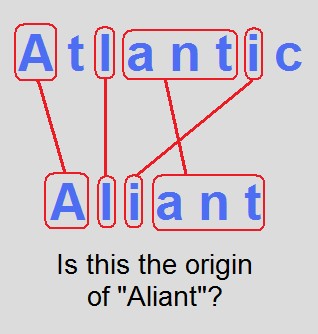
ST. JOHN'S, HALIFAX, CHARLOTTETOWN, SAINT JOHN, May 31 – A new name will enter the TSE tomorrow with the launch of Aliant Inc., a $3 billion growth company with annual revenues of $1.7 billion, 9,000 employees, and interests in telecommunications, information technology, mobile satellite communications, and emerging business.
Trading under the symbol "AIT", Aliant has emerged onto the Canadian technology scene from the business combination of Bruncor Inc., Island Telecom Inc., Maritime Telegraph and Telephone Company Limited, and NewTel Enterprises Limited, owners of the major IT and provincial telecommunications companies in Atlantic Canada. Over 99% of voting shareholders were in favour of the resolution to form one company in Shareholder Meetings which were held on May 18 and 19. BCE Inc. will beneficially own* 41.6% of Aliant. As a result of this combination, the shares of Bruncor (BRR), Island Tel (IT), MTT (MTT), and NewTel Enterprises (NEL) will no longer be traded on the stock exchanges as of the opening of business tomorrow...
* “Beneficial owner” is a legal term where specific property rights in equity belong to a person (or corporation) even though legal title of the property belongs to another person (or corporation). The “beneficial owner” is the true owner of a security. An investor may have securities registered in the name of a broker, trustee or bank to facilitate transfer or to preserve anonymity, but the investor is the beneficial owner and will receive any dividends, interest or profits from sales. Under SEC rules, a beneficial owner is someone who has either voting power or investment power over a security. Voting power is defined as the power to vote or direct the voting of a security. Investment power is defined as the power to dispose or direct the disposal of a security.
|
The Wayback Machine has archived copies
Archived: 2000 Feb 26 Launch of Aliant Inc.
Archived: 2000 Aug 23 Launch of Aliant Inc.
These links were accessed and found to be valid on 07 July 2010. |
|
The Wayback Machine has archived copies of this website:
Archived: 1996 Oct 19 Bruncor Inc. Home Page
Archived: 1996 Oct 19 Bruncor Inc. – What We Do
Archived: 1996 Oct 19 Bruncor Inc. Directors 1995
Archived: 1996 Oct 19 Bruncor Inc. year-end report 1995
Archived: 1998 Dec 05 Frank McKenna appointed a Bruncor director
Archived: 1998 Apr 24 Bruncor buys MITI
These links were accessed and found to be valid on 03 July 2010. |
|
The Wayback Machine has archived copies of this website:
Archived: 1996 Nov 11 Home page
They got the company's name wrong: Maritime Telephone and Telegraph Company Limited (“Telegraph” after “Telephone”)
Archived: 1996 Nov 11 Colin Latham speech to shareholders
Maritime Telegraph and Telephone Company Limited (“Telegraph” before “Telephone”)
Archived: 1997 Jan 25 Home page
Two different versions appear on this one page, with “Telegraph” before and after “Telephone”
Archived: 1996 Nov 11 MT&T reports results for 1995
Archived: 1996 Nov 11 MT&T reports results for first quarter 1996
Archived: 1996 Nov 11 MT&T reports results for third quarter 1996
Archived: 1996 Nov 11 Comments re MT&T results for third quarter 1996
These links were accessed and found to be valid on 05 July 2010. |
|
The Wayback Machine has archived copies of this website:
Archived: 1997 May 31 Island Telephone Company Limited
Archived: 1998 Jan 19 Island Telephone Company Limited
Archived: 1998 Jan 19 Welcome to Call Minder
Archived: 1998 Jan 19 Island Tel's Top Free Stuff
Archived: 1998 Jan 19 Online services now available
Archived: 1998 Jan 19 Digital switching conversion completed
Archived: 1998 Jan 19 Letter to shareholders
Archived: 1998 Dec 06 Island Tel Advanced Solutions
Archived: 2000 Feb 29 About Island Tel
Archived: 2000 Aug 23 Island Tel Advanced Solutions
These links were accessed and found to be valid on 03 July 2010. |
|
The Wayback Machine has archived copies of this website:
Archived: 1998 Dec 12 NewTel Enterprises
Archived: 1999 Mar 02 NewTel Enterprises
Archived: 1998 Dec 12 NewTech Instruments
Archived: 1998 Dec 12 Stratos Global Corporation
These links were accessed and found to be valid on 03 July 2010. |
Source: Nova Scotia Hansard, 16 November 1999, page 2144
http://nslegislature.ca/index.php/proceedings/hansard/C52/58_1_h99nov16/i99nov16.htm#[Page%202144]
From
Page 8597, Hansard's report of proceedings
in the Nova Scotia Legislature
on 22 April 2002:
Subcommittee of the Whole House on Supply
MR. MACKINNON: Mr. Chairman, through you, I thank the minister for that point because it leads me up to the next point I would like to make, and that's with regard to concerns that were raised over the last year with the Enron scandal. There were some suggestions through media reports and the like that the paper trail landed back here in part to Nova Scotia. Is the minister aware of any such action, and what was the impact on Nova Scotia business and, indeed, the Department of Economic Development, the bottom line for the province?[Page 156]
  Hits per calendar month
       2013 Aug     180
       2013 Jul     178
       2013 Jun     175
       2013 May     183
       2013 Apr     202
       2013 Mar     205
       2013 Feb     151
       2013 Jan     243

       2012 Dec     259
       2012 Nov     259
       2012 Oct     213
       2012 Sep     198
       2012 Aug     161
       2012 Jul     168
       2012 Jun     180
       2012 May     188
       2012 Apr     200
       2012 Mar     218
       2012 Feb     164
       2012 Jan     166

       2011 Dec     155
       2011 Nov     164
       2011 Oct     142
       2011 Sep     127
       2011 Aug     126
       2011 Jul     144
       2011 Jun     208
       2011 May     245
       2011 Apr     149
 |

W3C CSS Validation Service |