History of
Railway Companies
in Nova Scotia
Contents:
• #
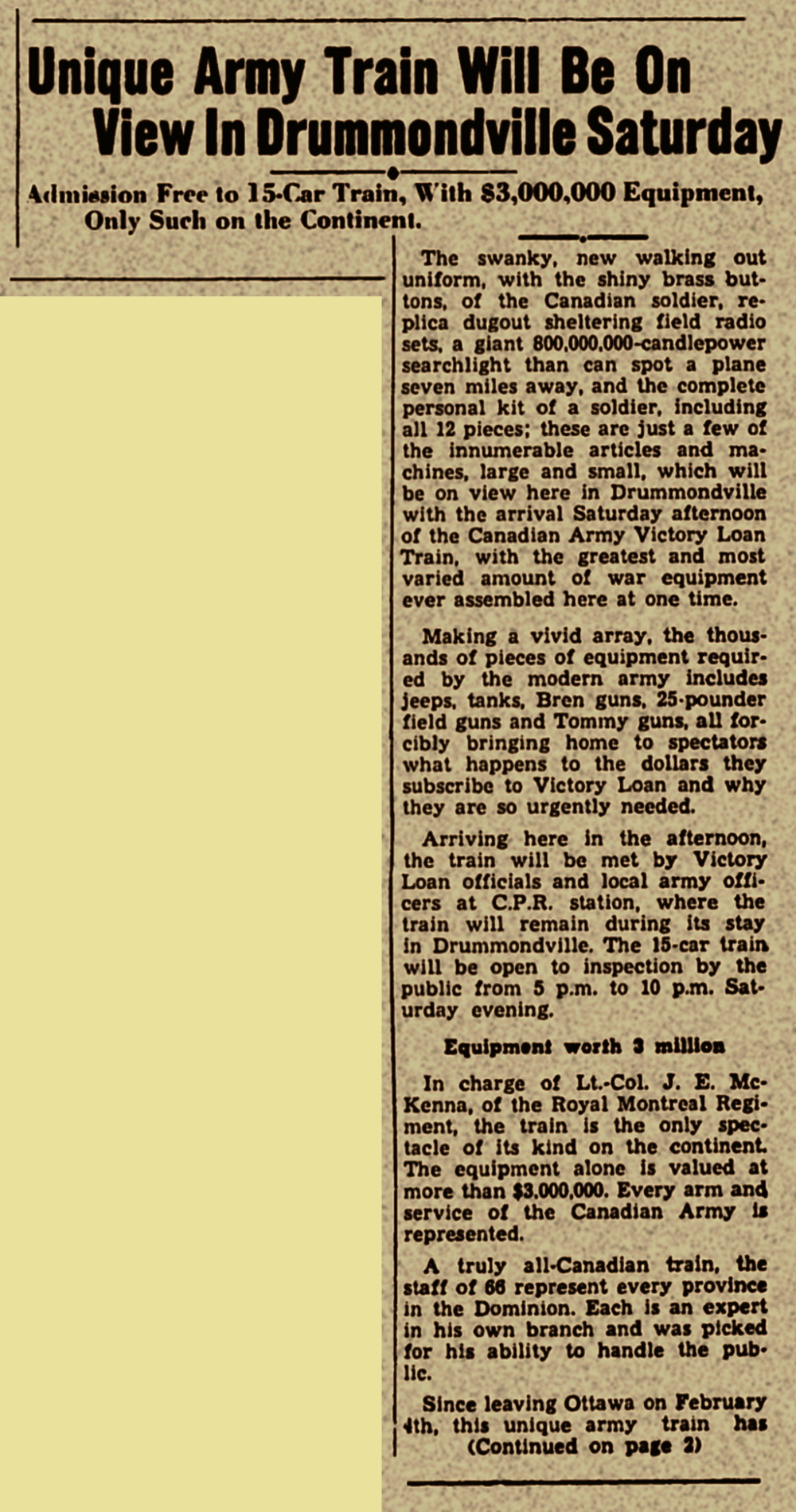
Canadian Army Train in Nova Scotia, March 1942
• #
Canadian National Railway
• #
Canadian Pacific Railway
• #
Cape Breton & Central Nova Scotia Railway
•
CIHM collection of historic NS railway documents
• #
Coast Railway Company
• #
Cornwallis Valley Railway
• #
Davison Lumber Company
• #
Dominion Atlantic Railway
• #
Eastern Extension Railway
•
ECO collection of historic NS railway documents
• #
Egerton Tramway Company
• #
European & North American Railway Company
• #
General Mining Association
• #
Great American & European Short Line Railway Company
• #
Guysborough Railway
• #
Halifax & Cape Breton Railway & Coal Company
• #
Halifax & Eastern Railway
• #
Halifax & South Western Railway
• #
Intercolonial Railway
• #
Inverness Railway & Coal Company
• #
Mackenzie, Mann & Company
• #
Montreal & European Short Line Railway
• #
Musquodoboit Railway
• #
North Mountain Railway
• #
Nova Scotia Central Railway
• #
Nova Scotia Railway
• #
Oxford & New Glasgow Railway
• #
Provincial & New England All Rail Line
• #
Rhodes, Curry & Company
• #
Silliker Car Company
• #
Springfield Railway
• #
Spring Hill & Parrsboro Coal & Railway Company
• #
Sydney Coal Railway
• #
Sydney & Louisburg Railway
• #
Terminal City Railroad Company
• #
Trenton Works
• #
Western Counties Railway
• #
Weymouth & New France Railway
• #
Windsor & Annapolis Railway
• #
Windsor & Hantsport Railway
• #
Yarmouth Street Railway
• #
Recent additions to this list
• #
Railway Timetables & Station Photographs
• #
Gross Earnings of Nova Scotia Railways, 1880 - 1882
• #
Gross Earnings of Nova Scotia Railways, 1887 - 1892
The full, official, legal name of each company is given, except perhaps in a few cases where the legal name is not yet clear. This list is known to be incomplete (I'm working on it).
Unless otherwise stated, "Act" means an Act of the Nova Scotia Legislature.
Where they appear below
"NSL" refers to the Nova Scotia Legislature in Halifax,
"DOM" refers to the Dominion Government in Ottawa (since 1867)
"ULC" refers to the Government of the Province of Canada
(1841–1867)
510845 N.B. Incorporated
A wholly-owned subsidiary of Emera Inc.
Took over the Devco Railway in December 2001
Devco Railway had taken over the old Sydney & Louisburg Railway in 1968
• Devco Railway was wholly owned by the Cape Breton Development Corporation, a crown corporation, and was operated as an unincorporated department within that corporation.
— Canadian Transportation Agency Decision No. 571-R-1997
• On 18 December 2001, 510845 N.B. Inc., a wholly-owned subsidiary of Emera Inc., Nova Scotia's largest electric utility company, acquired surface assets (railway track, rights-of-way, locomotives and other rolling stock, etc.) from the Cape Breton Development Corporation. The company will use the railway, managed under contract by SCFQ, to transport large quantities of coal to NS Power generating stations.
— Canadian Transportation Agency
Decision No. 192-R-2002, 19 April 2002
— Canadian Transportation Agency
Decision No. 341-R-2002, 28 June 2002
• This property included the rail operation between the international pier on the waterfront in Sydney and the Lingan power generating plant, the rail lines through the coal storage facility at Victoria Junction, including the railway maintenance centre, and a portion of the Glace Bay rail line between the railway maintenance centre and the end of the Old Tank siding, Cape Breton Island.
• On 1 January 2003, the operation of this railway was transferred from 510845 N.B. Inc. to Sydney Coal Railway Inc., a wholly-owned subsidiary of Quebec Railway Corporation Inc. (Societe des Chemins de Fer du Quebec).
— CTA Decisions No. 657-R-2002 and 683-R-2002
In 2005, it appears that ownership of this railway property lies with 510845 N.B. Inc., a wholly-owned subsidiary of Emera Inc., and that the responsibility for the operation of this railway lies with Sydney Coal Railway Inc., a wholly-owned subsidiary of Societe des Chemins de Fer du Quebec (Quebec Railway Corporation).
See: 3986250 Canada Inc.
See: Cape Breton Development Corporation Railway
See: Devco Railway
See “Emera Incorporated”
See: Sydney Coal Railway Inc.
Overview of the Development of Railways
on the Sydney Coal Fields: 1720-1999
3986250 Canada Incorporated
a.k.a. Sydney Coal Railway Incorporated
3986250 Canada Inc. is a wholly-owned subsidiary of Societe des Chemins de Fer du Quebec (Quebec Railway Corporation), set up for the purpose of entering into a contract to operate the the Sydney - Victoria Junction - New Waterford - Lingan railway for 510845 N.B. Inc., a subsidiary of Emera Inc.
3986250 Canada Inc. and Sydney Coal Railway Inc. were originally set up as separate corporations, both wholly-owned subsidiaries of Quebec Railway Corporation Inc. (Societe des Chemins de Fer du Quebec). These two separate corporations were amalgamated in April 2004, and thereafter were known as Sydney Coal Railway Inc.
— Canadian Transportation Agency
Decision No. 233-R-2004, 6 May 2004
• On 1 January 2003, responsibility for the operation of this railway was transferred from 510845 N.B. Inc. to Sydney Coal Railway Inc., a wholly-owned subsidiary of Quebec Railway Corporation Inc. (Societe des Chemins de Fer du Quebec).
— Canadian Transportation Agency Decision No. 657-R-2002
• ...the CTA notes that 3986250 Canada Inc. proposes to acquire and/or operate, through sale, lease or right of access, the railway which was formally owned and/or operated by 510845 N.B. Inc... The CTA also notes that 3986250 Canada Inc. proposes to commence the operation of its railway on January 1, 2003...
— Canadian Transportation Agency Decision No. 683-R-2002
See: 510845 N.B. Inc.
See: Cape Breton Development Corporation Railway
See: Devco Railway
See “Emera Incorporated”
See: Sydney Coal Railway Inc.
Acadia Coal Company (1865-1887)
Acadia Coal Company Limited (after 1887)
NSL 1865 chapter 64 — Act to incorporate the Acadia Coal Co.
NSL 1867 chapter 57 —
NSL 1869 chapter 62 — Act to incorporate the Halifax Coal & Iron Co. Ltd.
NSL 1872 chapter 73 — Act to incorporate the Vale Coal, Iron, & Manufacturing Co. Ltd.
NSL 1874 chapter 70 —
NSL 1874 chapter 74 — Act to incorporate the Halifax Co. Ltd.
NSL 1875 chapter 72 —
NSL 1883 chapter 64 —
NSL 1886 chapter 126 —
NSL 1886 chapter 161 —
NSL 1886 chapter 162 — Act to carry into effect amalgamation of Acadia Coal Co. with Halifax Co. Ltd. and Vale Coal, Iron & Manufacturing Co.
NSL 1887 chapter 115 — Act to add "Limited" to name, etc.
NSL 1898 chapter 165 —
NSL 1900 chapter 180 —
NSL 1904 chapter 147 —
NSL 1906 chapter 165 —
NSL 1907 chapter 141 —
NSL 1908 chapter 140 —
NSL 1910 chapter 113 —
NSL 1938 chapter 76 — Amendment
See: Halifax Co. Ltd.
See: Halifax Coal & Iron Co. Ltd.
See: Vale Coal, Iron & Manufacturing Co.
Ainslie Mining & Railway Company Limited
NSL 1904 chapter 144 — Act to incorporate the Ainslie Mining & Railway Co. Ltd.
Albion Mines Railway
The Albion Mines Railway — between Albion Coal Mines (now named Stellarton) and New Glasgow, Nova Scotia — was officially opened on 19 September 1839. Operations had started in December, 1838, using the Timothy Hackwork steam locomotives Samson, Hercules and John Buddle imported from England.
Chronology of Important Dates in Canadian Railway History, by Colin Churcher and Rick Roberts
Amalgamated Spring Hill & Parrsboro Coal & Railway Company Limited
Reference: Federal Government Order in Council
OIC 1883-1262, page 1 approved 30 May 1883
See: Spring Hill & Parrsboro Coal & Railway Co. Ltd.
Amherst & Eastern Railway Company Limited
NSL 1898 chapter 127 — Act to incorporate the Amherst & Eastern Railway Co. Ltd.
Amherst Street Railway Company Limited
NSL 1889 chapter 126 — Act to incorporate the Amherst Street Railway Co. Ltd.
NSL 1890 chapter 157 — Amendment
1891: — "It is proposed to open shortly an electric railway" between downtown Amherst and Fort Lawrence, near the New Brunswick border. This electric railway is planned in association with the new Chignecto Ship Railway now being built across the isthmus. The Tidnish terminus of the Ship Railway is reached by stagecoach from Amherst.
Excerpted from page 191 of "The Canadian Guide Book: The Tourist's and Sportsman's Guide to Eastern Canada and Newfoundland..." by Charles G.D. Roberts, published in 1891 by D. Appleton, New York.
Source: Early Canadiana Online http://www.canadiana.org/
page 191 http://www.canadiana.org/cgi-bin/ECO/mtq?id=73f2010914&display=56228+0263
Annapolis & Atlantic Railway Company Limited
NSL 1888 chapter 82 — Act to incorporate the Annapolis & Atlantic Railway Co. Ltd.
NSL 1890 chapter 76 — Time extended
NSL 1891 chapter 128 — Time extended
NSL 1892 chapter 69 — Amendment, providing for extension of line to Halifax or Dartmouth
NSL 1893 chapter 65 — Change name to Nova Scotia Southern Railway Co. Ltd.
NSL 1893 chapter 153 — Change of route
NSL 1894 chapter 76 —
See: Nova Scotia Southern Railway Co. Ltd.
Annapolis Iron Mining Company (1825-1863)
This company operated a pole railway about three miles [5km] long at Clementsport, Annapolis County. The only mention of this railway (that I know of) is a few words — "The iron mine was situated three miles south of this location and ore transported in trucks drawn by horses on a railway with rails of maple wood." — on a
bronze plaque at Clementsport.
Annapolis Iron Mining Company by P.L. Simmonds, 1872
http://www.rocarchives.com/Articles/Simmonds-AnnapolisIronMiningCompany.htm
Annapolis Iron Mining Company by Abraham Gesner, 1849
http://www.rocarchives.com/Articles/Gesner-AnnapolisIronMiningCompany.htm
Annapolis Iron Mining Company by Thomas C. Haliburton, 1829
http://www.rocarchives.com/Articles/Haliburton-AnnapolisIronMiningCompany.htm
Annapolis Valley Railway Company Limited
NSL 1907 chapter 143 — Act to incorporate the Annapolis Valley Railway Co. Ltd.
NSL 1908 chapter 131 — Amendment
Arisaig & Country Harbour Iron & Railway Company Limited
NSL 1906 chapter 154 — Act to incorporate the Arisaig & Country Harbour Iron & Railway Co. Ltd.
NSL 1908 chapter 134 — Amendment
NSL 1911 chapter 106 — Amendment
No railway track was ever built by this company.
Atlantic Grindstone, Coal & Railway Company Limited
NSL 1906 chapter 155 — Act to authorize the amalgamation of Atlantic Grindstone, Coal & Railway Co. with Atlantic Grindstone Co. and Fundy Coal Co.
See: Fundy Coal Co.
Atlantic & Inland Railway Company Limited 1896
NSL 1896 chapter 86 — Act to incorporate the Atlantic & Inland Railway Co. Ltd.
See: Atlantic & Inland Railway Co. of Nova Scotia Ltd.
The Atlantic & Inland Railway Co. was incorporated by chapter 86 of the Acts of 1896, to build a railway from Liverpool, via Caledonia, to Annapolis or New Germany or Springfield.
The Atlantic and Inland Railway Company of Nova Scotia by John R. Cameron
Atlantic & Inland Railway Company of Nova Scotia Limited 1893
NSL 1893 chapter 153 — Act to incorporate the Atlantic & Inland Railway Co. of Nova Scotia Ltd.
See: Atlantic & Inland Railway Co. Ltd.
The Atlantic & Inland Railway Co. of Nova Scotia was incorporated by chapter 153 of the Acts of 1893, to build a railway from Liverpool, via Caledonia, to Annapolis or New Germany.
The Atlantic and Inland Railway Company of Nova Scotia by John R. Cameron
Bay of Fundy Railway & Coal Company Limited
NSL 1875 chapter 71 — Act to incorporate the East Joggins Mining Co.
NSL 1890 chapter 180 — Change name from East Joggins Mining Co. to Bay of Fundy Railway & Coal Co.
See: East Joggins Mining Co.
Bear River & Caledonia Railway Company Limited
NSL 1907 chapter 144 — Act to incorporate the Bear River & Caledonia Railway Co. Ltd.
NSL 1911 chapter 110 — Amendment
Bedford Electric Company Limited
Incorporated March 1898
April 1906: renamed Halifax & Suburban Electric Company Limited
Block House Coal Company
NSL 1877 chapter 77 — Act to incorporate the Block House Coal Co.
See: Block House Mining Co.
See: Block House Coal & Railway Co.
Block House Coal & Railway Company
NSL 1872 chapter 72 — Act to incorporate the Block House Coal & Railway Co.
See: Block House Coal Co.
See: Block House Mining Co.
Block House Mining Company
NSL 1864 chapter 38 — Act to incorporate the Block House Mining Co.
NSL 1865 chapter 55 — Act to empower the Block House Mining Co. to guarantee bonds of the Sydney & Louisburg Railway Co.
NSL 1868 chapter 58 — Amendment, re borrowing money
See: Block House Coal Co.
See: Block House Coal & Railway Co.
See: Sydney & Louisburg Railway Co.
Blomidon Railway Company Limited
NSL 1911 chapter 111 — Act to incorporate the Blomidon Railway Co. Ltd.
NSL 1913 chapter 165 — Amendment
NSL 1916 chapter 99 — Amendment
On March 31, 1911, an act to incorporate the Blomidon Railway Company Limited was passed by the Nova Scotia Legislature. The act indicates that the new railway would connect with the existing main line track of the Dominion Atlantic Railway at Wolfville, cross the Cornwallis River at Port Williams, and continue generally northward to Canning via Starr's Point and Canard.
At or near Canning there would be a connection with and crossing of the existing Cornwallis Valley Railway. The new Blomidon Railway would run northward from Canning, through Woodside, North Corner, Upper Pereau, and Delhaven. The plan was to build the track to the top of Cape Blomidon to the site of the National Park, and from there continue to Scott's Bay and then to Cape Split.
Mr. Coleman comments: "Today, an old trail of unclear origin runs from the park site straight through the woods to Scott's Bay; perhaps it is the right of way hewed out of the forest by the fledgling Blomidon Railway Company."
A number of prominent professional men and merchants were named in the act as the officers of the proposed line and "it's obvious from this list that the Blomidon Railway was a serious undertaking."
One of the officers, Kentville lawyer Harry H. Wickwire, came from a pioneer family that had long played a prominent role in Kings County. Another officer, Leslie S. Macoun of Ottawa, was the son-in-law of Sir Frederick Borden.
Rumoured to have the blessing of Sir Frederick and with initial capital of a quarter million dollars, the plan to build the Blomidon Railway was far from a fanciful scheme. The act gave the Company two years from the date of incorporation to start work on the railway, but there is no known record of any significant construction work having been done.
The Blomidon Railway was never built.
[Excerpted from
Looking Back: The Blomidon Railway by Ed Coleman, 9 April 1999, one of his regular weekly columns in the Kentville Advertiser.]
Boston & Bridgeport Coal Mining Company Limited
NSL 1864 chapter 39 — Act to incorporate the Boston & Bridgeport Coal Mining Co. Ltd.
NSL 1866 chapter 116 — Amendment
NSL 1867 chapter 59 — Amendment
Boston & Nova Scotia Coal & Railway Company Limited
NSL 1893 chapter 147 — Act to incorporate the Boston & Nova Scotia Coal Co. Ltd.
DOM 1894 chapter 4 — Subsidy, Orangedale to Broad Cove
See: Inverness Railway & Coal Co. Ltd.
Boston, Parrsboro & Londonderry Railway & Steam Navigation Company Limited
NSL 1887 chapter 56 — Act to incorporate the Boston, Parrsboro & Londonderry Railway & Steam Navigation Co. Ltd.
Boynton Bicycle Electric Railway Company Limited
DOM 1894 chapter 64 — To incorporate the Boynton Bicycle Electric Railway Co. Ltd. to build a monorail railway from Winnipeg via Toronto, Ottawa, Montreal and Saint John to Louisburg in Nova Scotia
Bridgeport Tramway
Cape Breton County
The two mile 3km Bridgeport Tramway, on Cape Breton Island, was opened in 1830 by the General Mining Association. It was abandoned in 1849.
Chronology of Important Dates in Canadian Railway History, by Colin Churcher and Rick Roberts
British American Coal & Railway Company Limited
NSL 1905 chapter 134 — Act to incorporate the British American Coal & Railway Co. Ltd.
NSL 1906 chapter 157 — Amendment
British Empire Steel Corporation Limited BESCO
NSL 1921 chapter 152 —
NSL 1928 chapter 142 —
See: Dominion Coal Co. Ltd.
See: Dominion Iron & Steel Co. Ltd. DISCO
See: Dominion Steel & Coal Corp. DOSCO
These were primarily coal mining and steel manufacturing companies, but their extensive railway operations require that they be included in this history of railways in Nova Scotia. Beginning in the 1890s and throughout the first half of the twentieth century these companies kept the railways in eastern Nova Scotia busy. As late as the 1990s, and continuing into the spring of 2001, the steel and coal industry in the Sydney area generated about one thousand carloads per month of revenue traffic for the railway between Port Hawkesbury and Sydney, and corresponding traffic Hawkesbury - New Glasgow, and New Glasgow - Truro. When the Sydney steel mill and the DEVCO coal mining operations closed in 2001, traffic over the Hawkesbury - Sydney main line railway declined abruptly from about 15,000 carloads annually to barely 2,000 – from five trains a week to one.
Brief Overview
British Empire Steel Corp.
Dominion Coal Co.
Dominion Steel Corp.
Dominion Steel & Coal Corp.
Dominion Iron & Steel Co.
Nova Scotia Steel Co.
Nova Scotia Steel & Coal Co.
After a visit to Boston by the Nova Scotian premier, W.S. Fielding, in 1893, the Henry M. Whitney syndicate of Boston and other Nova Scotia businessmen united the Gowrie, Schooner Pond, Clyde, Glace Bay, Caledonia, Reserve, Lorway, Emery, International, Bridgeport, Gardiner, Lingan, Victoria, and other small collieries into the Dominion Coal Company. Henry Whitney was the central figure in this business empire — the Sydney suburb Whitney Pier is named after him. This new company did not, however, contain the operations and coal leases for the north side of Sydney Harbour, which were retained by the General Mining Association until 1900, when they were sold to the Nova Scotia Steel Company of New Glasgow.
Prior to World War One, the Dominion Coal Company occupied a prominent position in the Canadian coal industry. By 1912, the Company had 16 collieries in full operation and its production accounted for 40 percent of Canada's total output.
The Dominion Iron & Steel Company Limited was developed in Sydney by Whitney and his associates to provide a customer for the slack (poor quality) coal which was the result of screening. It should be noted that the Dominion Coal Company and Dominion Iron & Steel Company would become subsidiaries of the Dominion Steel Corporation.
In 1901, Whitney sold control of Dominion Coal Company to a prominent Montreal capitalist, James Ross, and during this time the Dominion Iron & Steel Company was also delivered to Canadian interests, both controlled by Ross and his associates until 1903, when control of the Steel Company was acquired by J.H. Plummer of Toronto. For the next seven years, these two companies, Dominion Coal Co. and Dominion Steel Co., quarrelled until in 1910, Plummer won and the merger gained control over the Cumberland Railway & Coal Co.
Nova Scotia Steel & Coal Company was taken over by American financial interests in 1917.
In 1919, a group of financiers and a syndicate of British industrialists, headed by a Montreal entrepreneur, Roy M. Wolvin, began the takeover of Dominion Steel. Initially, Wolvin proposed to fashion a $500,000,000 merger that would unite Canadian coal, iron and steel resources with the British steel and shipbuilding industries. In 1921, Wolvin and the London shareholders who backed him were able to merge with Nova Scotia Steel.
Thus, it was in the early 1920s that the British Empire Steel Corporation began its operations. But new markets for Nova Scotia coal and steel were hard to find, and hopes of large profits soon faded. During its short eight-year history BESCO was in a permanent state of financial crisis, mainly because it required an annual operating profit of about eight million dollars just to meet financial commitments.
Wolvin, with his directors, undertook a desperate attempt to save the corporation. The coal industry was expected to supply the funds for other areas of the faltering organization. It was at this time that BESCO began their campaign of wage reductions which was strongly opposed by the coal miners. In 1920, after intense lobbying by the company, the Liberal government decided that the provincial royalty on bituminous coal be set at 50 cents per ton, and the Duncan Report called for wider use of Canadian coke in Central Canada. Despite this, BESCO was unable to raise new capital or to return a satisfactory profit. As BESCO deteriorated, internal struggles and anxieties increased. Also prevalent was the labour strife that developed with the workers. Public opinion opposed to the practices of the company was partly responsible for the defeat of the provincial Liberal government which had been associated with the corporation.
After the spring of 1926, when short-term financing was refused him, Wolvin permitted Dominion Iron & Steel Company to slip into receivership. This marked the break-up of BESCO. In 1927, Dominion Steel was liquidated, but the Supreme Court of Nova Scotia declined to close BESCO. With a blunt refusal of reorganizational plans by shareholders, Wolvin sold his holdings and resigned as President of BESCO.
C.B. McNaught was Wolvin's successor. In 1928, J.H. McNaught visited the British investors and the group incorporated a new holding and operating company called the Dominion Steel & Coal Corporation, which took over the BESCO properties. In May 1930, BESCO ceased to exist.
Source: http://epe.lac-bac.gc.ca/100/205/301/ic/cdc/coal/history/tdominon.html
Also see: http://www.heritage.nf.ca/environment/mine/ch5p6.html
Overview of the Development of Railways
on the Sydney Coal Fields: 1720-1999
Broad Cove, Baddeck & North Sydney Railway
This railway never reached the stage of having an Act of Incorporation passed by the Legislature (at least not under that name) but fairly extensive planning work was done during the first few years of the twentieth century. The Broad Cove, Baddeck & North Sydney Railway was projected to be built from Broad Cove (now named Inverness) on the Gulf of St. Lawrence, to a point near Broad Cove Mines in Inverness County, on to Southwest Margaree, then following the Southwest Margaree River to Margaree Forks. From here the railway was to continue to Northeast Margaree, then turning nearly southward along the shores of the Lakes O'Law, then following Middle River until itreached Indian Bay on the Little Bras d'Or Lake, and along the shore of the Little Bras d'Or to Baddeck. It was planned to cross the Big Bras d'Or Gut at Seal Island (this would have been a very expensive bridge), through the centre of Boularderie Island to Little Bras d'Or, and onward to Sydney Mines and North Sydney.
Source: page 332, Cape Breton, Canada, at the Beginning of the Twentieth Century, (book) by C.W. Vernon, Nation Publishing Company, Toronto, 1903
The community at the planned northern terminal of this railway was named Broad Cove Shean, then Broad Cove Coal Mines. In 1901 the name Broad Cove was officially changed to Inverness.
Brotherhood of Railway Trainmen
NSL 1923 chapter 140 — Act to incorporate Evangeline Lodge No. 350, Brotherhood of Railway Trainmen
Caledonia Coal & Railway Company
NSL 1865 chapter 60 — Act to incorporate the Caledonia Coal & Railway Co.
Caledonia Mine to Port Caledonia, 2¼ miles, opened 1868. The harbour at Port Caledonia was abandoned in 1893 and a railway was built from Caledonia Junction to a connection with the Glace Bay Mining Company near the Sterling Mine. It was purchased by the Dominion Coal Company in March 1894 and the railway became part of the Sydney and Louisburg Railway.
— Colin Churcher
Caledonia Mines Railway
Canada Coals & Railway Company Limited
Cumberland County: Maccan - Joggins
NSL 1892 chapter 159 — Act to incorporate the Canada Coals & Railway Co. Ltd.
NSL 1893 chapter 189 — Amendment
NSL 1904 chapter 140 — Amendment
See: Canada Coals & Railroad Co. Ltd.
See: Joggins Coal & Railway Co.
See: Maritime Coal, Railway & Power Co. Ltd
On 1 November 1892, Canada Coals & Railway Co. purchased the assets of Joggins Coal & Railway Co.
Halifax, March 16th, 1893: — The Joggins Railway has changed hands, and is now being operated by the Canada Coals and Railway Company.
(signed) Martin Murphy,
Provincial Engineer
Source:
Appendix No. 7, page 8
Journals of the Legislative Council of Nova Scotia, 1893
Historical notes by Dara Legere
Canada Coals & Railroad Company Limited
Cumberland County: Maccan - Joggins
See: Canada Coals & Railway Co.
See: Maritime Coal, Railway & Power Co. Ltd.
Historical notes by Dara Legere
Canada, New Brunswick & Nova Scotia Railway Company
ULC 10-11 Victoria (1847) chapter 122 — To incorporate the Canada, New Brunswick & Nova Scotia Railway Co. to build a railway from Drummondville in Quebec to New Brunswick and Nova Scotia
Canadian Government Railways CGR
NSL 1854 chapter 1 —
NSL 1854 chapter 2 —
NSL 1855 chapter 6 —
See: Dartmouth to Deans Railway
See: Halifax & Eastern Railway Co.
See: Halifax & Guysborough Railway Co. Ltd.
See: Nova Scotia Eastern Railway Co. Ltd.
See: Windsor Branch Railway
Canadian National Railways CNR (1918 to 1960)
Canadian National Railway CN (since 1960)
DOM 1929 chapters 13-17 — Canadian National Railways (Lines acquired)
Canadian National Railway
Canadian National Railway
List of
companies included in the Canadian National Railways, by Pat Scrimgeour
Source:
|
The Wayback Machine has archived copies of this document:
List of companies included in the Canadian National Railways
Archived: 2003 August 16
http://web.archive.org/web/20030816035957/http://pat.scrimgeour.ca/railways/cn_index_of_companies.htm
Archived: 2003 December 10
http://web.archive.org/web/20031210001511/http://pat.scrimgeour.ca/railways/cn_index_of_companies.htm
Archived: 2004 February 19
http://web.archive.org/web/20040219232823/http://pat.scrimgeour.ca/railways/cn_index_of_companies.htm
Archived: 2004 October 23
http://web.archive.org/web/20041023123420/http://pat.scrimgeour.ca/railways/cn_index_of_companies.htm
These links were accessed and found to be valid on 6 December 2010.
|
Canadian National Railway history
Canadian Northern Railway CNoR
See: Halifax & South Western Railway
See: Mackenzie, Mann & Company
Canadian Pacific Railway Company Limited CPR
Port of Halifax Pier #21 and the Canadian Pacific Connection
by Don Scott
Canso & Louisburg Railway Company Limited
DOM 1892 chapter 36 —
NSL 1896 chapter 84 — Act to incorporate the Canso & Louisburg Railway Co. Ltd.
NSL 1898 chapter 131 — To amend and extend time
NSL 1900 chapter 169 — To further amend and extend time
See: Cape Breton Railway Co.
Cape Breton & Central Nova Scotia Railway Company Limited CB&CNS
Historical notes about the CB&CNS Railway
http://ns1758.ca/rail/railway22.html
Cape Breton Coal, Iron & Railway Company Limited
NSL 1895 chapter 110 — Act to incorporate the Cape Breton Coal, Iron & Railway Co. Ltd.
NSL 1898 chapter 164 — Amendment
NSL 1901 chapter 165 — Act to revive chapter 110 of 1895
NSL 1903 chapter 180 — Amendment
NSL 1905 chapter 132 — Amendment
NSL 1907 chapter 146 — Amendment
NSL 1908 chapter 136 — Amendment
NSL 1913 chapter 192 —
NSL 1915 chapter 91 —
Broughton Junction to Broughton, 2 miles, Broughton Junction to False Bay Head, 2½ miles. Construction began in 1905 and was completed in 1906. The entire project was abandoned in 1907 owing, it is said, to the opposition of the Dominion Coal Company which would not allow its Sydney and Louisburg Railway to carry the coal produced by the mine.
— Colin Churcher
A long article, detailing this company's history, appeared in the Montreal Daily Star, 25 May 1907
Cape Breton Development Corporation Railway (DEVCO)
Took over the old Sydney & Louisburg Railway in 1968
Devco Railway was wholly owned by the Cape Breton Development Corporation, a crown corporation,
and was operated as an unincorporated department within that corporation.
— Canadian Transportation Agency Decision No. 571-R-1997
On 18 December 2001, 510845 N.B. Inc., a wholly-owned subsidiary of Emera Inc., Nova Scotia's largest electric utility company,
acquired surface assets (railway track, rights-of-way, etc.) from the Cape Breton Development Corporation.
— Canadian Transportation Agency Decision No. 192-R-2002
See: Devco Railway
See: 510845 N.B. Inc.
See: Sydney Coal Railway Inc.
Cape Breton Electric Company Limited
Historical notes about the Cape Breton Electric Co.
http://ns1758.ca/electric/electricpwr02.html
NSL 1900 chapter 130 — Act to incorporate the Cape Breton Electric Tramway & Power Co. Ltd.
NSL 1901 chapter 159 — Change name to Cape Breton Electric Co. Ltd.
NSL 1902 chapter 183 — Amendment
NSL 1909 chapter 136 — Amendment
NSL 1911 chapter 115 — Amendment
NSL 1917 chapter 197 — Amend chapter 130 of 1900
See: Cape Breton Electric Tramway & Power Co. Ltd.
Cape Breton Electric Tramway & Power Company Limited
Historical notes about the Cape Breton ET&P Co.
http://ns1758.ca/electric/electricpwr02.html
NSL 1900 chapter 130 — Act to incorporate the Cape Breton Electric Tramway & Power Co. Ltd.
NSL 1901 chapter 159 — Change name to Cape Breton Electric Co. Ltd.
NSL 1917 chapter 197 — Amend chapter 130 of 1900
See: Cape Breton Electric Co. Ltd.
Cape Breton Northern Railway Company Limited
NSL 1902 chapter 132 — Act to incorporate the Cape Breton Northern Railway Co. Ltd.
NSL 1905 chapter 131 — Amendment
Cape Breton & Pictou Iron Company Limited
NSL 1885 chapter 97 — Act to incorporate the Cape Breton & Pictou Iron Co. Ltd.
NSL 1886 chapter 132 — Change name to Cape Breton & Pictou Iron & Railway Co. Ltd.
See: Cape Breton & Pictou Iron & Railway Co. Ltd.
Cape Breton & Pictou Iron & Railway Company Limited
NSL 1885 chapter 97 — Act to incorporate the Cape Breton & Pictou Iron Co. Ltd.
NSL 1886 chapter 132 — Change name to Cape Breton & Pictou Iron & Railway Co. Ltd.
NSL 1888 chapter 119 — Amendment
See: Cape Breton & Pictou Iron Co. Ltd.
Cape Breton Railway & Annex Steamboat Company Limited
NSL 1886 chapter 76 — Act to incorporate the Cape Breton Railway & Annex Steamboat Co. Ltd.
Cape Breton Railway, Coal & Iron Company Limited
NSL 1875 chapter 30 — Act to encourage the building of a railway from Strait of Canso to Louisburg
NSL 1878 chapter 55 — Act to incorporate the Cape Breton Railway, Coal & Iron Co. Ltd.
NSL 1878 chapter 56 —
See: Eastern Extension Railway
Cape Breton Railway Extension Company Limited (1884-1902)
Cape Breton Railway Company Limited (after 1902)
Richmond County
NSL 1875 chapter 30 — Act to encourage the building of a railway from Strait of Canso to Louisburg
NSL 1884 chapter 70 — Act to incorporate the Cape Breton Railway Extension Co. Ltd.
NSL 1886 chapter 75 — Act to revive and amend chapter 70 of 1884
NSL 1890 chapter 72 — Act to incorporate anew
DOM 1894 chapter 4 —
DOM 1899 chapter 7 —
NSL 1899 chapter 126 — Act to incorporate anew
NSL 1900 chapter 168 — Amendment, to authorize CBR to build a branch railway near Barraso's
NS 1902 Order-in-Council — Name changed by deleting "Extension", to Cape Breton Railway Co. Ltd.
NSL 1902 chapter 67 — Act to authorize Cape Breton Municipality to borrow money for right-of-way for Cape Breton Railway Co. Ltd.
NSL 1902 chapter 122 — Act to authorize Richmond Municipality to borrow money for right-of-way for Cape Breton Railway Co. Ltd.
NSL 1902 chapter 123 — Re Richmond Municipality land appraisers
NSL 1902 chapter 190 — Act to amend chapter 126 of 1899, re Cape Breton Railway Extension Co. Ltd.
DOM 1903 chapter 57 —
DOM 1908 chapter 63 —
DOM 1915 chapter 16 —
NSL 1921 chapter 154 — Act to amend chapter 126 of 1899 and chapter 190 of 1902, re Cape Breton Railway Extension Co. Ltd.
On 24 November 1890, the Cape Breton Railway was officially opened for regular traffic.
[National Post, 24 November 2000]
The Cape Breton Railway ran from St. Peters, Richmond County, to its junction with the main line track of the Intercolonial Railway at Point Tupper, a distance of 31.0 miles 49.9 km.
Cape Breton Railway Company
Point Tupper - St. Peters
|
Distance
from
St. Peters
miles |
Elev.
above
mean
sea level
feet |
Stations
1915 |
Distance
from
St. Peters
km |
| 0.0 |
66 |
St. Peters station |
0.0 |
| 6.0 |
111 |
Sporting Mountain station |
9.7 |
| 12.0 |
38 |
Grande Anse station |
19.3 |
| 16.3 |
135 |
Whiteside station |
26.2 |
| 19.0 |
147 |
Basin Road station (summit) |
30.6 |
| 21.0 |
24 |
Evanston station |
33.8 |
| 23.0 |
98 |
Chapel Road station |
37.0 |
| 31.0 |
9 |
Point Tupper
switch at junction with the
Cape Breton Branch of the
Intercolonial Railway (ICR) |
49.9 |
Source:
Altitudes in the Dominion of Canada 1915 (book),
by James White, F.R.S.C., F.R.G.S.,
Deputy Head of the Commission of Conservation, Ottawa
F.R.S.C.: Fellow of the Royal Society of Canada
F.R.G.S.: Fellow of the Royal Geographic Society
|
|
Comment: These distances look suspicious — all but one is an even mile.
Might they have been taken from early rough surveys and never updated?
However, the mileages above are those printed in Altitudes,
an official publication of the Dominion Government.
|
These trains were powered by coal-burning steam locomotives.
Castlereagh Pole Railway
Colchester County
There is a good photograph of an excursion train, a steam locomotive and four cars, on the Castlereagh Pole Railway on 28 June 1895, on page 26 of Historic Colchester: Towns & Countryside, (book) Colchester Historical Society, Nimbus Publishing Limited, Halifax, ISBN 1551093456, published 2000.
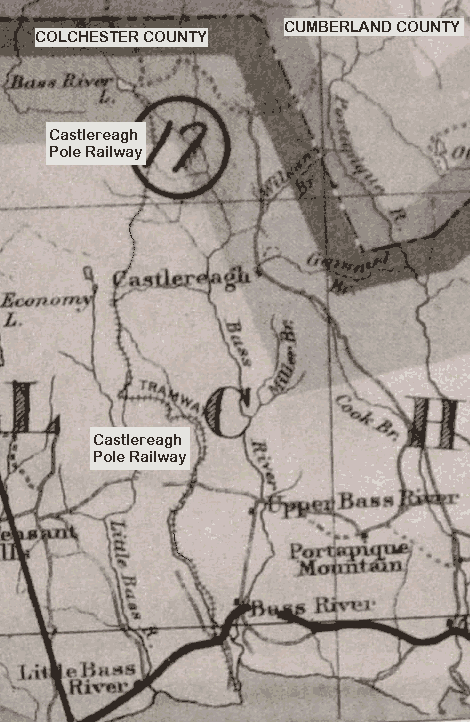
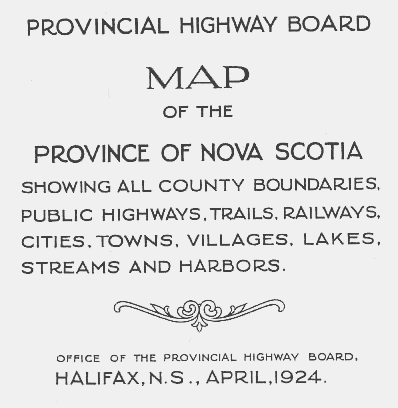
Map showing location of the Castlereagh Pole Railway
About 10 miles 16 km long
Central Railway Company Limited
NSL 1891 chapter 125 — Act to incorporate the Central Railway Co. Ltd.
NSL 1895 chapter 125 —
NSL 1896 chapter 89 —
NSL 1896 chapter 90 — Act respecting the Central Railway Co. Ltd., the Nova Scotia Central Railway Co. Ltd., and the Farmers' Loan & Trust Co. of New York
NSL 1903 chapter 2 —
See: Nova Scotia Central Railway Co. Ltd.
Central Short Line Railway Company
NSL 1892 chapter 131 — Act to incorporate the Central Short Line Railway Co. Ltd.
The Central Short Line Railway Company (1892, c.131) was chartered (notable incorporators included Fletcher Wade of the Nova Scotia Central, and Simon H. Holmes) to construct this railway line, from any point on the Intercolonial Railway to Dartmouth. However, the Central Short Line Railway Company never laid any track. The railway connecting Dartmouth to the Intercolonial at Windsor Junction was eventually built by the Intercolonial Railway.
See:
Dartmouth Extension by John R. Cameron
Chignecto Ship Railway
Chignecto Marine Transport Railway Company Limited
Cumberland County
DOM 1882 chapter 55 —
DOM 1882 chapter 76 —
DOM 1883 chapter 60 —
NSL 1883 chapter 42 —
NSL 1884 chapter 42 —
DOM 1886 chapter 18 —
DOM 1888 chapter 4 —
NSL 1889 chapter 102 —
NSL 1890 chapter 106 —
DOM 1891 chapter 12 —
DOM 1892 chapter 37 —
NSL 1898 chapter 144 —
Chignecto Ship Railway
Description published in 1891
1891: — The originator and promoter of the Chignecto Ship Railway is Mr. Henry George Cloppers Ketchum, Member of the Institute of Civil Engineers, a distinguished Canadian engineer... Associated with Mr. Ketchum in the enterprise are the great English engineers Sir John Fowler and Sir Benjamin Baker (Baker was the chief designer of the railway bridge over the Firth of Forth, Scotland, one of the greatest achievements of 19th century engineers; Fowler was Baker's employer, later his partner). The broad road-bed, carrying a double track railway 18 ft. 5.50 m wide from center to center, runs from the mouth of the La Planche River on the Bay of Fundy to Tidnish on Northumberland Strait. A vast dock is being constructed at each terminus... The toll on the Ship Railway will be 50 cents a ton on cargoes and 12 cents a ton on hulls...
From "The Canadian Guide Book: The Tourist's and Sportsman's Guide to Eastern Canada..." (pages 190-191)
1891, by Charles G.D. Roberts, Professor of English Literature at King's College, Windsor, Nova Scotia
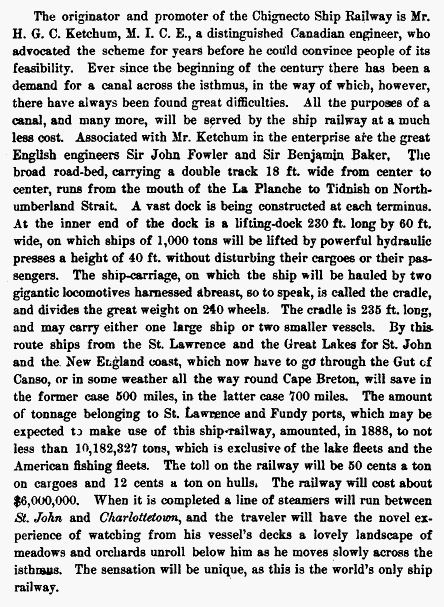
from pages 190-191 of "The Canadian Guide Book..." by Charles G.D. Roberts, 1891
Source: Early Canadiana Online http://www.canadiana.org/
page 190 http://www.canadiana.org/ECO/mtq?id=bb2b4c9564&display=56228+0260
page 191 http://www.canadiana.org/ECO/mtq?id=bb2b4c9564&display=56228+0263
Reference:
Ketchum's Folly (book, 130 pages) by Jay Underwood, published in 1995 by Lancelot Press Limited, Hantsport, Nova Scotia. ISBN 0889995532
This is the most comprehensive history of the Chignecto Ship Railway, that I know of.
Chignecto Ship Railway
Chignecto Marine Transport Railway
Chignecto Marine Railway
 Chignecto Ship Railway by Sarah K. Chapman: Eroded by time, only scattered remnants across the Chignecto isthmus stand as a monument to the dream of Henry George Clopper Ketchum...
http://www.geocities.com/SoHo/Studios/4016/chignecto_ship_railway.html
|
The Wayback Machine has archived copies of this document:
Chignecto Ship Railway
by Sarah K. Chapman
Archived: 1999 February 22
http://web.archive.org/web/19990222162802/http://www.geocities.com/SoHo/
Studios/4016/chignecto_ship_railway.html
Archived: 1999 October 4
http://web.archive.org/web/19991004123011/http://www.geocities.com/SoHo/
Studios/4016/chignecto_ship_railway.html
Archived: 2000 March 7
http://web.archive.org/web/20000307131914/http://www.geocities.com/SoHo/
Studios/4016/chignecto_ship_railway.html
Archived: 2000 October 14
http://web.archive.org/web/20001014234027/http://www.geocities.com/SoHo/
Studios/4016/chignecto_ship_railway.html
These links were accessed and found to be valid on 14 August 2012.
|
Chignecto Ship Railway
http://web.archive.org/web/20010214231641/http://www.trainweb.org/
canadianrailways/articles/ChignectoShipRailway.htm
 The Chignecto Marine Transport Railway Nova Scotia Provincial Parks
http://parks.gov.ns.ca/brochures/TidnishDock04.pdf
Chignecto Marine Railway, 1888 - 1891, Nova Scotia Industrial Heritage
http://www.gov.ns.ca/homa/muns/hert/indhert/chignect.htm
|
The Wayback Machine has archived copies of this document:
Chignecto Marine Railway, 1888 - 1891
Nova Scotia Industrial Heritage
Archived: 1999 December 22
http://web.archive.org/web/19991222003922/http://www.gov.ns.ca/homa/muns/hert/indhert/chignect.htm
Archived: 2000 March 9
http://web.archive.org/web/20000309144929/http://www.gov.ns.ca/homa/muns/hert/indhert/chignect.htm
Archived: 2000 June 14
http://web.archive.org/web/20000614084508/http://www.gov.ns.ca/homa/muns/hert/indhert/chignect.htm
These links were accessed and found to be valid on 14 August 2012.
|
|
Coast Railway Company of Nova Scotia Limited
Yarmouth County
Historical notes about the Coast Railway
http://ns1758.ca/rail/railway02.html#coarns
NSL 1893 chapter 154 — Act to incorporate the Coast Railway Co. of Nova Scotia Ltd.
NSL 1894 chapter 102 — Act to amend, with power to extend
NSL 1895 chapter 124 — Amendment
NSL 1896 chapter 103 — Act to amend, with power to extend to Lockeport
NSL 1896 chapter 154 —
DOM 1897 chapter 4 —
NSL 1897 chapter 84 — Amendment
NSL 1897 chapter 85 — Amendment
NSL 1899 chapter 123 — Act to provide for reappraisal of land taken for right of way
NSL 1899 chapter 128 — Change name to Halifax & Yarmouth Railway Co. Ltd.
NSL 1904 chapter 136 — To amend chapter 128 of 1899, respecting the Coast Railway Co. of Nova Scotia Ltd.
See: Halifax & South Western Railway Co. Ltd.
See:Halifax & Yarmouth Railway Co. Ltd.
The Coast Railway has commenced a regular train service.
[Digby Weekly Courier, 13 August 1897]
The business on the Coast Railway is away beyond the expectations of the management.
[Digby Weekly Courier, 20 August 1897]
Coast Railway begins operations, August 1897
http://ns1758.ca/rail/railway02.html#coarns
Cobequid Iron, Coal & Railway Company Limited
NSL 1873 chapter 48 — Act to incorporate the Cobequid Iron, Coal & Railway Co. Ltd.
Colchester Coal & Railway Company Limited
Colchester Coal & Railway Co. Ltd. was incorporated 26 Feb 1903 under the Nova Scotia Companies Act
NSL 1906 chapter 43 —
NSL 1906 chapter 109 — Act to authorize Colchester Municipality to exempt from taxation the Colchester Coal & Railway Co. Ltd.
NSL 1913 chapter 181 —
Colonial Iron, Coal & Railway Company Limited
NSL 1889 chapter 117 — Act to incorporate the Colonial Iron, Coal & Railway Co. Ltd.
NSL 1892 chapter 177 — Act to revive and amend chapter 117 of 1889
Consolidated European & North American Railway Company Limited
See: European & North American Railway Co. Ltd.
See: Great American & European Short Line Railway Co.
See: Montreal & European Short Line Railway Co.
Cornwallis Valley Railway Company Limited CVR
Kings County: Kingsport - Canning - Kentville
DOM 1887 chapter 24 —
NSL 1887 chapter 59 — Act to incorporate the Cornwallis Valley Railway Co. Ltd.
NSL 1888 chapter 87 — Amend, and change route
DOM 1889 chapter 3 —
NSL 1889 chapter 82 — Amend, as to telephone line
NSL 1890 chapter 73 — Amend, as to Farmers' Loan and Trust Co. of New York
NSL 1890 chapter 105 — Act to authorize the Municipality of Kings County to borrow money to pay for land taken for CVR right of way
NSL 1891 chapter 94 — Amendment
NSL 1891 chapter 116 — Amendment, as to connection with the Nova Scotia Central Railway
NSL 1892 chapter 107 — To authorize the sale of the Cornwallis Valley Railway to Windsor & Annapolis Railway Co. Ltd.
NSL 1892 chapter 108 —
NSL 1893 chapter 102 —
See: Dominion Atlantic Railway Co. Ltd.
See: Windsor & Annapolis Railway Co. Ltd.
The Cornwallis Valley Railway —
As sanctioned by the Extraordinary General Meeting of Shareholders, held on June 24th, 1892, the purchase of the Cornwallis Valley Railway was duly effected, a moiety [one half] of the purchase money being payable in cash, and the balance in debentures [bonds] authorized by the said meeting. The transfer of the property was made on July 26th, 1892, since which date it has been an integral part of the Windsor & Annapolis Railway Company's system. The CVR branch, 14 miles 23 km long, has proved of service in stimulating business on the trunk line, and in consolidating generally the W&AR Company's interests.
Source:
Appendix No. 7, page 7
Journals of the Legislative Council of Nova Scotia, 1893
The Cornwallis Valley Railway —
The Cornwallis Valley Railway is now [March 1893] merged in the Windsor and Annapolis Railway Company. The purchase was effected in June 1892, and the transfer was made on 26 July 1892. Since that date it has been operated as part of the Windsor and Annapolis Railway Company's road.
(signed) Martin Murphy,
Provincial Engineer
Source:
Appendix No. 7, page 8
Journals of the Legislative Council of Nova Scotia, 1893
History of the Cornwallis Valley Railway
Cornwallis Valley Railway and North Mountain Railway by John R. Cameron
http://www.rocarchives.com/Articles/Cameron-CornwallisValleyRailwayAndNorthMountainRailway.htm
1949 DAR Passenger Train Schedule
Kingsport - Canning - Centreville - Aldershot - Kentville
http://ns1758.ca/rail/railway05.html

Map showing the North Mountain Railway,
the Cornwallis Valley Railway, and the Dominion Atlantic Railway
Kings County, Nova Scotia

Cornwallis Valley Railway: (c.1930) apple warehouses
and station at Sheffield Mills
The photograph was taken by Edson Graham and published in the
book Some Economic Aspects of the Apple Industry in Nova Scotia
by Willard Longley, 1931.
Source:
Dominion Atlantic Railway Wikipedia
Cornwallis Valley Railway
Kingsport - Canning - Kentville
Stations
1893
|
miles
1893
note 1
|
Station |
miles
1915
note 2
|
km |
| - |
Kentville |
0.0 |
0.0 |
| - |
Steam Mill Village |
2.9 |
4.7 |
| - |
Centreville |
4.8 |
7.7 |
| - |
Canard |
7.3 |
11.8 |
| - |
Canning |
10.8 |
17.4 |
| - |
Kingsport |
13.8 |
22.2 |
| |
Note 1: Belcher's Almanack, 1893, (page 164)
For this railway, the Alamanack gives the names of
the stations but not the locations (mileages).
|
Note 2: Altitudes in the Dominion of Canada, 1915
(page 20) by James White, F.R.S.C., F.R.G.S.
Deputy Head of the Commission of Conservation
Ottawa
|
|
Cumberland Railway & Coal Company Limited CR&C
Cumberland County
DOM 1883 chapter 77 —
DOM 1884 chapter 77 —
DOM 1887 chapter 24 —
DOM 1887 chapter 86 —
DOM 1903 chapter 57 —
DOM 1908 chapter 100 —
DOM 1928 chapter 57 —
See: Dominion Steel Corporation
See: Spring Hill & Parrsboro Coal & Railway Co. Ltd.
See: Amalgamated Spring Hill & Parrsboro Coal & Railway Co. Ltd.
Dartmouth Branch Extension
aka: Dartmouth to Deans Railway
See: Musquodoboit Railway
Musquodoboit Railway
Dartmouth & Cow Bay Railway Company
NSL 1911 chapter 120 — Act of Incorporation
NSL 1914 chapter 170 — Extension of Completion Time
See: Dartmouth Tram & Power Company Limited
Dartmouth & Cow Bay Railway history by John R. Cameron
http://www.rocarchives.com/Articles/Cameron-DartmouthAndCowBayRailway.htm
Dartmouth to Deans Railway
aka: Dartmouth to Deans Branch of the Canadian Government Railways
aka: Dartmouth Branch Extension of the Intercolonial Railway
See: Musquodoboit Railway
Also see: Halifax & Guysborough Railway Co. Ltd.
Dartmouth Electric Tram Company Limited
April 1908
See: Dartmouth Tram & Power Company Limited
Dartmouth Tram & Power Company Limited
NSL 1890 chapter 189 — Act to incorporate the Dartmouth Tram & Power Co. Ltd.
NSL 1908 chapter 138 — Act to revive and amend chapter 189 of 1890
April 1890: Dartmouth Tram and Power Company Limited
April 1908: renamed Dartmouth Electric Tram Company Limited
March 1911: renamed Dartmouth and Cow Bay Electric Company Limited
See: Dartmouth & Cow Bay Railway Company Limited
Davison Tramway Company Limited
Lunenburg and Annapolis Counties
NSL 1904 chapter 146 — Act to incorporate the Davison Tramway Co. Ltd.
NSL 1905 chapter 135 — Change name from Davison Tramway Co. Ltd. to Springfield Railway Co. Ltd.
NSL 1906 chapter 158 —
NSL 1915 chapter 95 —
NSL 1920 chapter 182 —
See: Springfield Railway Co.
The Davison Tramway Co. and the Springfield Railway Co. were closely associated with the Davison Lumber Company, headquartered in Bridgewater.
Davison Lumber Company
http://www.antique-engine.ns.ca/davison.html
Springfield Railway
http://www.tallships.ca/crossburn/history.htm
DEVCO Railway
Devco Railway was wholly owned by the Cape Breton Development Corporation and was operated
as an unincorporated department within that corporation.
— Canadian Transportation Agency Decision No. 571-R-1997
See: Cape Breton Development Corporation Railway
See: Sydney Coal Railway Inc.
Digby to Yarmouth Railway
NSL 1879 chapter 65 — Act to authorize the Government to aid a Railway between Digby and Yarmouth
Dominion Atlantic Railway Company Limited DAR
NSL 1893 chapter 141 —
NSL 1893 chapter 142 —
NSL 1893 chapter 143 —
DOM 1894 chapter 69 —
DOM 1895 chapter 47 — To incorporate the Dominion Atlantic Railway Co. Ltd.
DOM 1895 chapter 69 —
DOM 1898 chapter 8 —
DOM 1900 chapter 59 —
NSL 1901 chapter 114 — To authorize the Town of Kentville to borrow money for bonus to the Dominion Atlantic Railway Co. Ltd.
DOM 1903 chapter 57 —
DOM 1905 chapter 85 —
NSL 1905 chapter 130 — Act respecting the purchase of the Midland Railway by the Dominion Atlantic Railway Co. Ltd.
DOM 1907 chapter 40 —
DOM 1908 chapter 101 —
DOM 1910 chapter 51 —
DOM 1910 chapter 88 —
NSL 1910 chapter 134 —
NSL 1910 chapter 135 —
NSL 1910 chapter 136 — Act respecting the North Mountain Division of the Dominion Atlantic Railway
DOM 1911 chapter 72 —
DOM 1912 chapter 86 —
NSL 1912 chapter 201 — Amendment
DOM 1914 chapter 84 —
NSL 1916 chapter 87 — Act to change the name of Kingston Station, Kings County
NSL 1977 chapter 93 — Act to authorize the Town of Wolfville to purchase property of the Dominion Atlantic Railway
See: Cornwallis Valley Railway Co
See: Midland Railway Co. Ltd.
See: Missing Link Railway
See: Western Counties Railway Co. Ltd.
See: Windsor & Annapolis Railway Co. Ltd.
DAR's First Through Train,
Yarmouth to Halifax
1 October 1894
"Under financial and political pressures, the Windsor & Annapolis Railway and the Western Counties Railway united as the Dominion Atlantic Railway, and their first train ran through from Yarmouth to Halifax, October 1, 1894."
[From 99 Years of Dominion Atlantic, by J.B. King, in the December 1968 issue of The Maritime Express, a newsletter published by the Scotian Railroad Society.]
Dominion Atlantic Railway history by Jim Simmons
http://www.rocarchives.com/Articles/Simmons-DominionAtlanticRailway.htm
Passenger Services at Digby
July-August 1897
Dominion Atlantic Railway
Passenger Trains to/from Digby
1897 Summer Schedule
On and after July 3rd, 1897,
the Steamship and Train Service
of this Railway will be as follows:
|
TRAINS WILL ARRIVE AT DIGBY |
| Express from Yarmouth, daily except Sun. |
9:58am |
| Express from Halifax, daily except Sun. |
11:55am |
| Flying Bluenose from Yarmouth, Mon. and Thu. |
10:20am |
| Flying Bluenose from Halifax, Mon. and Thu. |
12:46pm |
| Accomodation from Annapolis, Tue. Thu. Sat. |
6:51am |
| Accomodation from Yarmouth, Mon. Wed. Fri. |
3:49pm |
|
TRAINS WILL LEAVE DIGBY |
| Express for Halifax, daily except Sun. |
10:08am |
| Express for Yarmouth, daily except Sun. |
12:05pm |
| Flying Bluenose for Halifax, Mon. and Thu. |
10:25am |
| Flying Bluenose for Yarmouth, Mon. and Thu. |
12:56pm |
| Accomodation for Yarmouth, Tue. Thu. Sat. |
7:01am |
| Accomodation for Annapolis, Mon. Wed. Fri. |
4:00pm |
|
The Steamship
Prince Edward
Sails from Yarmouth for Boston
every Monday and Thursday
immediately on arrival of
Flying Bluenose
Royal Mail Steamship Prince Rupert
Between Saint John and Digby
Operated by the Dominion Atlantic Railway Company
1897 Summer Schedule
|
Daily Except Sunday |
| Leaves Saint John |
7:00am |
| Arrives Digby |
9:30am |
| Leaves Digby |
1:00pm |
| Arrives Saint John |
3:30pm |
|
[Source: DAR display ad in the Digby Weekly Courier, all issues, July and August 1897]
Big and Fast
From Lloyd's Register it appears that the Dominion Atlantic Railway's new twin-screw steamship Prince Edward has a registered tonnage of 1,416, and from the particulars of her engines a speed of considerably over 19 knots is quite certain. This new steamship cost about $350,000 to build.
[Digby Weekly Courier, 30 July 1897]
Halifax to Boston in 23 Hours
On Mondays and Thursdays the Flying Bluenose connects at Yarmouth with the Prince Edward for Boston. The Dominion Atlantic Railway company are now in a position to carry passengers from Halifax to Boston, or vice versa, in 23 hours.
[Digby Weekly Courier, 1 October 1897]

The Dominion Atlantic Railway station at Windsor, Nova Scotia
Business at the Berwick Station has been pretty lively lately Besides the ordinary traffic there has been shipped some thirty tons of cucumbers, and already about thirty-five hundred barrels of apples have gone, besides plums galore. At present the rush is in potatoes although the price is rather small.
— Berwick Register, 28 September 1898
The Dominion Atlantic Road
Halifax, N.S. April 15, 1893 — Among the competing routes for New England and travel was the Windsor and Annapolis, better known as the "Land of Evangeline" Line, running from Halifax to Annapolis, thence by the
Western Counties Railway
to Yarmouth, a total rail distance of 217 miles , and thence by steamer to Boston. It was only a year ago that the missing link between Annapolis and Digby, twenty miles, was completed by the Dominion Government, at a cost of $500,000. Previous to that the twenty-mile gap was covered by steamer, thus making four changes between Halifax and Boston.
The Western Counties Road between Digby and Yarmouth has long been in litigation. Last year it passed into the hands of an English syndicate, who were compelled to carry out their agreement with the local stock and bondholders and the municipality of Yarmouth to purchase the road. General Manager Campbell of the Windsor and Annapolis has long had an eye on the Western Counties Road, and during the past Winter has steadily worked to control it. He has just succeeded in completing negotiations for its purchase, and hereafter the two roads will be operated under his management under the name of the Dominion Atlantic Railway. The capital of the new company, composed of English capitalists, will be $5,000,000.
The Western Counties section will be relaid with steel rails, its wooden bridges will be replaced with iron structures, and the road will be equipped with new rolling stock. "The Flying Bluenose," the fast vestibule train hitherto run on the Windsor and Annapolis Road for American tourists, will hereafter run through between Halifax and Yarmouth, where connection will be made with the steamships Boston and Yarmouth, so that Boston passengers will be landed in Halifax in twenty-four hours. Under its reorganized management, the Dominion Atlantic Railway will keenly compete with all existing routes for all Nova Scotia business with New England and the Western Canadian provinces via Boston.
— Source: New York Times, 16 April 1893
DAR Passenger Train Timetables
1936 DAR Passenger Train Schedule
Truro - South Maitland - Kennetcook - Scotch Village - Windsor
http://ns1758.ca/rail/railway11.html
1949 DAR Passenger Train Schedule
Kingsport - Canning - Centreville - Aldershot - Kentville
http://ns1758.ca/rail/railway05.html
1949 DAR Passenger Train Schedule
Halifax - Windsor - Kentville - Annapolis Royal - Digby - Yarmouth
http://ns1758.ca/rail/railway06.html
1949 DAR Passenger Train Schedule
Kentville - Hantsport - Windsor - Kennetcook - South Maitland - Truro
http://ns1758.ca/rail/railway04.html
1949 DAR-CNR Connecting Passenger Train Schedule
Windsor - Wolfville - Middleton - New Germany - Bridgewater
http://ns1758.ca/rail/railway07.html
1949 DAR-CNR Connecting Passenger Train Schedule
Yarmouth - Digby - Annapolis Royal - Middleton - New Germany - Bridgewater
http://ns1758.ca/rail/railway08.html
1949 DAR-CNR Connecting Passenger Train Schedule
Kingsport - Canning - Kentville - Middleton - New Germany - Bridgewater
http://ns1758.ca/rail/railway09.html
1949 DAR Passenger Train Schedule
Kingsport - Canning - Kentville - Hantsport - Windsor - Halifax
http://ns1758.ca/rail/railway10.html
1949 CNR-DAR Connecting Passenger Train Schedule
Sydney - Antigonish - Truro - Kennetcook - Windsor - Kentville - Digby - Yarmouth
http://ns1758.ca/rail/railway12.html
1949 CNR-DAR Connecting Passenger Train Schedule
Sydney - Antigonish - Truro - Windsor - Middleton - New Germany - Bridgewater
http://ns1758.ca/rail/railway13.html
Canadian Transportation Agency
Decision No. 350-R-1989
13 July 1989
IN THE MATTER OF the application by Canadian Pacific Limited for authority to abandon the operation of the portion of the Kentville Subdivision (of the Dominion Atlantic Railway) from Kentville (mileage 4.6) to Annapolis Royal (mileage 58.4) and the entire Yarmouth Subdivision (of the Dominion Atlantic Railway) from Annapolis Royal (mileage 0.0) to Yarmouth (mileage 86.6), a total distance of 140.4 miles (225.9 km), in the Province of Nova Scotia.
End of the Windsor Branch
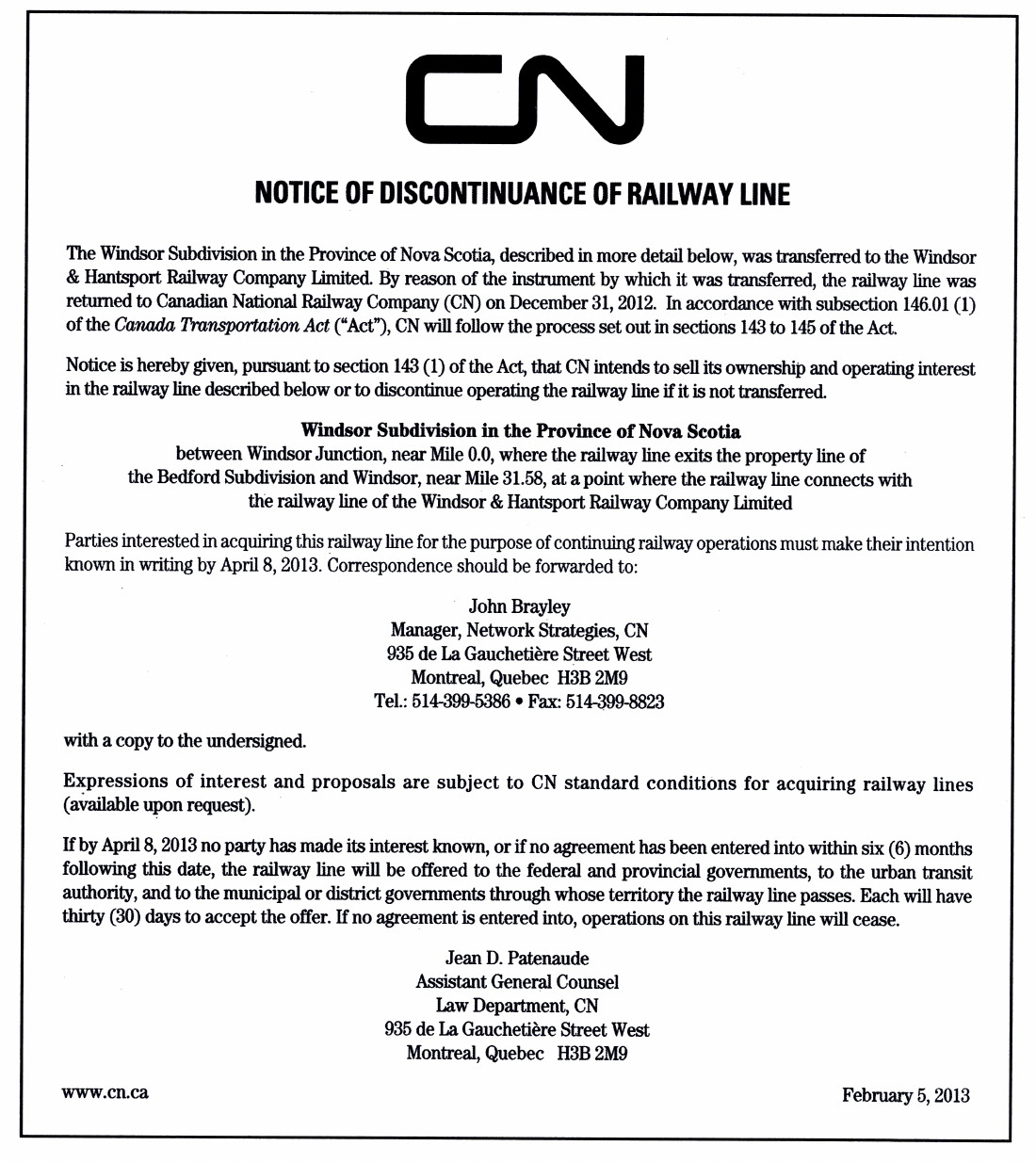
“The Windsor Subdivision... was transferred to the Windsor & Hantsport Railway Company” in August 1994.
“By reason of the instrument by which it was transferred, the railway line was returned to Canadian National Railway Company (CN) on December 31, 2012.”
Brief History of the Windsor Branch
(a.k.a. the Windsor Subdivision)
Last Train to/from Windsor Junction
On 2 November 2010, the last train operated over the Windsor Branch (a.k.a. the Windsor Subdivision) between Windsor and Windsor Junction. Eastbound toward the Junction it consisted of two diesel locomotives pulling eleven empty grain hoppers, and one hopper still loaded with corn for animal feed that had not been emptied before the last train departed. The return trip westbound to Windsor consisted of the two locomotives "running light" (no cars). The two engines were WHRC 1968 and WHRC 4079, both B23-7s painted
Conrail blue.
Demolition of D.A.R. Roundhouse
Demolition of Two D.A.R. Bridges
Bid 60140711 for Transportation and Infrastructure Renewal:
Tender for demolition of abandoned railway bridges on the Nova Scotia Trail System for two projects in Digby County:
Project 1: Bear River Railway Bridge.
Project 2: Sissiboo River Railway Bridge.
Issued: 06 October 2010
Closed: 28 October 2010 @ 02:00 PM
        1. McNally Construction Inc           $5,777,250.00
        2. Dexter Construction Co. Ltd.       $5,310,000.00
        3. Western Specialty Contracting ULC  $4,456,590.00
        4. Concrete USL Ltd                   $3,650,000.00
        5. RJ MacIsaac Construction Ltd       $2,888,000.00
Moose River Bridge Dominion Atlantic Railway
Bear River Bridge Dominion Atlantic Railway
Sissiboo River Bridge Dominion Atlantic Railway
Sissiboo River railway bridge
Weymouth, Digby County, Nova Scotia
b-2010nov30.jpg "Dominion Atlantic Railway: Sissiboo River Bridge, Digby County, Nova Scotia, 30 Nov 2010")
November 2010 (above)
March 2012 (below)
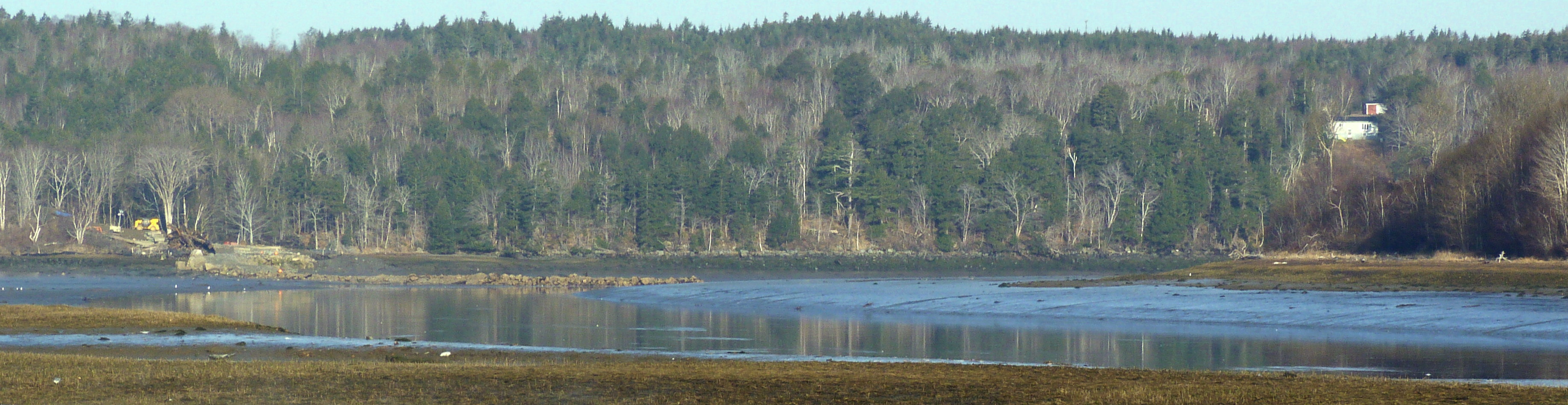
Sissiboo River bridge Dominion Atlantic Railway
Dominion Coal Company Limited
NSL 1893 chapter 145 — Act to incorporate the Dominion Coal Co. Ltd.
NSL 1905 chapter 61 —
NSL 1906 chapter 159 — Act respecting bridges on Dominion Coal Company's railway in Sydney
NSL 1919 chapter 142 — Act to incorporate Dominion Coal Workers' Relief Association
NSL 1933 chapter 134 —
NSL 1949 chapter 128 —
NSL 1952 chapter 114 —
NSL 1970-71 chapter 116 — Act to amend chapter 142 of 1919
NSL 1976 chapter 85 — Act to further amend chapter 142 of 1919
NSL 1984 chapter 13 — Act to repeal chapter 142 of 1919
See: British Empire Steel Corp.
• The Dominion Coal Company was incorporated on 16 February 1893 with an authorized capital of $18,000,000. The first directors were:
•
Henry M. Whitney, Boston, President
• Sir
Donald A. Smith, Montreal
•
Henry F. Dimock, New York
•
Hugh McLennan, Montreal
•
F.S. Pearson, Boston
•
William Cornelius van Horne, Montreal
•
Robert Winsor, Boston
•
William Ross, Q.C., Halifax
• Alfred Winsor, Boston
By March 1st, 1894, the Dominion Coal Company had acquired and paid for in full about seventy square miles 180 square kilometres of coal lands. These included the following collieries (mines) in the Galce Bay - Sydney area:
• Caledonia [404] formerly owned by the Caledonia Coal & Railway Co.
• International [247] formerly owned by the International Coal Co.
• Gardiner [350] formerly owned by Burchell Bros., Sydney
• Glace Bay [343] formerly owned by the Galce Bay Mining Co.
• Old Bridgeport [165] formerly owned by the International Coal Co.
• Reserve [347] formerly owned by the Sydney & Louisburg Coal & Railway Co.
• Gowrie [350] formerly owned by the Gowrie Coal Mining Co.
• Victoria [—] formerly owned by the Low Point, Barrasios & Lingan Mining Co.
History of the Dominion Coal Company
Overview of the Development of Railways
on the Sydney Coal Fields: 1720-1999
Dominion Eastern Railway Company Limited
DOM 1897 chapter 4 —
NSL 1897 chapter 81 — Act to incorporate the Dominion Eastern Railway Co. Ltd.
NSL 1898 chapter 130 — Amendment
NSL 1899 chapter 131 — Amendment
Dominion Iron & Steel Company Limited DISCO
NSL 1899 chapter 139 — Act to incorporate the Dominion Iron & Steel Co. Ltd.
NSL 1900 chapter 66 —
NSL 1900 chapter 118 —
NSL 1928 chapter 69 —
NSL 1928 chapter 70 —
NSL 1954 chapter 68 —
NSL 1976 chapter 68 —
See: British Empire Steel Corp. BESCO
See: Dominion Steel & Coal Corp. DOSCO
Dominion Steel & Coal Corporation Limited DOSCO
NSL 1928 chapter 141 — Act to incorporate the Dominion Steel & Coal Corp. Ltd.
NSL 1932 chapter 131 —
NSL 1939 chapter 107 —
See: British Empire Steel Corp. BESCO
See: Dominion Iron & Steel Co. Ltd. DISCO
Dominion Steel Corporation Limited
NSL 1921 chapter 152 —
NSL 1928 chapter 142 —
See: British Empire Steel Corp.
See: Cumberland Railway & Coal Co. Ltd.
See: Dominion Iron & Steel Co. Ltd.
See: Spring Hill & Parrsboro Coal & Railway Co. Ltd.
East Bay Railway Company Limited
NSL 1889 chapter 121 — Act to incorporate the East Bay Railway Co.
See: Sydney & East Bay Railway Company Ltd.
Eastern Car Company Limited Trenton, Pictou County
NSL 1907 chapter 147 —
NSL 1913 chapter 100 —
NSL 1913 chapter 114 —
NSL 1947 chapter 113 —
Eastern Car Company by
Andrew Merrilees (written in 1963)
The first car order processed through this plant was one for 2,000 steel-framed wood-sheathed, wood-roofed box cars for the Grand Trunk Railway in 1913. For these cars almost all the steel was rolled next door – in the mill of the parent company Nova Scotia Steel & Coal Company – including the heavy bar stock for the arch-bar trucks, then the standard truck for freight cars. Orders from most of the major Canadian railways quickly followed, and in 1915 the plant also secured a large export order for box cars for the Czarist Russian government. The Trenton plant, often referred to as the “Trenton Works,” was in continuous operation from 1913 until 2007, owned first by the Eastern Car Company and later by several successor companies. In the late 1950s, Dominion Steel & Coal Corporation (DOSCO), the parent company of Eastern Car Company, was taken over by
Avro Canada a Canadian company closely associated with
A.V. Roe, a large British aircraft manufacturer. In the early 1960s, Avro Canada (including DOSCO with Trenton Works) was taken over by Hawker Siddeley (Canada) Limited, a large British aircraft concern and holding company. On March 9, 1995, Trenton Works was purchased by a joint partnership of Canadian and American businessmen with the latter, Greenbrier Company of Lake Oswego, Oregon acquiring the majority interest. The plant was renamed TrentonWorks Limited and became part of the Greenbrier Companies. Greenbrier closed TrentonWorks permanently in 2007. During its working life, 1913-2007, Trenton Works produced well over 70,000 railway freight cars.
Eastern Counties Railroad Company Limited
NSL 1874 chapter 62 — Act to incorporate the Eastern Counties Railroad Co.
NSL 1876 chapter 71 — Act to amend, and extend time
Eastern Extension Railway from New Glasgow to the Strait of Canso
NSL 1876 chapter 3 —
NSL 1876 chapter 4 —
DOM 1877 chapter 46 —
NSL 1878 chapter 47 — Payment for land for right of way
DOM 1879 chapter 12 —
NSL 1879 chapter 66 —
NSL 1883 chapter 19 —
NSL 1883 chapter 21 — Act to confirm agreements with Halifax & Cape Breton Railway & Coal Co. Ltd.respecting the Eastern Extension Railway
NSL 1883 chapter 73 — Respecting the claims of Charles C. Gregory
NSL 1884 chapter 1 — Act to authorize the transfer of the Eastern Extension Railway to the Government of Canada
DOM 1884 chapter 5 —
NSL 1905 chapter 3 — Act respecting claims of municipalities for refund relating to land taken for right of way
See: Guysborough & Atlantic Railway Co. Ltd.
See: Halifax & Cape Breton Railway & Coal Co. Ltd.
See: New Glasgow to Strait of Canso Railway
See: Whitehaven Railway Co. Ltd.
Order in Council 1876-1042
Subject: Proposed transfer of the Intercolonial Railway's Pictou and Truro Branch to a Company to build a railway from New Glasgow to the Strait of Canso (the Eastern Extension)...
The undersigned [Minister of Public Works, Ottawa] has the honor to report that an Order in Council was passed on the 7th February 1876, authorizing notice being sent to the Government of the Province of Nova Scotia that the Dominion Government would be prepared to submit a proposition to Parliament for the transfer of the Truro & Pictou Branch Railway to a Company which might undertake, in consideration thereof, the construction of a railway line to the Straits of Canso, and thence to West Bay, at the head of the Bras D'Or Lake, including a Steam Ferry across the Straits...
OIC 1876-1042, page 1
OIC 1876-1042, page 2
OIC 1876-1042, page 3
OIC 1876-1042, page 4
OIC 1876-1042, page 5
OIC 1876-1042, page 6
OIC 1876-1042, page 7
OIC 1876-1042, page 8
OIC 1876-1042, page 9
OIC 1876-1042, page 10
OIC 1876-1042, page 11
OIC 1876-1042, page 12
OIC 1876-1042, page 13
Approved: 9 November 1876
— Source:
Ottawa, Federal Government Orders in Council
http://www.collectionscanada.ca/02/020157_e.html
Proceedings of the Legislative Council of Nova Scotia —
Halifax, 19 April 1883: —
"I congratulate you (the Members of the Nova Scotia Legislative Assembly) on the passage of legislation to take over the Eastern Extension Railway, together with the Pictou Branch of the Intercolonial Railway. These properties will, it is confidently believed, prove of great value to the Province, and it is hoped will be the means of materially assisting in carrying out further railway extension, especially in the Island of Cape Breton."
The above is the fourth paragraph of the speech at the closing of the 1883 session of the Nova Scotia Legislative Assembly, by Lieutenant-Governor Adams George Archibald, 19 April 1883.
Source: Page 131 of the 1883 section of:
Debates and Proceedings of the Legislative Council of Nova Scotia, 1883-90
Eastern Railway Company
NSL 1870 chapter 59 — Act to incorporate the Eastern Railway Co.
NSL 1871 chapter 62 — Amendment re grant of land
NSL 1876 chapter 3 — To amend the Acts relating to Eastern Railway Extension
NSL 1876 chapter 4 — Act to confer certain privileges on parties tendering for the construction of the Eastern Railway
NSL 1879 chapter 66 — To amend the Acts relating to Eastern Railway Extension
East Joggins Mining Company
NSL 1875 chapter 71 — Act to incorporate the East Joggins Mining Co.
NSL 1890 chapter 180 — Change name to Bay of Fundy Railway & Coal Co.
See: Bay of Fundy Railway & Coal Co. Ltd.
Egerton Tramway Company Limited
In Pictou County: Trenton - New Glasgow - Stellarton - Westville
Historical notes http://ns1758.ca/electric/electricpwr06.html
NSL 1902 chapter 137 — Act to incorporate the Egerton Tramway Co. Ltd.
NSL 1903 chapter 234 — Amendment
NSL 1904 chapter 133 — Act respecting assessment of the Egerton Tramway in New Glasgow, Stellarton, and Westville
NSL 1906 chapter 160 — Amendment
NSL 1909 chapter 142 — Act to confirm contract between New Glasgow Electric Co. Ltd. and Egerton Tramway Co. Ltd.
NSL 1909 chapter 143 — Amendment and name changed
NSL 1910 chapter 163 — Amendment
NSL 1916 chapter 105 — Amendment
NSL 1952 chapter 135 —
See: New Glasgow Electric Co. Ltd.
Emera Incorporated
510845 N.B. Inc., a wholly-owned subsidiary of Emera Inc.,
took over the Devco Railway in December 2001.
Devco Railway had taken over the old Sydney & Louisburg Railway in 1968.
On 18 December 2001, 510845 N.B. Inc., a wholly-owned subsidiary of Emera Inc., Nova Scotia's largest electric utility company,
acquired surface assets (railway track, rights-of-way, etc.) from the Cape Breton Development Corporation.
— Canadian Transportation Agency Decision No. 192-R-2002
510845 N.B. Incorporated's railway operated trains to carry coal from the international pier on the waterfront in Sydney to
a coal storage facility in Victoria Junction, and from Victoria Junction to the Lingan power generating plant
owned by Nova Scotia Power Inc., on Cape Breton Island.
See: Cape Breton Development Corporation Railway
See: Devco Railway
See: 510845 N.B. Inc.
See: Sydney Coal Railway Inc.
See “Emera Incorporated”
European & North American Railway Company (Canada)
European & North American Railway Company (Maine)
DOM 1875 chapter 71 —
See: Consolidated European & North American Railway Co.
See: Great American & European Short Line Railway Co.
See: Montreal & European Short Line Railway Co.
Sir Sanford Fleming Park
NSL 1908 chapter 71 — Act to provide for establishment of Sir Sanford Fleming Park
NSL 1910 chapter 17 — Amendment
Fundy Coal Company Limited
NSL 1903 chapter 202 — Act to incorporate the Fundy Coal Co. Ltd.
NSL 1906 chapter 155 — Act to authorize the amalgamation of Atlantic Grindstone, Coal & Railway Co. with Atlantic Grindstone Co. and Fundy Coal Co.
See: Atlantic Grindstone, Coal & Railway Co.
General Mining Association (1836-1871) GMA
General Mining Association Limited (after 1871)
NSL 1836 chapter 87 — Act to incorporate the General Mining Association
NSL 1841 chapter 14 — To incorporate again
NSL 1851 (page 156) —
NSL 1858 chapter 1 — Act for giving effect to the surrender to Her Majesty by the legal representatives of the late Duke of York and Albany, and by the GMA and their trustee, of the Mines in Nova Scotia...
NSL 1858 chapter 2 —
NSL 1858 chapter 48 — To amend chapter 1 of 1858, as to clerical errors, &c.
NSL 1870 chapter 95 — To revive and continue the Act of incorporation, as amended
NSL 1871 chapter 61 — To amend, adding to the name the word Limited
NSL 1874 chapter 69 —
NSL 1889 chapter 120 —
...The General Mining Association built and operated six tramways or railways in the province of Nova Scotia:
• the South Pictou Railroad from Albion Mines (Stellarton) to the Loading Ground of Pictou harbour;
• the Bridgeport Tramway, from the Bridgeport pits to the bar of Indian Bay;
• the Sydney Mines Railway, from Sydney Mines to North Sydney;
• the Lingan Colliery Railway, from Lingan to the bar of Indian Bay;
• a short incline plane at Joggins; and
• the Victoria Mines Railway, from Victoria Mines to the South Bar of Sydney River...
Glasgow & Cape Breton Railway Company
NSL 1868 chapter 53 — Act to incorporate the Glasgow & Cape Breton Railway Co.
Glasgow & Cape Breton (Nova Scotia) Coal & Railway Company Limited
NSL 1872 chapter 71 — Act to incorporate the Glasgow & Cape Breton (Nova Scotia) Coal & Railway Co. Ltd.
Gowrie & Blockhouse Colliery Company of Newcastle
Cape Breton County
This company is believed to have had legal authority to build a railway in connection with its coal mining business.
A company organized (incorporated) in England, and known as the Gowrie & Blockhouse Colliery Company of Newcastle, is now (1903) mining about 150 tons of coal a day from the Gowrie and Blockhouse Colliery near Port Morien, Cape Breton. It has erected a shipping pier with storage bins able to hold 800 tons of coal in readiness for transfer to ships. The coal is conveyed from the mine to the pier by an aerial ropeway system, the rope travelling at a speed of five miles eight km per hour.
Source: pages 227 and 278, Cape Breton, Canada, at the Beginning of the Twentieth Century, (book) by C.W. Vernon, Nation Publishing Company, Toronto, 1903
Granville Valley & Victoria Beach Railway Company Limited
Annapolis County
Historical notes http://ns1758.ca/rail/railway02.html#gvalvbr
NSL 1891 chapter 126 — Act to incorporate the Granville Valley & Victoria Beach Railway Co. Ltd.
See: Granville & Victoria Beach Railway & Development Co. Ltd.
See: Halifax & South Western Railway Co.
See: Middleton & Victoria Beach Railway Co. Ltd.
Historical notes by John Cameron
Granville & Victoria Beach Railway & Development Company Limited
Annapolis County
Historical notes http://ns1758.ca/rail/railway02.html#gvbdev
NSL 1897 chapter 82 — Act to incorporate the Granville & Victoria Beach Railway & Development Co. Ltd.
NSL 1899 chapter 129 — Amendment
NSL 1901 chapter 160 — Act to revive and amend chapter 82 of 1897, re Granville & Victoria Beach Railway & Development Co. Ltd.
NSL 1903 chapter 175 — Act to revive and amend chapter 82 of 1897, re Granville & Victoria Beach Railway & Development Co. Ltd.
See: Granville Valley & Victoria Beach Railway Co. Ltd.
See: Halifax & South Western Railway Co.
See: Middleton & Victoria Beach Railway Co. Ltd.
Historical notes by John Cameron
Great American & European Short Line Railway Company
NSL 1882 chapter 23 — Act to incorporate the Great American & European Short Line Railway Co.
NSL 1884 chapter 7 — Amentment as to arbitrators
NSL 1885 chapter 39 — Act to confirm agreement with the North American Construction Company, the Great American & European Short Line Railway Company, and William Stewart and W.H. Chisholm
See: Consolidated European & North American Railway Co. Ltd.
See: European & North American Railway Co. Ltd.
See: Montreal & European Short Line Railway Co.
Proceedings of the Legislative Council of Nova Scotia —
Halifax, 9 April 1883: — "The Great American & European Short Line Railway bill was referred back to select committee for further consideration."
Halifax, 10 April 1883: — "Hon. J.B. Dickie, as chairman of the Select Committee to whom were referred the bill to amend the Act to Incorporate the Great American & European Short Line Railway bill reported, that the committee had reconsidered the bill and recommended the same to the favourable consideration of the House without amendment."
Source: Page 94 of the 1883 section of
Debates and Proceedings of the Legislative Council of Nova Scotia, 1883-90
Great Northern Mining & Railway Company Limited
NSL 1909 chapter 147 —
NSL 1910 chapter 142 — Act changing name, etc.
Greenbrier Companies
See: Trenton Works Ltd.
The Greenbrier Companies
Wikipedia
Guysborough & Atlantic Railway Company Limited
NSL 1877 chapter 74 — Act to incorporate the Whitehaven Railway Co. Ltd.
NSL 1886 chapter 164 — Act to change name to Guysborough & Atlantic Railway Co. Ltd.
NSL 1889 chapter 123 — Amendment
NSL 1890 chapter 78 — Change name back to Whitehaven Railway Co. Ltd.
See: Whitehaven Railway Co. Ltd.
Guysborough Railway
Pictou and Guysborough Counties
Deadline for Tenders for Construction of
Guysboro Railway
15 September 1911
Department of Railways and Canals
Branch line of Railway from Guysboro to Sunny Brae
through Country Harbor Cross Roads with an extension from
Country Harbor Cross Roads to Deep Water of Country Harbor
Sealed Tenders addressed to the undersigned and endorsed "Tender for Guysboro - Country Harbor line" will be received at this office until 16 o'clock, on Friday, September 15th, 1911, for section No. 1 of the above line of railway, comprising that portion extending from Guysboro to Country Harbor Cross Roads and from the latter point to Deep Water, Country Harbor.
Plans, profiles, specifications and form of contract to be entered into can be seen on or after the 15th instant [August 15, 1911] at the office of the Chief Engineer of the Department of Railways and Canals, Ottawa; at the office of the Chief Engineer of the Intercolonial Railway, Moncton; and at the office of the Board of Trade, Halifax. Forms of tender may be procured from the Chief Engineer of the Intercolonial Railway. Parties tendering will be required to accept the fair wages schedule prepared or to be prepared by the Department of Labor, which schedule will form part of the contract.
Contractors are requested to bear in mind that tenders will not be considered unless made strictly in accordance with the printed forms, and in the case of firms, unless there are attached the actual signature, the nature of the occupation, and the place of residence of each member of the firm.
An accepted [certified] bank cheque for the sum of $100,000, made payable to the order of the Minister of Railways and Canals must accompany each tender, which sum will be forfeited if the party tendering declines entering into contract for the work, at the rates stated in the offer submitted. The cheque thus sent in will be returned to the respective contractors whose tenders are not accepted. The cheque of the successful tenderer will be held as security, or part security, for the due fulfilment of the contract to be entered into. The lowest or any tender will not necessarily be accepted.
By order, L.K. Jones, Secretary
Department of Railways and Canals, Ottawa
[Halifax Morning Chronicle, 22 August 1911]
Tenders Accepted for Construction of
Guysboro Railway
and
Musquodoboit Railway
On October 5th, 1911, an announcement appeared in the two daily Halifax newspapers, as follows:
An Order-in-Council has been passed awarding the contracts for the extensions of the Intercolonial Railway in Nova Scotia for which money was unanimously voted by Parliament last June, and for which the tenders were received over a month ago. The lowest tenderer in each case is awarded the contract. The branch from Dartmouth to Deans will be built by M.P. Davis, and the Guysboro County line will be built by the Nova Scotia Construction Company. The Government in awarding the contracts have simply complied with the mandate of Parliament and have followed the usual procedure in concurring in the recommendation of the Departmental Engineers as to the lowest figures submitted by the various firms tendering.
[Halifax Morning Chronicle, 5 October 1911]
[Halifax Herald, 5 October 1911]
Halifax & Cape Breton Railway & Coal Company Limited
New Glasgow - Antigonish
NSL 1876 chapter 4 —
NSL 1876 chapter 74 — Act to incorporate the Halifax & Cape Breton Railway & Coal Co. Ltd.
NSL 1878 chapter 47 — Payment for land for right of way
NSL 1879 chapter 6 —
NSL 1879 chapter 70 — To amend chapter 74 of 1876, as to proceedings taken by Harry Abbott
NSL 1883 chapter 19 —
NSL 1883 chapter 21 — To confirm agreements with Halifax & Cape Breton Railway & Coal Co. Ltd.respecting the Eastern Extension Railway
NSL 1886 chapter 55 — Respecting the claims of Charles C. Gregory
See: Eastern Extension Railway
See: Eastern Railway Co.
See: Truro & Pictou Railway
Halifax & Cape Breton
Railway & Coal Company
Inventory of
Railway Rolling Stock
31 December 1880
|
| 5 |
Steam locomotives |
| 5 |
Tenders
(To carry water and coal for steam locomotives) |
| 6 |
First-class passenger coaches |
| 5 |
Second-class passenger coaches |
| 5 |
Stock cars |
| 4 |
Post Office cars |
| 25 |
Box cars |
| 70 |
Platform (flat) cars |
| 1 |
Snow plough |
|
Source: Page iii of Appendix 7, Journal and Proceedings of the
Legislative Council of Nova Scotia, 1881
|
|
Halifax & Cape Breton
Railway & Coal Company
Traffic Report
October 1879 to December 1880
39 miles [63 km] open for traffic
New Glasgow - Antigonish
|
| Month |
Passengers |
Freight &
Live Stock |
|
|
| |
No. |
Revenue |
Weight
(lb.) |
Revenue |
Mail &
Sundries |
Total
Revenue |
| Oct 1879 |
1585 |
$1432.97 |
580,094 |
$461.03 |
none |
$1894.00 |
| Nov 1879 |
926 |
$881.01 |
622,940 |
$460.69 |
$100.00 |
$1441.70 |
| Dec 1879 |
1169 |
$978.20 |
795,776 |
$563.02 |
$100.00 |
$1641.22 |
January - April 1880 figures not available
(omitted in source document)
|
| May 1880 |
1290 |
$1095.79 |
711,260 |
$696.28 |
$81.12 |
$1873.19 |
| Jun 1880 |
1152 |
$986.09 |
2,258,354 |
$856.68 |
$96.76 |
$1939.53 |
| Jul 1880 |
1640½ |
$1266.38 |
956,007 |
$725.07 |
$157.49 |
$2148.94 |
| Aug 1880 |
1360 |
$1133.29 |
1,307,462 |
$717.30 |
$102.07 |
$1952.66 |
| Sep 1880 |
1921 |
$1448.59 |
3,083,594 |
$1767.96 |
$107.15 |
$2323.70 |
| Oct 1880 |
1496½ |
$1301.19 |
1,526,844 |
$1041.46 |
$187.61 |
$2530.26 |
| Nov 1880 |
1737½ |
$1453.04 |
2,361,416 |
$1533.05 |
$117.10 |
$3103.19 |
| Dec 1880 |
2504 |
$2209.58 |
1,615,359 |
$1549.26 |
$241.66 |
$4000.50 |
|
Source: Pages ix-xvi of Appendix 7, Journal and Proceedings of the
Legislative Council of Nova Scotia, 1881
|
|
Note: Throughout the 1800s, and continuing into the 1970s,
the pound, abbreviated as "lb.",
was a standard, frequently-used way of measuring or stating weight.
One lb. = 454 grams
|
|
Halifax City Railroad Company
NSL 1863 chapter 83 — Act to incorporate the Halifax City Railroad Co.
NSL 1866 chapter 98 — Amend, Province may assume ownership
NSL 1870 chapter 99 — Amendment
See: Halifax Street Railway Co. Ltd.
Halifax & Colchester Railway Company Limited
NSL 1899 chapter 127 — Act to incorporate the Halifax & Colchester Railway Co. Ltd.
NSL 1901 chapter 170 — Amendment
Halifax Company Limited
NSL 1874 chapter 74 — Act to incorporate the Halifax Co. Ltd.
NSL 1875 chapter 72 —
NSL 1886 chapter 126 —
NSL 1886 chapter 161 —
NSL 1886 chapter 162 — Act to carry into effect amalgamation of Acadia Coal Co. with Halifax Co. Ltd. and Vale Coal, Iron & Manufacturing Co.
See: Acadia Coal Co.
See: Halifax Coal & Iron Co. Ltd.
See: Vale Coal, Iron & Manufacturing Co.
Halifax Cotton Manufacturing Company Limited
NSL 1870 chapter 58 — Act to incorporate the Halifax Cotton Manufacturing Co. Ltd.
See: Nova Scotia Cotton Manufacturing Co. Ltd.
Halifax & Eastern Railway Company
NSL 1906 chapter 161 — Act to incorporate the Halifax & Eastern Railway Co.
DOM 1912 chapter 2 —
DOM 1929 chapter 34 —
See: Canadian Government Railways
See: Dartmouth to Deans Railway
See: Halifax & Guysborough Railway Co. Ltd.
See: Nova Scotia Eastern Railway Co. Ltd.
Halifax Electric Tramway Company Limited
NSL 1895 chapter 107 — Act to incorporate the Halifax Electric Tramway Co. Ltd.
NSL 1896 chapter 87 — Amendment
NSL 1902 chapter 180 — Act to amend chapter 107 of 1895
NSL 1906 chapter 66 — Act respecting taxation by City of Halifax
NSL 1911 chapter 11 — Of Street Railway Companies
NSL 1912 chapter 209 —
NSL 1912 chapter 78 —
NSL 1913 chapter 194 —
See: Halifax Street Railway Co.
See: Halifax Gas Light Co. Ltd.
NSL 1897 chapter 92 — Act respecting amalgamation of Halifax Gas light Co. with People's Heat & Light Co.
Electric Streetcars Begin Operating in Halifax
13 February 1896
"The first trolley car started out on February 13, 1896," according to a technical paper Halifax Electric Tramway Plant and Steam Engineering read on May 7, 1907, by Philip A. Freeman, Chief Engineer of the Halifax Electric Tram Company, before the Nova Scotia Society of Engineers. It is unclear whether this was a test run or the beginning of regular service, but it is certain that the electric street railway was able to operate at least one car on the track on this day.
Halifax & Great Western Railway Company
NSL 1886 chapter 2 — Act to incorporate the Halifax & Great Western Railway Co.
Nova Scotia Legislature, Chapter 2, 1886
Act to incorporate the
Halifax & Great Western Railway Company
Passed on 11 May 1886
...Be it therefore enacted by the Governor, Council and Assembly, as follows:—
Jasper Wilson Johns, M.P., William Eckersley, George Wells Owen, Richard Gervase ElwesNOTE 1, Brinsley de Courey Nixon, Robert John Price, Adam West Watson, and
Francis Taylor Piggott, all of Great Britain, and the Honourable
Loran E. Baker, , Jacob Bingay, Hyacinthe H. Fuller, John S. Maclean, William Esson, Adam Burns,
Edward Farrell, M.D. and Charles Armstrong Scott, all of Nova Scotia, and such other persons as shall become shareholders in the company hereby created, their successors and assigns, are hereby constituted a body politic and corporate by the name of “The Halifax and Great Western Railway Company.”
...The objects for which the Company is established are:—
...The acquisition, wholly or in part by purchase or otherwise... of the existing railways whether finished or not, between Windsor Junction and Yarmouth, both in the Province of Nova Scotia...
The acquisition of
running powers over and use of the railway between Windsor Junction and Halifax...
Halifax & Guysborough Railway Company Limited
NSL 1896 chapter 83 — Act to incorporate the Halifax & Guysborough Railway Co.
NSL 1897 chapter 86 — Amendment, authority to build branch to Canso
NSL 1906 chapter 1 — Act to provide for construction of Halifax & Guysborough Railway
NSL 1911 chapter 28 — Amendment
See: Canadian Government Railways
See: Dartmouth to Deans Railway
See: Halifax & Eastern Railway Co.
See: Nova Scotia Eastern Railway Co. Ltd.
Halifax & North Eastern Railway Company Limited
NSL 1887 chapter 53 — Act to incorporate the Halifax & North Eastern Railway Co. Ltd.
Halifax Omnibus, Express, & Conveyance Company
Incorporated May 1867
Halifax Railway Company
NSL 1884 chapter 62 — Act to incorporate the Halifax Railway Co. Ltd.
NSL 1886 chapter 123 — Amendment
Halifax & South Western Railway Company Limited H&SWR
Historical notes about the H&SWR
http://ns1758.ca/rail/railway02.html
H&SWR Passenger Train Schedules
http://ns1758.ca/rail/railway03.html
NSL 1902 chapter 1 — Act respecting the Halifax & South Western Railway Co.
NSL 1902 chapter 2 — Act confirming charter
DOM 1903 chapter 57 —
NSL 1903 chapter 75 — To enable the City of Halifax to contribute toward the cost of land for right of way
NSL 1903 chapter 83 — To enable Halifax Municipality to contribute toward the cost of land for right of way
NSL 1903 chapter 152 — To authorize Chester Municipality to borrow money to pay for land taken for H&SWR right of way
NSL 1904 chapter 34 — Act to authorize extension of time
NSL 1904 chapter 53 — Amendment
NSL 1904 chapter 54 — Amendment
NSL 1904 chapter 55 — Amendment
NSL 1904 chapter 109 — To authorize Town of Bridgewater to borrow money to pay for land taken for H&SWR right of way
NSL 1904 chapter 135 — Amendment
NSL 1905 chapter 1 — Act relating to Halifax & South Western Railway Co. and Halifax & Yarmouth Railway Co. and Middleton & Victoria Beach Railway Co.
NSL 1905 chapter 122 — Act respecting crossing of streets in Shelburne
DOM 1906 chapter 43 —
NSL 1906 chapter 129 —
NSL 1907 chapter 11 —
NSL 1907 chapter 12 — Amendment
NSL 1907 chapter 14 — Act relating to Liverpool & Milton Railway Co. Ltd.
NSL 1907 chapter 80 — Act respecting Patrick Kehoe, damages by H&SWR Co. Ltd.
DOM 1908 chapter 63 —
NSL 1908 chapter 127 — Act respecting H&SWR right of way
NSL 1909 chapter 7 — Act respecting unfinished work, etc.
DOM 1910 chapter 51 —
NSL 1911 chapter 27 — Amendment
NSL 1912 chapter 27 —
NSL 1913 chapter 64 —
DOM 1914 chapter 20 —
DOM 1917 chapter 24 —
DOM 1919 chapter 13 —
See: Coast Railway Co. of Nova Scotia Ltd.
See: Granville Valley & Victoria Beach Railway Co. Ltd.
See: Granville & Victoria Beach Railway & Development Co.
See: Halifax & Yarmouth Railway Co. Ltd.
See: Liverpool & Milton Tramway Co. Ltd.
See: Mackenzie, Mann & Company
See: Middleton & Victoria Beach Railway Co. Ltd.
See: Nova Scotia Central Railway Co. Ltd.
Halifax Street Carette Company Limited
NSL 1891 chapter 162 — Act to incorporate the Halifax Street Carette Co. Ltd.
Halifax Street Railway Company Limited
NSL 1886 chapter 124 — Act to incorporate the Halifax Street Railway Co. Ltd.
NSL 1890 chapter 193 — Act to empower Nova Scotia Power Co. Ltd. to purchase the property of Halifax Street Railway Co. Ltd.
NSL 1891 chapter 158 — Amend chapter 193 of 1890, and extend powers
NSL 1892 chapter 184 — Amendment
See: Halifax City Railroad Co.
See: Nova Scotia Power Co. Ltd. (electric utility)
NSL 1889 chapter 135 — Act to incorporate the Nova Scotia Power Co. Ltd.
Halifax & Suburban Electric Company Limited
See: Bedford Electric Company Limited
Halifax Transit Corporation
NSL 1970 chapter 94 —
Halifax & Yarmouth Railway Company Limited
Historical notes http://ns1758.ca/rail/railway02.html#hayary
NSL 1893 chapter 154 — Act to incorporate the Coast Railway Co. of Nova Scotia Ltd.
NSL 1899 chapter 128 — Change name to Halifax & Yarmouth Railway Co. Ltd.
NSL 1900 chapter 105 — Relating to reassessment of land in the Municipality of Barrington taken for right of way
DOM 1901 chapter 7 —
NSL 1901 chapter 3 —
NSL 1904 chapter 136 — To amend chapter 128 of 1899
NSL 1905 chapter 1 — Act relating to Halifax & South Western Railway Co. and Halifax & Yarmouth Railway Co. and Middleton & Victoria Beach Railway Co.
NSL 1906 chapter 128 — Act respecting assessment of land taken in Argyle Municipality for right of way for Halifax & Yarmouth Railway Co.
See: Coast Railway Co. of Nova Scotia Ltd.
See: Halifax & South Western Railway Co. Ltd.
See: Mackenzie, Mann & Company
Hants Central Railway Company
NSL 1887 chapter 54 — Act to incorporate the Hants Central Railway Co.
NSL 1890 chapter 74 — Amendment
Hazel Hill Electric Railway
Hazel Hill, Nova Scotia:–
A project is on foot to run an electric railway from Hazel Hill to Canso, Nova Scotia, a distance of three miles [5 km].
—
The Electrical World, New York, v24 n4 11 July 1894
Illinois Steel Solid Forge Car Wheel Company Limited
North Sydney
NSL 1908 chapter 86 —
NSL 1908 chapter 93 — Act to authorize the Town of North Sydney to grant concessions to the Illinois Steel Solid Forge Car Wheel Co. Ltd.
Intercolonial Coal Mining Company
Intercolonial Coal Mining Company Limited
NSL 1866 chapter 110 — Act to incorporate the Intercolonial Coal Mining Co.
NSL 1867 chapter 51 — Amendment
NSL 1872 chapter 68 — Amendment
NSL 1877 chapter 79 — Amendment
NSL 1900 chapter 182 — Amendment
NSL 1903 chapter 236 — Amendment
NSL 1904 chapter 122 — Amendment
NSL 1904 chapter 159 — Amendment
NSL 1908 chapter 142 — Amendment
NSL 1921 chapter 171 — Amendment
NSL 1923 chapter 149 — Amendment
Intercolonial Iron & Steel Company Limited
NSL 1868 chapter 50 — Act to incorporate the Intercolonial Iron & Steel Co. Ltd.
Intercolonial Railway Company ICR
The construction of the Intercolonial Railway
was the biggest Canadian public works project
of the nineteenth century.
Historical notes about the ICR
http://ns1758.ca/rail/railway01.html
1846: Railway between Nova Scotia and Canada sixteen documents written in 1846 about the proposed railway between Halifax and Quebec
http://ns1758.ca/rail/railway1846.html
NSL 1863 chapter 21 — Act to provide for the construction and management of the Intercolonial Railway
NSL 1863 chapter 22 — To authorize construction of a further section of Provincial Railway from Truro
NSL 1888 chapter 88 — Act respecting the right of way, station grounds, and terminal facilities for the North Sydney Branch Railway
NSL 1888 chapter 89 — Act respecting the right of way for railway extension in the Town of Sydney
DOM 1899 chapter 5 — Intercolonial Railway Extension to Montreal Act
DOM 1907 chapter 18 — Amendment to Chapter 5, 1899
NSL 1909 chapter 98 — Act respecting the cost of extension of I.C.R. into the Town of North Sydney
NSL 1910 chapter 94 — Amendment
NSL 1911 chapter 76 — Amendment
NSL 1912 chapter 121 — Amendment
NSL 1913 chapter 106 — Amendment
See: Nova Scotia & New Brunswick Intercolonial Railway Co. Ltd.
International Coal Company Limited
NSL 1886 chapter 145 — Act to authorize International Coal Co. Ltd. to operate a Railway to Bridgeport and Sydney
NSL 1889 chapter 162 — Amendment
International Coal & Railway Company
NSL 1864 chapter 42 — Act to incorporate the International Coal & Railway Co.
NSL 1865 chapter 65 — Amendment
NSL 1865 chapter 66 — Amendment
NSL 1866 chapter 115 — Amendment
NSL 1867 chapter 53 — Amendment, extending time
NSL 1869 chapter 61 — Amendment
See: International Coal & Transportation Co. Ltd.
See: International Railway & Coal Co.
In 1869, A. C. Morton was President of the International Coal & Railway Company.
International Coal & Transportation Company Limited
NSL 1883 chapter 52 —
NSL 1883 chapter 75 — Act to incorporate the International Coal & Transportation Co. Ltd.
See: International Coal & Railway Co.
International Mining & Transportation Company Limited
NSL 1891 chapter 133 — Act to incorporate the International Mining & Transportation Co. Ltd.
International Railway & Coal Company
Cape Breton Island: Sydney - Bridgeport
See: Sydney & Louisburg Railway Co. (1910)
Halifax, March 16th, 1893: — The International Railway & Coal Company have been doing work as public carriers over their railway line from Sydney to Bridgeport. Besides carrying 71,492 tons of coal and freight, they carried 17,606 passengers and a regular mail service during 1892. Trains run at regularly appointed hours and all the necessary
accommodation is provided by the Company to trade and travel between these ports.
(signed) Martin Murphy,
Provincial Engineer
Source:
Appendix No. 7, page 6
Journals of the Legislative Council of Nova Scotia, 1893
Inverness Coal Company Limited
Inverness Coal, Iron & Railway Company Limited
NSL 1874 chapter 63 — Act to incorporate the Inverness Railway Co.
NSL 1875 chapter 67 —
NSL 1876 chapter 75 — Change name to Inverness Coal, Iron & Railway Co. Ltd.
NSL 1878 chapter 57 —
NSL 1879 chapter 71 —
NSL 1886 chapter 146 —
NSL 1898 chapter 107 — To confirm an agreement between Municipality of Inverness County and the Inverness Coal, Iron & Railway Co. Ltd.
See: Inverness Railway Co.
See: Inverness Railway Co. Ltd.
See: Inverness Railway & Coal Co. Ltd.
Inverness Mining & Transportation Company Limited
NSL 1890 chapter 190 — Act to incorporate the Inverness Mining & Transportation Co. Ltd.
NSL 1895 chapter 131 — Act to change the name to Nova Scotia Coal & Gypsum Co. Ltd.
NSL 1899 chapter 163 — Act to change the name to Mabou Coal Mining Co. Ltd.
NSL 1900 chapter 179 — Act to repeal chapter 163 of 1899
NSL 1907 chapter 153 —
Inverness Railway & Coal Company Limited
NSL 1887 chapter 60 —
NSL 1888 chapter 78 —
NSL 1888 chapter 79 —
NSL 1889 chapter 83 —
DOM 1890 chapter 2 —
NSL 1890 chapter 68 —
NSL 1890 chapter 70 —
DOM 1892 chapter 5 —
NSL 1892 chapter 105 —
NSL 1894 chapter 94 —
NSL 1896 chapter 105 —
NSL 1897 chapter 89 —
NSL 1898 chapter 107 —
NSL 1899 chapter 133 —
DOM 1900 chapter 8 —
NSL 1900 chapter 41 —
NSL 1900 chapter 85 —
DOM 1901 chapter 7 —
NSL 1901 chapter 107 —
NSL 1902 chapter 162 —
DOM 1903 chapter 57 —
NSL 1903 chapter 97 —
DOM 1908 chapter 63 —
NSL 1909 chapter 92 —
DOM 1910 chapter 51 —
NSL 1924 chapter 126 —
NSL 1925 chapter 168 —
DOM 1929 chapter 13 —
See: Inverness & Richmond Railway Co. Ltd.
See: Mackenzie, Mann & Company

Inverness Railway crossing, Highway 4, c.1960
Inverness Railway Company (incorporated 1874)
NSL 1874 chapter 63 — Act to incorporate the Inverness Railway Co.
NSL 1875 chapter 67 —
NSL 1876 chapter 75 — Change name to Inverness Coal, Iron & Railway Co. Ltd.
See: Inverness Coal, Iron & Railway Co. Ltd.
See: Inverness Railway Co. Ltd.
Inverness Railway by Colin Churcher
http://www.rocarchives.com/Articles/Churcher-InvernessRailway.htm
Inverness Railway Company Limited (incorporated 1897)
NSL 1897 chapter 83 — Act to incorporate the Inverness Railway Co. Ltd.
NSL 1898 chapter 132 — Change name to Inverness Coal Co. Ltd.
NSL 1899 chapter 132 — Amendment
See: Inverness Coal, Iron & Railway Co. Ltd.
See: Inverness Railway Co.
Inverness Railway by Colin Churcher
http://www.rocarchives.com/Articles/Churcher-InvernessRailway.htm
Inverness-Richmond Collieries & Railway Company Limited of Canada
NSL 1902 chapter 162 — Act respecting Inverness & Richmond Railway Co. Ltd. and Inverness-Richmond Collieries & Railway Company Limited of Canada
See: Inverness Railway & Coal Co. Ltd.
See: Inverness & Richmond Railway Co. Ltd.
Inverness & Richmond Railway Company Limited
NSL 1887 chapter 60 — Act to incorporate the Inverness & Richmond Railway Co. Ltd.
NSL 1888 chapter 78 —
NSL 1888 chapter 79 —
NSL 1888 chapter 83 —
NSL 1889 chapter 83 —
NSL 1890 chapter 68 —
NSL 1890 chapter 69 —
NSL 1890 chapter 70 —
NSL 1892 chapter 105 — To amend, as to limitation of time for work, etc.
NSL 1894 chapter 94 — To further amend, as to limitation of time for completion
NSL 1896 chapter 105 — To further amend, as to time for completion
NSL 1897 chapter 89 —
NSL 1898 chapter 107 —
NSL 1899 chapter 133 —
NSL 1900 chapter 41 —
NSL 1900 chapter 81 —
NSL 1900 chapter 85 —
NSL 1900 chapter 86 —
NSL 1901 chapter 107 —
NSL 1902 chapter 103 —
NSL 1902 chapter 162 — Act respecting Inverness & Richmond Railway Co. Ltd. and Inverness-Richmond Collieries & Railway Company Limited of Canada
NSL 1903 chapter 97 —
See: Inverness Railway & Coal Co. Ltd.
See: Inverness-Richmond Collieries & Railway Co. Ltd. of Canada
Inverness & Victoria Railway Company Limited
NSL 1887 chapter 57 — Act to incorporate the Inverness & Victoria Railway Co. Ltd.
NSL 1891 chapter 84 — To amend, extending time for completion
Joggins Coal & Railway Company Limited
Cumberland County: Maccan - Joggins
NSL 1871 chapter 59 — Act to incorporate the Joggins Coal Mining Co. Ltd.
NSL 1873 chapter 44 — Amendment
NSL 1883 chapter 76 — Act to incorporate the Joggins Railway Co. Ltd.
NSL 1888 chapter 85 — Change name to Joggins Coal & Railway Co. Ltd.
NSL 1889 chapter 102 —
NSL 1890 chapter 106 —
See: Joggins Railway Co. Ltd.
See: Canada Coals & Railway Company Limited
See: Maritime Coal, Railway & Power Co. Ltd
The Joggins Coal & Railway Co. was formed in 1888 by the amalgamation of the Joggins Railway Co. with the Joggins Coal Mining Co. In 1892 the Joggins Coal & Railway Co. was sold to the Canada Coals & Railway Co.
Historical notes by Dara Legere
http://www.rocarchives.com/Articles/Legere-MaritimeRailway.htm
Joggins Railway
Joggins Coal & Railway Co.
Maccan - Joggins
Stations
1893
|
miles
note 1
|
Station |
miles
note 2
|
km |
| - |
Maccan |
0.0 |
0.0 |
| - |
River Hebert |
7.2 |
11.6 |
| - |
Joggin Mines (Joggins) |
11.6 |
18.7 |
| |
Note 1: Belcher's Almanack, 1893, (page 163)
For this railway, the Alamanack gives the names of
the stations but not the locations (mileages).
|
Note 2: Altitudes in the Dominion of Canada, 1915
(page 304) by James White, F.R.S.C., F.R.G.S.
Deputy Head of the Commission of Conservation
Ottawa
|
|
Note 3: In 1915 this railway was owned and operated by the Maritime Coal, Railway & Power Company.
Joggins Railway Company Limited
Joggins, Cumberland County
NSL 1883 chapter 65 —
NSL 1883 chapter 76 — Act to incorporate the Joggins Railway Co. Ltd.
NSL 1888 chapter 85 — Change name to Joggins Coal & Railway Co. Ltd.
See: Joggins Coal & Railway Co. Ltd.
The Joggins Railway Co. was incorporated in 1883 by Act of the Nova Scotia Legislature. It was opened for regular operation on 3 November 1887.
Historical notes by Dara Legere
http://www.rocarchives.com/Articles/Legere-MaritimeRailway.htm
Joggins Railway Ticket (1910)
Lennox Bridge & Railway Company Limited
Richmond County
NSL 1871 chapter 35 — Act for establishing the Lennox Passage Ferry
NSL 1872 chapter 80 —
NSL 1886 chapter 112 —
NSL 1887 chapter 44 —
NSL 1893 chapter 156 — Act to incorporate the Lennox Bridge & Railway Co. Ltd.
NSL 1893 chapter 194 —
Liverpool Branch Railway Company
NSL 1872 chapter 62 — Act to incorporate the Liverpool Branch Railway Co. Ltd.
Liverpool & Caledonia Railway Company Limited
NSL 1911 chapter 131 — Act to incorporate the Liverpool & Caledonia Railway Co. Ltd.
NSL 1912 chapter 228 — Time extension
Liverpool & Milton Railway Company Limited
Historical notes http://ns1758.ca/rail/railway02.html#limiry
NSL 1896 chapter 88 — Act to incorporate the Liverpool & Milton Tramway Co. Ltd.
NSL 1900 chapter 176 — Act to change name to Liverpool & Milton Railway Co. Ltd.
NSL 1907 chapter 14 — Act relating to Liverpool & Milton Railway Co. Ltd.
NSL 1910 chapter 151 — Authorization to build a railway from Milton through Greenfield and Caledonia to Bear River
See: Halifax & South Western Railway Co.
See: Liverpool & Milton Tramway Co. Ltd.
See: Mackenzie, Mann & Company
Historical notes by Robert Chant and Colin Churcher
http://www.rocarchives.com/Articles/Chant-LiverpoolAndMiltonRailway.htm
Historical notes by John R. Cameron
http://www.rocarchives.com/Articles/Cameron-LiverpoolAndMiltonRailway.htm
Liverpool & Milton Tramway Company Limited
Historical notes http://ns1758.ca/rail/railway02.html#limitm
NSL 1896 chapter 88 — Act to incorporate the Liverpool & Milton Tramway Co. Ltd.
NSL 1897 chapter 87 — Amendment
NSL 1900 chapter 176 — Act to change name to Liverpool & Milton Railway Co. Ltd.
NSL 1907 chapter 155 — Amendment
NSL 1910 chapter 151 — Amendment
NSL 1910 chapter 152 — Amendment
See: Liverpool & Milton Railway Co. Ltd.
See: Milton Tramway Company
Historical notes by Robert Chant
http://www.rocarchives.com/Articles/Chant-LiverpoolAndMiltonRailway.htm
Historical notes by John R. Cameron
http://www.rocarchives.com/Articles/Cameron-LiverpoolAndMiltonRailway.htm
Lockeport Railway Company Limited
NSL 1916 chapter 112 — Act to incorporate the Lockeport Railway Co. Ltd.
Logan Mining & Railway Company Limited
NSL 1873 chapter 42 — Act to incorporate the Logan Mining & Railway Co. Ltd.
Londonderry & West Shore Railway Company Limited
Colchester County
NSL 1887 chapter 61 — Act to incorporate the Peninsular Railway Co. Ltd.
NSL 1890 chapter 77 — Act to change name to Londonderry & West Shore Railway Co. Ltd.
See: Peninsular Railway Co. Ltd.
Louisburg Extension Railway Company Limited
NSL 1872 chapter 17 — Act to grant Crown lands to the Louisburg Extension Railway Co. Ltd.
NSL 1872 chapter 63 — Act to incorporate the Louisburg Extension Railway Co. Ltd.
NSL 1875 chapter 66 — Act to incorporate anew, the Louisburg Extension Railway Co. Ltd.
Louisburg Mining & Transportation Company Limited
NSL 1898 chapter 156 — Act to incorporate the Louisburg Mining & Transportation Co. Ltd.
NSL 1899 chapter 138 — Change name to Nova Scotia Mining & Development Co. Ltd.
NSL 1902 chapter 185 — Change name to Nova Scotia Development Co. Ltd.
See: Nova Scotia Development Co. Ltd.
See: Nova Scotia Mining & Development Co. Ltd.
Louisburg Railway Company (incorporated 1864)
NSL 1864 chapter 36 — Act to incorporate the Louisburg Railway Co.
Louisburg Railway Company Limited (incorporated 1891)
NSL 1891 chapter 127 — Act to incorporate the Louisburg Railway Co.
NSL 1892 chapter 84 — Amendment
Lunenburg Electric Railway Company Limited
Authorized to build electric railway lines anywhere in Lunenburg County
NSL 1911 chapter 97 — To authorize Lunenburg Municipality to pay for land for Lunenburg Electric Railway right of way
NSL 1911 chapter 133 — Act to incorporate the Lunenburg Electric Railway Co. Ltd.
NSL 1911 chapter 134 — Amendment
NSL 1913 chapter 185 — Extend time
NSL 1919 chapter 168 — Extend time
Mabou Coal & Railway Company Limited
NSL 1908 chapter 135 — Act to incorporate the Mabou Coal & Railway Co. Ltd.
NSL 1910 chapter 153 — Amendment
Mabou & Gulf Railway Company Limited
NSL 1902 chapter 134 — Act to incorporate the Mabou & Gulf Railway Co. Ltd.
DOM 1903 chapter 57 —
NSL 1903 chapter 98 — Act to authorize Inverness Municipality to give aid to Mabou & Gulf Railway Co. Ltd.
NSL 1904 chapter 96 — Act to authorize Inverness Municipality to borrow money to pay for land for Mabou & Gulf Railway Co. Ltd.
NSL 1905 chapter 98 —
Mabou and Gulf Railway
by John R. Cameron
Four miles six km of Mabou & Gulf Railway track was built "from the coal mines at Traban to a junction with the Inverness & Richmond Railway", and the remaining portion "along the shore of Lake Ainslie to Whycocomagh and thence to Orangedale" was "in the course of construction" in 1903.
|
I'm doubtful about Vernon's description of the planned route of the Mabou & Gulf Railway
as being "along the shore of Lake Ainslie to Whycocomagh". A perusal of a topographic
map of the area, beginning with the section of the railway that was built along the north shore
of Mabou Harbour, and the known point near Glendyer Station at which the Mabou & Gulf
Railway was to cross the main line track of the Inverness Railway [see Jim St. Clair's column
"Then and Now" on 8 October 2003, in the Inverness Oran] shows that a route along the
valley of the Skye River – well south of Lake Ainslie – was much shorter and probably would
have had easier grades, than a route along the shore of Lake Ainslie. This point could be
clarified by obtaining a copy of chapter 134 of the 1902 acts of the Nova Scotia Legislature,
the Act of Incorporation of the Mabou & Gulf Railway. Acts of Incorporation for railways
usually were very specific about just where a railway was authorized to build track, because
the acquisition of a right of way often meant serious conflict with existing landowners.
Note by ICS, written 10 October 2003
|
Mackenzie, Mann & Company (before 1902)
Mackenzie, Mann & Company Limited (after 1902)
The history of railways in Canada was strongly influenced by the working partnership between William Mackenzie and Donald Mann, the legendary "Mackenzie and Mann." Mackenzie, Mann & Company was an unincorporated private contracting partnership that was active in promoting and constructing railways in the 1890s. Eventually it became necessary for William Mackenzie and Donald Mann to convert their working relationship to a more formal legal structure, and in 1902 Mackenzie, Mann & Company Limited was formed.
The first business relationship between Mackenzie and Mann came about in 1888. Donald Mann obtained contracts from the Canadian Pacific Railway for the construction of two sections of track on the "short line" that the CPR was building across the state of Maine between Quebec and New Brunswick. He discovered that William Mackenzie had the contracts for the two sections adjacent to his own on the Maine short line. The two discussed the situation and agreed to pool their resources and work the four sections together. This initial working arrangement was successful, and the two men worked together as railway contractors and promoters for the next thirty years.
Mackenzie and Mann maintained a remarkable construction record — they built an average of a mile 1.6 km of railway a day, including weekends and holidays, over a period of 21 years. Of course this was not a mile completed each and every day, because railway construction went much better in summer than in winter and railway promotion was much more active in some years than in others, but in the 21-year period 1896 to 1917 they built 7700 miles 12,300 km of track — including all the associated infrastructure such as culverts, trestles, bridges, tunnels, signals, telegraph lines, water tanks, station buildings, etc. — in less than 7700 days.
In Nova Scotia, Mackenzie and Mann completed the Halifax & South Western Railway, partly by acquisition and partly by construction. They purchased the Nova Scotia Central Railway Company on 1 July 1902 for $525,000; in the late 1880s the NSCR had built the railway from Middleton through New Germany, Bridgewater and Mahone Bay to Lunenburg. On 11 April 1903, Mackenzie and Mann acquired the Nova Scotia Southern Railway Company, which had no track constructed but under whose charter 22 miles was built in 1903 between New Germany in Lunenburg County and Caledonia in Queens County. On 15 May 1905 they bought two railways, the Halifax & Yarmouth Railway Company which was operating trains over 50 miles of track between Yarmouth and Barrington, and the Middleton & Victoria Beach Railway which had built no track but under whose charter 29 miles was built in 1907 from Middleton to Port Wade in Annapolis County. On 25 April 1907 they bought the Liverpool & Milton Railway Company. In most of these purchases the equity shares of the acquired company was purchased by Mackenzie, Mann & Company Limited and then exchanged for shares in the Halifax & South Western Railway Company. The Halifax & South Western Railway was generally considered to be a part of the Canadian Northern Railway system, mainly because its bonds had been guaranteed by CNoR.
In Cape Breton, Mackenzie and Mann acquired the railway between Inverness and Port Hastings on the Strait of Canso.
There were several historically significant men who worked with Mackenzie and Mann in their railway and financial dealings; these include Zebulon Acton Lash and David Blythe Hanna.
Source:
Excerpted from The Canadian Northern Railway, by T.D. Regehr, published by the Macmillan Company of Canada, 1976, ISBN 0770512852
See: Halifax & South Western Railway Co. Ltd.
See: Halifax & Yarmouth Railway Co. Ltd.
See: Inverness Railway & Coal Co. Ltd.
See: Liverpool & Milton Railway Co. Ltd.
See: Nova Scotia Central Railway Company
See: Nova Scotia Southern Railway Co. Ltd.
Also see:
Sir William Mackenzie (1849-1923) Nova Scotia Railway Hall of Fame
Sir Donald Mann (1853-1934) Nova Scotia Railway Hall of Fame
Sir William Mackenzie Wikipedia
Sir Donald Mann Wikipedia
Sir William Mackenzie Dictionary of Canadian Biography
Zebulon Aiton Lash Dictionary of Canadian Biography
David Blythe Hanna Nova Scotia Railway Hall of Fame
David Blythe Hanna Wikipedia
Margaree Coal & Railway Company Limited
NSL 1897 chapter 83 —
NSL 1904 chapter 143 — Act to incorporate the Margaree Coal & Railway Co. Ltd.
NSL 1905 chapter 99 —
NSL 1906 chapter 123 — Act to authorize Inverness Municipality to pay a bonus to Margaree Coal & Railway Co. Ltd.
NSL 1906 chapter 124 — Time extended
NSL 1906 chapter 148 — Act to authorize Richmond Municipality to provide aid (free right of way) to Margaree Coal & Railway Co. Ltd.
NSL 1907 chapter 13 — Act to authorize and confirm agreement of Margaree Coal & Railway Co. Ltd. with the Government of Nova Scotia providing a subsidy of $4,000 per mile
NSL 1907 chapter 156 — Amendment
DOM 1907 chapter 40 —
DOM 1908 chapter 63 —
NSL 1908 chapter 111 — Time extended
NSL 1909 chapter 46 — Time extended
NSL 1909 chapter 93 — Time extended
NSL 1909 chapter 159 — Time extended
DOM 1910 chapter 51 —
NSL 1910 chapter 43 — Amendment
NSL 1910 chapter 74 — Time extended
NSL 1911 chapter 136 — Time extended
DOM 1913 chapter 46 —
NSL 1914 chapter 145 — Time extended
NSL 1916 chapter 118 — Time extended
Maritime Coal & Railway Company Limited
NSL 1904 chapter 153 — Act to incorporate the Maritime Coal & Railway Co. Ltd.
NSL 1904 chapter 154 — Amendment
NSL 1906 chapter 162 — Amendment
NSL 1909 chapter 160 — Amendment
NSL 1910 chapter 154 — Amendment
NSL 1911 chapter 138 — Amendment
Maritime Coal, Railway & Power Company Limited MCRP
Cumberland County: Maccan - Joggins
NSL 1871 chapter 59 — Act to incorporate the Joggins Coal Mining Co. Ltd.
NSL 1873 chapter 44 — Amendment
NSL 1883 chapter 76 — Act to incorporate the Joggins Railway Co. Ltd.
DOM 1886 chapter 10 —
DOM 1887 chapter 24 —
NSL 1888 chapter 85 — Change name to Joggins Coal & Railway Co. Ltd.
DOM 1889 chapter 3 —
NSL 1889 chapter 102 —
NSL 1890 chapter 106 —
NSL 1892 chapter 159 — Act to incorporate the Canada Coals & Railway Co. Ltd.
NSL 1893 chapter 189 —
DOM 1894 chapter 4 —
DOM 1903 chapter 57 —
NSL 1903-04 chapter 140 —
DOM 1908 chapter 63 —
DOM 1921 chapter 64 —
NSL 1930 chapter 144 —
See: Canada Coals & Railroad Co.
See: Canada Coals & Railway Co.
See: Joggins Coal & Railway Co. Ltd.
See: Joggins Railway Co. Ltd.
Maritime Coal, Railway & Power Co. Ltd. [RJSC ID#1755312] was incorporated (reincorporated?) on 6 October 1912. In 1962, its registered agent was Norman T. Avard of Amherst.
Source:
Nova Scotia Registry of Joint Stock Companies
http://www.gov.ns.ca/snsmr/business/rjsc/
In 1907, Maritime Coal, Railway & Power Co. bought the assets — a short-line railway and a coal mine — of Canada Coals & Railroad Co. MCR&P continued to operate the railway until 23 September 1961, when it ceased operation forever. At the time of the shutdown, the railway had three steam locomotives. Locomotives #9 and #10 were sold for scrap; locomotive #5 went to the Canadian Railway Museum at Delson, Quebec, where it remained in 2000.
In the 1930s, Maritime Coal, Railway & Power Co. was controlled by the Utilities Power & Light Corporation of Chicago.
Maritime Coal, Railway
& Power Company |
Distance
from
Maccan
miles |
Elev.
above
mean
sea level
feet |
Stations
1915 |
Distance
from
Maccan
km |
| 0.00 |
31 |
Maccan
(switch at junction with ICR) |
0.00 |
| 0.34 |
34 |
Maccan River bridge
(rail 6 feet 2m above high tide) |
0.55 |
| 3.20 |
216 |
Summit |
5.15 |
| 7.00 |
27 |
Bridge over River Hebert,
(rail 9 feet 3m above high tide) |
11.26 |
| 7.15 |
29 |
River Hebert station |
11.50 |
| 10.20 |
191 |
Summit |
16.41 |
| 11.60 |
58 |
Joggins station |
18.66 |
Source:
Altitudes in the Dominion of Canada 1915 (book),
by James White, F.R.S.C., F.R.G.S.,
Deputy Head of the Commission of Conservation, Ottawa
F.R.S.C.: Fellow of the Royal Society of Canada
F.R.G.S.: Fellow of the Royal Geographic Society
|
Maritime (Joggins) Railway by Dara Legere
Maritime (Joggins) Railway (1887-1961) by Dara Legere
History of the Town of Joggins by Dara Legere
Maritime Railway & Joggins Mines History by Dara Legere
The Railway by Dara Legere
Joggins Railway
Joggins Railway by John R. Cameron
Maritime Coal Railway & Power Company by Dara Legere
Joggins Railway Company, Joggins Coal and Railway Company...
Middleton & Victoria Beach Railway Company Limited
Annapolis County
Historical notes http://ns1758.ca/rail/railway02.html#mdvbry
DOM 1900 chapter 8 —
DOM 1901 chapter 7 —
DOM 1903 chapter 57 —
NSL 1903 chapter 175 —
NSL 1904 chapter 142 — To Authorize changes in location of track
NSL 1905 chapter 1 — Act relating to Halifax & South Western Railway Co. and Halifax & Yarmouth Railway Co. and Middleton & Victoria Beach Railway Co.
NSL 1906 chapter 2 — To confirm mortgage on Middleton & Victoria Beach Railway Co.
See: Granville Valley & Victoria Beach Railway Co. Ltd.
See: Granville & Victoria Beach Railway & Development Co.
See: Halifax & South Western Railway Co. Ltd.
See: Halifax & Yarmouth Railway Co. Ltd.
See: Mackenzie, Mann & Company
In 1905, the Middleton & Victoria Beach Railway was purchased by the Halifax & South Western Railway.
Historical notes by John Cameron
Midland Great Western Railway Company of Nova Scotia Limited
NSL 1887 chapter 55 — Act to incorporate the Midland Great Western Railway Co. of N.S. Ltd.
NSL 1889 chapter 86 — Amendment
NSL 1890 chapter 75 — Change the route and extend the time
Midland Railway Company Limited
Cobequid and Hants Counties: Truro - Kennetcook - Windsor
NSL 1896 chapter 85 — Act to incorporate the Midland Railway Co. Ltd.
NSL 1898 chapter 85 —
DOM 1899 chapter 7 —
NSL 1899 chapter 88 — Act to authorize Town of Truro to pay bonus to Midland Rly. Co.
NSL 1899 chapter 98 — Act to authorize Municipality of West Hants to pay for land taken for Midland Railway right-of-way
NSL 1899 chapter 101 — Act with respect to payment of Railway Damages by the Town of Windsor
NSL 1899 chapter 102 — To authorize Municipality of East Hants to pay for land taken for Midland Railway right-of-way
NSL 1899 chapter 130 — Amendment
NSL 1901 chapter 91 — To authorize the Town of Truro to pay a bonus to the Midland Railway Co. Ltd.
NSL 1902 chapter 175 — To amend chapter 85 of 1896
DOM 1903 chapter 57 —
NSL 1903 chapter 121 — To authorize Colchester Municipality to borrow money to pay for land taken for Midland Railway right-of-way
NSL 1903 chapter 233 — To amend chapter 85 of 1896
NSL 1905 chapter 130 — Act respecting the purchase of the Midland Railway by the Dominion Atlantic Railway Co. Ltd.
NSL 1976 chapter 17 — Act to repeal chapter 88 of 1899, and chapter 91 of 1901
See: Dominion Atlantic Railway Co. Ltd.
Order in Council, Ottawa, 1896
Subject: Midland Railway
Order in Council 1896-2441
Approved: 6 July 1896
Subject: Midland Railway - contract for Railway from Newport or Windsor to Truro, Nova Scotia, Stewiacke, Eastville, Musquodoboit to Dartmouth Branch Intercolonial Railway and bridge over Shubenacadie River - Minister of Railways and Canals
Shipment of Rails
The schooner Keewaydin arrived in Halifax from New York with a cargo of steel rails "for the Midland road."
[Halifax Daily Echo, 8 September 1899]
This was the Midland Railway, then under construction, from
Truro through South Maitland, Kennetcook, and Stanley, to Windsor.
Midland Railway Passenger Train Schedule
Beginning 12 October 1903

Wolfville Acadian, 8 April 1904
The Midland Railway Company
On and after October 12th, 1903,
passenger trains will run as follows,
connecting at Truro with Intercolonial Railway trains and
at Windsor with trains of the Dominion Atlantic Railway.
H.V. Harris
General Manager
(These trains were powered by coal-burning steam locomotives.)
Midland Railway
Truro - Kennetcook - Windsor
Stations
1903
|
| location |
|
elevation |
| miles |
km |
Station |
feet |
m |
| 0.0 |
0.0 |
Truro |
59.7 |
18.2 |
| |
|
Lower Truro |
33.0 |
10.1 |
| |
|
McNutt Creek |
34.8 |
10.6 |
| 6.7 |
10.8 |
Clifton |
32.1 |
9.8 |
| 12.1 |
19.5 |
Princeport Road |
212.0 |
64.6 |
| 15.6 |
25.1 |
Green Oaks |
85.3 |
26.0 |
| 16.8 |
27.0 |
Shubenacadie River Bridge |
51 |
16 |
| 17.4 |
28.0 |
South Maitland |
31.4 |
9.6 |
| 22.6 |
36.4 |
Burton |
140.8 |
42.9 |
| 25.9 |
41.7 |
Doddridge |
139.3 |
42.5 |
| |
|
Patterson |
116.3 |
35.4 |
| 31.2 |
50.2 |
Kennetcook |
98.2 |
29.9 |
| 38.9 |
62.6 |
Clarksville |
70.7 |
21.5 |
| 42.9 |
69.0 |
Stanley |
41.2 |
12.6 |
| 45.6 |
73.4 |
Mosherville |
38.1 |
11.6 |
| 47.7 |
76.7 |
Scotch Village |
135.1 |
41.2 |
| 51.4 |
82.7 |
Brooklyn |
34.1 |
10.4 |
| 54.1 |
87.0 |
St. Croix River Bridge |
39 |
12 |
| 54.2 |
87.2 |
St. Croix |
39 |
12 |
| 55.4 |
89.1 |
Dimock |
33 |
10 |
| 57.5 |
92.5 |
Windsor |
28.3 |
8.6 |
|
Note 1: Distance between stations was measured along the track centerline.
Note 2: All elevations were measured from mean sea level to the top of the rail.
Source: Altitudes in the Dominion of Canada, second edition, by James White, Assistant to the Chairman and Deputy Head of the Commission of Conservation, published by the Dominion Government, Ottawa, 1915
pages 20-21 (station locations) and page 584 (elevations)
|
|
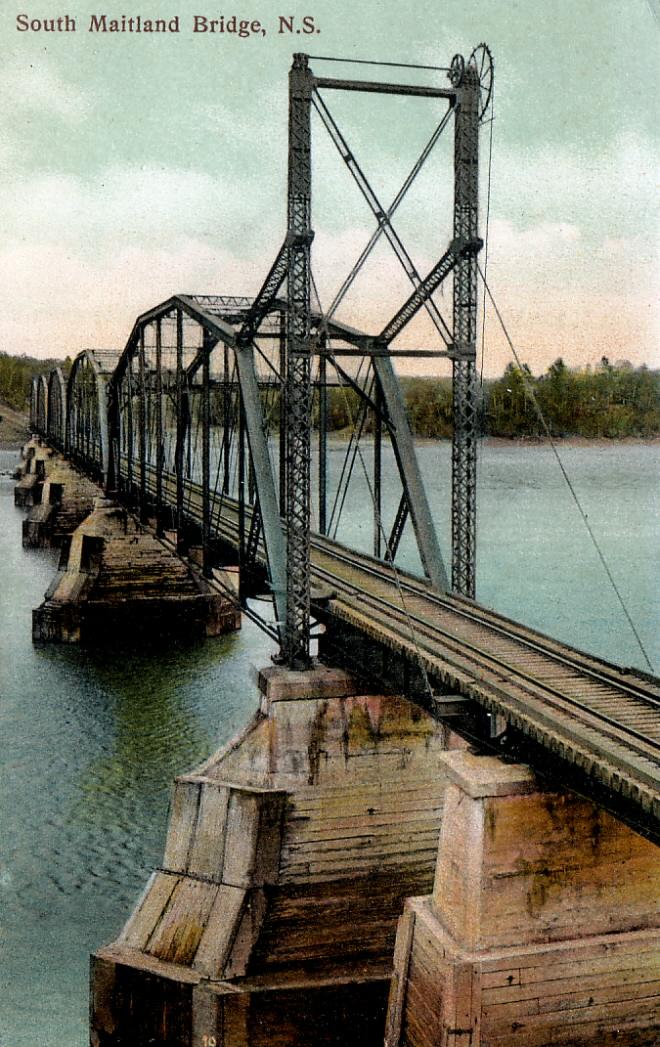
Midland Railway bridge across the Shubenacadie River at South Maitland,
Nova Scotia. This bridge straddled the boundary between
Colchester County (far end) and Hants County (near end).
This postcard was postmarked at Truro in July 1910.
Truro's Railway Debt
In December 1931, the Town of Truro retired Bonds of $30,000 issued (probably in December 1901) to provide a subsidy to the Midland Railway for construction of the railway line from Truro to Windsor.
[This Week in History, 75 Years Ago in the Hants Journal, 7 December 2006]
The term "retired," as used here, is jargon meaning the bonds have been paid in full.
Milton Railroad Company
Queens County
NSL 1856 chapter 72 — Act to incorporate the Milton Railroad Co.
Milton Tramway Company
Queens County
NSL 1872 chapter 64 — Act to incorporate the Milton Tramway Co.
Minudie Coal Railway Company Limited
NSL 1902 chapter 140 —
NSL 1903 chapter 190 — Act to incorporate the Minudie Coal Railway Co. Ltd.
Minudie Mining & Transportation Company Limited
NSL 1873 chapter 55 — Act to incorporate the Minudie Mining & Transportation Co. Ltd.
Minudie Railway Company Limited
NSL 1887 chapter 63 — Act to incorporate the Minudie Railway Co. Ltd.
NSL 1888 chapter 80 — Amendment to extend time
DOM 1887 chapter 24 —
DOM 1889 chapter 3 —
DOM 1894 chapter 4 —
DOM 1903 chapter 57 —
See:
Amos Peck Seaman, the "Grindstone King" Minudie
http://ns1763.ca/cumberco/seamanmon.html
Missing Link Railway
DOM 1884 chapter 8 —
DOM 1887 chapter 25 —
DOM 1889 chapter 8 —
See: Western Counties Railway Co. Ltd.
Montreal & European Short Line Railway Company
DOM 1882 chapter 14 —
DOM 1882 chapter 73 —
DOM 1883 chapter 25 —
DOM 1883 chapter 77 —
DOM 1884 chapter 8 —
DOM 1884 chapter 55 —
DOM 1887 chapter 27 —
See: Consolidated European & North American Railway Co. Ltd.
See: European & North American Railway Co. Ltd.
See: Great American & European Short Line Railway Co.
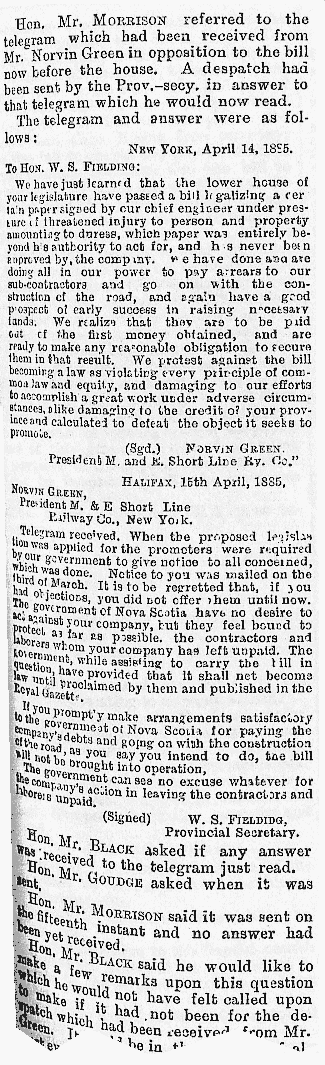
Legislative Council of Nova Scotia
Halifax, 17 April 1885
The following is quoted directly from the printed official transcript
of proceedings in the Legislative Council of Nova Scotia, Halifax, on 17 April 1885
Short Line Railway
The bill to confirm an indenture made between the Short Line Company and others was taken up:
Hon. Mr. Morrison referred to the telegram which had been received from Mr. Norvin Green in opposition to the bill now before the House. A despatch had been sent by the Provincial Secretary in answer to that telegram which he would now read.
The telegram and answer were as follows:
New York, April 14, 1885
To Hon. W.S. Fielding:
We have just learned that the lower house of your legislature have passed a bill legalizing a certain paper signed by our chief engineer under pressure of threatened injury to person and property amounting to duress, which paper was entirely beyond his authority to act for, and has never been approved by the company. We have done and are doing all in our power to pay arrears to our sub-contractors and go on with the construction of the road, and again have a good prospect of early success in raising necessary funds. We realize that they are to be paid out of the first money obtained, and are ready to make any reasonable obligation to secure them in that result. We protest against the bill becoming a law as violating every principle of common law and equity, and damaging to our efforts to accomplish a great work under adverse circumstances, alike damaging to the credit of your province and calculated to defeat the object it seeks to promote.
(signed) Norvin Green
President M. and E. Short Line Ry. Co.
Norvin Green
President M. and E. Short Line
Railway Co., New York
Telegram received. When the proposed legislation was applied for the promoters were required by our government to give notice to all concerned, which was done. Notice to you was mailed on the third of March. It is to be regretted that, if you had objections, you did not offer them until now. The government of Nova Scotia have no desire to act against your company, but they feel bound to protect as far as possible, the contractors and laborers whom your company has left unpaid. The government, while assisting to carry the bill in question, have provided that it shall not become law until proclaimed by them and published in the Royal Gazette.
If you promptly make arrangements satisfactory to the government of Nova Scotia for paying the company's debts and going on with the construction of the road, as you say you intend to do, the bill will not be brought into operation.
The government can see no excuse whatever for the company's action in leaving the contractors and laborers unpaid.
(signed) W.S. Fielding
Provincial Secretary
Hon. Mr. Black asked if any answer was received to the telegram just read.
Hon. Mr. Goudge asked when it was sent.
Hon. Mr. Morrison said it was sent on the fifteenth instant [April 15th] and no answer had been yet received.
Hon. Mr. Black said he would like to make a few remarks upon this question which he would not have felt called upon to make if it had not been for the despatch [telegram] which had been received from Mr. Green. It would be in the memory of almost every hon. gentleman in this chamber that this company [the Montreal and European Short Line Railway Company, of New York] had started with great promises and that in 1883, in July, it ceased operations all at once and left a large sum of money due to its creditors and that since that there had been a great many efforts made to induce the company to pay those laborers, all of which had been abortive.
Now during the winter quite a number of senators and members of the house of commons [of the Nova Scotia Legislature] had made an offer to this company, which the company promised to carry out, but which they had not done. The last of the despatches which came from Mr. Norvin Green stated that he, on his return to Boston, found that he had misunderstood the former telegrams and that the company would make the required deposit in ten days.
Now, that time had expired and the money was not forthcoming, the laborers remain unpaid and he thought it was a very strange thing that a company representing what was generally supposed to be a large amount of property and great wealth should be in the position of leaving its laborers unpaid for months and years, promising to deposit the money and promising time and again that the laborers should be paid but never performing their promises.
This despatch which was now before the house was a most extraordinary document to come from a company contemplating the erection of a long and extensive line of railway, to say that this agreement, this mortgage or whatever it was that was given, was signed under duress.
He must confess that to his mind this seemed to be a deliberate falsehood. He did not believe that the gentleman who signed that document was ever threatened in his person.
He was well aware that while the counties of Pictou, Colchester and Cumberland were all sufferers, he believed that the largest amount of sufferers on this account existed in the county [Cumberland] from which he had the honor to come. He knew that the laborers to a large extent had been left unpaid and that there was not only a great deal of hardship, annoyance and loss, but in some instances, bankruptcy, because this wretched company had failed time and again to fulfil its promises and pay their laborers their hard earned wages.
To show that this claim of duress was untrue he would refer hon. members to a letter written by this same Mr. Snow [the railway company's chief engineer] on the 12th March, the purport of which was that the agreement of security had been made in justice to the contractors. Now this was what this very Mr. Snow had written on the 12th March with reference to the way in which that paper was signed, and here was what Mr. Norvin Green, the president of the company said, in striving to get rid of this paper, that it was "under pressure of threatened injury to person and property amounting to duress."
He thought that a company which had cheated its workmen in the way in which this company had done and then sent a telegram of this kind to the president of this council in order to arrest the legislation by which the creditors would get their pay was an exceedingly cheeky thing. He did not think this legislature should listen for one moment to such an appeal, and he must say this, that he was very much pleased indeed with the way in which the government had carried on this legislation.
The best lawyers had given an opinion upon this matter that the Nova Scotia parliament could make legal that document, and that also the Dominion government by this act could get a legal claim on the line of rails and to enable them both to pay the arrears due the creditors and to get hold of the property and either construct the line themselves or give it to some other company.
He maintained that in doing as they had done the government did everything that any of the sufferers could want, and coming from the county which was suffering from the act of this company he would repeat that he was very much pleased indeed with the government for doing what they did in this matter, and he did not see how the government could do anything more.
He hoped that operation of this bill would result in the payment of the laborers who had been robbed by this company who were now whining under the legislation which had for its object the payment of the debts, out of which they had attempted to cheat their poor laborers.
Hon. Mr. Morrison said that he was not ready to charge Mr. Norvin Green with having stated anything in the despatch but what had been possibly stated to him by his engineer. He thought that Norvin Green and his company had censured the engineer for having made this transfer and had said that he had done that which he had no right to do, being employed simply as an engineer for the company and that the engineer had excused himself by saying that he was under duress.
He thought that this was the way in which Mr. Green had acted, but this did not excuse the company for not having made an arrangement to pay the laborers of the province of Nova Scotia and the way in which this bill came before the house was this: The parties who got this transfer from Snow had applied to the Dominion government wanting them to to take the road and pay the money to the laborers. The Dominion government had said, we cannot take the road; you have not got a legal title to that road and the only party who can give you a legal title to the road under the agreement is the provincial legislature of Nova Scotia.
So they had come here and the government had said we will do all we can consistently to assist you in getting your money off that road. The best constitutional authority in this country had said that this legislature had the power to make that document valid which was invalid for want of the president's signature and the seal of the company, but it was feared that Norvin Green and his company might bring an action against the province of Nova Scotia.
If the province had not the right to make a legal document — they were then prepared to give all the legislation on that point that the province of Nova Scotia had the power to give, provided that the Dominion government before giving a subsidy to the road would guarantee to keep this province of Nova Scotia harmless if it should be attacked by Green and his company.
Therefore it was that they had held the act in abeyance until they had got a guarantee from the Dominion government and had given Mr. Norvin Green and his company two weeks to make preparations to pay the laborers. He could assure the men that the government recognized their claim to the strongest sympathy in view of the position in which they were placed and whatever Mr. Norvin Green might think about the matter the government thought that, so far as they had the power, they should protect their own people.
Hon. Dr. Parker said his hon. friend from Cumberland seemed to think that Mr. Norvin Green and his company were just now [offensive remark deleted] and that they required not only close supervision but prompt action. He hoped the government would act with energy and not procrastinate too long. It was really a crying disgrace to the company and he thought the province itself was to blame in the matter. He only hoped that the suggestion would be acted upon and that the government would with promptness deal with the matter and bring it to a speedy conclusion.
Hon. Mr. Morrison said that the government, while anxious to help the parties who had just claims upon the road, did not want to run the province into unnecessary expenditure. They wanted to protect the interests of the province as well as those of the laborers. He thought they were perfectly justified in what they had done looking to the interests of the province.
The bill passed.
End of quotation from the printed official transcript
of proceedings in the Legislative Council of Nova Scotia
Source: Pages 80-82 of the 1885 section, in:
Debates and Proceedings of the Legislative Council of Nova Scotia, 1883-90
Nova Scotia Legislative Council
The above discussion took place in the Legislative Council, the upper house of Nova Scotia's bicameral Legislature. It was sometimes called the Provincial Senate; in fact, in the
above excerpt Hiram Black speaks of "senators and members of the house of commons" meaning members of Nova Scotia's government, the "senators" being officially known as members of the Legislative Council, and the "members of the house of commons" being the MLAs or Members of the Legislative Assembly. The members of the Legislative Council were appointed by the Premier of Nova Scotia, not elected by the citizens (the same system as that which continues in Ottawa today (2012), in which the Members of the federal Senate are appointed by the Prime Minister, not elected). On 31 May 1928, the Nova Scotia Legislative Council voted itself out of existence.
|
Norvin Green
Green, Norvin, 1818-1893: Physician, Kentucky state legislator, and business executive. During his career Green held many offices, including commissioner of public schools for Henry County, Kentucky; president of the New York, Mahoning and Western Railroad Co.; president of the Montreal and European Short Line Railway Co.; president of the United Claims Mining Co.; president of the Western Union Telegraph Company — then the wealthiest and most powerful telecommunications company in North America (maybe in the world) — and U.S. Consul General to Japan. On 13 May 1884 the American Institute of Electrical Engineers (AIEE, now the IEEE) was founded with Norvin Green, president of Western Union, as the first president, with six vice-presidents — Alexander Graham Bell, Charles D. Cross, Thomas A. Edison, George A. Hamilton, Charles H. Haskins, and Franklin L. Pope. Green exchanged correspondence with many prominent and influential people, including C.C. Baldwin, James G. Blaine, John G. Carlisle, Thomas A. Edison, Cyrus W. Field, Jay Gould, Abram S. Hewitt, H.H. Honore, Collis P. Huntington, Lazarus W. Powell, Hiram Sibley, Joshua F. Speed, John W. Stevenson, William H. Vanderbilt, and James B. Wilder.
Sources:
http://www.ieee.org/organizations/history_center/historical_articles/history_of_ieee.html
http://www.histech.rwth-aachen.de/www/quellen/Histcomp/50th/May.html
http://www.filsonhistorical.org/guide3.html
|
Nova Scotia Legislative Council
(Members connected with this discussion of the affairs of the
Montreal and European Short Line Railway Company)
J. Hiram Black, (1837-1897); born 9 October 1837 at
Amherst, Nova Scotia; J.P. 1864-1897; Member of the Legislative Assembly for Cumberland County, 1874-1878; Legislative Council, 1879-1897; died 19 October 1897 at Amherst.
William Stevens Fielding, (1848-1929); journalist; born 24 November 1848 at Halifax; journalist, later menaging editor of the Halifax Chronicle, 1864-1884; Member of the Legislative Assembly for Halifax County, 1882-1896; Minister without portfolio, Dec. 1882 to May 1884; Premier and Provincial Secretary, July 1884 to July 1896; resigned from the Legislature and elected to House of Commons in Aug. 1896 for Shelburne-Queens; re-elected 1900 and 1904; unseated on petition Aug. 1906; re-elected in by-election Oct. 1906; re-elected in general election, 1908 and 1917; re-elected in by-election, 1922 and 1925; sworn in as Member of the Privy Council (federal cabinet) July 1896; federal Minister of Finance and Receiver General July 1896 - Oct. 1911 and Dec. 1921 to Sep. 1925; appointed Member of the U.K. Privy Council June 1923; died 23 June 1929 at Ottawa.
Monson Hoyt Goudge, (1829-1920); commission merchant and auctioneer in Windsor, Nova Scotia; born in Windsor, 22 October 1829; represented Windsor district in the federal House of Commons, 1873-1878; appointed to the Legislative Council of Nova Scotia in 1884; became president of the Legislative Council in 1903; died 1 March 1920.
Thomas Fletcher Morrison, (1808-1886); master mariner, farmer; born 22 February 1808 at Londonderry, Nova Scotia; Member of the Legislative Assembly (the last) for Londonderry Township 1855-1859; MLA for Colchester County, North Division, 1860-1863; MLA for Colchester County, 1867-1874; Legislative Council, Jan. 1876-1886; Executive Council (cabinet) Aug. 1882-1886; died 23 July 1886 at Folly Village, Colchester County.
Daniel McNeill Parker, M.D. (1822-1898), medical doctor; born 1822 at Windsor, Nova Scotia; studied medicine with Sir James Y. Simpson (1811-1870) of Edinburgh, discover of chloroform; practiced in Halifax; member of the Legislative Council, January 1868 to 1898.
Sources:
• The Legislative Assembly of Nova Scotia 1758-1983: A Biographical Directory, edited and revised by Shirley B. Elliott, 1984, ISBN 088871050X. This volume was prepared as a contribution of the Public Archives of Nova Scotia to the celebration of the bicentenary of the establishment of representative government in Canada.
• Windsor, Nova Scotia: A Journey in History, by Leslie Sinclair Loomer, West Hants Historical Society, 1996, ISBN 0968064108.
|
S
Musquodoboit Railway Company Limited
NSL 1898 chapter 126 — Act to incorporate the Musquodoboit Railway Co. Ltd.
NSL 1901 chapter 130 — Act to incorporate the Nova Scotia Eastern Railway Co. Ltd.
NSL 1901 chapter 131 — Act to revive the incorporation of Musquodoboit Railway Co. Ltd.
NSL 1902 chapter 136 — Act to amalgamate Musquodoboit Railway Co. Ltd. with Nova Scotia Eastern Railway Co. Ltd.
NSL 1903 chapter 213 — Amendment
NSL 1904 chapter 138 — Amendment
NSL 1905 chapter 129 — Amendment
See: Nova Scotia Eastern Railway Co. Ltd.
Musquodoboit Railway
Musquodoboit Railway
aka: Dartmouth to Deans Branch of the Canadian Government Railways
aka: Dartmouth Branch Extension of the Intercolonial Railway
Deadline for Tenders for Construction of
Musquodoboit Railway
15 September 1911
Department of Railways and Canals
Branch line of Railway from Dartmouth to Deans
Sealed Tenders addressed to the undersigned and endorsed "Tender for Branch Line, Dartmouth to Deans" will be received at this office until sixteen o'clock, on Friday, September 15th, 1911.
Plans, profiles, specifications and form of contract to be entered into can be seen on and after the 15th instant [August 15, 1911] at the office of the Chief Engineer of the Department of Railways and Canals, Ottawa; at the office of the Chief Engineer of the Intercolonial Railway, Moncton; and at the office of the Board of Trade, Halifax. Forms of tender may be procured from the Chief Engineer of the Department of Railways and Canals, or from the Chief Engineer of the Intercolonial Railway.
Parties tendering will be required to accept the fair wages schedule prepared or to be prepared by the Department of Labor, which schedule will form part of the contract.
Contractors are requested to bear in mind that tenders will not be considered unless made strictly in accordance with the printed forms, and in the case of firms, unless there are attached the actual signature, the nature of the occupation, and the place of residence of each member of the firm.
An accepted [certified] bank cheque for the sum of $150,000, made payable to the order of the Minister of Railways and Canals must accompany each tender, which sum will be forfeited if the party tendering declines entering into contract for the work, at the rates stated in the offer submitted. The cheque thus sent in will be returned to the respective contractors whose tenders are not accepted. The cheque of the successful tenderer will be held as security, or part security, for the due fulfilment of the contract to be entered into.
The lowest or any tender not necessarily accepted.
By order, L.K. Jones, Secretary
Department of Railways and Canals, Ottawa
[Halifax Morning Chronicle, 14 August 1911]
Tenders Accepted for Construction of
Guysboro Railway
and
Musquodoboit Railway
On October 5th, 1911, an announcement appeared in the two daily Halifax newspapers, as follows:
An Order-in-Council has been passed awarding the contracts for the extensions of the Intercolonial Railway in Nova Scotia for which money was unanimously voted by Parliament last June, and for which the tenders were received over a month ago. The lowest tenderer in each case is awarded the contract. The branch from Dartmouth to Deans will be built by M.P. Davis, and the Guysboro County line will be built by the Nova Scotia Construction Company. The Government in awarding the contracts have simply complied with the mandate of Parliament and have followed the usual procedure in concurring in the recommendation of the Departmental Engineers as to the lowest figures submitted by the various firms tendering.
[Halifax Morning Chronicle, 5 October 1911]
[Halifax Herald, 5 October 1911]
|
The Dartmouth to Deans railway was built as planned, and
was officially opened for regular operation on 1 January 1916.
This railway line was legally named the Dartmouth Branch
Extension of the Intercolonial Railway, but is usually known
as the Musquodoboit Railway. It ran 69.3 miles 111.6 km
from Dartmouth, through Eastern Passage, Lawrencetown,
Three-Fathom Harbour, Seaforth, West Chezzetcook,
Head of Chezzetcook, East Chezzetcook, Meagher Grant,
and Middle Musquodoboit, to Upper Musquodoboit.
It continued to carry trains until 1982.
|
Musquodoboit Railway
The Musquodoboit Railway, officially known as the Dartmouth Subdivision, between Caldwell Road (mile 20.50) and Upper Musquodoboit (mile 81.87) was officially authorized abandoned on 28 August 1983 by Board Order R-32623. In October 1991 this abandoned section was sold "en bloc" to the Province of Nova Scotia for $107,750 based on an area of 735 acres at the overall rate of $146.50 per acre.
New France Railroad
Digby County
See: Weymouth & New France Railroad
New Glasgow Electric Company Limited
Pictou County: New Glasgow, Stellarton, Trenton
NSL 1889 chapter 129 — Amend the Act to incorporate the New Glasgow Electric Co. Ltd.
See: Historical Notes about the New Glasgow Electric Co. Ltd.
http://ns1758.ca/electric/electricpwr06.html

Chapter 129, Acts of 1889
Passed the 17th day of April, 1889
§23 (The New Glasgow Electric Company) shall have the
exclusive right and privilege of constructing, maintaining,
and operating a line or lines of street railway, with all the
necessary side tracks, switches, and turnouts, and all other
appliances for the passage of cars, carriages, or other
vehicles upon and along the streets of New Glasgow town,
and of the towns of Stellarton and Trenton, and between
any point in the one to any point in the other of the
said towns for the period of eight years from the coming
into force of this Act...
§26 The cars shall be drawn or propelled by horses, or
electricity, or any other motive power approved by the
directors of the company...
|
New Glasgow Iron, Coal & Railway Company Limited
Pictou County: Eureka - Sunny Brae
NSL 1888 chapter 126 — Act to incorporate the New Glasgow Iron, Coal & Railway Co. Ltd.
NSL 1891 chapter 176 — Amendment, grant from Pictou County
NSL 1892 chapter 174 — Amendment, issue of Preference Shares
NSL 1895 chapter 123 — Act to confirm the sale of the property of NGIC&R to the Nova Scotia Steel Co. Ltd.
See: Nova Scotia Steel Co. Ltd.
The following is excerpted from Appendix No. 7 in the
Journals of the Legislative Council of Nova Scotia, 1893
The New Glasgow Iron, Coal & Railway Company's line —
Eureka to Sunny Brae in Pictou County, 13 miles 21 km, 12½ miles 20 km of which is said to be completed, leaves the New Glasgow Branch of the Intercolonial Railway at Ferrona Junction, crosses the West Branch of the East River to Ferrona, where the smelting works of the company are located, and runs up the Valley of the East Branch to Sunny Brae. The first 10½ miles 17 km was opened for traffic to the public on July 1st, 1892, and the remainder has been in operation since November, 1892.
The company applied for payment of subsidy according to contract with the Provincial Government — (See Appendix No. 17, page 15, Journals of the Legislative Council of Nova Scotia, 1891), the conditions being: —
(a) "They shall have completed, equipped and put in operation the said line of railway."
(b) "They shall have paid, or cause to be paid, the wages due to the workmen employed, and all charges for materials supplied for the construction of the said railway."
(c) "They shall have constructed, completed and put in operation at some place within the County of Pictou, a blast furnace for the smelting of iron ores."
(d) "They shall have established to the satisfaction of the Governor-in-Council, that they have bona fide expended in cash in the construction of said railway and blast furnace a sum of $400,000."
All these conditions the company claims to have fulfilled, and to have carried them into effect before the time stipulated for completion, the 31st day of December, 1892, and further, that they have constructed the line of railway in accordance with the specification and all other conditions of contract.
On 30th day of December, 1892, I received formal instructions to examine the contract, to inspect the works, and to report accordingly. Since that time an inspection could not be made with any degree of reliability owing to the covering of snow that concealed and prevented all surface examination; as soon as the ground is clear it will receive immediate attention.
(signed) Martin Murphy,
Provincial Engineer
Source:
Appendix No. 7, pages 8-9
Journals of the Legislative Council of Nova Scotia, 1893
End of excerpt from Appendix No. 7
Journals of the Legislative Council of Nova Scotia, 1893
New Glasgow to Strait of Canso Railway
NSL 1872 chapter 17 —
NSL 1874 chapter 12 —
NSL 1875 chapter 21 —
NSL 1876 chapter 3 —
NSL 1876 chapter 4 —
NSL 1878 chapter 32 —
NSL 1879 chapter 66 —
See: Eastern Extension Railway
New York & Nova Scotia Iron & Railway Company Limited
NSL 1888 chapter 131 — Act to incorporate the New York & Nova Scotia Iron & Railway Co. Ltd.
NSL 1889 chapter 119 — Act to change name to Nova Scotia Midland Railway & Iron Co. Ltd.
See: Nova Scotia Midland Railway & Iron Co. Ltd.
Nictaux & Atlantic Railway Company Limited
Historical notes http://ns1758.ca/rail/railway02.html#niatry
NSL 1873 chapter 40 — Act to incorporate the Nictaux & Atlantic Railway Co. Ltd.
NSL 1875 chapter 70 — Act to change name to Nova Scotia, Nictaux & Atlantic Central Railway
NSL 1886 chapter 1 — Act to provide for completion and consolidation of Railways between Halifax and Yarmouth
See: Nova Scotia, Nictaux & Atlantic Central Railway Co. Ltd.
See: Nova Scotia Central Railway Co. Ltd.
See: Halifax & South Western Railway Co. Ltd.
North Colchester Railway Company Limited
NSL 1890 chapter 64 — Act to incorporate the North Colchester Railway Co. Ltd. to build a railway from Brule or Tatamagouche (on the Northumberland Strait) to Truro
NSL 1903 chapter 121 — Empower the Municipality of Colchester to pay for right of way
NSL 1905 chapter 130 — Authorizes the Dominion Atlantic Railway to build between Truro and the Northumberland Strait
North Mountain Railway Company Limited
Kings County
Historical notes http://ns1758.ca/rail/railway15.html
NSL 1902 chapter 130 — Act to incorporate the North Mountain Railway Co. Ltd.
NSL 1904 chapter 137 — Amendment
NSL 1906 chapter 163 — Amendment
NSL 1908 chapter 132 — Act respecting Kings Municipality and the North Mountain Railway Co. Ltd.
NSL 1908 chapter 133 — Amendment

Blueprint (partial): North Mountain Railway, April 1912
North Sydney Branch Railway
NSL 1888 chapter 88 — Act respecting the Right of Way, Station Grounds, and Terminal facilities for the North Sydney Branch Railway
See: Intercolonial Railway Co.
North Sydney Coal & Railway Company Limited
NSL 1890 chapter 169 — Act to incorporate the North Sydney Coal & Railway Co. Ltd.
North Sydney Mining & Transportation Company Limited
NSL 1895 chapter 111 — Act to incorporate the North Sydney Mining & Transportation Co. Ltd.
Nova Scotia Car Works Limited
Halifax
Historical notes http://ns1758.ca/rail/railway14.html
NSL 1911 chapter 41 — Act to authorize the City of Halifax to assist Nova Scotia Car Works Ltd.
See: Silliker Car Co. Ltd.
Nova Scotia Central Railway Company Limited NSCR
Historical notes about the Nova Scotia Central Railway Co.
http://ns1758.ca/rail/railway02.html#nscenr
NSL 1873 chapter 40 — Act to incorporate the Nictaux & Atlantic Railway Co. Ltd.
NSL 1875 chapter 70 — Act to change name to Nova Scotia, Nictaux & Atlantic Central Railway Co. Ltd.
NSL 1886 chapter 17 — Act to change name to Nova Scotia Central Railway Co. Ltd.
NSL 1887 chapter 3 — Amendment
NSL 1888 chapter 77 — Amendment
NSL 1889 chapter 79 — Amendment
NSL 1889 chapter 80 — Act respecting depot grounds of NSCR at Bridgewater
NSL 1889 chapter 81 — Act to empower NSCR extension to Margaretville
NSL 1890 chapter 65 — Amendment
NSL 1890 chapter 66 — Amendment
NSL 1890 chapter 67 — Amendment
NSL 1891 chapter 67 — Amendment
NSL 1891 chapter 93 — Act respecting payment of balance of subsidy to NSCR
NSL 1892 chapter 114 — Act to appoint Commissioners to hear appeals re land damages
NSL 1892 chapter 115 — Amendment
NSL 1893 chapter 47 — Amendment
NSL 1893 chapter 116 — Act to authorize a highway from the Mahone Bay station
See: Nictaux & Atlantic Railway Co. Ltd.
See: Nova Scotia, Nictaux & Atlantic Central Railway Co. Ltd.
See: Halifax & South Western Railway Co. Ltd.
See: Mackenzie, Mann & Company
Nova Scotia Coal-field Iron-works, & Railway Company Limited
NSL 1873 chapter 47 — Act to incorporate the Nova Scotia Coal-field Iron-works, & Railway Co. Ltd.
Nova Scotia Coal, Iron, Copper & Railway Company Limited
NSL 1900 chapter 117 — Act to incorporate the Nova Scotia Coal, Iron, Copper & Railway Co. Ltd.
NSL 1902 chapter 191 — Act to amend chapter 117 of 1900
Nova Scotia Coal & Railway Company Limited
NSL 1889 chapter 115 — Act to incorporate the Nova Scotia Coal & Railway Co. Ltd.
NSL 1892 chapter 179 — Amendment
Nova Scotia Cotton Manufacturing Company Limited
NSL 1882 chapter 69 — Act to incorporate the Nova Scotia Cotton Manufacturing Co. Ltd.
NSL 1884 chapter 30 — Act to confirm location of Railway Siding from Richmond to NSCMCo.
NSL 1885 chapter 50 — Act to enable Halifax City to carry out an agreement with NSCMCo.
DOM 1888 chapter 3 —
See: Halifax Cotton Manufacturing Co. Ltd.
Cotton Factory Siding Petition
Nova Scotia Legislative Council
April 1885
The following is the petition relating to the Cotton Factory Siding:
Source: Appendix, on page 104 of the 1885 section, in:
Debates and Proceedings of the Legislative Council of Nova Scotia, 1883-90
Nova Scotia Development Company Limited
NSL 1898 chapter 156 — Act to incorporate the Louisburg Mining & Transportation Co. Ltd.
NSL 1899 chapter 138 — Change name to Nova Scotia Mining & Development Co. Ltd.
NSL 1902 chapter 185 — Change name to Nova Scotia Development Co. Ltd.
See: Louisburg Mining & Transportation Co. Ltd.
See: Nova Scotia Mining & Development Co. Ltd.
Nova Scotia Eastern Railway Company Limited
NSL 1901 chapter 130 — Act to incorporate the Nova Scotia Eastern Railway Co. Ltd.
NSL 1902 chapter 59 — Act to authorize Halifax Municipality to borrow money to assist Nova Scotia Eastern Railway Co. Ltd.
NSL 1902 chapter 136 — Act to amalgamate Musquodoboit Railway Co. Ltd. with Nova Scotia Eastern Railway Co. Ltd.
NSL 1903 chapter 1 — Act to confirm contract between Nova Scotia Eastern Railway Co. Ltd. and Government of Nova Scotia
NSL 1903 chapter 213 — Amendment
NSL 1904 chapter 138 — Amendment
NSL 1905 chapter 129 — Amendment
See: Canadian Government Railways
See: Dartmouth to Deans Railway
See: Halifax & Eastern Railway Co.
See: Halifax & Guysborough Railway Co. Ltd.
See: Musquodoboit Railway Co. Ltd.
Nova Scotia Iron & Coal Company Limited
NSL 1893 chapter 148 — Act to incorporate the Nova Scotia Iron & Coal Co. Ltd.
NSL 1895 chapter 136 — Amendment
NSL 1898 chapter 161 — Amendment
Nova Scotia Iron Company Limited
NSL 1890 chapter 132 — Act to incorporate the Nova Scotia Steel & Iron Co. Ltd.
NSL 1891 chapter 175 — Change name to Nova Scotia Iron Co. Ltd.
See: Nova Scotia Steel & Iron Co. Ltd.
Nova Scotia Iron & Steel Company Limited
NSL 1898 chapter 80 —
NSL 1898 chapter 137 — Act to incorporate the Nova Scotia Iron & Steel Co. Ltd.
NSL 1900 chapter 72 — Act to authorize the Town of North Sydney to expropriate land to provide a location for the Nova Scotia Iron & Steel Co. Ltd.
NSL 1900 chapter 172 —
See: Nova Scotia Steel & Iron Co. Ltd.
Nova Scotia Midland Railway & Iron Company Limited
NSL 1888 chapter 131 — Act to incorporate the New York & Nova Scotia Iron & Railway Co. Ltd.
NSL 1889 chapter 119 — Act to change name to Nova Scotia Midland Railway & Iron Co. Ltd.
NSL 1892 chapter 185 — Amendments
See: New York & Nova Scotia Iron & Railway Co. Ltd.
Nova Scotia Mining & Development Company Limited
NSL 1898 chapter 156 — Act to incorporate the Louisburg Mining & Transportation Co. Ltd.
NSL 1899 chapter 138 — Change name to Nova Scotia Mining & Development Co. Ltd.
NSL 1900 chapter 170 — Amend, time limited, authorization to increase Capital Stock
NSL 1902 chapter 185 — Change name to Nova Scotia Development Co. Ltd.
See: Louisburg Mining & Transportation Co. Ltd.
See: Nova Scotia Development Co. Ltd.
Nova Scotia Mining, Mineral & Transportation Company Limited
NSL 1890 chapter 133 — Act to incorporate the Nova Scotia Mining, Mineral & Transportation Co. Ltd.
NSL 1891 chapter 132 — Act to incorporate anew the Nova Scotia Mining, Mineral & Transportation Co. Ltd.
Nova Scotia & New Brunswick (Intercolonial) Railway Co. Ltd.
This company, "incorporated under the laws of England", owned the railway between Moncton and Amherst – often known as the "Eastern Extension Railway" – during the time of its construction, August 1865 to January 1870.
See: Intercolonial Railway Co. Ltd.
Nova Scotia, Nictaux & Atlantic Central Railway Company Limited
Historical notes http://ns1758.ca/rail/railway02.html#nsnacr
NSL 1873 chapter 40 — Act to incorporate the Nictaux & Atlantic Railway Co. Ltd.
NSL 1875 chapter 70 — Act to change name to Nova Scotia, Nictaux & Atlantic Central Railway Co. Ltd.
NSL 1877 chapter 27 — Amendment, extension from Bridgewater to Lunenburg
NSL 1879 chapter 67 — Amendment
NSL 1878 chapter 23 — Amendment
NSL 1882 chapter 20 — Act for the Consolidation of Nova Scotia Railways
NSL 1882 chapter 22 — Amendment
NSL 1883 chapter 19 — Act to Authorize a Provincial Loan, section 1b
NSL 1884 chapter 3 — Act to Authorize a Provincial Loan, section 2a
NSL 1884 chapter 6 — Amendment
NSL 1885 chapter 38 — Amendment
NSL 1886 chapter 17 — Act to change name to Nova Scotia Central Railway Co. Ltd.
See: Nictaux & Atlantic Railway Co. Ltd.
See: Nova Scotia Central Railway Co. Ltd.
See: Halifax & South Western Railway Co. Ltd.
Nova Scotia Northern Railway Company Limited
NSL 1902 chapter 133 — Act to incorporate the Nova Scotia Northern Railway Co. Ltd.
NSL 1904 chapter 139 — Amendment
NSL 1905 chapter 133 — Amendment
Nova Scotia Railway Company (incorporated 1853, reincorporated 1880)
Nova Scotia Railway Company Limited (incorporated 1880, sold 1884)
NSL 1853 chapter 1 — Act to incorporate the Nova Scotia Railway Co.
NSL 1853 chapter 2 — Act to authorize the construction of certain railways
NSL 1853 chapter 3 — Act to authorize a Loan for the construction of certain Public Works
NSL 1880 chapter 69 — Act to incorporate the Nova Scotia Railway Company Limited
NSL 1882 chapter 20 — Act for the consolidation of the Nova Scotia Railways
NSL 1884 chapter 1 — Act to authorize the Transfer of certain Railways and Property to the Government of Canada
NSL 1886 chapter 1 — Act to provide for completion and consolidation of Railways between Halifax and Yarmouth
Nova Scotia Railway Wikipedia

Nova Scotia Railway advertisement
Source: McAlpine's Nova Scotia Directory for 1868-69
Avard Longley (1823-1884)
Large view of both pages
“...the lands so taken shall not be less than four rods
nor more than six rods in breadth for the track...”
For many centuries, continuing into the 1970s, the
rod was a standard measure of length or distance.
It was/is legally defined as being equal to 16½ feet.
Four rods = 66 feet = 20.12 metres
Six rods = 99 feet = 30.18 metres


Nova Scotia Railway Syndicate
The Joint Stock Association Limited
NSL 1882 chapter 20 — Act For the Consolidation of the Nova Scotia Railways
NSL 1886 chapter 1 — Railways Aid and Consolidation Act 1886 (Act to authorize certain grants in aid of railways, and provide for the completion and consolidation of the railways between Halifax and Yarmouth)
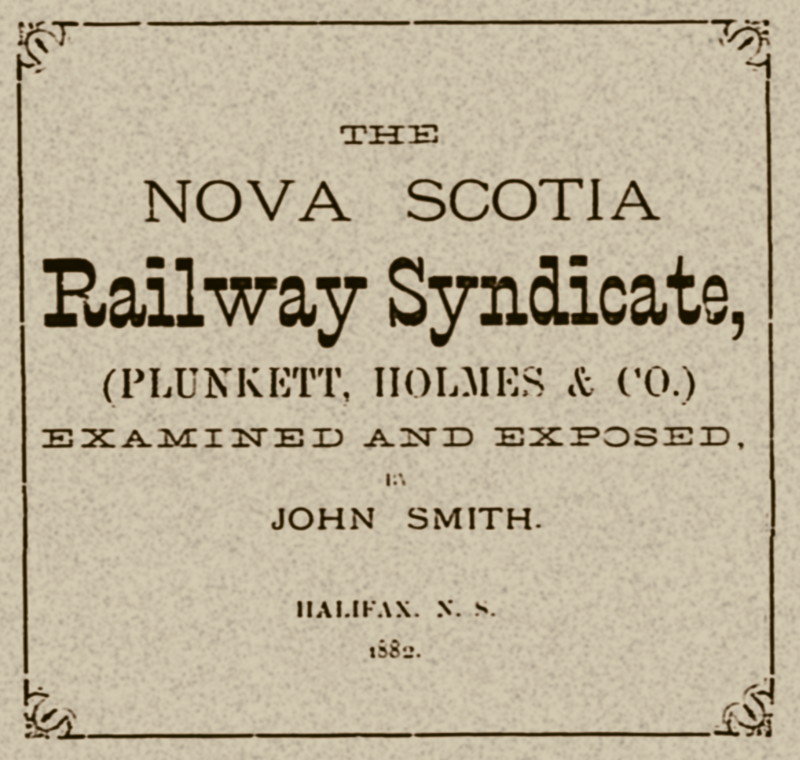

Also see:
The Nova Scotia Railway Syndicate
(Plunkett, Holmes & Co.) Examined and Exposed
Classic Reprint paperback, August 2012

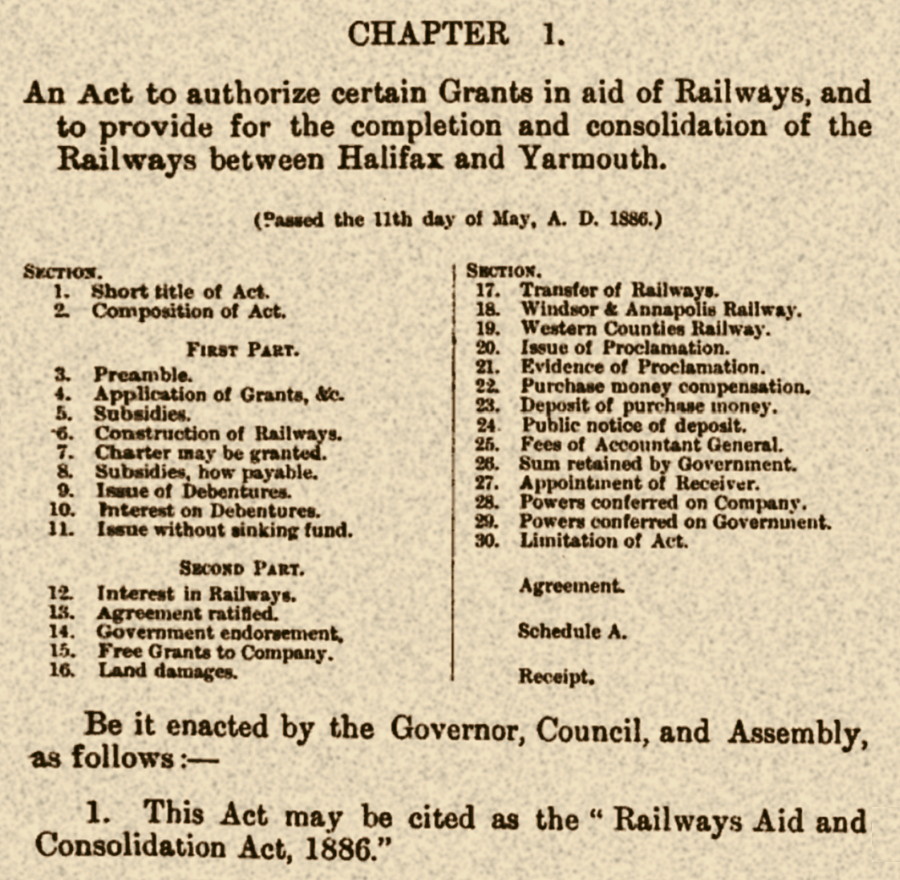
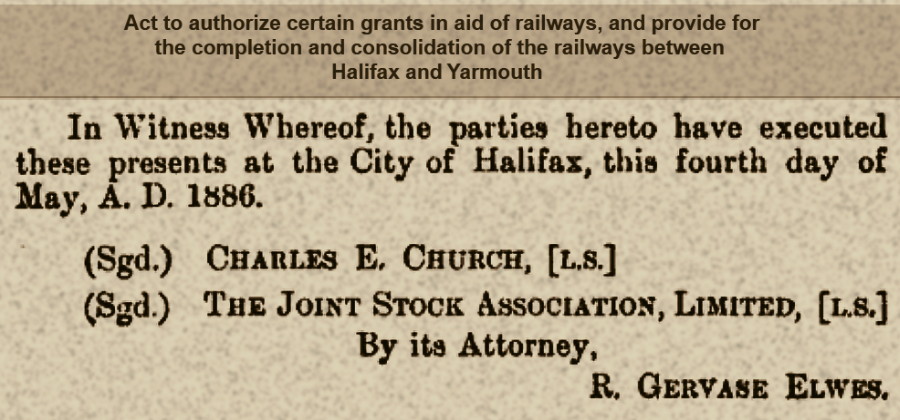
...By the 1850s the changed nature of the Society (Charitable Irish Society of Halifax), which was by then less conservative, could be seen clearly during the presidency of William Condon, at the height of the Crimean War. Irish Nova Scotians soon came to decry the hostilities publically...
The period of the 1850s boiled over into an unseemly, impassioned and nasty politico-religious struggle which pitted the “loyal” Protestant against the seemingly “disloyal” Catholic Irish. As if the Crimean War were not enough of an issue, that matter became meshed with the construction of the Nova Scotia Railway. Stabbings, lawlessness, strikes and the famous Gourly Shanty Riot were all a part of this violent period of our history. Needless to say, and almost unavoidably, the Charitable Irish Society, due to its growing Irish Catholic and less conservative nature, was at the centre of the controversy. The two chief opposing personalities were presidents of the Society – Condon and Howe.
Joseph Howe, in 1855, was Chief Commissioner of Railways for Nova Scotia. Under the guise of finding railway workers for Nova Scotia, he was also carrying on clandestine recruiting, in the United States, for the British army. His recruiting of men for the “N.S.R.” – which could mean either Nova Scotia Railway or Nova Scotia Regiment – caused William Condon, the president of the C.I.S. in 1855, to expose Howe's efforts for what they were. A vindictive struggle followed which would stain Howe's reputation, would contribute to the defeat of a government, and would have political consequences for a generation in Nova Scotia. The presidency of the Charitable Irish Society would never again be as political. In future, the Society would, in general, revert to the position reflected in its first sixty years, as that of a social, charitable and loyal institution...
Nova Scotia Southern Railway Company Limited
NSL 1888 chapter 82 — Act to incorporate the Annapolis & Atlantic Railway Co. Ltd.
NSL 1890 chapter 76 — Time extended
NSL 1891 chapter 128 — Time extended
NSL 1892 chapter 69 — Amendment, providing for extension of line to Halifax or Dartmouth
NSL 1893 chapter 65 — Change name to the Nova Scotia Southern Railway Co. Ltd.
NSL 1893 chapter 153 — Change of route
NSL 1894 chapter 76 — Act to reincorporate the Nova Scotia Southern Railway Co. Ltd.
NSL 1895 chapter 133 — Amendment
NSL 1897 chapter 88 — Amendment
NSL 1898 chapter 129 — Amendment
NSL 1899 chapter 134 — Amendment, providing for railway lines from Sand Point and Indian Gardens
NSL 1900 chapter 185 — Amendment, providing for a railway line from the Central Railway to Chester and Halifax, and extending time
NSL 1903 chapter 3 — To amend chapter 76 of 1894
NSL 1909 chapter 7 — Act respecting unfinished railway work, etc.
See: Annapolis & Atlantic Railway Co. Ltd.
Nova Scotia Steel & Coal Company Limited
NSL 1921 chapter 152 —
NSL 1928 chapter 142 —
Nova Scotia Steel Company Limited
NSL 1888 chapter 126 — Act to incorporate the New Glasgow Iron, Coal & Railway Co. Ltd.
NSL 1895 chapter 123 — Act to confirm the sale of the property of New Glasgow Iron, Coal & Railway Co. to the Nova Scotia Steel Co. Ltd.
NSL 1895 chapter 159 —
NSL 1896 chapter 92 —
NSL 1898 chapter 80 —
See: New Glasgow Iron, Coal & Railway Co. Ltd.
Nova Scotia Steel & Iron Company Limited
NSL 1890 chapter 132 — Act to incorporate the Nova Scotia Steel & Iron Co. Ltd.
NSL 1890 chapter 186 —
NSL 1891 chapter 175 — Change name to Nova Scotia Iron Co. Ltd.
See: Nova Scotia Iron Co. Ltd.
See: Nova Scotia Iron & Steel Co. Ltd.
Nova Scotia Tramways & Power Company Limited
NSL 1914 chapter 180 — Act to incorporate the Nova Scotia Tramways & Power Co. Ltd.
NSL 1915 chapter 104 — Amendment
NSL 1917 chapter 53 — Amendment
NSL 1917 chapter 183 — Amendment
NSL 1919 chapter 171 — Amendment
NSL 1920 chapter 203 — Amendment
NSL 1921 chapter 181 — Amendment
NSL 1928 chapter 144 — To amend Act of incorporation
NSL 1947 chapter 120 — To further amend Act of incorporation
See: Nova Scotia Light & Power Co. Ltd. (electric utility)
In 1928, Nova Scotia Tramways & Power Co. Ltd. changed its name to Nova Scotia Light & Power Co. Ltd.
Oxford Foundry & Machine Company Limited
NSL 1924 chapter 97 —
NSL 1973 chapter 100 —
Oxford and New Glasgow Railway
This railway's main line track ran from Oxford Junction in Cumberland County, through Oxford, Tatamagouche and Scotsburn to Brown's Point (near the town of Pictou) in Pictou County.
See: European & North American Railway Co. Ltd.
See: Great American & European Short Line Railway Co.
See: Montreal & European Short Line Railway Co.
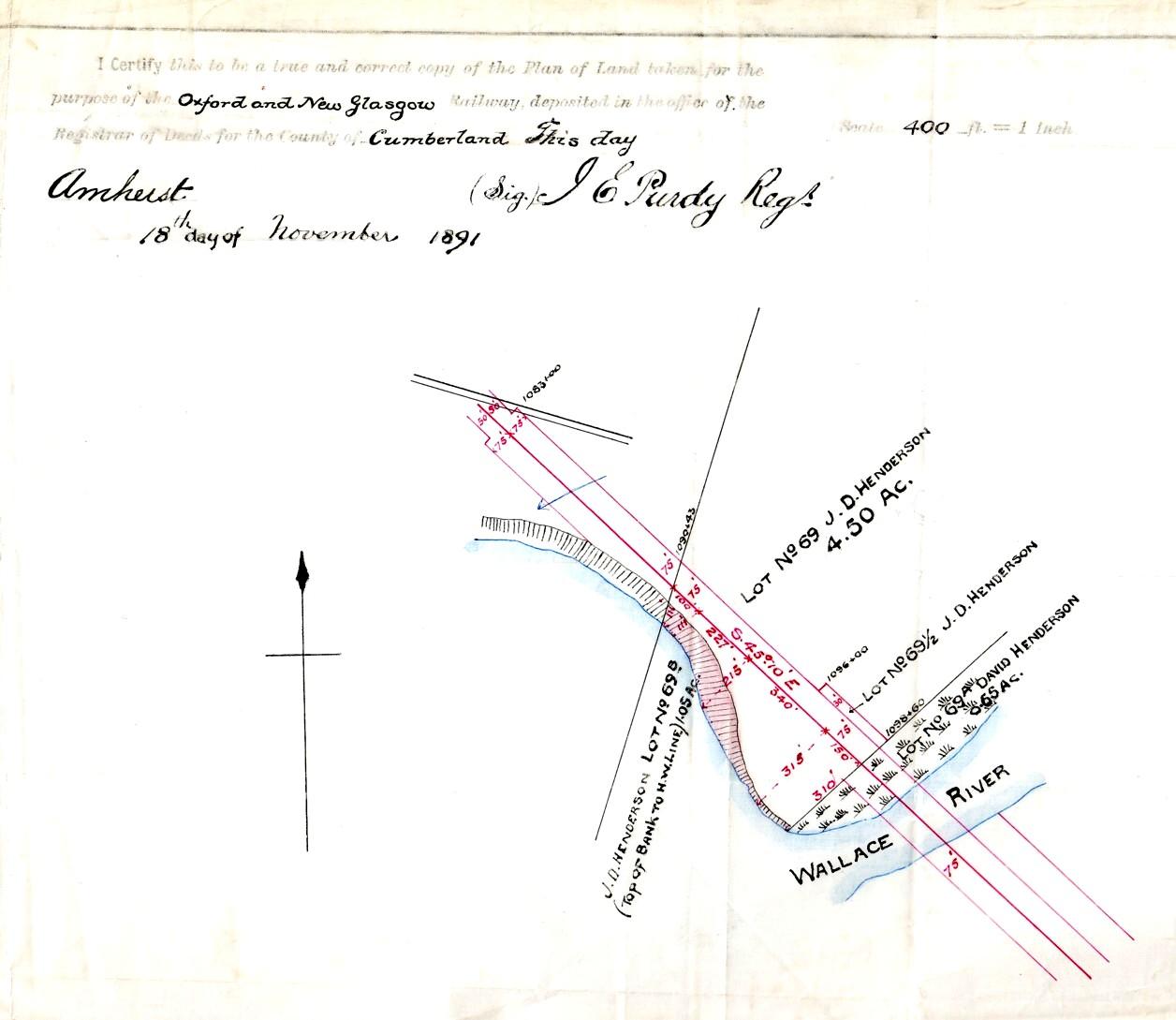
Oxford & New Glasgow Railway, a.k.a. The Short Line
(Great American & European Short Line Railway Company)
Right-of-way plan 1891: crossing the Wallace River
Wallace River Railway Swing Bridge
Peninsular Railway Company Limited
NSL 1887 chapter 61 — Act to incorporate the Peninsular Railway Co. Ltd.
NSL 1888 chapter 86 — Amendment
NSL 1890 chapter 77 — Act to change name to Londonderry & West Shore Railway Co. Ltd.
See: Londonderry & West Shore Railway Co. Ltd.
Pictou Development & Mining Company Limited
NSL 1894 chapter 88 — Act to incorporate the Pictou Development & Mining Co. Ltd.
Pictou Town Branch Railway
NSL 1884 chapter 1 —
NSL 1886 chapter 106 — Act respecting the Right of Way and Station Gorunds for the Pictou Town Branch Railway
NSL 1889 chapter 84 — Respecting payment for land for right of way for the Pictou Town Branch Railway
Port Breton Railway Company Limited
NSL 1907 chapter 164 — Act to incorporate the Port Breton Railway Co. Ltd.
Port Hood-Richmond Railway Coal Company Limited
NSL 1903 chapter 181 — Act to incorporate the Port Hood-Richmond Railway Coal Co. Ltd.
NSL 1905 chapter 138 — Amendment
NSL 1907 chapter 165 — Amendment
NSL 1909 chapter 173 — Amendment
NSL 1910 chapter 165 — Amendment
Protheroe Coal & Railway Company
NSL 1875 chapter 75 — Act to incorporate the Protheroe Coal & Railway Co. Ltd.
Provincial and New England All Rail Line

Source: The Official railway guide: North American freight service edition
by American Association of Passenger Traffic Officers
National Railway Publication Co., Philadelphia, 1881
1881
Daily passenger train service
between
Nova Scotia and New England
Provincial and New England All Rail Line
Schedule in effect September 1881
| Going WEST |
Express |
|
Lv. Halifax
|
8:10am
|
6:00pm
|
Lv. Pictou
|
6:40am |
2:00pm |
Lv. Truro
|
10:40am |
8:55pm |
Lv. Amherst
|
1:50pm |
11:55pm |
Ar. Moncton
|
3:40pm |
1:40am |
Lv. Moncton
|
3:50pm |
2:45am |
Ar. St. John
|
7:30pm |
6:00am |
Lv. St. John
|
9:00pm
|
8:15am
|
Ar. Vanceboro
|
1:30am |
12:50pm |
Lv. Vanceboro
|
(note 2)
|
1:15pm
|
Lv. Mattawamkeag
|
4:30am |
3:40pm |
Lv. Oldtown
|
6:52am |
5:40pm |
Ar. Bangor
|
7:30am |
6:25pm |
Lv. Bangor
|
7:50am
|
8:00pm
|
Lv. Waterville
|
9:27am |
10:03pm |
Lv. Augusta
|
10:10am |
10:58pm |
Lv. Brunswick
|
11:45am |
12:35am |
Lv. Yarmouth Jct.
|
12:14pm |
1:03am |
Lv. Westbrook Jct.
|
12:40pm |
1:31am |
Ar. Portland
|
1:00pm |
1:50am |
Lv. Portland
|
1:00pm
|
2:00am
|
Ar. Boston
|
5:30pm |
6:30am |
|
|
Intercolonial Railway
European and North American Railway
Maine Central Railroad
Eastern Railroad

Provincial and New England All Rail Line
Schedule in effect September 1881
| Going EAST |
Express |
Express |
Lv. Boston
|
7:30am
|
7:00pm
|
Ar. Portland
|
12:05pm
|
11:00pm
|
Lv. Portland
|
12:50pm |
11:15pm |
Lv. Westbrook Jct.
|
1:11pm |
11:34pm |
Lv. Yarmouth Jct.
|
1:36pm |
12:01am |
Lv. Brunswick
|
2:12pm |
12:45am |
Lv. Augusta
|
3:23pm |
2:22am |
Lv. Waterville
|
4:15pm |
4:15am |
Ar. Bangor
|
6:10pm
|
(note 3)
|
Lv. Bangor
|
6:50pm
|
7:10am
|
Lv. Oldtown
|
7:42pm |
8:10am |
Lv. Mattawamkeag
|
10:20pm |
10:10am |
Ar. Vanceboro
|
1:20am |
12:40pm |
Lv. Vanceboro
|
1:55am
|
1:20pm
|
Ar. St. John
|
7:00am |
5:50pm |
Lv. St. John
|
7:55am
|
10:30pm
|
Ar. Moncton
|
11:25am |
1:50am |
Lv. Moncton
|
11:35am |
2:35am |
Lv. Amherst
|
1:45pm |
4:25am |
Lv. Truro
|
4:50pm |
7:35am |
Ar. Pictou
|
8:35pm |
1:15pm |
Ar. Halifax
|
7:30pm |
10:00am |
|
|

1873
Daily passenger train service
between
Nova Scotia and New England
A precursor to the Provincial and New England All Rail Line

Source: The Official railway guide: North American freight service edition
by American Association of Passenger Traffic Officers
National Railway Publication Co., Philadelphia, 1874
1907: 600 Trains Depart Each Day
Pugwash & Spring Hill Railway Company
NSL 1872 chapter 61 — Act to incorporate the Pugwash & Spring Hill Railway Co. Ltd.
NSL 1874 chapter 61 — Amendment
NSL 1877 chapter 73 — Amend, and extend time
NSL 1879 chapter 69 — Amend, and further extend time
Quebec & Halifax Railway Company Limited
Quebec, New Brunswick & Nova Scotia Railway Company Limited
Quebec Railway Company
NSL 1849 chapter 9 — Act to empower the Commissioners for building the Main Line of Railway from Halifax to Quebec to construct same within the boundaries of Nova Scotia
NSL 1851 chapter 2 — Act to make provision for the construction of a Main Line Railway through British North America
NSL 1851 chapter 3 — Act to authorize borrowing £1,000,000 Sterling for the construction of a railway from Halifax to Quebec
NSL 1852 chapter 8 — Act to authorize raising £800,000 Sterling for the construction of a railway from Halifax to Quebec
NSL 1852 chapter 9 —
Queens Central Railway Company Limited
NSL 1910 chapter 166 — Act to incorporate the Queens Central Railway Co. Ltd.
NSL 1912 chapter 228 — Amendment
Queens County Railway Company Limited
NSL 1909 chapter 174 — Act to incorporate the Queens County Railway Co. Ltd.
NSL 1912 chapter 229 — Amendment
NSL 1917 chapter 188 — Amendment
Rolling Stock Company of Nova Scotia
NSL 1872 chapter 97 — Act to incorporate Rolling Stock Co. of Nova Scotia
Rhodes & Curry Company Limited
Rhodes, Curry & Company Limited
Amherst
NSL 1891 chapter 146 — Act to incorporate Rhodes & Curry Co. Ltd.
NSL 1903 chapter 247 — Amendment
NSL 1905 chapter 158 — Amendment
NSL 1907 chapter 159 — Amendment
NSL 1908 chapter 149 — Amendment
Rhodes, Curry & Company's entry into the railway car building business dated from their purchase in 1893, of the plant machinery and inventory of the firm of James Harris & Company, Saint John, N.B., and its removal from Saint John to Amherst, N.S.
Rhodes, Curry & Co. already had a millwork and building supply business in Amherst, and it was felt that the car business, purchased from the estate of the late James Harris of Saint John, would form a profitable sideline to their main effort. It was to do so to such an extent as to dwarf to insignificance the original enterprise.
The capacity of the plant in 1893 was about 3 or 4 cars per day, but by 1909 it could turn out 20 freight cars per day and 5 passenger cars per month. The annual output in 1891 was 331 cars; in 1908 it was 2044 cars.
Essentially, it was a large wood car building plant, and included wheel, grey iron and malleable iron foundries, axle and machine shops, planing and rolling mills, cabinet shops and erecting and painting shops. It was also the largest woodworking factory in the Canadian Maritime provinces, and its property covered about 40 acres.
The company also owned 20,000 acres of timber limits in fee simple, at Little Forks, 16 miles from Amherst, equipped with saw and planing mills, necessary stores, dwellings, etc.
In addition to the car works, a profitable business was done in constructing buildings of all classes, and in the manufacture and sale of building materials. At Sydney, N.S., the company owned a woodworking factory, a lumber yard and wharf property, and at Halifax a lumber yard and warehouse for supplying building materials.
The location of the plant in the centre of the timber producing provinces of New Brunswick and Nova Scotia, guaranteed an unfailing supply of spruce and other local woods at low prices, whilst the proximity to tidewater on the Bay of Fundy enabled the importation of southern pine, oak and raw materials at favourable prices. From Springhill and Sydney the plant was able to obtain its supplies of coal and steel at low cost.
Rhodes, Curry & Co. sold rolling stock to practically all the railways of Canada, not only in the Maritimes, but also to the larger roads further west, and they rivalled the Crossens of Cobourg as the largest Canadian wooden car builder in the early years of the century.
The Canadian Northern, Canadian Pacific and Grand Trunk Pacific were all customers, as were the Temiskaming & Northern Ontario and other smaller Ontario roads. Even the far away Morrisey, Farnie & Michael Railway in British Columbia had some miners' coaches which were Rhodes Curry products — exact counterparts of some similar ones which the firm has supplied the Nova Scotia Steel & Coal Co. in Cape Breton.
Rhodes, Curry built 34 open and closed street cars for use in Halifax, two for Moncton and six for Sherbrooke — all of the single truck variety, plus five large double truck cars for use in Montreal.
Most, if not all, of the four wheel coal “jimmies” which until fairly recent years were so much a feature of Cape Breton, were built by Rhodes, Curry and its predecessor, James Harris & Company.
Probably the most elegant car ever constructed by Rhodes, Curry was the ALEXANDRA, built in 1905 for the use of the Governor General of Canada. It is the writer's good fortune to possess the original specification for this car, the interior of which was entirely of selected St. Jago mahogany. The car still exists as a Canadian National business car in greatly-altered form. It now has a steel underframe, and is steel plated, completely altering its former appearance.
The Canadian Pacific gave Rhodes, Curry an order for ten first-class coaches in 1903, and also several early freight car orders, but by no means could the firm be said to have been extensive builders for the Canadian Pacific, who were noted adherents of Crossens of Cobourg.
The highly-successful partners in this enterprise were Nathaniel Curry and Nelson A. Rhodes of Amherst. Edgar Rhodes, who later became a premier of Nova Scotia and Dominion Minister of Fisheries, was a son of Mr. Nelson A. Rhodes.
By 1908, the business had grown to extremely large proportions, and 1,000 men were employed throughout the year, compared with 250 in 1893. The company's real estate, buildings, machinery and timber limits at Halifax, Sydney, Athol and Amherst were valued in March 1907 at $908,339. Current assets as of March 31, 1908 were $1,387,558, and current liabilities on the same date were $380,927, but the advent of the steel car was looming on the horizon and Mr. Nathaniel Curry moved with remarkable foresight.
He first incorporated his firm in August 1909 as the Rhodes, Curry Co., Limited with an authorized capital of three million dollars. Then, later in the same year, he engineered a merger of his firm with the Dominion Car & Foundry Co. and Canada Car Co. of Montreal. The ensuing new company was known as the Canadian Car & Foundry Co. and Mr. Curry moved to Montreal and became its first president.
The move was made only in the nick of time, because it may be doubted if the Rhodes Curry wooden car building plant in the Maritimes would have been much use to the merger a few years later, after the steel car had gained widespread acceptance.
Canadian Car & Foundry operated the Amherst plant on a steadily decreasing basis until 1931, when it was closed altogether, the last car work being the overhaul of several linesmen's boarding cars for the Western Union Telegraph Company.
The plant today (April 1963) is the bar stock rolling mill of Enamel & Heating Products Limited, whose head office is in the neighbouring town of Sackville, New Brunswick.
Source:
http://members.rogers.com/iancranstone2001/builders1.html#Rhodes
The above is an excerpt from an unpublished manuscript written by Andrew Merrilees in 1963, which can be found as part of the Merrilees collection at the National Archives of Canada and at the Archives of Ontario. The introduction to this unpublished book is signed by
Andrew Merrilees, President
Andrew Merrilees Ltd. and Merrilees Equipment Limited
Dealers in Rails, Track Supplies, Locomotives, Freight Cars for Industrial Railways
May 28, 1963
189 Old Weston Road, Toronto 9, Ontario
|
The Wayback Machine has archived copies of this document:
The Railway Rolling Stock Industry in Canada
A History of 110 Years of Canadian Railway Car Building
by Andrew Merrilees
Archived: 2002 March 12
http://web.archive.org/web/20020312051927/http://members.rogers.com/iancranstone2001/builders1.html
Archived: 2003 March 07
http://web.archive.org/web/20030307195935/http://members.rogers.com/iancranstone2001/builders1.html
Archived: 2004 January 03
http://web.archive.org/web/20040103080825/http://members.rogers.com/iancranstone2001/builders1.html
Archived: 2004 October 17
http://web.archive.org/web/20041017145611/http://www.nakina.net/builders1.html
Archived: 2005 August 27
http://web.archive.org/web/20050827001138/http://www.nakina.net/builders1.html
Archived: 2006 February 20
http://web.archive.org/web/20060220071715/http://www.nakina.net/builders1.html
Archived: 2007 April 22
http://web.archive.org/web/20070422114627/http://www.nakina.net/builders1.html
These links were accessed and found to be valid on 27 October 2010.
|
Rock Plaster Company
NSL 1914 chapter 165 — Act to authorize the Rock Plaster Co. to build and operate a tramway
Sable River Railway Company
The Sable River Railway was located near Sable River, Shelburne County and operated for ten to fifteen years. In 1904 a five mile long pole railway was built using wooden poles as rails. The Sable Lumber Company was incorporated on June 21, 1907 with a head office in York Village, Maine. During the fall and winter that followed lumbering operations began under the directions of William S. Hall, the Company's Nova Scotia agent... Construction of a proper railway began with the arrival of used 56 pounds per yard [27.8 kilograms per metre] rail from a dealer in Saint John, N.B. The main line was twenty miles in length and ran from Wilkins Siding on the H&SW inland to several mill sites. Short spurs, built for temporary use, were constructed up to two miles in length. When the timber was exhausted on one site, the rails were taken up and a new spur built...
Sable River Railway by Colin Churcher
Colin Churcher's website
Shelburne & Bear River Railway Company Limited
NSL 1911 chapter 152 — Act to incorporate the Shelburne & Bear River Railway Co. Ltd.
Silliker Car Company Limited
Halifax
Historical notes
NSL 1907 chapter 70 —
NSL 1908 chapter 73 —
NSL 1911 chapter 41 —
See: Nova Scotia Car Works Ltd.
Silliker Car Company Halifax
Silliker Car Company Halifax
Sissiboo Pulp & Paper Company Limited
NSL 1898 chapter 135 — Act to incorporate the Sissiboo Pulp & Paper Co. Ltd.
NSL 1899 chapter 170 — Amendment
NSL 1900 chapter 167 — Amendment, to authorize the company to construct a Trolley or Tramway near Weymouth
NSL 1900 chapter 171 — Amendment
Skye Mountain Railway Corporation
NSL 1914 chapter 176 — Act to incorporate the Skye Mountain Railway Corporation
NSL 1917 chapter 169 — Amendment
South Shore Railway Company
NSL 1892 chapter 130 — Act to incorporate the South Shore Railway Co.
The South Shore Railway Company was incorporated on 30 April 1892, comprising twelve members (shareholders) from Yarmouth and Shelburne Counties, with the intention of building a railroad from Yarmouth to Shelburne. Exactly a year later, on 29 April 1893, after that company had spent a whole year in discussing what route it was to follow, a new company was formed, the Coast Railway Company, comprising five Americans, mostly from Philadelphia, who wanted to build a railroad from Yarmouth to Lockeport. In a letter dated 24 January 1894, from Philadelphia, there is mentioned a plan to build electric railways in Nova Scotia...
—
The Railroad Era by Father Clarence-J. d'Entremont
Yarmouth Vanguard, 30 July 1990
Springfield Railway Company Limited
Lunenburg and Annapolis Counties
NSL 1904 chapter 146 — Act to incorporate the Davison Tramway Co. Ltd.
NSL 1905 chapter 135 — Change name from Davison Tramway Co. Ltd. to Springfield Railway Co. Ltd.
NSL 1906 chapter 158 —
NSL 1915 chapter 95 —
NSL 1920 chapter 182 —
See: Davison Tramway Company Limited
The Davison Tramway Co. and the Springfield Railway Co. were closely associated with the Davison Lumber Company, headquartered in Bridgewater.
Springfield Railway by Philip L. Spencer
Springfield Railway by John R. Cameron
Springfield Railway by Colin J. Churcher
Colin Churcher's website
https://churcher.crcml.org
Also see:
Davison Lumber Company
Davison Lumber Company's Shay Locomotives
Built by Lima Locomotive Works, Lima, Ohio
Lima serial number 990, Springfield Railway number 3 built April 1905
Lima serial number 1647, Springfield Railway number 4 built March 1906
Lima serial number 2778, Springfield Railway number 6 built December 1915
Davison Lumber Company
In 1902, Frank Davison and other family members sold the firm of E.D. Davison & Sons along with the woodlands and mill to the American Lumber Company which then changed its name to the Davison Lumber Company. The head office was in New York with a local head office near Bridgewater. The Davison Lumber Company continued to operate the existing mill and within a short time had built it up to become the largest lumber mill operation east of Montreal ... To move the wood to feed the mill as well as take the dressed lumber to market, several miles of new track were laid from the mill in Hastings to Springfield, then connected to the Nova Scotia Central Railway which ran to Bridgewater and joined with the Halifax and Southwestern Railway. Eventually, the company obtained running rights on the entire Halifax and Southwestern line. In addition, the company laid more than 40 miles of track which wormed its way through 325,000 acres of company-owned woodland. The company owned many conventional side-rod steam locomotives but also had two Shay locomotives...
Source: Davison Lumber Company
Also see:
Springfield Railway
Spring Hill Mining, Manufacturing & Transportation Company
NSL 1864 chapter 50 — Act to incorporate the Spring Hill Mining, Manufacturing & Transportation Co.
Spring Hill & Oxford Railway
Cumberland County
Proceedings of the Legislative Council of Nova Scotia —
Halifax, 26 March 1888: — Hon. Mr. Baker said ... (in his report) the provincial engineer thus refers to the new railway from Springhill to Oxford:
"Interest centres largely on Springhill, the latest born of Nova Scotia colleries, owing to the very gratifying results of the year's operations. There have been 466,223 tons removed by rail during 1887, an increase of 49,454 tons over the year 1886. Good news reaches us daily from the coal field showing that the late (recent) infusion of speculation and activity is being successfully rewarded.
"The last thing announced is the cutting of the sod for the new railway from Springhill to Oxford. The line will connect here (at Oxford) with the Short Line and open up the harbor of Pugwash for transportation northwards thus completing a circuit of trade channels by rail and by water in every cardinal point of the compass. The colliery is well placed for the future and in excellent hands..."
Source: Page 26 of the 1888 section, in:
Debates and Proceedings of the Legislative Council of Nova Scotia, 1883-90
The Spring Hill & Oxford Railway —
This line remains in the same condition as reported for last year, 1891. There have been no traffic operations carried on over it so far. Assuming the line to be 14 miles about 23 km long, there still remains a balance of subsidy of $10,640.
(signed) Martin Murphy,
Provincial Engineer
Source:
Report of the Provincial Engineer on the Subsidized Railways and
Other Public Works in the Province of Nova Scotia for the Year 1892
Halifax, March 16th, 1893
Appendix No. 7, page 8, in:
Journals of the Legislative Council of Nova Scotia, 1893
Spring Hill & Parrsboro Coal & Railway Company Limited
Cumberland County
NSL 1872 chapter 70 — Act to incorporate the Spring Hill & Parrsboro Coal & Railway Co. Ltd.
NSL 1874 chapter 12 —
NSL 1874 chapter 72 — Amendment, respecting issuance of bonds
NSL 1875 chapter 69 — Act to explain chapter 72 of 1874
NSL 1876 chapter 7 — Act to extend time for completion of the railway
NSL 1883 chapter 73 —
NSL 1883 chapter 85 — Amendment
See: Cumberland Railway & Coal Co. Ltd.
Spring Hill & Parrsboro Coal & Railway Co.
The first run of the Springhill & Parrsboro Railway was on July 1st, 1873. The Parrsboro Cornet Band was mentioned in the newspaper article as being on hand to greet the train as it arrived. In the first year of railroad operations to Parrsboro, 900 ships were loaded with coal from the Springhill mines. One third of the tonnage shipped from Nova Scotia in 1878, was loaded at Parrsboro.
In its peak years of the 1890s, more than 1500 ships departed annually from the port of Parrsboro. At the turn of the 20th century (1900), Parrsboro was second only to Halifax in the number of ships sailing on the Canadian east coast.
Ottawa: Federal Government Orders in Council 1867-1882
http://www.collectionscanada.ca/02/020157_e.html
OIC 1875-0886, page 1
OIC 1875-0886, page 2
Subject: Recommendation by the Minister of Finance, Ottawa, to pay a construction subsidy of $5,000 per mile to the Spring Hill and Parrsborough Coal and Railway Company, to be charged to the debt of the Province of Nova Scotia...
Approved: 9 September 1875
Spring Hill & Parrsboro
Railway
Stations
1893
|
miles
note 1
|
Station |
miles
note 2
|
km |
| 0 |
Spring Hill Junction |
0.0 |
0.0 |
| 5 |
Spring Hill Mines
(Springhill) |
4.0 |
6.4 |
| 13 |
Maccan River
(East Southampton) |
12.3 |
19.8 |
| 16 |
Southampton |
15.2 |
24.5 |
| 19 |
West Brook |
18.0 |
29.0 |
| 22 |
Halfway Lake
(Newville) |
20.9 |
33.6 |
| 28 |
Lakeland |
24.6 |
39.6 |
| 32 |
Parrsborough |
30.2 |
48.6 |
|
Note 1: Belcher's Almanack, 1893, (page 163)
|
Note 2: Altitudes in the Dominion of Canada, 1915
(page 305) by James White, F.R.S.C., F.R.G.S.
Deputy Head of the Commission of Conservation
Ottawa
|
|
Note 3: The 1893 Almanack uses the spelling "Parrsborough" both for the town and the railway, but the railway spelling as specified in the 1872 Act of Incorporation was the "Spring Hill & Parrsboro Coal & Railway Co. Ltd." "Altitudes in the Dominion of Canada", published in 1915, uses the spelling "Parrsboro" for the town, and the railway was then the Cumberland Railway and Coal Company.
Ottawa: Federal Government Orders in Council 1867-1882
http://www.collectionscanada.ca/02/020157_e.html
OIC 1883-1909, page 1
OIC 1883-1909, page 2
OIC 1883-1909, page 3
OIC 1883-1909, page 4
OIC 1883-1909, page 5
OIC 1883-1909, page 6
OIC 1883-1909, page 7
OIC 1883-1909, page 8
OIC 1883-1909, page 9
OIC 1883-1909, page 10
OIC 1883-1909, page 11
OIC 1883-1909, page 12
OIC 1883-1909, page 13
OIC 1883-1909, page 14
OIC 1883-1909, page 15
OIC 1883-1909, page 16
OIC 1883-1909, page 17
OIC 1883-1909, page 18
OIC 1883-1909, page 19
Subject: Disallowance of Nova Scotia Act to amend the Act to incorporate the Spring Hill and Parrsborough Coal and Railway Company...
Approved: 18 September 1883
Ottawa: Federal Government Orders in Council 1867-1882
http://www.collectionscanada.ca/02/020157_e.html
OIC 1883-1262, page 1
OIC 1883-1262, page 2
OIC 1883-1262, page 3
Subject: Approval of agreement with Amalgamated Spring Hill and Parrsboro' Coal & Railway Company for conveyance of their coal over the line of the Intercolonial Railway from the Spring Hill Mines to Chaudiere Junction for the West and for Quebec...
Approved: 30 May 1883
Standard Coal & Railway Company Limited
NSL 1903 chapter 184 — Act to incorporate the Standard Coal & Railway Co. Ltd.
NSL 1906 chapter 164 — Amendment
Standard Drain Pipe Company Limited
NSL 1909 chapter 177 — Act to authorize the Standard Drain Pipe Co. Ltd. to construct an aerial tramway, etc.
Stewiacke Valley & Lansdowne Railway Company Limited
NSL 1886 chapter 155 — Act to incorporate the Stewiacke Valley & Lansdowne Railway Co. Ltd.
NSL 1887 chapter 62 — Amendment, may extend line to Westville
NSL 1888 chapter 84 — Amendment
NSL 1888 chapter 91 — Amendment
NSL 1889 chapter 85 — Amendment
NSL 1890 chapter 63 — Amendment
NSL 1890 chapter 98 — Amendment
NSL 1891 chapter 98 — Amendment
NSL 1892 chapter 87 — Amendment
NSL 1893 chapter 117 — Amendment
NSL 1900 chapter 120 —
NSL 1901 chapter 51 —
The Stewiacke Valley & Lansdowne Railway
Halifax, March 16th, 1893 —
(Page 8:) Under the conditions of an agreement and specifications made and entered into between this company and the Government on the 6th of July, 1891, the Lieutenant-Governor-in-Council agrees to pay a cash subsidy of $3,200 per mile $1,990 per kilometre for the construction of a line of railway from a point on the Intercolonial Railway main line at Brookfield, Halifax County, to a point at Maitland, Hants County, and thence to a point in Hants County at Newport or Windsor on the line of the Windsor Branch Railway (W&AR, later the DAR), all of which points and route shall be approved by the Lieutenant-Governor-in-Council. Work under this contract has not yet commenced.
(Page 9:) No progress has been made with the works of the Stewiacke Valley and Lansdowne Railway during the year 1891, under the provisions of the contract made in 1887.
(signed) Martin Murphy,
Provincial Engineer
Source:
Appendix No. 7, pages 8-9, in:
Journals of the Legislative Council of Nova Scotia, 1893
Suburban Development Company Limited
NSL 1901 chapter 137 — Act to incorporate the Suburban Development Co. Ltd.
NSL 1903 chapter 211 —
NSL 1903 chapter 239 — Amendment
Sydney Coal Railway Inc.
Incorporated December 2001, Registry of Joint Stock Companies ID#3062819
Sydney Coal Railway Inc. is a wholly-owned subsidiary of Societe des Chemins de Fer du Quebec (Quebec Railway Corporation Inc.)
• Devco Railway was wholly owned by the Cape Breton Development Corporation, a crown corporation, and was operated as an unincorporated department within that corporation.
— Canadian Transportation Agency Decision No. 571-R-1997
• On 18 December 2001, 510845 N.B. Inc., a wholly-owned subsidiary of Emera Inc., Nova Scotia's largest electric utility company, acquired surface assets (railway track, rights-of-way, locomotives and other rolling stock, etc.) from the Cape Breton Development Corporation.
— Canadian Transportation Agency Decision No. 192-R-2002
• This property included the rail operation between the international pier on the waterfront in Sydney and the Lingan power generating plant, the rail lines through the coal storage facility at Victoria Junction, including the railway maintenance centre, and a portion of the Glace Bay rail line between the railway maintenance centre and the end of the Old Tank siding, Cape Breton Island.
• On 1 January 2003, responsibility for the operation of this railway was transferred to Sydney Coal Railway Inc., from 510845 N.B. Inc.
— Canadian Transportation Agency Decision No. 657-R-2002
• 3986250 Canada Inc. and Sydney Coal Railway Inc. were originally set up as separate corporations, both wholly-owned subsidiaries of Quebec Railway Corporation Inc. (Societe des Chemins de Fer du Quebec). These two separate corporations were amalgamated in April 2004, and thereafter were known as Sydney Coal Railway Inc.
— Canadian Transportation Agency
Decision No. 233-R-2004, 6 May 2004
See: Cape Breton Development Corporation Railway
See: Devco Railway
See “Emera Incorporated”
See: 510845 N.B. Inc.
See: 3986250 Canada Inc.
Sydney & East Bay Railway Company Limited
NSL 1873 chapter 39 — Act to incorporate the Sydney & East Bay Railway Co.
NSL 1904 chapter 141 — Act to incorporate the Sydney & East Bay Railway Co. Ltd.
NSL 1909 chapter 179 — Act to incorporate the Sydney & East Bay Railway Co. Ltd. as an electric interurban railway
Sydney & Glace Bay Railway Company Limited
NSL 1902 chapter 160 — Act to incorporate the Sydney & Glace Bay Railway Co. Ltd.
NSL 1909 chapter 182 — Amend
Sydney & Louisburg Coal & Railway Company Limited
NSL 1881 chapter 73 — Act to incorporate the Sydney & Louisburg Coal & Railway Co. Ltd.
Sydney & Louisburg Railway Company (incorporated 1865)
NSL 1865 chapter 50 — Act to incorporate the Sydney & Louisburg Railway Co.
NSL 1865 chapter 55 — Act to empower the Block House Mining Co. to guarantee bonds of the Sydney & Louisburg Railway Co.
See: Block House Mining Co.
Sydney & Louisburg Railway Company (incorporated 1910) S&L
NSL 1910 chapter 171 — Act to incorporate the Sydney & Louisburg Railway Co.
NSL 1911 chapter 155 — Amend
NSL 1912 chapter 238 — Act relating to S&LR, Red Bridge
NSL 1972 chapter 120 — Act to Wind Up the Sydney & Louisburg Railway Employees' Trust Fund
Sydney & Louisburg Railway by Robert Chant
http://www.rocarchives.com/Articles/Chant-SydneyAndLouisburgRailway.htm
Sydney & Louisburg Railway by John R. Cameron
http://www.rocarchives.com/Articles/Cameron-SydneyAndLouisburgRailway.htm
Overview of the Development of Railways
on the Sydney Coal Fields: 1720-1999
Sydney Mines Railway
The Sydney Mines Railway was opened in 1830 at Sydney, Nova Scotia. This was a horse drawn tramway.
Chronology of Important Dates in Canadian Railway History, by Colin Churcher and Rick Roberts
Sydney, New Waterford & East Bay Monorail Company
NSL 1911 chapter 156 — Act to incorporate the Sydney, New Waterford & East Bay Monorail Co.
Terminal City Railroad Company Limited
Guysborough County
NSL 1888 chapter 115 — Act to incorporate the Terminal City Co. Ltd.
NSL 1888 chapter 116 — Act to incorporate the Terminal City Railroad Co. Ltd.
NSL 1892 chapter 178 — Act to amend, and extend time for construction
NSL 1894 chapter 96 — Act to extend time for commencing and completing
Proceedings of the Legislative Council of Nova Scotia —
Halifax, 26 March 1888: —
(Page 28:) Hon. Mr. Goudge said ... A few days ago a bill entitled a Bill to Incorporate the Terminal City Company had passed this House, which originated from a number of American gentlemen who proposed to expend a large sum of money near Canso. According to their charter, their capital would be five millions of dollars, of which one million two hundred and fifty thousand dollars would be paid up, and that was an indication that the company was no bogus company. It was hoped by the expenditure of this large sum of money in the vicinity of the Strait of Canso to induce tourists to come in very large numbers and visit that locality and spend the summer season there, and thus the traffic of the steamships and railways would be largely increased...
(Page 30:) Hon. Mr. LeBlanc said he had no doubt that the people of the province would read with pleasure the speeches that had been delivered this afternoon on the prosperity of the province in the matter of steamships and railways. He was very glad to know that the Yarmouth Steamship Company was prosperous, and that the missing link between Annapolis and Digby was going to be built as the filling in of that gap would be a benefit to the whole province. At every session of this legislature new steamship and railway companies were being incorporated, and this year a bill had passed the House which incorporated a company called the Terminal City Company Limited...
(Page 30:) Hon. Mr. Black said it was perfectly delightful to hear so many hon. gentlemen indulge in congratulations on the prosperity of the country, as it was in striking contrast to certain utterances of a few months ago when Nova Scotia was represented as being down trodden, and as having its life blood sucked out. But now the proud boast was that the time of the legislature was being taken up in the incorporation of railway and steamship companies, and Terminal City companies, and everything was prospering at such a rapid rate that the coal mines of the province had to be worked every day in the year, Sundays included, to supply the demand...
Source: Pages 28-30 of the 1888 section, in:
Debates and Proceedings of the Legislative Council of Nova Scotia, 1883-90
Terminal City —
New Glasgow, 27 October 1888: —
W. Harrington, a well known miner of long experience, is moving an engine and plant from Pictou to Hawkesbury, near Terminal City, where it will be used in sinking (drilling) for coal. The Diamond Drill was in operation there this summer, and several valuable seams were found. We understand the Terminal City Company, which is composed of wealthy American capitalists, are pushing things ahead to make the Terminal City one of the greatest business centres in America. As they have the capital we see no possible reason why they should not succeed.
Source: New Glasgow Enterprise, 27 October 1888
Terminal City — 1891
The town of Canso is on Chedabucto Bay, 32 miles 51 km southeast of Guysborough. It has a population of about 1,500, and is the western terminus of several of the Atlantic telegraph cables ... At Canso a company of Canadian and American capitalists is proposing to erect a great city, to be called Terminal City, whence fast steam ships are to traverse the Atlantic and lightning express trains rush westward. This scheme is pretty fully developed, and may perhaps be carried out, in which case the splendid Bay of Chedabucto would emerge from its present obscurity.
Source: Page 247 of The Canadian Guide Book: The Tourist's and Sportsman's Guide to Eastern Canada and Newfoundland... by Charles G.D. Roberts, Professor of English Literature at King's College, Windsor, Nova Scotia; 378 pages, published by D. Appleton, New York, 1891.
[23 October 2001] Early Canadiana Online http://www.canadiana.org/ has this book at
http://www.canadiana.org/cgi-bin/ECO/mtq?id=24a0011313&doc=56228
Page 247 is at
http://www.canadiana.org/cgi-bin/ECO/mtq?id=73f2010914&display=56228+0335
Tidewater Fuel and Navigation Company
Torbrook Branch Railway
Annapolis County
NSL 1891 chapter 150 — Act to incorporate the Torbrook Iron Co. Ltd.
NSL 1892 chapter 68 — Act to authorize the Municipality of Annapolis to pay for land for right of way for Torbrook Branch Railway
Trenton Works Inc.
TrentonWorks Limited
See: The Greenbrier Companies Inc.
In 2006 the Greenbrier Companies are the leading North American manufacturer of intermodal railcars with an average market share of approximately 60% over the last five years. In addition to our strength in intermodal railcars, we manufacture a broad array of other railcar types in North America and have demonstrated an ability to capture high market shares in several of the car types we produce. In North America, we have commanded an average market share of approximately 40% in flat cars and 30% in boxcars over the last five years... Outside of the United States, we operate in Canada, Germany and Poland... At our manufacturing facility in Trenton, Nova Scotia, Canada – as of 31 August 2006 – 557 employees are covered by collective bargaining agreements that expired in October 2006 and are currently being negotiated... Subsequent to year end, approximately 500 employees at our manufacturing facility in Canada were laid off due to a suspension of operations upon completion of an order...
—
History of the Trenton Railcar Works
Trenton Works as it stood in the last decades of the twentieth century, was a direct descendent of the Hope Iron Works founded in 1872 by two blacksmiths, Graham Fraser and Forrest MacKay. They made iron forgings – most of them, such as anchors, knees and other fittings, for use in wooden ships. The company very early expanded its range of products and in 1876 railway car axles were being manufactured from bundled faggots of iron. These were perhaps the first standard gauge car axles forged in Canada. The market for iron forgings was expanding rapidly in the era and in 1878 a new plant was built at Trenton under the name of the Nova Scotia Forge Company. The new forge works had a voracious appetite for raw materials, a demand that became increasingly difficult to meet. To satisfy the growing need for steel the Nova Scotia Steel Company was established in 1882. During the year 1883, the first steel to be made in Canada was produced at the Trenton plant by the Siemens process in an open hearth furnace...
The Eastern Car Company Limited was organized in 1912 as a division of the Nova Scotia Steel & Coal Company, which already owned foundry and forging facilities in and near New Glasgow, Nova Scotia, of which Trenton is a suburb. The first car order processed through the Eastern Car Company plant was one for 2,000 steel-framed wood-sheathed, wood-roofed box cars for the Grand Trunk Railway in 1913. For these cars almost all the steel was rolled next door – in the mill of the parent company Nova Scotia Steel & Coal Company – including the heavy bar stock for the arch-bar trucks, then the standard truck for freight cars. Orders from most of the major Canadian railways quickly followed, and in 1915 the plant also secured a large export order for box cars for the Czarist Russian government. The Trenton plant, often referred to as the “Trenton Works,” was in continuous operation from 1913 until 2007, owned first by the Eastern Car Company and later by several successor companies. In the late 1950s, Dominion Steel & Coal Corporation (DOSCO) – including Eastern Car Company with Trenton Works – was taken over by Avro Canada a Canadian company closely associated with A.V. Roe, a large British aircraft manufacturer. In 1962, Avro Canada – including DOSCO with Trenton Works – was taken over by Hawker Siddeley (Canada) Limited, a large British aircraft concern and holding company. On March 9, 1995, Trenton Works was purchased by a joint partnership of Canadian and American businessmen with the latter, Greenbrier Company of Lake Oswego, Oregon acquiring the majority interest. The plant became part of the Greenbrier Companies and was renamed TrentonWorks Limited. In 2005, TrentonWorks employed more than a thousand people, but this number was substantially reduced as production fell off through 2006. On the completion of its last production contract in 2007, Greenbrier decided to close TrentonWorks permanently. The last shift ended at TrentonWorks Limited on 4 May 2007, one month following the closure announcement. During its working life, 1913-2007, Trenton Works produced well over 70,000 railway freight cars.
|
The Wayback Machine has archived copies of this document:
History of the Trenton Railcar Works
Archived: 2001 January 26
http://web.archive.org/web/20010126025100/http://www.trentonworks.ca/history.html
Archived: 2001 February 8
http://web.archive.org/web/20010208125533/http://www.trentonworks.ca/history.html
Archived: 2001 April 23
http://web.archive.org/web/20010423102031/http://www.trentonworks.ca/history.html
These links were accessed and found to be valid on 8 September 2012.
|
TrentonWorks Wikipedia
Reference:
Eastern Car Company
by Andrew Merrilees (written in 1963)
History of the Steel Industry in Pictou County
How the Canadian steel industry was born in the County of Pictou
Madam Speaker, one of bright spots in Nova Scotia is Trenton Works. Trenton Works has been for many years the centre of economic activity in Pictou County. And while that is less so, perhaps, today than it once was, it is still a key part of the economy of our end of the province.
I would like to share with the members (of the Nova Scotia Legislature) some of the history of the steel industry and the (railway) car making industry in Pictou County. I would like to provide the members with some information on how the Canadian steel industry was born in the County of Pictou. The centre of this activity was the Town of Trenton, but certainly in earlier times, other areas of the county as well.
Between 1783 and 1792, three settlers received grants of land totalling 1,300 acres covering most of what would eventually become the Town of Trenton. The town’s first industry was shipbuilding, on the site of the Nova Scotia Power Corporation generating station. Later industry would be a sawmill, three quarries and the operation of what is now Trenton Works.
However, the real purpose here is to concentrate on the development of the steel industry in the County of Pictou. In 1828, the General Mining Association experimented with iron ore found in nearby MacLellans Brook. A blast furnace was built in Albion Mines, which is now Stellarton, and 50 tons of unusually hard pig-iron was produced. That is less than one pour of (today's) electric furnace in Sydney. Some of this early steel was used to make stamps for a gold crushing mill in Guysborough County.
Railways were opening up and in 1872 two youthful blacksmiths in the New Glasgow shipyards formed a partnership, called the Hope Iron Works, capitalized by $4,000. They began production of railway car axles, railway spikes, and marine forgings. In 1878, the name changed to the Nova Scotia Forge Company and moved two miles north, to an area which was to become the Town of Trenton and the area where Trenton Works now sits. The secretary of the Forge Company, a Harvey Graham, brought home the name Trenton after a visit to Trenton, New Jersey . The two partners formed the Nova Scotia Steel Company, capitalized with $160,000, and installed a 15 ton capacity open hearth furnace, a 26 inch cogging mill , two bar-rolling mills and a plate mill.
In July 1883, they poured the first commercial steel ingots and in 1889, they merged the forge and steel companies. Initially, the company used Scottish pig-iron but later on acquired iron ore deposits further up the East River above Stellarton. Further expansion led to a railway, iron ore mines, limestone quarrying and a blast furnace using local coal and, as well, coke ovens and a coal washing plant. Pig-iron was produced from 1892 to 1904 in a local self-contained operation providing locally all the key ingredients to make steel.
The Ferrona Operation, just above Stellarton, employed up to 300 men. The East River iron deposits became depleted and in 1894 the extensive submarine deposit which outcrops at Bell Island on Conception Bay, Newfoundland, was acquired and so began the mining town of Wabana. It was found through experimenting that Cape Breton coal made much better coke and the company procured a coal supply in Cape Breton.
In 1900, a composite of the old affiliated companies and their coal properties was formed under the name the Nova Scotia Steel and Coal Company capitalized at $6.2 million. For $300,000 Scotia Steel, as it would now be commonly called bought the leases and collieries in the Sydney Mines-Florence area, owned by the General Mining Association. Scotia Steel built a plant at Sydney Mines to produce steel ingots. The billet cogging, mill rolling, forging and spike making operation continued at Trenton.
In 1912, 40 years after MacKay and Fraser’s modest beginning with the Hope Iron Works, the Nova Scotia Steel and Coal Company Ltd. was a $14 million industrial giant. At the time, the Trenton based company was one of Canada’s largest enterprises, and one of the world’s few entirely self-contained steelmaking operations producing 50 per cent of the steel consumed annually in Canada.
Valid Claim
Thus the claim of Trenton as the birth place of steel in Canada is a valid one. The company installed a 2,000 ton hydraulic forging press, the Big Chief, and being built during this period was the eventual jewel of the company’s crown, the Eastern Car Company.
During World War One, the Nova Scotia Steel and Coal produced 14 million artillery shells. Ironically the Big Chief forging press, bought from Germany, produced the 18 pounder shell block. From 1914-1918, the plant contributed well to the war effort including plate for tanks and other supplies for war. The subsidiary shipbuilding yard in Trenton made the first steel steamers in Nova Scotia.
The steel plant peaked during World War One, at 2,100 men. A merger of Scotia Steel with the large Dominion concern occurred in 1920 to form the British Empire Steel and Coal Corporation, commonly called BESCO. Local control of the local steel interests and the subsidiary Acadia Coal Company was lost. BESCO control resulted in a dismantling of the cogging mill in Trenton and the steel plant in Sydney Mines was abandoned. There followed years of operation without significant re-investment in equipment.
In 1928, the Dominion Steel and Coal Corporation, DOSCO, was incorporated specifically to take over BESCO. By this time, BESCO was debt ridden and drained by its promoters. The Trenton plants, like those in industrial Cape Breton were controlled from Montreal. Local officials were to do as they were told. Re-organization of the various companies resulted in all being subsidiaries either directly or indirectly of DOSCO.
In the late 1930s, the car plant Eastern Car Company, was taken over by the federal government but repurchased by the company after the war. In 1943, the nut and bolt department was closed as was the rolling mill, putting 540 men out of work. During World War Two, components of artillery pieces were produced in the gun shop and 2 million artillery shells were produced.
After World War Two, the continent needed new railway rolling stock and a new mechanical manipulator was installed in the axle forge replacing human brawn. During the peak year, 65 thousand axles were forged. On a personal note, my grandfather worked 50 years in the axle forge completing his 50 years in 1957. I was working as a summer student in the testing lab and was present when the plant ceased production on a hot July afternoon for a ceremony to honour him for his 50 years of service. He retired a few months later.
In the 1950s, a 7,000 ton forging press, costing $3.6 million, with auxiliary furnaces and machine shop equipment was installed. This was the largest press in North America for many years. The ingots were produced in Sydney and shipped hot by insulated rail car. Ingots as large as 75 tons were handled in this way. This process was recognized by a full page colour photograph in Life Magazine. The end products were (drive) shafts for naval destroyers. The forging of an ingot, which was not allowed to cool after pouring, made a superior product and was a major world innovation.
In 1957, the A.V. Roe Company, a subsidiary of Hawker-Siddeley, acquired control of DOSCO. The parent company, in 1962, changed its name from A.V. Roe Canada Ltd. to Hawker-Siddeley Canada Ltd. In 1968, Hawker-Siddeley withdrew from its steelmaking operation in Sydney and as well from its coal mining operations in Cape Breton and on the mainland. Thus beginning the long saga of SYSCO with its most recent chapter beginning with the agreement of the province with Minmetals to a joint venture, prior to outright purchase.
The Trenton Works continue to be supplied with raw materials from the Sydney steel plant, now sponsored by the Nova Scotia Government. Growth came to the Trenton steel industry with local ownership and management and decline came with foreign ownership and absentee management. Many local businesses contributed to the early success of the local steel industry. William Knoll, Senior, general manager from 1942 to 1954, was noted for aggressive leadership in a time of an expanding economy.
Part of the Trenton complex, the Eastern Car Company, which does the rail car manufacturing, was a dream of Thomas Cantley. The company incorporated in 1912, capitalized at $3 million. The Four Shop Railway Car Construction factory was built in 18 months and the first box car rolled off the assembly line in 1913.
Mr. Alf Mason, a long-time resident of Trenton, was involved in the construction of the plant in 1912-1913 and later became a long-term employee. Mr. Mason, who still resides with his wife in his own home in Trenton, recently celebrated his 100th birthday and is the last living link with the birth of the Eastern Car Company. Mr. Mason reports that he helped dig the foundation for the large stack and participated in building the outer wall next to the stack.
The demand was so great that production of rolling stock began before the building was even completed. Mr. Mason was, over the years, an employee of the Steel Works and Eastern Car, retiring in May of 1964, 52 years after he first began with the company.
The Eastern Car Company has provided rolling stock to Russia, France, Argentina, Belgium, Indonesia and the North American market. At peak capacity the car plant employed 1,200 men, producing freight cars and cars for specific purposes.
In 1941, Trenton Industries was formed. It produced naval guns for the war effort, employing 600 men and, in the post-war years, produced the DOSCO continuous furnace. At the end of the war, the plant still was the largest producer of heavy forgings in Canada.
During the 1980s, the fortunes at Hawker-Siddeley were at a low ebb. Trenton was vying for CN car orders with National Steel Car of Hamilton. As CN was publicly (government) owned, the National Steel Car felt it deserved one-half of the orders for CN rolling stock.
In 1984, one half of a large order won by Trenton Works was ordered by the government to be produced by National Steel Car, a political decision. The unfairness of the situation was underlined by the fact that CP had a company relationship with National Steel Car and National Steel Car got all CP’s business.
In the late 1980s the Hawker-Siddeley President from London and the Chief Executive Officer from Montreal came to Trenton and stated they would “bulldoze the plant into the ground and turn the area into an industrial park.” This industry, like Sydney Steel and Devco in Cape Breton, is a symbolic part of life for Pictonians that has been eroded by absentee ownership and politics. Were it not for the intervention of the federal and provincial governments in 1988, there would be no Trenton Works today. The assistance in 1988 took the form of early retirement for elderly workers, and capital over the next several years for modernization was provided and there was an attempt to arrange local ownership. The reduction in the average age of the work force allowed Lavalin to purchase the plant in 1988. The federal government provided two-thirds of the early retirement package and, as well, the money for modernization. The last $12.4 million was paid to the Nova Scotia Government in February 1995, the end of the agreement.
In 1988, the provincial government provided one-third of the early retirement package and the Town of Trenton, with that downsizing, lost a valuable source of tax income. Some 200 workers were involved in the so-called SORP Program. The Mayor and Council of Trenton were part of the negotiating process and part of the solution. The loss of the tax base guaranteed that Trenton would spend the next years on emergency funding awaiting the tax income from the biggest employer in the town, the Nova Scotia Power Corporation. This action in 1988 by the federal and provincial governments, with cooperation of the work force and the Town of Trenton provided the true salvation for Trenton Works.
When Lavalin went bankrupt in 1991, the Urban Transport Development Corporation of Toronto became the owner, and when the UTDC company was placed in receivership, the Ontario Government, as the main creditor, obtained control of the plant but had no interest in operating the plant as it was a rival of their National Steel Car in Hamilton. The Nova Scotia Government again stepped in, expressing confidence in the local work force and local management, and underwrote the operating loan at the Royal Bank, and a search for a new owner began.
The operating line of credit guaranteed by the Cameron Government allowed the company to bid on and complete contracts. In 1991, a 30 year plant veteran, Mr. John Fitzpatrick, became president and this aggressive local management, with a cooperative and skilled work force sponsored by the Nova Scotia Government, partnered to create the success to follow. The show of faith was not without some trepidation, as the plant in the 1980s was losing some $9 million a year.
In 1994, the Ontario Government turned ownership over to the Nova Scotia Government. The company’s shares were placed in a holding company led by Mr. Earl Joudry and Mr. Gerald Regan. Mr. Regan and others in the town played a leadership role in the revitalization since 1991. Management and the labour force formed a powerful alliance, not without much pain on both sides, which gradually filled the order book in the 1990s, paving the way for a sale of the plant back into private hands. Diversification into filling military contracts helped the process and included the production of automatic mobile refuelers and wheeled military water carriers.
While this program did not pay immediate dividends, it allowed the plant to survive and open the door for the recent sale of the majority interest in the plant to the Greenbrier Companies of Portland, Oregon. This new ownership opens the door for increased business in the United States and provides financial stability to the plant. As well, Trenton Works Limited will be licensed to build certain Gunderson designs for Canada. Diversification of rail car manufacture allowed the plant to provide double-stack rail cars for the local container market. Improvement in rail car orders will require a second track to be set up, and employment over the next two months will be over 1,000. At present, the Pictou Campus of the Community College is upgrading the training of over 200 welders and many will be hired by Trenton Works.
The success today of Trenton Works is due to the confidence of government in the work force at Trenton and the current management. Ongoing support by the Nova Scotia Government and the federal government allowed survival in 1988. The support of the Cameron Government in 1991, in underwriting the operating loan for the company, without an interested owner, was a key decision.
The honourable member for Cumberland North, while Minister for the Economic Renewal Agency, is to be congratulated for his support of Trenton Works. That minister, in August 1993, supported Trenton Works and continued the program of operational loan guarantees begun by the Cameron Government. The minister participated in that decision when the current government made the decision as to whether or not they were going to continue sponsorship of the company. They did continue to guarantee the operating credit in the manner begun by the previous administration. This decision to continue was paramount to the eventual sale of the plant.
The outlook today at Trenton is bright. In January the open die forge shop was the first in Canada to be awarded the ISO 9002 registration from the Quality Management Institute. This is a tribute to their labour force. The company has prospered since 1991 under the new management, with sales in 1994 of $54 million and with anticipated sales in 1995 of over $100 million. The company is bidding on Defence Department work, having previously completed orders, and recently received the largest rail order in the history of the plant.
In 1988, when the federal and provincial governments stepped in to save the operation, there were 100 persons working. At present the plant has enough orders to guarantee full employment into the middle of 1996 and, as I previously stated, in the next two months the work force will reach 1,000. The faith of government in Trenton Works since 1988 is providing the rewards northern Nova Scotians are receiving today from the success at Trenton Works.
Madam Speaker, in concluding my remarks in my Address in Reply to the Speech from the Throne, I again emphasize to the government that we have an economy based on industry. It is an economy that in bad economic times is extremely fragile. Over the last number of years, however, we have diversified and there is strength in diversification. But we continue to require the interest of government, to ensure that our industries continue to prosper.
You have supported Trenton Works and, on behalf of Pictonians, I thank you for that. But bear in mind that we need your continued support and I will be looking for it in the days and weeks and months to come.
Thank you, Madam Speaker.
DR. JOHN HAMM: The for Pictou Centre
as reported in Hansard, April 7, 1995
Truro & Pictou Railway
NSL 1879 chapter 66 —
See: Eastern Extension Railway
See: Halifax and Cape Breton Railway and Coal Company
DOM 1877: Transfer of the Truro and Pictou Branch Railway
Resolution: That it is expedient to authorize the Governor in Council to make arrangements for carrying out the transfer of the Truro and Pictou Branch of the Intercolonial Railway in pursuance of negotiations entered into with the Government of Nova Scotia, and the Halifax and Cape Breton Railway and Coal Company under the resolution passed by this House on the 19th May 1874...
Mr. Alexander MacKenzie (Minister of Public Works, and Prime Minister):
...the Truro and Pictou Branch was opened for traffic in 1865-6, and the rails being pretty well worn out, in 1873 five miles were re-laid with steel rails; in 1874 – for the financial year ending 30th June – seven miles; in 1875, ten miles; and during the last year and a half, up to the 31st of last December, 15½ miles, making in all 37½ miles which had been re-laid with steel rails, leaving 13½ miles of road with the old iron rails, but he was informed that these were in such a dilapidated condition that it was quite impossible to keep them in use. Iron rails with ordinary traffic were supposed to last for eight or ten years; but a pretty heavy coal traffic had passed over this line, and the rails had, on the whole, lasted very well.
Source: Debates of the House of Commons, Ottawa, 18 April 1877
Truro Street Railway Company Limited
NSL 1889 chapter 125 — Act to incorporate the Truro Street Railway Co. Ltd.
NSL 1890 chapter 160 — Amendment, extending time for construction
NSL 1895 chapter 143 — Amendment, further extending time
NSL 1897 chapter 116 — Further amend and extend time
Vale Coal, Iron, & Manufacturing Company Limited
NSL 1865 chapter 64 — Act to incorporate the Acadia Coal Co.
NSL 1869 chapter 62 — Act to incorporate the Halifax Coal & Iron Co. Ltd.
NSL 1872 chapter 73 — Act to incorporate the Vale Coal, Iron, & Manufacturing Co. Ltd.
NSL 1874 chapter 74 — Act to incorporate the Halifax Co. Ltd.
NSL 1886 chapter 126 —
NSL 1886 chapter 161 —
NSL 1886 chapter 162 — Act to carry into effect the agreement of amalgamation made between the Acadia Coal Company Ltd., the Halifax Company Ltd., and the Vale Coal, Iron, & Manufacturing Company Ltd.
Valley Railway Company Limited
Proposed to connect Middleton, along the south side of the North Mountain, to Port Williams and continuing across the Annapolis River to the Gaspereaux Valley and thence to Windsor – no track was ever laid
NSL 1902 chapter 131 — Act to incorporate the Valley Railway Co. Ltd.
Victoria Railway Company Limited
NSL 1888 chapter 81 — Act to incorporate the Victoria Railway Co. Ltd.
NSL 1891 chapter 84 — Time extended
Wentworth Gypsum Company
NSL 1891 chapter 144 — Act to incorporate the Wentworth Gypsum Co. Ltd.
NSL 1893 chapter 183 — Amendment, empowering the company to build a Railway
Western Counties Iron & Steel Company Limited
NSL 1902 chapter 146 — Act to incorporate the Western Counties Iron & Steel Co. Ltd.
Western Counties Railway Company WCR
Annapolis Royal - Digby - Weymouth - Yarmouth
NSL 1870 chapter 81 — Act to incorporate the Western Counties Railway Co.
NSL 1872 chapter 17 —
NSL 1873 chapter 26 — Act to authorize the Township of Yarmouth to take Stock in WCR
NSL 1873 chapter 43 —
NSL 1874 chapter 12 —
NSL 1875 chapter 54 —
NSL 1875 chapter 68 —
NSL 1876 chapter 73 —
NSL 1877 chapter 29 —
NSL 1877 chapter 41 —
NSL 1877 chapter 63 —
NSL 1877 chapter 71 —
NSL 1877 chapter 72 —
NSL 1878 chapter 35 —
NSL 1878 chapter 53 —
NSL 1878 chapter 54 — Amend, as to construction of iron instead of wood bridges, etc.
NSL 1879 chapter 64 — Amend, defining Western Division and Eastern Division, etc.
NSL 1879 chapter 65 —
NSL 1880 chapter 69 —
NSL 1880 chapter 74 — Directors authorized to sell to the Nova Scotia Railway Co. Ltd.
NSL 1881 chapter 48 —
NSL 1883 chapter 19 —
NSL 1884 chapter 3 —
NSL 1886 chapter 1 — Act to provide for completion and consolidation of Railways between Halifax and Yarmouth
NSL 1886 chapter 16 — Provincial Secretary empowered to sell the Western Division
NSL 1887 chapter 2 — Amend chapter 16 of 1886, as to giving public notice of sale
NSL 1893 chapter 46 — Change the name of Western Counties Railway Co. Ltd. to Yarmouth & Annapolis Railway Co. Ltd.
NSL 1893 chapter 141 — Authorize the sale of the Yarmouth & Annapolis Railway to the W&AR
NSL 1893 chapter 142 — Authorize the purchase of the Yarmouth & Annapolis Railway by the W&AR
NSL 1893 chapter 143 — Amend chapter 141 of 1893
See: Dominion Atlantic Railway Co. Ltd.
See: Nova Scotia Railway Co. Ltd.
See: Missing Link Railway
See: Yarmouth & Annapolis Railway Co. Ltd.
Also see: Western Counties Railway
by John R. Cameron
The Western Counties Railway
Halifax, March 16th, 1893: — Generally, all over the line of railway, between Halifax and Yarmouth [meaning the Windsor & Annapolis Railway and the Western Counties Railway] traffic operation is assuming a more healthy appearance; there is steady progress, the outlook seems favorable, and although it may be truly remarked there is plenty of room, and much need, for improvement, it is pleasing to be able to report each year a considerable advance towards a higher and more remunerative standard of railway returns.
The increase in passenger traffic shown by the figures in the table is no doubt largely due to the Yarmouth Steamship Company's enterprise and energy. Every modern improvement in both the ships, the machinery and the furnishings that time and experience can suggest for the safety, quick dispatch, comfort and convenience of passengers is furnished for the run over this now popular route, Boston to Yarmouth. The trip is short and pleasant, made in 17 hours; the line is gaining confidence and public favor and the summer stream of travel is yearly increasing as it is becoming better known. Then again the railway companies receive the passengers at Yarmouth, give them more than American attention and forward them through during the summer months in parlour cars by flying (express) trains to Halifax. This attention to the cultivation of tourist travel influences the growth and development of traffic, and is the chief cause of the results, so desirable, which it is our experience and pleasure year after year to place on record...
The following extract from the report of the Directors of the Windsor and Annapolis Railway Company for their fiscal year ending 30th September 1892, shows what has been done within the year by that company:
The year has been one of steady development, and the popularity of the railway, from the standpoint of both freight and passenger requirements, has been extended; but to attract and cope with an enlarged traffic, a considerable addition to the working expenses has been necessary. The result of the year's business, especially in freight, has justified this inceased expenditure.
To meet competition, particularly from steamships plying between Boston and Halifax, improved facilities for travel had to be supplied. Our system of advertising the district through which we run has resulted in making 'The Land of Evangeline' widely known beyond the borders of Canada, and in drawing visitors from the States.
The 1892 train mileage exceeds that of 1891 by 28,896 miles, the increase being alike influenced by passenger and freight traffic.
The capital expenditure for the year [1st October 1891 to 30th September 1892], amounting to £11,881 3s. 5d., has been incurred largely in connection with the addition of needed working equipment. The development of freight and passenger traffic would have been otherwise hampered, and serious obstacles placed in the way of the company's expansion.
A new locomotive and 31 vehicles were added to the railway's rolling stock, and helped materially in swelling the gross receipts. The important works completed during the year have been the construction of a commodious station at Annapolis, through which passes most of the traffic to and from the Upper Provinces and the States, and the erection of iron bridges at Kentville and Roundhill.
In the current year, 1893, the Western Counties Railway Company expects to lay out $150,000 on the improvement of their line and its equipment.
(signed) Martin Murphy,
Provincial Engineer
Source:
Appendix No. 7, pages 6-7
Journals of the Legislative Council of Nova Scotia, 1893
Western Counties Railway
Annapolis - Digby - Yarmouth
Stations
1893
|
miles
note 1
|
Station |
miles
note 2
|
km |
| 0 |
Annapolis Royal |
0.0 |
0.0 |
| 4 |
Potters |
- |
- |
| 8 |
Clementsport |
7.7 |
12.4 |
| 11 |
Deep Brook |
- |
- |
| 14 |
Bear River |
13.9 |
22.4 |
| 17 |
Smith's Cove |
17.3 |
27.9 |
| 20 |
Digby |
20.4 |
32.8 |
| 24 |
Jordan Town |
24.6 |
39.6 |
| 29 |
Bloomfield |
28.6 |
46.0 |
| x |
North Range |
30.8 |
49.6 |
| - |
Plympton |
33.8 |
54.4 |
| x |
Port Gilbert |
- |
- |
| x |
Weymouth |
41.6 |
67.0 |
| x |
Belliveau |
46.2 |
74.4 |
| x |
Church Point |
50.4 |
81.1 |
| x |
Little Brook |
51.6 |
83.1 |
| x |
Saulnierville |
54.2 |
87.3 |
| x |
Meteghan |
57.4 |
92.4 |
| x |
Hectanooga |
66.6 |
107.2 |
| - |
Norwood |
- |
- |
| 74 |
Brazil Lake |
73.9 |
119.0 |
| 77 |
Pitman Road |
77.9 |
125.4 |
| 80 |
Ohio |
80.2 |
129.1 |
| 82 |
Hebron |
82.6 |
133.0 |
| 87 |
Yarmouth |
86.3 |
138.9 |
Note 1: Belcher's Almanack, 1893, (page 165)
(Station locations shown as "x" have been omitted
because the Almanack's numbers clearly are mistakes.)
|
Note 2: Altitudes in the Dominion of Canada, 1915
(page 20) by James White, F.R.S.C., F.R.G.S.
Deputy Head of the Commission of Conservation
Ottawa
|
|
Weymouth & New France Railway W&NF
Digby County
Weymouth & New France Railway
August 1897
By the end of the summer of 1897, the Weymouth & New France Railway track was finished from New France to Riverdale, about eleven miles 18 km and the railway was in business, with the home-made locomotive Fire Fly hauling logs to the mill and sawn lumber as far as Riverdale. The speed was only ten miles an hour 15 km/h, but this was a tremendous improvement over the two miles per hour 3 km/h by ox team.
On August 6th, 1897, a Dominion Atlantic Railway freight train delivered two carloads of equipment for the W&NF Railway at Weymouth. The equipment had been shipped from Amherst, Nova Scotia, by Robb Engineering Limited and Rhodes Curry Limited. The passenger car Caribou arrived in this shipment, together with trucks to make more flat cars. Caribou was twenty feet 6 m long, with the sides covered by narrow wood sheathing painted eggshell blue with maroon trim along the edge of the roof. There were four windows on each side and a door at each end. There was an observation platform at the back. The roof was rounded and covered with brown-painted canvas. Just above the windows in large yellow letters was painted
W. and N.F. Railway
Below the windows, also in large yellow letters, was the name Caribou. The inside was divided into two compartments, the forward one with fixed wooden seats for use by the workmen, was smaller than the rear one. The rear compartment with observation platform was for the Stehelin family and had no fixed seats. Easy chairs would be taken from the house when ladies and the owner were to travel. Caribou was hauled from Weymouth to Riverdale by several yokes of oxen, and was put on the rails and pulled along by Fire Fly for a trial run. Everything seemed to work well, although the extra load slowed the train down to about eight miles per hour 12 km/h. One can imagine what this sort of luxury travel meant to these pioneers.
Robb Locomotive Arrives
A steam locomotive built by the Robb Engineering factory in Amherst to the order of the W&NF Railway arrived at Weymouth on September 3rd, 1897, also by D.A.R. freight. The locomotive, shipped on an ordinary railway flat car, had waited for several hours at Digby the day before, and attracted a large number of people from the town came who came to the station to see it. The arrival of the locomotive at Weymouth was a cause of great excitement. It took time to unload it from the flatcar onto a special wagon to haul it over the rough woods road from Weymouth to Riverdale, and there was ample time for people to come from some distance to see it. It took eight yokes of oxen and two days to haul it over the rough forest road to Riverdale, the end of the W&NFR track at that time. The locomotive had a brass oil lantern as a headlight, mounted in front of the stack, a brass bell, and a steam whistle. Supplied with the locomotive was a tender to carry fuel and water. The tender, as usual, was coupled immediately behind the locomotive. The locomotive and tender were painted black. Along both sides of the locomotive, in yellow letters was painted the name Maria Theresa. Along both sides of the tender, in yellow letters was painted "W. & N.F. Ry." The wood-burning locomotive was mounted on two trucks of four wheels each. The trucks were arranged on pivots so they could turn to follow the rough track, and each truck had two steam cylinders to provide motive power. The tender was equipped with four wheels on two axles.
Source:
Electric City: The Stehelins of New France (book) by Paul H. Stehelin
Lancelot Press, Hantsport, Nova Scotia, 3rd printing December 1983
For the Pole Railway
Two railway carloads of Messrs. Stehelin's New France railroad equipment went down [westbound from Digby] by yesterday's freight, from Amherst. A number of trucks and a caboose were on board, and each was marked with "W. & N. F. Ry." The caboose, which is a good-sized car, is named "Caribou", and looks as if the passengers on the
Weymouth & New France line are to travel in comfort.
[Digby Weekly Courier, 6 August 1897]
Messrs. Stehelin's Railway
Says the Amherst News: "The Robb Engineering Co. have just constructed and on Friday night tested a locomotive for the new pole railway running from Weymouth, Digby County, to New France. It resembles an ordinary locomotive, boiler and engine mounted on a flat car, the wheels of which are concave to fit the wooden rails of the road, which are less than a foot in diameter. This is the first locomotive of this type ever in use. Some years ago, McPherson & Company of Oxford, made one for the Fossil Four Company of Bass River, but this boiler was of the upright pattern." Five flat cars and a caboose have already gone forward from Rhodes, Currey & Company, and these are to be ten cars in all.
[Digby Weekly Courier, 13 August 1897]
The New France Railway
The pole railroad which Messrs. Stehelin are building between their lumber mills at New France and their wharf property in Weymouth has been attracting much attention from the day the first sod was turned. It is recognized as a new departure in the Digby County lumbering industry, and one which needs but the trial to prove its excellence. When completed it will be the second of its kind in the province, and in many respects it will surpass the one now in operation.
A vast amount of work has been necessary to build this road. It is not yet finished but the main constructive work may be said to be practically completed and what remains is the rail laying, final grading, etc. In its stretch of twelve miles 20km there have been not a few heavy cuttings found necessary and one of these, not far from Weymouth, is shown in one of the accompanying illustrations. It will be seen that real railroad skill has been called into play to form the track of this new road.
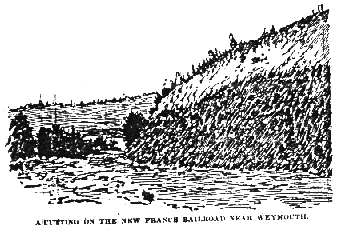
A Cutting on the New France Railroad near Weymouth
The other of our illustrations shows the second of Messrs. Stehelin's engines, as it
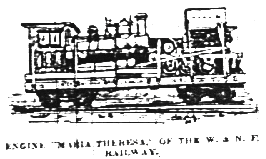 passed through Digby recently on a D.A.R. [Dominion Atlantic Railway] freight train.
The "Maria Theresa", as it is named, is a neat and powerful-looking little locomotive. It required ten pairs of oxen to convey it from Weymouth station to the mills at New France, and it was a good load for them. It has been tested on the part of the track already completed and beyond a slight difficulty in its speed government, which can be easily overcome, it has worked very satisfactorily. The road will be pushed forward to completion as speedily as possible. Messrs. Stehelin have named it the "Weymouth & New France Railway".
passed through Digby recently on a D.A.R. [Dominion Atlantic Railway] freight train.
The "Maria Theresa", as it is named, is a neat and powerful-looking little locomotive. It required ten pairs of oxen to convey it from Weymouth station to the mills at New France, and it was a good load for them. It has been tested on the part of the track already completed and beyond a slight difficulty in its speed government, which can be easily overcome, it has worked very satisfactorily. The road will be pushed forward to completion as speedily as possible. Messrs. Stehelin have named it the "Weymouth & New France Railway".
[Digby Weekly Courier, 8 October 1897]
Electric City
Electric City, which is marked on Nova Scotia maps as New France, existed only from 1895 to 1912, yet it had an impact on life in Nova Scotia that continues today (2001). About seventeen miles 27 km south of Weymouth, it was listed as a part of the Parish of Digby, in the County of Digby.
The aristocratic Jean Jacques Stehelin arrived in Digby County in 1892, and built a homestead, large enough to house all fourteen members of his family, modeled on his family home back in St. Charles, France. In 1895 the family joined him and helped to build the rest of the settlement.
They developed a lumbering operation with a sawmill, and built a bunkhouse for the loggers. There was a cookhouse and gardens to provide the meals. The barn, home to horses and oxen, took two months to complete, and measured fifty feet by fifty feet fifteen by fifteen metres, with a high roof. They built a large chicken coop, and bred Plymouth Rock hens for eggs. There were extensive kennels with dogs to accompany the men when they went out into the woods to hunt. Eventually there was a wine cellar, a chapel, an office, a clubhouse for relaxation, and a boathouse called the casino. The Stehelin family even constructed a pole railway and trains ran to Weymouth to move the lumber produced in the New France sawmill.
Two dams were built of logs and gravel to raise the level of Little Tusket Lake and channel the water flow to the Silver river. This powered the sawmill. There were three turbines which drove long hardwood shafts. Placed at intervals along the shafts were pulleys with belts that powered the gang saw, the haul-up, the trimmer, the edger, and the planer.
A small building beside the mill, called the powerhouse, housed a dynamo, a rotating machine that produced direct current electric power to provide light for the settlement's buildings, a full twenty years before Weymouth was first supplied with electric power in 1926. It was this that caused New France to be popularly known as Electric City.
The forests of Digby County were diverse and rich in hardwoods. The mill at New France exported maple, oak, beech and birch lumber for sale for flooring and doors, as well as red spruce and balsam fir for framing, and white pine for ships' masts. The mill could saw and trim fifteen thousand board feet of lumber in a single day, and much of the product was sold to South America and England.
A hundred years ago the Stehelin family entertained friends and business colleagues from around the world with dinners, dances, hunting and skating. New France blended European French, Acadian, Black and Mi'kmaq cultures. In its short history it had a major impact on the culture of southwestern Nova Scotia, including a role in the development of today's Universite Ste. Anne. Today only a few foundations remain visible at New France.
To get to New France from Weymouth, travel south on Route 340 for seventeen kilometres, then turn east on Langford Road and drive another 5.5 km. At Southville Corner, turn on to the dirt road and after 11 km turn north on Silver Road, which leads to the settlement.
[Down Memory Lane, in the Middleton Mirror-Examiner, 19 July 2000]
Reference:
Industry Canada Internet history resources, Electric City
http://epe.lac-bac.gc.ca/100/205/301/ic/cdc/electric/english/enter.html
Weymouth Terminal Railway Company Limited
Digby County
NSL 1900 chapter 119 — Act to incorporate the Weymouth Terminal Railway Co. Ltd.
Whitehaven Branch Railway Company
NSL 1853 chapter 41 — Act to incorporate the Whitehaven Branch Railway Co.
Whitehaven, New Glasgow & North Shore Railway Company
NSL 1873 chapter 38 — Act to incorporate the Whitehaven, New Glasgow & North Shore Railway Co.
Whitehaven Railway Company Limited
NSL 1877 chapter 74 — Act to incorporate the Whitehaven Railway Co. Ltd.
NSL 1879 chapter 68 — Amendment
NSL 1886 chapter 164 — Act to revive and amend, and change name to Guysborough & Atlantic Railway Co. Ltd.
NSL 1889 chapter 123 — Amendment
NSL 1890 chapter 78 — Change name back to Whitehaven Railway Co. Ltd.
NSL 1893 chapter 180 — Amend, and extend time
NSL 1896 chapter 106 — Amendment
See: Guysborough & Atlantic Railway Co. Ltd.
White Rock Mills Tramway
Gaspereaux, Kings County
NSL 1873 chapter 24 — Act to authorize the construction of a Tramway from White Rock Mills, by S.P. Benjamin and others
See: S.P. Benjamin Co. Ltd.
NSL 1897 chapter 111 — Act to incorporate S.P. Benjamin Co. Ltd.
NSL 1899 chapter 135 — Act to incorporate the Nova Scotia Electric Light Co. Ltd.
NSL 1900 chapter 165 — Amendments
Windsor & Annapolis Railway Company Limited W&AR
NSL 1865 chapter 13 —
NSL 1866 chapter 1 — Act to incorporate the Windsor & Annapolis Railway Co. Ltd.
NSL 1867 chapter 36 — Act to incorporate again the Windsor & Annapolis Railway Co. Ltd.
NSL 1867 chapter 40 — Act to provide for a Station at Windsor
NSL 1868 chapter 24 — To assess the Windsor & Annapolis Railway Co. for Dyke Rates
NSL 1868 chapter 32 — To appraise for damages for W&AR, in Kings County
NSL 1868 chapter 33 — To appraise for damages for W&AR, in Annapolis County
NSL 1868 chapter 34 — Amendment, providing for three Arbitrators for Kings County
NSL 1869 chapter 23 —
NSL 1870 chapter 30 — Relating to assessments of property of the Windsor & Annapolis Railway Co. Ltd.
NSL 1870 chapter 31 —
NSL 1870 chapter 32 —
NSL 1870 chapter 33 —
NSL 1870 chapter 56 —
NSL 1873 chapter 86 — Act to incorporate the Windsor & Annapolis Railway Mutual Sick and Accident Fund Society
NSL 1877 chapter 28 —
NSL 1878 chapter 22 —
NSL 1880 chapter 69 —
NSL 1885 chapter 89 — Act to authorize the W&AR to change the location of the Middleton Station
NSL 1886 chapter 1 — Act to provide for completion and consolidation of Railways between Halifax and Yarmouth
NSL 1886 chapter 2 —
NSL 1892 chapter 107 — Re Cornwallis Valley Railway Co. Ltd.
NSL 1893 chapter 46 — Change the name of Western Counties Railway Co. Ltd. to Yarmouth & Annapolis Railway Co. Ltd.
NSL 1893 chapter 102 — Amend chapter 107 of 1892
NSL 1893 chapter 141 — Authorize the sale of the Yarmouth & Annapolis Railway to the W&AR
NSL 1893 chapter 142 — Authorize the purchase of the Yarmouth & Annapolis Railway by the W&AR
NSL 1893 chapter 143 — Amend chapter 141 of 1893
See: Cornwallis Valley Railway Co. Ltd.
See: Dominion Atlantic Railway Co. Ltd.
See: Halifax & Great Western Railway Co. Ltd.
See: Missing Link Railway
See: Western Counties Railway Co. Ltd.
See: Yarmouth & Annapolis Railway Co. Ltd.
Windsor & Annapolis
Railway
Stations
1893
|
miles
|
Station |
miles
|
km |
| 0 |
North Street Station, Halifax
|
0.0 |
0.0 |
| 4 |
Rockingham
|
4.1 |
6.6 |
| 9 |
Bedford
|
8.7 |
14.0 |
| 12 |
Rocky Lake
|
11.4 |
18.4 |
| 14 |
Windsor Junction |
13.9 |
22.4 |
| 17 |
Beaver Bank |
16.8 |
27.0 |
| 27 |
Mount Uniacke |
26.8 |
43.1 |
| 34 |
Stillwater |
33.4 |
53.8 |
| 37 |
Ellershouse |
36.8 |
59.2 |
| 40 |
Newport |
39.8 |
64.1 |
| 43 |
Three Mile Plains |
42.7 |
68.7 |
| 46 |
Windsor |
45.6 |
73.4 |
| 48 |
Falmouth |
46.9 |
75.5 |
| 51 |
Mount Denson |
- |
- |
| 53 |
Hantsport |
52.5 |
84.5 |
| 58 |
Avonport |
57.0 |
91.8 |
| 60 |
Horton Landing |
59.4 |
95.6 |
| 61 |
Grand Pre |
60.6 |
97.6 |
| 64 |
Wolfville |
63.6 |
102.4 |
| 66 |
Port Williams |
65.4 |
105.3 |
| 71 |
Kentville |
70.6 |
113.7 |
| 76 |
Coldbrook |
75.0 |
120.8 |
| 78 |
Cambridge |
77.6 |
124.9 |
| 80 |
Waterville |
79.8 |
128.5 |
| 83 |
Berwick |
82.7 |
133.1 |
| 88 |
Aylesford |
88.0 |
141.7 |
| 90 |
Auburn |
89.6 |
144.3 |
| 95 |
Kingston |
96.1 |
154.7 |
| 98 |
Wilmot |
97.6 |
157.1 |
| 102 |
Middleton |
101.2 |
162.9 |
| 108 |
Lawrencetown |
107.6 |
173.2 |
| 111 |
Paradise |
110.4 |
177.7 |
| 116 |
Bridgetown |
115.2 |
185.5 |
| 120 |
Tupperville |
- |
- |
| 124 |
Round Hill |
122.9 |
197.9 |
| 130 |
Annapolis Royal |
129.1 |
207.9 |
|
Note 1: Belcher's Almanack, 1893, (page 164)
|
Note 2: Altitudes in the Dominion of Canada, 1915
(pages 19, 283) by James White, F.R.S.C., F.R.G.S.
Deputy Head of the Commission of Conservation
Ottawa
|
|
Windsor & Annapolis Railway
Passenger Train Timetable
Commencing 18 November 1889

Source: The Western Chronicle (weekly newspaper)
— Source:
W&AR advertisement in the Kentville Western Chronicle, 12 March 1890
Order in Council 1868-0284
Subject: Minister of Finance – Messrs Painchaud, Barry and Clarke for exchange on payment of Nova Scotia Bonds, Windsor and Annapolis Railway - If the Government of Nova Scotia approve - Canada to assume said Bonds amounting to £24,700 as part of Debt of Nova Scotia
OIC 1868-0284, page 1
OIC 1868-0284, page 2
On an application from Mr. C. Grant as agent for Messrs Painchaud, Barry and Clarke for payment in Exchange of £24,700 Sterling of the Bonds of Nova Scotia issued to them as contractors for the Windsor & Annapolis Railway...
Approved: 6 February 1868

Windsor Branch Railway
Windsor Junction - Mount Uniacke - Ellershouse - Windsor
See: Canadian Government Railways
See: Dominion Atlantic Railway Co. Ltd.
See: Stewiacke Valley & Lansdowne Railway Co. Ltd.
See: Windsor & Annapolis Railway Co. Ltd.
Windsor & Hantsport Railway Company Limited W&HR
Windsor - Ellershouse - Mount Uniacke - Windsor Junction
Windsor - Mantua
Windsor - Hantsport - Wolfville - New Minas
- The Windsor & Hantsport Railway Company Limited [RJSC ID#2266257] was incorporated on 10 December 1993. As of 2 November 2001, it had its registered office at 1601 Lower Water Street, Halifax, Nova Scotia, and the company's directors were:
- Robert T. Schmidt, Alexandria, Virginia; CEO
- Daniel R. Sabin, Northville, Michigan; President
- Benjamin F. ("Pete") Collins, Livonia, Michigan; Vice President
- John F. Depodesta, Alexandria, Virginia; Chairman
Source: Nova Scotia Registry of Joint Stock Companies [RJSC]
http://www.gov.ns.ca/snsmr/business/rjsc/
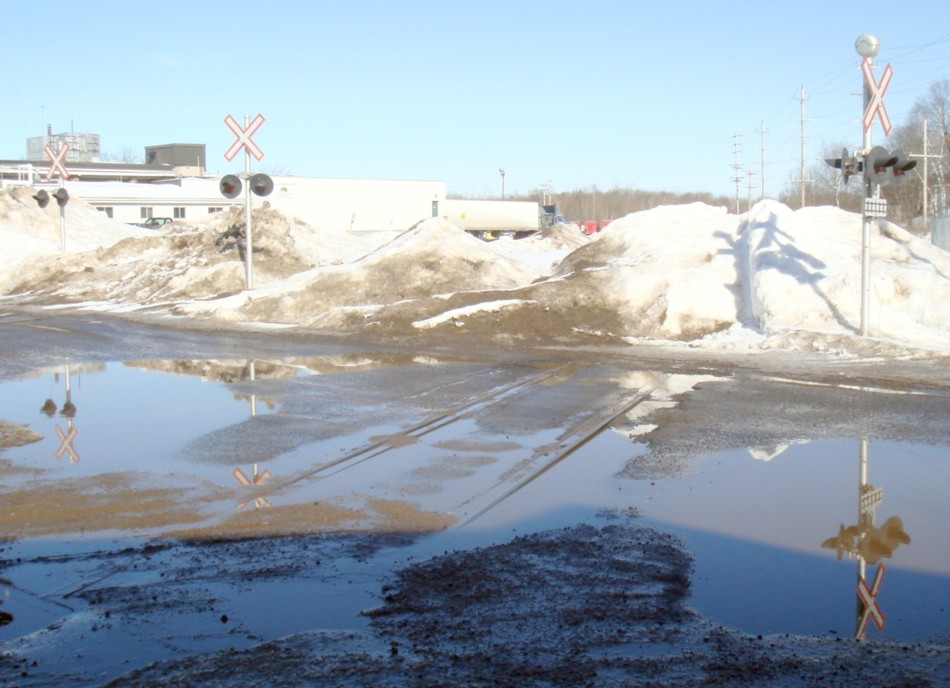
The Windsor & Hantsport Railway, New Minas,
Minas Warehouse Road crossing (three tracks), 18 February 2009
eighteen months after the Last Train departed on 17 August 2007
Train to New Minas 15 June 2007
http://ns1763.ca/rail/whr-minas-june15.html
Train to New Minas 22 June 2007
http://ns1763.ca/rail/whr-minas-june22.html
Train to New Minas 27 June 2007
http://ns1763.ca/rail/whr-minas-june27.html
Yarmouth & Annapolis Railway Company Limited
NSL 1870 chapter 81 — Act to incorporate the Western Counties Railway Co.
NSL 1893 chapter 46 — Change the name of Western Counties Railway Co. Ltd. to Yarmouth & Annapolis Railway Co. Ltd.
NSL 1893 chapter 141 — Authorize the sale of the Y&AR to the Windsor & Annapolis Railway Co. Ltd.
NSL 1893 chapter 142 — Authorize the purchase of the Y&AR by the Windsor & Annapolis Railway Co. Ltd.
NSL 1893 chapter 143 — Amend chapter 141 of 1893
NSL 1894 chapter 28 —
See: Dominion Atlantic Railway Co. Ltd.
See: Western Counties Railway Co. Ltd.
See: Windsor & Annapolis Railway Co. Ltd.
Yarmouth & Digby Electric Railway Company Limited
NSL 1902 chapter 135 — Act to incorporate the Yarmouth & Digby Electric Railway Co. Ltd.
NSL 1903 chapter 240 — Amendment
NSL 1909 chapter 186 — Act to reincorporate the Yarmouth & Digby Electric Railway Co. Ltd.
Yarmouth & Eastern Railway Company Limited
(intended to be an electric railway between Yarmouth and Wedgeport)
NSL 1909 chapter 188 — Act to incorporate the Yarmouth & Eastern Railway Co. Ltd.
Yarmouth Street Railway Company Limited
NSL 1887 chapter 93 — Act to incorporate the Yarmouth Street Railway Co. Ltd.
NSL 1889 chapter 124 — Amend, limiting time for commencement of construction
NSL 1890 chapter 191 — Amend, extending time
NSL 1892 chapter 176 — Amend, as to quality of rails
NSL 1892 chapter 182 — Amend, further extending time
NSL 1893 chapter 186 — Amendments
NSL 1904 chapter 145 — Act to consolidate Acts relating to the Yarmouth Street Railway Co. Ltd.
NSL 1908 chapter 139 — Amendment
NSL 1912 chapter 243 — Amendment

Yarmouth electric streetcar, circa 1900, on Main Street at John Street.
The streetcar is travelling away from the camera.
Source: http://www.novascotia-cyberstores.com/oldpix/street29.html

Electric streetcar, Main Street, Yarmouth, mid-1890s.
This car is travelling toward the camera. Note the buggy, beside the streetcar,
driving on the left side of the street as everyone in Nova Scotia did at that time.
The streetcars ran mostly on a single track located in the middle of Main Street,
with a short stretch, about a block, of double track at the halfway point.
Source: http://www.novascotia-cyberstores.com/oldpix/street4.html

Yarmouth electric streetcar in winter, on Main Street near Forest Street.
Source: http://www.novascotia-cyberstores.com/oldpix/street26.html
Yarmouth to Saint John Electric Railway
Yarmouth, Nova Scotia:–
Notice is given of the application to the Dominion Government for charters to confer power for building and operating an electric railway between Yarmouth and New Brunswick. E. Franklin Clements, the applicant, says the idea is to follow the main line of travel from Yarmouth, skirting the shore to Weymouth, thence to Truro, Amherst, and into St. John, New Brunswick. Water power, including tidal waters, is to be utilized to power the railway. The cost of travel, it is claimed, will be fifty per cent less than on any existing railroad.
— The Electrical World, New York, v24 n20, 21 November 1894
Canadian Army Train in Nova Scotia
11-17 March 1942
Canadian Army Train at Halifax
Wednesday, 11 March 1942
The Canadian Army Exhibition Train, 15 cars containing more than three million dollars worth of the tools of war for which Canadians are working and saving, arrived in Halifax early this morning. Preparations were made immediately to display the train to thousands of Haligonians the greatest assembly of weapons of war ever exhibited here.
Where to See the Train
The train is standing in Halifax at the South Terminal, Union Station, on a siding on the east side of the station. Enter the front of the station and guides will direct the way to the train. The train will be open for the public to view from 11:30 this morning until 10 o'clock tonight. As an added feature the Pictou Highlanders band will play at the Parade Grounds and parade to the station three times during the day: 11am, 2pm, and 7pm.
The purpose of the Army Train inspection is to acquaint Canadians with the expensive tools of war and the great need for them, and to give youth an insight into the highly modernized way of army life.
The train is made up of fifteen coaches which bear the colors of the four Canadian Divisions now overseas: red, blue, French gray, and maroon.
Members of the Signal Corps, working with the latest in modern communication equipment, will demonstrate communications systems of armies in the field. A placard display shows how folding boat bridges and pontoon bridges are rapidly thrown across rivers by the Royal Canadian Engineers, and how other natural obstacles are surmounted.
An interesting display of army food is brought to the train daily and arranged in one of the largest exhibits featured on the train. One car is devoted to showing the completeness and utility of the soldier's wardrobe. All the essential items of army dress in all climates are featured in this car which is under the supervision of the Royal Canadian Ordnance Corps.
[Excerpted from The Halifax Herald, 11 March 1942]
Canadian Army Train at New Glasgow
Thursday, 12 March 1942
Due to the large crowds from the town of New Glasgow and surrounding districts, the Army Train which was scheduled to stay at New Glasgow from 10:00 to 11:30 a.m., remained until 12:45 to give everyone the opportunity to view the train's exhibits. At 12 the station was still densely packed with people, many of them school children who had been standing more than an hour waiting their turn. It was estimated that over 4,000 people passed through the train.
[The Halifax Herald, 12 March 1942]
Canadian Army Train at Antigonish
Thursday, 12 March 1942
The Canadian Army Train was inspected by 2912 people at Antigonish this afternoon. Half an hour late from New Glasgow, the train arrived at 2:30, and left for Sydney at 5:15 o'clock.
[The Halifax Herald, 12 March 1942]
Canadian Army Train at Pictou
Sunday, 15 March 1942
Conductor Dan Hay left Stellarton railway yard on an extra [not in the regular schedule] train on Saturday, March 14th, to bring the Canadian Army Train, consisting of 15 cars, from Mulgrave. The train arrived in Stellarton Sunday morning, March 15th, and was taken to Pictou, where thousands of people passed through the train.
[The Halifax Herald, 16 March 1942]
The Army Train, on a four-hour stop at Pictou, was visited by 4151 persons. Many from the upper towns who had not an opportunity of seeing it when it stopped in New Glasgow last Thursday, motored down on Sunday, and surrounding rural districts were also well represented. Shipyard employees working seven days a week were given an extra hour at lunch to visit the train. Originally scheduled to be open for inspection from 10 to 11:59 a.m., the time was extended to 2 p.m. so that it did not necessarily interfere with attendance at morning church services.
[The Halifax Herald, 16 March 1942]
Canadian Army Train on the South Shore
Shelburne, Liverpool, Bridgewater, and Lunenburg
Tuesday, 17 March 1942
The Canadian Army Train passed over the South Shore railway line on Tuesday, March 17th, making stops at Shelburne, Liverpool, Bridgewater, and Lunenburg. Some 2400 people visited the train at Liverpool, about 2700 at Bridgewater, and about 2500 at Lunenburg. The train was in charge of Conductor R.C. Roop, and was powered by two steam locomotives, required to handle the unusual weight of a long train of heavy passenger equipment on the steep grades of the Halifax & South Western Railway. It had fifteen cars, consisting of one observation car, one diner, four sleepers, seven baggage cars carrying the demonstration equipment, and two flat cars with other equipment. Railway officials accompanying the train over the South Shore railway were Master Mechanic J.A. Fraser of Halifax, Trainmaster G.O. Baker, and Roadmasters S.J. Cook and J.E. Kelly of Bridgewater.
[The Halifax Herald, 20 March 1942]
Special Treatment
|
Why So Many Passenger Trains?
|
Canadian Army Train Crossing Canada
18 February 1942
Canadian Army Train
18 February 1942
Canadian Army Train has 500,000th Visitor
Monday, 30 March 1942
The Canadian Army Train celebrated its visit to Hull, Quebec, on March 30th, by passing the 500,000th visitor through its displays of army weapons and equipment.
[The Halifax Herald, 31 March 1942]
General-Purpose Railway Acts Of Nova Scotia
(not known to be associated with a specific railway company)
NSL 1818 chapter 22 — Act to facilitate the opening and working His Majesty's Coal Mines, including authority to construct a railway
NSL 1858 chapter 11 — City of Halifax, To carry out the provisions of Act to authorize a Loan for construction of Railways
NSL 1861 chapter 40 — For assessing the City of Halifax for Railway liabilities
NSL 1868 chapter 32 — Appraisal of land in Kings County taken for railway rights of way
NSL 1868 chapter 33 — Appraisal of land in Annapolis County taken for railway rights of way
NSL 1869 chapter 33 — Re appraisal of land in Kings County taken for railway rights of way
NSL 1869 chapter 34 — Appointment of Commissioners to appraise land in Kings County taken for railway rights of way
NSL 1869 chapter 37 — Appointment of Commissioners to appraise land in Annapolis County County taken for railway rights of way
NSL 1870 chapter 31 — To provide for Municipality of East Hants to pay for land taken for railway purposes
NSL 1870 chapter 32 — To provide for Municipality of West Hants to pay for land taken for railway purposes
NSL 1870 chapter 33 — Act to legalize the loan of money (to/from?) Annapolis County to buy land for railway rights of way
NSL 1873 chapter 24 — Act for the construction of a Tramway (in Kings County?)
NSL 1874 chapter 59 — Act to authorize Township of Yarmouth to borrow money to pay for land for railway rights of way
NSL 1875 chapter 22 — Act to encourage the building of railways: Middleton to Bridgewater; Strait of Canso to Broad Cove
NSL 1875 chapter 30 — Act to encourage the building of a railway from Strait of Canso to Louisburg
NSL 1876 chapter 2 — Act to amend chapter 22 of 1875
NSL 1876 chapter 57 — To provide for Digby County to pay for land taken for railway purposes
NSL 1877 chapter 5 — Re Supreme Court at Kentville
NSL 1877 chapter 30 — Act to revive and amend chapter 22 of 1875
NSL 1877 chapter 41 — Act to reappraise land in Annapolis County taken for railway rights of way
NSL 1877 chapter 42 — Act to provide for payment for land in Annapolis County taken for railway rights of way
NSL 1877 chapter 50 — To amend chapter 57 of 1876
NSL 1878 chapter 7 — Re Supreme Court at Kentville
NSL 1878 chapter 24 — Act to revive and continue chapter 22 of 1875
NSL 1878 chapter 32 — Act to provide for payment for land in Antigonish County taken for railway rights of way
NSL 1878 chapter 35 — Act to appoint commissioners to reappraise land in Digby County taken for railway rights of way
NSL 1881 chapter 24 — To appropriate a lot of land for a Railway Terminus in the City of Halifax
NSL 1881 chapter 49 — Act to authorize Municipality of Yarmouth County to redeem railway bonds
NSL 1883 chapter 32 — Act to authorize the Town of Dartmouth to levy an assessment in aid of Railway extension
NSL 1883 chapter 49 —
NSL 1884 chapter 1 — Act to authorize transfer of certain Railways and Property
NSL 1885 chapter 54 — Act to authorize Antigonish County to assess for land taken for railway rights of way
NSL 1886 chapter 92 — To settle by arbitration, a dispute between the Municipalities of Guysborough and St. Mary's, respecting land bought for railway rights of way
NSL 1888 chapter 83 — Re land in Inverness County taken for railway rights of way
NSL 1888 chapter 90 — Act to authorize the Municipalities of Shelburne and Barrington to assess themselves to pay for land taken for railway rights of way
NSL 1890 chapter 98 — Act to authorize the Municipality of Colchester County to borrow money to buy land for railway rights of way
NSL 1890 chapter 105 — Act to authorize Municipality of Kings County to borrow money to pay for right of way land
NSL 1891 chapter 47 — Act to amend County Incorporations Act
NSL 1892 chapter 128 — Act to authorize Town of Yarmouth to borrow money to buy Railway Stock
NSL 1893 chapter 135 — To authorize municipalities to assess for buying land for railway rights of way
NSL 1893 chapter 136 — To authorize municipalities to borrow money to pay railway bonds
NSL 1893 chapter 117 — Respecting land for railway rights of way
NSL 1896 chapter 79 — Respecting Poll Tax for buying land for railway rights of way
NSL 1898 chapter 106 — To amend chapter 83 of 1888, buying land in Inverness County for railway rights of way
NSL 1899 chapter 58 — Act relating to City of Halifax, railway track across Kempt Road, siding for Imperial Oil Co., etc.
NSL 1899 chapter 101 — Act relating to payment for land for railway purposes, by the Town of Windsor
NSL 1899 chapter 102 — Act relating to payment for land for railway purposes, by the Municipality of East Hants
NSL 1899 chapter 123 — Act for reappraisal of land for railway purposes, by the Municipality of Barrington
NSL 1900 chapter 81 — To authorize the Municipality of Inverness County to borrow $60,000 for purchase of land for railway rights of way
NSL 1900 chapter 82 — To repeal and supersede chapter 106 of 1898, railway damages in Inverness County
NSL 1900 chapter 86 — Respecting payment by Town of Port Hawkesbury for land for railway rights of way
NSL 1901 chapter 107 — To provide for further construction of a railway in Inverness County
NSL 1901 chapter 109 —
NSL 1901 chapter 111 — Act to confirm agreement between Inverness Municipality and Town of Port Hawkesbury respecting land for railway purposes
NSL 1902 chapter 62 — Act respecting railway right of way in the Town of Bridgetown
NSL 1902 chapter 103 —
NSL 1902 chapter 104 — Act respecting buying land in Inverness County for railway rights of way
NSL 1902 chapter 105 — Act ratifying agreement between Inverness Municipality and Town of Port Hawkesbury respecting land for railway purposes
NSL 1902 chapter 122 — To authorize Municipality of Richmond to borrow money to pay for land for railway rights of way
NSL 1902 chapter 123 — Act to confirm appointment of appraiser and to divide Richmond County for appraisal of value of land taken for railway rights of way
NSL 1903 chapter 96 —
NSL 1903 chapter 117 — To amend chapter 62 of 1902, respecting railway right of way in the Town of Bridgetown
NSL 1903 chapter 119 — To authorize Annapolis Municipality to borrow money to pay for land for railway rights of way
NSL 1903 chapter 129 — To amend chapter 101 of 1899, respecting payment for land for railway purposes, by the Town of Windsor
NSL 1903 chapter 132 — To amend chapter 98 of 1899, respecting payment for land for railway purposes, by the Municipality of West Hants
NSL 1903 chapter 133 — To amend chapter 102 of 1899, respecting payment for land for railway purposes, by the Municipality of East Hants
NSL 1903 chapter 145 — To authorize Shelburne and Barrington Municipalities to assess for cost of land taken for railway purposes
NSL 1904 chapter 105 — To authorize Municipality of Lunenburg to borrow money to pay for land for railway rights of way
NSL 1904 chapter 106 — Respecting land for railway rights of way in the Municipality of Lunenburg
NSL 1904 chapter 123 — To authorize Queens Municipality to borrow money to pay for land for railway rights of way
NSL 1905 chapter 99 —
NSL 1905 chapter 117 — To amend chapter 123 of 1904
NSL 1905 chapter 120 — To authorize Shelburne Municipalitiy to borrow money to pay for land taken for railway rights of way
NSL 1905 chapter 125 — To authorize Barrington Municipalitiy to borrow money to pay for land taken for railway rights of way
NSL 1906 chapter 124 —
NSL 1906 chapter 147 — To authorize Town of Liverpool to borrow money to pay for land for railway rights of way
NSL 1906 chapter 151 — To authorize Shelburne Municipalitiy to borrow money to pay for land taken for railway rights of way
NSL 1907 chapter 124 — To authorize Town of Bridgewater to grant concessions to a Car Manufacturing company
NSL 1907 chapter 134 — To authorize Queens Municipality to borrow money to pay for land for railway rights of way
NSL 1908 chapter 111 —
NSL 1908 chapter 125 — To authorize Town of Liverpool to borrow money to pay for land for railway rights of way
NSL 1909 chapter 93 —
NSL 1910 chapter 74 —
NSL 1920 chapter 99 — Act to confirm resolution respecting railway siding for Amherst Pianos Co. Ltd.
NSL 1936 chapter 60 — Act to authorize Eastern Hay & Feed Co. Ltd. to construct a railway siding across Sackville Road
NSL 1952 chapter 93 — Act respecting Proposed Road adjacent to the Railway Station Grounds in the Town of Bridgewater
NSL 1955 chapter 81 — Act to Extinguish Right Of Way for Electric Railway, etc., in Fleming Glen Subdivision, Halifax County
NSL 1959 chapter 92 — Act to Extinguish Right Of Way for Electric Railway, etc., in Fleming Heights Subdivision, Halifax County
NSL 1960 chapter 86 — Act to Extinguish Right Of Way for Electric Railway, etc., in Fleming Heights Subdivision, Halifax County
Unless otherwise stated, "Act" means an Act of the Nova Scotia Legislature.
Where it appears above, "NSL" refers to the Nova Scotia Legislature.
In the old days, Acts were often dated not by the calendar year but by the year of reign of the current sovreign. Example: The Act to incorporate the Halifax & Cape Breton Railway & Coal Company is often listed as "39 Vic. c. 74", meaning chapter (Act) number 74 passed in March 1876, the 39th year of the reign of Queen Victoria. The legislative references above have all been converted to the calendar year, but the reignal year may be needed if you want to look up the original Act. Example: to find the 1836 Act to incorporate the General Mining Association you will need to ask for 6 Wm. IV c. 87. The conversion between a reignal year and a calendar year is not just a simple addition or subtraction, because the beginning of a reign rarely coincides with the beginning of a calendar year.
|
"3 Wm. IV" means 26 June 1832 to 25 June 1833 |
"6 Wm. IV" means 26 June 1835 to 25 June 1836 |
|
"5 Vic." means 20 June 1841 to 19 June 1842 |
"10 Vic." means 20 June 1846 to 19 June 1847 |
|
"15 Vic." means 20 June 1851 to 19 June 1852 |
"20 Vic." means 20 June 1856 to 19 June 1857 |
|
"25 Vic." means 20 June 1861 to 19 June 1862 |
"30 Vic." means 20 June 1866 to 19 June 1867 |
|
"35 Vic." means 20 June 1871 to 19 June 1872 |
"40 Vic." means 20 June 1876 to 19 June 1877 |
|
"45 Vic." means 20 June 1881 to 19 June 1882 |
"50 Vic." means 20 June 1886 to 19 June 1887 |
|
"55 Vic." means 20 June 1891 to 19 June 1892 |
"60 Vic." means 20 June 1896 to 19 June 1897 |
|
"4 Edw. VII" means 22 Jan. 1904 to 21 Jan. 1905 |
"8 Edw. VII" means 22 Jan. 1908 to 21 Jan. 1909 |
|
"5 Geo. V" means 6 May 1914 to 5 May 1915 |
"10 Geo. V" means 6 May 1919 to 5 May 1920 |
Gross Earnings
Nova Scotia Railways
1880 - 1882
|
| Railway |
1880 |
1881 |
1882 |
| Eastern Extension |
- |
$57,080 |
$69,747 |
| Windsor & Annapolis |
$180,140 |
$187,387 |
$214,770 |
| Western Counties |
$13,509 |
$36,976 |
$44,741 |
Spring Hill &
Parrsboro |
$17,649 |
$19,372 |
$21,745 |
International Railway
of Cape Breton |
$644 |
$887 |
$1,654 |
Sydney & Louisburg
Coal & Railway Co. |
$241 |
$2,406 |
$2,259 |
Source:
Appendix No. 7, Journal and Proceedings of
the Legislative Council of Nova Scotia, 1883
|
|
Note 1: The ICR is not included in these statistics; it was owned and operated by the Dominion Government and did not report traffic or financial statistics to the provincial government.
|
|
Note 2: "Gross Earnings", often called Gross Income or Gross Receipts, is the amount of money taken in during each year from all sources, before expenses. Freight, mail and passengers were the main sources of income for these railways, but there were other minor sources.
|
|
Gross Earnings
Nova Scotia Railways
1887 - 1892
|
| Railway |
1887 |
1888 |
1889 |
1890 |
1891 |
1892 |
Windsor &
Annapolis |
$228,952 |
$241,969 |
$269,733 |
$269,415 |
$292,607 |
$316,687 |
Western
Counties |
$52,125 |
$55,135 |
$65,199 |
$69,173 |
$88,137 |
$104,643 |
Cumberland
Railway &
Coal Co. |
$47,450 |
$35,261 |
$42,928 |
$45,874 |
$59,952 |
$61,203 |
| Totals |
$328,527 |
$332,365 |
$377,860 |
$384,462 |
$440,696 |
$482,533 |
Source:
Appendix No. 7, page 1,
Journals of the Legislative Council of Nova Scotia, 1893
|
|
Note 1: The ICR is not included in these statistics; it was owned and operated by the Dominion Government and did not report traffic or financial statistics to the provincial government.
|
|
Note 2: "Gross Earnings", often called Gross Income or Gross Receipts, is the amount of money taken in during each year from all sources, before expenses. Freight, mail and passengers were the main sources of income for these railways, but there were other minor sources.
|
|
Note 3: The Cumberland Railway & Coal Co. used to be named the Spring Hill & Parrsboro Railway & Coal Co.
|
|
Note 4: The following is excerpted from the Provincial Engineer's Report for 1892:
For the Western Counties Railway Company, the increase of $16,506 for 1892 over 1891 is partly due to the additional 20 miles 32 km in operation between Digby and Annapolis, open throughout the year 1892, whereas it was operated only for the last six months of 1891.
The earnings from railway operations of the Cumberland Railway & Coal Company's line, 32 miles 51 km, is chiefly due to the transport of coal from the Spring Hill Colliery; it depends upon the production of the coal mines and the quantity forwarded by rail to Parrsboro' for shipment.
|
|
Note: The above list of Nova Scotia railway companies was compiled by reviewing the complete list of Private and Local Acts of Nova Scotia for the years 1758 to 1989, inclusive, and selecting each company which had "Railway" or "Railroad" or "Tramway" in its corporate name. These companies make up most of this list, but certain other companies have been included.
It was not unusual for the Act of Incorporation of a manufacturing or mining company to include wording authorizing the company to build and/or operate transportation facilities. For example, mining companies often need a way to transport large quantities of minerals such as ore, coal, or gypsum. Any company known to have been granted legal authority to build and/or operate a railway or tramway has been included. Examples are: Dominion Steel & Coal Corporation, Minudie Mining & Transportation Company Limited, Sissiboo Pulp & Paper Company Limited, Vale Coal, Iron, & Manufacturing Company Limited, and Wentworth Gypsum Company.
Also included are selected companies whose line of business was closely related to railways. Examples are: Rhodes, Curry & Company Limited, Illinois Steel Solid Forge Car Wheel Company Limited, and Silliker Car Company Limited.
Note on alphabetization: The above list of railway companies was put in alphabetical order by reading each name as if all spaces, ampersands, hyphens and commas had been deleted. Where the legal corporate name began/begins with “The”, it has been omitted here.
Rules for the Construction of Corporate Names for historical and archiving purposes. "The Rules are designed for the consistent construction of proper names in the description, cataloguing and indexing" of archives...
http://anws.llgc.org.uk/ncarules/rules4.htm
First Railways in Canada
The first use of railways in Canada can be traced back more than two and a half centuries, and originated in the province of Nova Scotia.
Originally, railways, or their crude predecessors, were used merely to facilitate industrial processes. It was not for at least another century until they were used to transport passengers, and the creation of passenger teminals found their unrefined beginnings.
Evidence has been discovered of the first known railway used in Canada near the Fortress of Louisbourg in Cape Breton. During the construction of the fortress in the 1720s this railway, drawn by horses, was used to transport stone from a nearby quarry to the site for the construction of the ramparts.
Similar types of horse-drawn tramways were used throughout British North America for industrial purposes through the next century, and progressed slowly beyond the al1-wood carts and wooden rails first used at the Fortess of Louisbourg site. A similar process was used in the construction of the Rideau Canal in Bytown (now Ottawa) in the 1820s for transporting stone to be used in the locks and weirs of the canal, and again in the construction of Quebec city's Citadel in the 1820s, this time however powered by a stationary steam engine which powered the tramway up the steep incline of the cliff-side.
The next milestone in Canadian railway history came once again in Nova Scotia at the unlikely location of the former Albion Mines near the town that is now Stellarton [in Pictou County]. In 1829 the mining Company there used a rudimentary railway system for transporting coal from their mines to a wharf for shipment, and ran over cast-iron rails manufactured at the mine site; these rails are considered to be the first iron rails manufactured on the North American continent.
Within a decade, the same mine imported from England a steam locomotive to transport their coal over a six mile track, and began running the first railroad in Nova Scotia. This locomotive was a technological advancement over most previous railroad operations in North America, and was among the largest and most powerful of engines on the continent, along with being the first to burn coal and run over all-iron rails.
Source:
pages 4-5, The Conservation of Heritage Railway Stations in Canada, by Jeff Hayes, 1999, Thesis, Faculty of Architecture,
Dalhousie University - Daltech, Halifax
http://www.nlc-bnc.ca/obj/s4/f2/dsk2/ftp03/MQ39659.pdf
|
Also see:
A Legislative History of Nova Scotia Railways by John R. Cameron
 Rail Transit Alternatives for the Halifax Metropolitan Region
by McNutt, Kim Donald , 1982. The Halifax area is small compared to other Canadian cities with rail transit. However, demand figures show that the Halifax to Bedford-Sackville corridor could generate as much traffic as some heavy rail commuter runs in the Montreal area...
Rail Transit Alternatives for the Halifax Metropolitan Region
by McNutt, Kim Donald , 1982. The Halifax area is small compared to other Canadian cities with rail transit. However, demand figures show that the Halifax to Bedford-Sackville corridor could generate as much traffic as some heavy rail commuter runs in the Montreal area...
http://www.atlanticplanners.org/theses/theses82/mcnutt.htm
Towards a Policy Framework on Abandoned Railway Rights-of-Way in the Province of Nova Scotia
by Dhaneshwar K. Neermul, 1990. Given the number of railway line abandonments that have taken place in Nova Scotia, the time is opportune for a policy to be formulated to guide the disposition and reuse of this province's railway ROWs, before the opportunity to introduce alternative uses on these corridors is lost...
http://www.atlanticplanners.org/theses/theses90/neermul.htm
A Trensit Supportive Future for Halifax Regional Municipality: Challenges and Opportunities for Diesel Light Rail by Ken Todd Kelly, 1997. Halifax Regional Municipality is on the verge of making fundamental growth and urban form decisions ... Denser corridors of growth can be better served by transit, utilities and other infrastructure. In this regard many have suggested using the existing CN Rail line as a commuter service. Diesel Light Rail Transit would allow a short extension into the Central Business District...
http://www.atlanticplanners.org/theses/theses97/kelly.htm
Railways
The saga of the Samson, Canada's Oldest Locomotive
http://www.parl.ns.ca/samson/index.htm
Pictures of the Samson
http://www.parl.ns.ca/samson/images.htm
Excellent maps showing the railway travelled by the Samson
http://www.parl.ns.ca/samson/route.htm
Significant Dates in Nova Scotia Railway History — Before 1850
http://ns1758.ca/rail/sigdates-rail01.html
Significant Dates in Nova Scotia Railway History — 1850-1899
http://ns1758.ca/rail/sigdates-rail02.html
Significant Dates in Nova Scotia Railway History — 1900-1949
http://ns1758.ca/rail/sigdates-rail03.html
Significant Dates in Nova Scotia Railway History — From 1950
http://ns1758.ca/rail/sigdates-rail04.html
Significant Dates in Canadian Railway History by Colin Churcher.
An excellent compilation, with many Nova Scotia references.
1720: short tramway in Louisburg...
1818: A tramway was built to haul coal at Pictou...
A regular rail track was laid in 1829...
http://www.railways.incanada.net/candate/candate.htm
Nova Scotia Railway Heritage Society NSRHS website startup: 10 February 2003
http://novascotiarailwayheritage.com/index.htm
Historical Nova Scotian Railway Photographs Canadian National Railway stations
http://novascotiarailwayheritage.com/photos.htm
Historical Nova Scotian Railway Photographs Dominion Atlantic Railway stations
http://novascotiarailwayheritage.com/photos2.htm
The Railways of Nova Scotia Archives by Robert Chant
A Legislative History of Nova Scotia Railways by John R. Cameron
The Nova Scotia Railway Hall of Fame by Jay Underwood
Photographs of Shortline and Industrial Railways in Nova Scotia Pat & David Othen.
Nova Scotia has two shortlines — the Cape Breton and Central Nova Scotia Railway
and the Windsor & Hantsport Railway — and a variety of industrial operations
based on gypsum mining, coal mining and steel manufacture and fabrication. Be patient.
This page takes some time to download, but there are numerous good photographs of
railway operations in the 1990s in Nova Scotia.
Halifax & Southwestern Railway Museum Lunenburg
Nova Scotia Passenger Train Timetables
1936 DAR Passenger Train Schedule
Truro - South Maitland - Kennetcook - Scotch Village - Windsor
http://ns1758.ca/rail/railway11.html
1949 DAR Passenger Train Schedule
Halifax - Windsor - Kentville - Annapolis Royal - Digby - Yarmouth
http://ns1758.ca/rail/railway06.html
1949 DAR Passenger Train Schedule
Kingsport - Canning - Centreville - Aldershot - Kentville
http://ns1758.ca/rail/railway05.html
1949 DAR Passenger Train Schedule
Kentville - Hantsport - Windsor - Kennetcook - South Maitland - Truro
http://ns1758.ca/rail/railway04.html
1949 DAR-CNR Connecting Passenger Train Schedule
Windsor - Wolfville - Middleton - New Germany - Bridgewater
http://ns1758.ca/rail/railway07.html
1949 DAR-CNR Connecting Passenger Train Schedule
Yarmouth - Digby - Annapolis Royal - Middleton - New Germany - Bridgewater
http://ns1758.ca/rail/railway08.html
1949 DAR-CNR Connecting Passenger Train Schedule
Kingsport - Canning - Kentville - Middleton - New Germany - Bridgewater
http://ns1758.ca/rail/railway09.html
1949 DAR Passenger Train Schedule
Kingsport - Canning - Kentville - Hantsport - Windsor - Halifax
http://ns1758.ca/rail/railway10.html
1949 CNR-DAR Connecting Passenger Train Schedule
Sydney - Antigonish - Truro - Kennetcook - Windsor - Kentville - Digby - Yarmouth
http://ns1758.ca/rail/railway12.html
1949 CNR-DAR Connecting Passenger Train Schedule
Sydney - Antigonish - Truro - Windsor - Middleton - New Germany - Bridgewater
http://ns1758.ca/rail/railway13.html
CN employee timetable for the Atlantic Region, April 1973 by Steve Boyko
Photograph, Building a Culvert under the Intercolonial Railway Nova Scotia, 1871
Earwicker's Pictures: Windsor & Hantsport Railway
Earwicker's Pictures: Cape Breton And Central Nova Scotia Railway
Earwicker's Pictures: Canadian National in Nova Scotia
Earwicker's Pictures: VIA Rail in Nova Scotia
Canadian Street Railways includes Halifax, Sydney, Yarmouth,
the Pictou County interurban, and the Cape Breton Electric interurban railways.
All Time List of Canadian Transit Systems (Nova Scotia section) by David A. Wyatt
Dominion Atlantic Railway Abandons main line to Yarmouth
Histories of Nova Scotia Railways
Canadian National In The Maritimes - Part I
Canadian National In The Maritimes - Part II
Canadian National In The Maritimes - Part III
Canadian Pacific In The Maritimes - Part I
Canadian Pacific In The Maritimes - Part II
Canadian Pacific In The Maritimes - Part III
Canadian Pacific In The Maritimes - Part IV
Dominion Atlantic Railway
Cornwallis Valley Railway
North Mountain Railway
Cornwallis Valley Railway Kings County
North Mountain Railway Kings County
Looking back: the old Weston rail line by Ed Coleman
North Mountain Railway, Kings County
Cornwallis Valley Railway and North Mountain Railway by John R. Cameron
http://www.rocarchives.com/Articles/Cameron-CornwallisValleyRailwayAndNorthMountainRailway.htm
Dominion Atlantic Railway's Buffet-Parlor Cars, Circa 1949
http://www.rocarchives.com/Articles/Scott-DARBuffetParlorCars.htm
Moncton-Saint John-Digby and Return 15 March 1964
Passenger Service on CP's Dominion Atlantic, 1930-1950s
http://www.rocarchives.com/Articles/Scott-PassengerServiceOnTheDAR.htm
How CPR Moved Locomotives & Rolling Stock to Its Dominion Atlantic Railway
http://www.rocarchives.com/Articles/Scott-MovingEquipmentToTheDAR.htm
Egerton Tramway Company The Trenton - New Glasgow - Stellarton - Westville streetcars
http://ns1758.ca/electric/electricpwr06.html
Sable River Railway by Colin Churcher
http://www.rocarchives.com/Articles/Churcher-SableRiverRailway.htm
Inverness Railway by Colin Churcher
Inverness Coal, Iron & Railway Co. Inverness & Richmond Railway Co.
http://www.rocarchives.com/Articles/Churcher-InvernessRailway.htm
Springfield Railway by Colin Churcher
The Davison Tramway was incorporated under Nova Scotia law in 1903...
http://www.rocarchives.com/Articles/Churcher-SpringfieldRailway.htm
Liverpool and Milton Railway by Robert Chant and Colin Churcher
Cape Breton and Central Nova Scotia Railway by Robert Chant
http://www.rocarchives.com/Articles/Chant-CapeBretonAndCentralNovaScotiaRailway.htm
Sydney and Louisburg Railway by Robert Chant
http://www.rocarchives.com/Articles/Chant-SydneyAndLouisburgRailway.htm
Cape Breton Development Corporation Railway — Devco by Robert Chant
http://www.rocarchives.com/Articles/Chant-CapeBretonDevelopmentCorporationRailway.htm
Cape Breton Eastern Extension Railway by Robert Chant
http://www.rocarchives.com/Articles/Chant-CapeBretonEasternExtensionRailway.htm
Middleton and Victoria Beach Railway by John R. Cameron
Musquodoboit Railway by David Othen
Halifax and Eastern Railway, Nova Scotia Eastern ...
http://www.rocarchives.com/Articles/Othen-MusquodoboitRailway.htm
The Atlantic and Inland Railway Company of Nova Scotia by John R. Cameron
Nova Scotia's First Tramway: Landmark or Legend ? by Herb MacDonald
http://www.rocarchives.com/Articles/MacDonald-NovaScotiasFirstTramway.htm
Across the Trackless Wastes: Unbuilt Nova Scotia Railway Proposals by John R. Cameron
Peter Crerar by David Crerar
An interesting biography of the designer of the Albion Mines Railways in Pictou County
http://www.rocarchives.com/Articles/Crerar-BiographyOfPeterCrerar.htm
Speaking Of Coal by Don Scott
The CN main line between Moncton and Halifax was known as "wreck alley"...
http://www.rocarchives.com/Articles/Scott-SpeakingOfCoal.htm
Cape Breton Passenger Train: Feasibility Study
On 23 August 1997, an ad was placed in the Cape Breton Post by the
Cape Breton County Economic Development Authority. Qualified
firms were invited to submit proposals to BCA Holdings of Sydney for
assessment of the feasibility of operation of a rail passenger
service between Sydney and Halifax by Silver Dart Railway Ltd.,
a private company. Deadline was September 15th.
http://www.reocities.com/Athens/forum/2463/cb.html
Windsor and Hantsport Railway's Evangeline Express by Wayne Hines
A new passenger train is operating in the Annapolis Valley, weekends only
http://www.reocities.com/Athens/forum/2463/return.html
Trip Report: Moncton-Saint John-Digby and return, March 15, 1964
http://www.trainweb.org/canadianrailways/
articles/TripReportMarch151964.html
Foaming Nova Scotia Stories told by a California railfan who toured NS railways in 1997
http://www.trainweb.org/canadianrailways/
articles/FoamingNovaScotia.html
Wolfville Railway Station: Renovation Story
http://avrl.library.ns.ca/wollib/renov.htm
|
The Wayback Machine has archived copies of this document:
Wolfville Railway Station: Renovation Story
Archived: 2000 August 17
http://web.archive.org/web/20000817012116/http://avrl.library.ns.ca/wollib/renov.htm
Archived: 2001 April 20
http://web.archive.org/web/20010420052501/http://avrl.library.ns.ca/wollib/renov.htm
Archived: 2002 February 28
http://web.archive.org/web/20020228181715/http://avrl.library.ns.ca/wollib/renov.htm
These links were accessed and found to be valid on 6 December 2010.
|
Photographs of the Sydney & Louisburg Railway

0-8-0 Number 87 working hard, starting a heavy coal train in a cloud of smoke
http://web.archive.org/web/19990202204805/http://fortress.uccb.ns.ca/historic/train.html
Coach #4 at Louisbourg
http://web.archive.org/web/20010421202229/http://fortress.uccb.ns.ca/historic/train6.html
Engine 59 lies on its side in a wreck 16 August 1920, Red Bridge, Dominion, Nova Scotia
http://web.archive.org/web/19991122022826/http://fortress.uccb.ns.ca/historic/train3.html
At Clark's Siding, heading to Louisbourg
http://web.archive.org/web/19980207161750/http://fortress.uccb.ns.ca/historic/train5.html
Engine 105 in an engine shed Note the stacks on the roof of the shed to allow smoke to escape from the live engines that were put in here for maintenance and repairs.
http://web.archive.org/web/19980418134344/http://fortress.uccb.ns.ca/historic/train2.html
Halifax Street Railway Company: 1894 photograph of two horse cars, with conductors
http://www.gov.ns.ca/nsarm/virtual/halifax/exhibit.asp?ID=118

Unloading rails at Bridgewater, 1904
Shipment of rails unloading at Bridgewater — Steamer Nether Holme 1285 tons hailing from Maryport, Great Britain, Captain Gorley, arrived at Bridgewater with a cargo of rails, on September 15, 1904. The rails were for the construction of the Halifax & Southwestern Railway in Nova Scotia. This photo was taken as the rails were being unloaded at the Railway Wharf on the east side of the LaHave River, at Bridgewater. (The spur track to the Railway Wharf remained in place until the rails were lifted and sold for scrap steel as part of the scrapping of the H&SW between Liverpool and East Chester in 1992. My recollection is that there had been no traffic along this spur since the early 1980s. — ICS) The photo was donated by Reid Whynot and scanned for the Internet by Joe Mailman.
Source
http://www.tallships.ca/shipping/holme.jpg
Reference:
Shipping in the LaHave River, 1899-1925
http://www.tallships.ca/shipping/pictures.htm
VIA Rail schedule, Halifax-Fredericton Nov 1981
http://web.archive.org/web/20040823123521/http://www.trainweb.org/canadianrailways/PrototypeData/Timetables/VIAHalifaxToFrederictonNov15_1981.html
Diesel locomotive 6788 (FPA-4) on CN train #18, The Ocean
at Truro, Nova Scotia, 12 April 1969, by Jerry Appleman
http://jerryapp.com/arcv3b/ja-r344.jpg
Modernized heavyweight 14 section sleeping car, POINTE BASSE
on train #14-18, the Ocean
at Truro, Nova Scotia, 12 April 1969, by Jerry Appleman
http://jerryapp.com/arcv3d/ja-r588.jpg
3834 (RS-18) on train #601, the Ocean connection from Halifax,
at Truro, Nova Scotia, 12 April 1969, by Jerry Appleman
http://jerryapp.com/arcv3c/ja-r496.jpg
6774 (FPA-4) on train #15, the Ocean
at Truro, Nova Scotia, 16 April 1969, by Jerry Appleman
http://jerryapp.com/arcv3f/ja-r714.jpg
Photographs of Railway Stations (many in Nova Scotia)
http://www.trainweb.org/canadianrailways/StationFile/index.html
Wentworth Station (mid-1930s)
http://www.trainweb.org/canadianrailways/StationFile/STA1930S.jpg
Wentworth Station (before the 1898 fire)
http://www.trainweb.org/canadianrailways/StationFile/STA1890.jpg
Kennetcook Station Midland Railway (DAR)
http://www.kennetcook.com/photo09.htm
Kennetcook Station (a view from the top of a boxcar on the siding)
http://www.kennetcook.com/photo10.htm
Station at Victoria Junction
http://www.trainweb.org/canadianrailways/StationFile/NSVictoriaJct.jpg
Station at Springhill Junction Canadian National Railway
http://www.trainweb.org/canadianrailways/StationFile/SpringhillJct.htm
Station at River Hebert Maritime Coal, Railway & Power Company
http://www.trainweb.org/canadianrailways/StationFile/RiverHebertStation.jpg
Station at Pugwash Great European & North American Short Line Railway
http://www.trainweb.org/canadianrailways/StationFile/Pugwash.htm
Station at Oxford Junction
http://www.trainweb.org/canadianrailways/StationFile/OxfordJct.htm
Orangedale Station (colour)
http://www.trainweb.org/canadianrailways/StationFile/NSOrangedaleToday.jpg
Orangedale Station (black and white)
http://www.trainweb.org/canadianrailways/StationFile/NSOrangedale1890.jpg
Grand Narrows Station Cape Breton
http://www.centralcapebreton.com/photoalbum/grandnarrows.jpg
Station at Mira Gut Sydney & Louisburg Railway
http://www.trainweb.org/canadianrailways/StationFile/mirastat.jpg
Louisbourg Station Sydney & Louisburg Railway
http://www.trainweb.org/canadianrailways/StationFile/NSLouisbourg.jpg
Louisbourg Station Sydney & Louisburg Railway
http://www.trainweb.org/canadianrailways/StationFile/NSLouisbourg1895.jpg
Station at Louisbourg, 1950s Sydney & Louisburg Railway
http://www.trainweb.org/canadianrailways/StationFile/lou_stat.jpg
H&SWR Station at Liverpool Halifax & Southwestern Railway
http://www.trainweb.org/canadianrailways/StationFile/Liverpool.jpg
DAR Station at Kentville Dominion Atlantic Railway
http://www.trainweb.org/canadianrailways/StationFile/NSKentville1868.jpg
Halifax Railway Station
http://www.trainweb.org/canadianrailways/StationFile/NSHalifax1928.jpg
VIA Rail Station at Halifax formerly Canadian National Railway
http://www.trainweb.org/canadianrailways/StationFile/Hfxsta.jpg
Station at Glace Bay Sydney & Louisburg Railway
http://www.trainweb.org/canadianrailways/StationFile/gb_stat2.jpg
H&SWR Station at Bridgewater Halifax & Southwestern Railway
http://www.trainweb.org/canadianrailways/StationFile/NSBridgewater1888.jpg
CGR Station at Antigonish Canadian Government Railways
http://www.trainweb.org/canadianrailways/StationFile/NSAntigonish1905.jpg
ICR Station at Antigonish built about 1907 by Rhodes, Curry Company
http://www.stfx.ca/people/lstanley/History/01297704.htm
Shubenacadie Station 1885
http://epe.lac-bac.gc.ca/100/205/301/ic/cdc/cnphoto/archives/anglais/intercolonial/22106.html
Pubnico Station 1897, Opening of the Coast Railway (soon taken over by the H&SWR)
http://epe.lac-bac.gc.ca/100/205/301/ic/cdc/cnphoto/archives/anglais/intercolonial/50043-2.html
Picture: DAR Flying Bluenose arriving at Digby Station, 1915
http://museum.gov.ns.ca/imagesns/binaries/DHP043453-DEV01514.jpg
Public Transit in Halifax - Dartmouth: 1866 to 1999
|
The Wayback Machine has archived copies of this document:
Public Transit in Halifax - Dartmouth: 1866 to 1999
Archived: 1999 October 05
http://web.archive.org/web/19991005044854/http://www.chebucto.ns.ca/Government/Transit/resources/history.html
Archived: 2000 October 16
http://web.archive.org/web/20001016211001/http://www.chebucto.ns.ca/Government/Transit/resources/history.html
Archived: 2001 April 22
http://web.archive.org/web/20010422124922/http://www.chebucto.ns.ca/Government/Transit/resources/history.html
These links were accessed and found to be valid on 6 December 2010.
|
Weymouth & New France Railroad
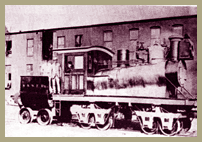 Electric City
In the 1890s, the Stehelin family moved from France to Nova Scotia in search of a new beginning. They transfomed a rugged, wooded location into a thriving community, known as Electric City, about 30 km southeast of Weymouth, in Digby County. (The location appears on modern maps as "New France.")
Electric City
In the 1890s, the Stehelin family moved from France to Nova Scotia in search of a new beginning. They transfomed a rugged, wooded location into a thriving community, known as Electric City, about 30 km southeast of Weymouth, in Digby County. (The location appears on modern maps as "New France.")
New France (Electric City), Digby County. The Weymouth & New France Railroad, when it was completed in 1898, carried passengers in its specially outfitted caboose called "Caribou"...
|
The Wayback Machine has archived copies of this document:
New France (Electric City)
Archived: 1998 February 14
http://web.archive.org/web/19980214031111/http://www.ifdn.com/unique/france/unique.htm
Archived: 2000 August 17
http://web.archive.org/web/20000817012112/http://www.ifdn.com/unique/france/unique.htm
Archived: 2001 August 15
http://web.archive.org/web/20010815002830/http://www.ifdn.com/unique/france/unique.htm
Archived: 2002 December 19
http://web.archive.org/web/20021219194137/http://www.ifdn.com/unique/france/unique.htm
These links were accessed and found to be valid on 14 August 2012.
|
|
Added 2002 Oct 01: New Glasgow Electric Company Limited
Added 2003 Mar 17: Oxford and New Glasgow Railway
Added 2004 Sep 04: 510845 N.B. Inc.
Added 2004 Sep 04: Emera Incorporated
Added 2004 Sep 04: Sydney Coal Railway Inc.
Added 2005 Jan 16: Bedford Electric Company Limited
Added 2005 Jan 16: Dartmouth Electric Tram Company Limited
Added 2005 Jan 16: Halifax & Suburban Electric Company Limited
Added 2005 Feb 05: Annapolis Iron Mining Company
Added 2005 Feb 09: Tidewater Fuel and Navigation Company
Added 2007 Jan 23: Amalgamated Spring Hill & Parrsboro Coal & Railway Co. Ltd.
Added 2007 Jan 24: Caledonia Mines Railway
Added 2008 Jun 24: Nova Scotia & New Brunswick Intercolonial Railway Co. Ltd.
Added 2010 Sep 14: Provincial and New England All Rail Line
Added 2012 Sep 08: Trenton Works Inc.
Added 2012 Sep 08: TrentonWorks Limited
Added 2012 Sep 08: Greenbrier Companies
Halifax Chronicle-Herald, page F4, 24 April 2008
|
Library and Archives Canada has an archived copy of this webpage:
History of Railway Companies in Nova Scotia
Archived: 2007 April 09
http://epe.lac-bac.gc.ca/100/205/300/nova_scotias_electronic_attic/07-04-09/www.littletechshoppe.com/ns1625/railways.html
This link was accessed and found to be valid on 27 October 2010.
|
Copyright 1999 – 2015 by Ivan C. Smith
Permission to copy
Permission to copy this document, including the associated appendices or "historical notes", without fee is hereby granted provided that
(1) the copies are not made, used, displayed, or distributed for commercial advantage;
(2) this copyright notice and the title of the publication and date appear on the copies, and
(3) it is 100% intact with author credit, citations, and text, including this notice.
This publication is a work in progress, and the original source should be checked occasionally for updates.
  Hits per calendar month
       2015 Jun    702
       2015 May    638
       2015 Apr    752
       2015 Mar    620
       2015 Feb    591
       2015 Jan    621

       2014 Dec    664
       2014 Nov    873
       2014 Oct   1034
       2014 Sep   1688
       2014 Aug   1623
       2014 Jul    897
       2014 Jun    895
       2014 May   1033
       2014 Apr   1303
       2014 Mar    869
       2014 Feb    732
       2014 Jan    932

       2013 Dec    812
       2013 Nov    790
       2013 Oct    669
       2013 Sep    662
       2013 Aug    515
       2013 Jul    510
       2013 Jun    492
       2013 May    550
       2013 Apr    547
       2013 Mar    594
       2013 Feb    555
       2013 Jan    724

       2012 Dec    697
       2012 Nov    690
       2012 Oct    682
       2012 Sep    687
       2012 Aug    786
       2012 Jul    730
       2012 Jun    599
       2012 May    775
       2012 Apr    776
       2012 Mar    832
       2012 Feb    699
       2012 Jan    794

       2011 Dec    712
       2011 Nov    709
       2011 Oct    568
       2011 Sep    436
       2011 Aug    526
       2011 Jul    389
       2011 Jun    430
       2011 May    504
       2011 Apr    344  (April 10-30 only)
Go To: Nova Scotia Railway Heritage Society
http://novascotiarailwayheritage.com/index.htm
Go To: History of Telegraph and Telephone Companies in Nova Scotia
http://ns1758.ca/tele/telephone.html
Go to: Ode to the Code ...Morse Code is officially retired...
http://ns1763.ca/tele/sgr-cbh.html
Go to: Farewell to Morse Code
http://ns1763.ca/tele/morse01.html
Go To: The Duke of Kent's Signal Stations by S.G. Roscoe
http://www.coastalradio.org.uk/spud/spud/spud02.pdf
Go To: History of Electric Power Companies in Nova Scotia
http://ns1758.ca/electric/electric.html
Go To: History of Automobiles in Nova Scotia
http://ns1758.ca/auto/automobiles.html
Go To: Nova Scotia History - Chapter One
http://newscotland1398.ca/hist/nshistory01.html
Go To: Nova Scotia Historical Biographies
http://newscotland1398.ca/hist/nshistory00.html#ns-historical-biog
Go To: Nova Scotia Quotations
http://ns1758.ca/quote/quotes.html
Go To: Photographs of War Memorials, Historic Monuments and Plaques in Nova Scotia
http://ns1763.ca/remem/plaques.html
Go To: Home Page
http://ns1758.ca/index.html
First uploaded to the WWW: 1996 November 05
Moved to new hosting service: 2011 April 10
Latest update: 2015 July 13
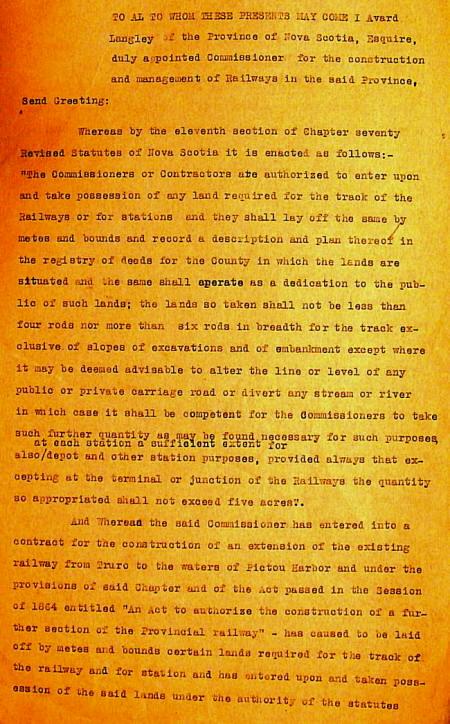 Page 1
 Page 2