
Map showing Southwest Junction
Halifax and South Western Railway
Halifax is agitating now for the construction of a direct line of railway from Halifax to Yarmouth along the South Shore. The latest contribution to the literature on the subject is a letter from Hon. A.G. Jones in the Halifax Chronicle, in which he strongly advocates the construction of this line. As reason for the work Mr. Jones states that the D.A.R. Company is proceeding in such a manner that the interests of the Yarmouth Steamship Company are being imperilled. Mr. Jones further states that there is a feeling generally entertained in Halifax that the Dominion Atlantic railway have not shown a very ready disposition to accommodate the trade of Halifax, and that they have been rather disposed to throw their interest more towards Saint John, and for that reason it is important for Halifax to have a line that will make the city somewhat more independent and give it equal facilities with Saint John. Therefore the proposed line should be built. Notwithstanding that the road, if constructed, will be of great benefit to Halifax — indeed that is the main object sought — Mr. Jones holds out no hope that any Halifax capital will be invested in the work. On the contrary, he says, there is no possibility of private capital being provided. The Provincial and Dominion governments, he says, have declared a willingness to give $3,200 each per mile $1,990 per kilometre, and Halifax city might grant a bonus of $500,000. As the line would be two hundred miles 320km long and the lowest estimate places the cost at $18,000 per mile $11,200 per kilometre, there would still be a very large sum of money to be raised, which might be obtained by bonding the road.
[Digby Weekly Courier, 27 August 1897]
A charter was granted by the Nova Scotia government on 4 April 1901 to William MacKenzie, Donald D. Mann, and R.J. Mackenzie in the name of the Halifax & South Western Railway to construct and operate a railway from Halifax to Yarmouth. The charter was confirmed on 27 March 1902. That Act exempted forever, from municipal taxation, the railways of the company, including lands for the right-of-way and station purposes, tracks, stations, and other buildings, rolling stock, and equipment. The railway was completed and opened for traffic as follows:
• On 30 January 1904 – Bridgewater Junction to Liverpool, 30.02 miles
• On 27 October 1904 – Halifax to Mahone Junction, 67.86 miles
—
The Railway That Was, by Armand Wigglesworth
Queens County Advance, 11 September 2007
Mahone Junction was the junction at Mahone Bay between the new (1904) H&SW Railway main line track and the existing (1889) main line track of the Nova Scotia Central Railway between Lunenburg and Bridgewater.
Bridgewater Junction was the junction at Bridgewater – at the east end of the railway bridge across the LaHave River – between the new (1904) H&SW Railway main line track and the existing (1889) main line track of the Nova Scotia Central Railway between Bridgewater and Middleton.
The distances (mileages) quoted by Mr. Wigglesworth are accurate, but one requires some interpretation.
Bridgewater Junction to Liverpool, 30.02 miles
This distance is in full agreement with 30.0 miles, the track length given for this section as stated in the CN Employee's Timetable No. 99, effective 24 April 1960.
Halifax to Mahone Junction, 67.86 miles
This requires interpretation. The casual reader might interpret this as the distance from Mahone Junction to the Halifax Railway Station, but this would be wrong. For starters, the H&SW Railway did not own the track all the way to the Halifax railway station. Also, the modern railway station at the south end of Halifax did not exist then. When the H&SW was opened in 1904, the station, now called the Old North Station, was in the north end of Halifax, and the track arrangement for H&SW trains to reach the station in 1904 was quite different from the track arrangement in later years (see map below). Mr. Wigglesworth's 67.86 miles is between Southwest Junction (not Halifax) and Mahone Junction. The CN Employee's Timetable No. 99, effective 24 April 1960, does not mention either Halifax or Mahone Junction. The relevant item in the Employees Timetable is 66.7 miles from Southwestern Junction to the Mahone Bay station. Mahone Junction was located about half a mile west of the Mahone Bay station, which would yield a distance of 67.2 miles between Mahone Junction and Southwest Junction. This appears to disagree, by more than half a mile, with the 67.86 miles stated by Mr. Wigglesworth, but the location of Southwest Junction in 1904 (when the H&SW Railway was opened) was different from its location in 1960. In 1904, the Halifax station serving all railway passengers, including those travelling on the H&SW, was in the north end of Halifax, at the intersection of North Street with Barrington Street (where the western cable anchor block of the Macdonald Bridge is now located). The distance 67.86 miles is measured to the 1904 location of Southwest Junction, which was roughly half a mile further from Mahone Junction than the later (after 1920) location that appears in the 1960 Employees Timetable. Mr. Wigglesworth's distance figure is accurate as of 1904, when the H&SW opened.
Halifax and South Western Railway by J.R. Cameron
http://web.archive.org/web/20140219034025/http://www.rocarchives.com/Articles/Cameron-HalifaxAndSouthWesternRailway.htm
H&SWR Passenger Train Schedules
http://ns1758.ca/rail/railway03.html
Halifax and Southwestern Railway Wikipedia
http://en.wikipedia.org/wiki/Halifax_and_Southwestern_Railway

| The above advertisement refers to "Passenger and Mixed Trains". A Mixed Train carried both passengers and freight. Along its route, the train would stop at the stations to pick up and drop passengers, and it would switch sidings wherever there were freight cars to be 'set out' or taken away. For example, the weekly Mixed Train from Bridgewater to Port Wade and return, each Wednesday, had a passenger car to accomodate any passengers who wanted to travel along that route, also it would take freight cars from Bridgewater for delivery to sidings along the way, and it would take away from sidings any freight cars that had been emptied or filled and were ready to go. Mixed Trains were not a fast way to travel, but they offered dependable, comfortable, low-cost transportation at a time when a traveller had little alternative other than a horse. |


|
In the early 1920s, each Friday at 6:30pm a steamship departed Yarmouth for Boston, a regular service that many travellers used. The Dominion Atlantic Railway operated a special passenger train each Friday, leaving Halifax and travelling through the Annapolis Valley, reaching the wharf at Yarmouth in time for travellers to transfer to the steamship for Boston. At that time, this was the fastest way to travel from Halifax to Boston. However, on Friday, March 30th, 1923, trains were unable to operate over the Dominion Atlantic Railway line because of washouts caused by a storm a few days before.
In the 1920s there were two railways operating trains between Halifax and Yarmouth: the D.A.R. from Halifax through Windsor, Kentville, Middleton and Digby to Yarmouth, and the Canadian National Railways line — usually called the Halifax & South Western Railway — along the South Shore from Halifax through Chester, Bridgewater, Liverpool and Shelburne to Yarmouth. When the D.A.R. boat train was cancelled, the two railway managements arranged for the D.A.R. passengers to be transferred to the C.N.R. (H.&S.W.R.) train. The transfer was simple for the passengers because both D.A.R. and C.N.R. trains going to Yarmouth departed Halifax from the same railway station. No doubt an additional passenger car or two was added to the C.N.R. train to accomodate the extra passengers. |
|
The railway between Bridgewater and Middleton — built in the late 1880s by the Nova Scotia Central Railway — in 1923 was owned and operated by Canadian National Railways but was still often called the N.S.C.R.
For about fifteen kilometres upstream from Bridgewater this track closely followed the east bank of the LaHave River in Lunenburg County, and in many places was only a metre or two above the river's normal water level. In late winter and early spring, when rain caused the river ice to break up, it was not uncommon for ice blockades to form here and there along the river. These temporary ice dams formed quickly and could cause the river water to rise two or three metres in a few hours. At such times the railway track was often under water and trains had to be cancelled until the water went down. The Caledonia train operated six days a week from Caledonia to New Germany and Bridgewater in the morning, returning in the afternoon. The Middleton train operated six days a week from Bridgewater to Middleton and return. Both trains travelled along the N.S.C.R. track between Bridgewater and New Germany, and both had to be cancelled if that track was impassable. |
| In the 1920s the railways provided the most important transportation service – for both passengers and freight – throughout Nova Scotia (and pretty much everywhere else in North America). When the trains were delayed or cancelled, for any reason, there were immediate and serious effects on many people and businesses. Travellers were stranded, and freight could not be moved. The mail was stopped. Any disruption in the normal railway operations had an immediate and far-reaching impact, and such events were newsworthy. |
Canadian Transportation Agency
Decision No. 193-R-1988
1 August 1988
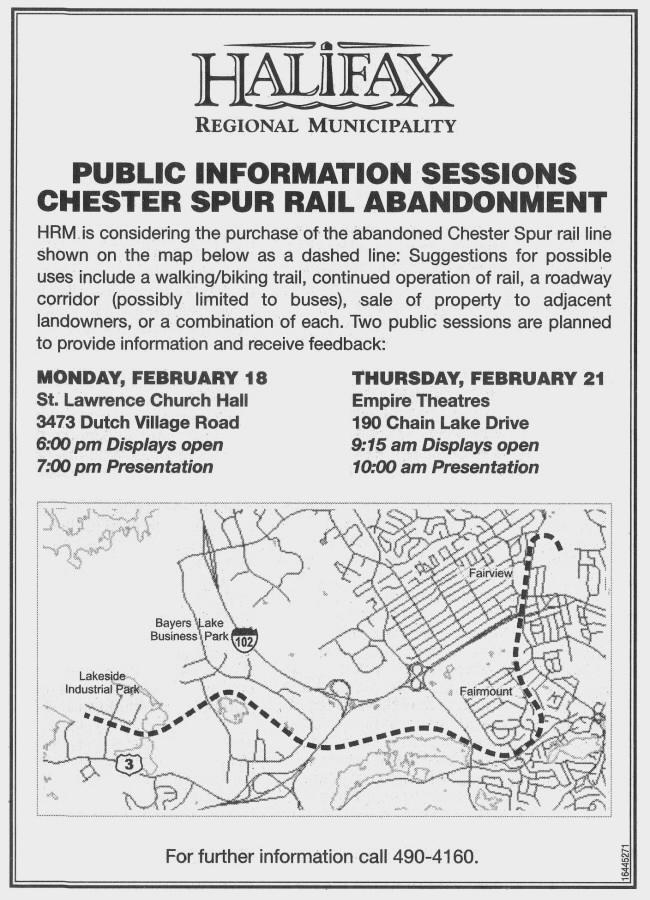
IN THE MATTER OF an application by Canadian National Railway Company (CN) to abandon its operations on the Chester Subdivision between Barry's Stillwater Marsh Mileage 42.25 and Liverpool Mileage 109.07, in the Province of Nova Scotia.
|
The original plan (1893) was to build a railway connect Yarmouth to Lockeport
via East Pubnico, Wood's Harbour, Barrington Passage and Shelburne. |
The Coast Railway has commenced a regular train service.
[Digby Weekly Courier, 13 August 1897]
The business on the Coast Railway is away beyond the expectations of the management.
[Digby Weekly Courier, 20 August 1897]
Work on the Coast Railway is progressing nicely. The road is already doing an immense business in natural local trade, which is supplemented by one or two excursions each week. On boat days the road sometimes handles as many as 200 passengers, and local freight is developing wonderfully. In fact, the business is beyond the expectations of the company. The "bargain excursion" feature is being well received by Yarmouth merchants. As yet the public are somewhat hampered in transfer arrangements at Yarmouth as the Coast Railway company have been unable to make amicable arrangements with the D.A.R.
[Digby Weekly Courier, 27 August 1897]
The Yarmouth News says that the Coast Railway proposes completing their line to Shelburne early next year. They will then place a fast boat on between Shelburne and Halifax to connect at Shelburne with the train to and from Yarmouth.
[Digby Weekly Courier, 8 October 1897]
In 1893, the Coast Railway was chartered (1893, chapter 154) by the Nova Scotia Legislature. It had a complex history and there is some thought that it was created to be bought out. This was originally planned as a narrow gauge railway, which would be cheaper to build, virtually the only narrow gauge public carrier the Nova Scotia legislature ever authorized. The original plan was to connect Yarmouth via East Pubnico, Wood's Harbour, Barrington Passage and Shelburne to Lockeport. Soon (1894, chapter 102), the company was active and extended its plans to include branches from Tusket to Carleton and Kempt (inland in Yarmouth County) and from Pubnico Head to West Pubnico (down the west side of Pubnico Harbour). Another branch would run from Barrington Passage to Port LaTour. Additional powers were granted in 1895 (chapter 124), the most important of which was the authority to change to standard gauge...
Excerpted from: Coast Railway by J.R. Cameron
http://web.archive.org/web/20140219021833/http://www.rocarchives.com/Articles/Cameron-CoastRailway.htm
|
There is an interesting link between the Coast Railway of Nova Scotia, one of the H&SW's predecessor companies, and the remarkable WW&F, in Maine. The narrow-gauge Wiscasset, Waterville & Farmington Railroad has been described in several books. Perhaps the best, and certainly the most comprehensive that I know of, is Two Feet to Tidewater by Robert C. Jones and David L. Register, ISBN 0871087294, Pruett Publishing Company, Boulder, Colorado, 1987, which explicitly mentions the H&SWR on page 55. (The WW&F was built to a gauge of 24 inches 60 cm, the "Two Feet" in the book title.) Leonard Atwood was born in Farmington Falls, Maine, on 30 July 1845. He served in the Union Navy from April 1862 to May 1864, during the American Civil War. After leaving the Navy, Atwood started working for an obscure new company, Flagler and Rockefeller, which was selling oil by the barrel. (Following a consolidation in 1870, the company became known as the Standard Oil Company.) Atwood was interested in anything mechanical, and in the 1870s made a lot of money installing elevators in hotels, using machinery he designed and manufactured. In the early 1880s, Atwood sold his elevator patents to Elisha Graves Otis and moved to Nova Scotia, where he went to work organizing the Coast Railway, built southward from Yarmouth in the early 1890s. The Coast Railway was a narrow-gauge railway – an interesting choice in that narrow-gauge railways were common in Maine but rare in Nova Scotia. In Maine, the Wiscasset, Waterville & Farmington Railroad was incorporated in the spring of 1901 to take over the Wiscasset & Quebec Railroad; in June 1901 Leonard Atwood became president of the WW&F. Atwood died in 1930. (Question: Is there a connection between Leonard Atwood and the community name "Atwoods Brook" about 5 km west of Barrington Passage? Note by ICS, 8 March 2003 Go To: History of the Wiscasset, Waterville & Farmington Railroad http://www.wwfry.org/history/history.html Go To: Wiscasset, Waterville & Farmington Railroad Wikipedia http://en.wikipedia.org/wiki/Wiscasset,_Waterville_and_Farmington_Railway |
These are days of much talk in railway circles, and there is no lack of schemes. The recent impetus given by the transpirings on the south coast of Nova Scotia has started the Granville project again. One of the promoters of this road, which is as yet only in the prospective, is quoted as saying that the prospects are growing brighter every day and that it is a sure thing. The expense will be only about $12,000 per mile about $7,500 per kilometre and it is thought that this can be raised by subsidies and debenture. The chief hope of the scheme lies at the western terminus of the line. At Digby Gut nature has provided a magnificent harbour and the Furness and other lines of steam ships running between St. John and England would probably make this a port of call during the apple-shipping season, thus diverting a large amount of this business from all along the Granville country. A summer hotel at Victoria Beach is another probability. The scheme has a good sound and it is to be hoped that it may materialize, but it will likely be some time in the future.
[Digby Weekly Courier, 27 August 1897]
The Liverpool and Milton Railway was purchased by the Halifax and South Western Railway Company in 1907.
See:
Liverpool and Milton Railway by Robert Chant and Colin Churcher
http://web.archive.org/web/20130905194006/http://www.rocarchives.com/Articles/Chant-LiverpoolAndMiltonRailway.htm
The Liverpool and Milton Tramway Company was incorporated in 1896, and was opened for regular traffic on 1 February 1897. The track was constructed from tidewater at Liverpool through Milton, to the pulp mill of the Milton Pulp company. The name was changed to the Liverpool and Milton Railway by chapter 176 of the Acts of 1900, which also authorized the company to sell the railway to any other company.
See: Liverpool and Milton Railway John R. Cameron
http://web.archive.org/web/20140219041843/http://www.rocarchives.com/Articles/Cameron-LiverpoolAndMiltonRailway.htm

Thornes Cove trestle was located about 3.2km east from Port Wade
on the main line of the Middleton & Victoria Beach Railway
(a subsidiary of the H&SW Railway)
In 1905, the Halifax & South Western Railway purchased the Middleton & Victoria Beach Railway. The Halifax & South Western was eventually merged into the Canadian Northern empire, which was taken over by the Government of Canada and became a part of Canadian National.
See: Middleton & Victoria Beach Railway by John Cameron
http://web.archive.org/web/20140219040735/http://www.rocarchives.com/Articles/Cameron-MiddletonAndVictoriaBeachRailway.htm
   The expenditure for construction with reference to payments for
   subsidy to the Nova Scotia Central Railway by the Government of
   Nova Scotia, stands up to the 1st of January, 1893, as follows:

   Total subsidy authorized after deducting
       allowance for diverge is  . . . . . . . . . . . $411,119.94
   Deduct amount paid to the passing of
       the Act of 1882   . . . . . . . . . . . . . . . $ 95,696.13
                                                       -----------
   Leaving a balance in 1882 of  . . . . . . . . . . . $315,423.81

       Out of this there has been paid:
   Certificates during 1884  . . . . . . $ 14,891.01
   Certificates during 1885  . . . . . .   11,962.75
   Certificates during 1886  . . . . . .   14,477.79
   Certificates during 1887  . . . . . .    8,234,66
   Certificates during 1888  . . . . . .   44,000.00
   Certificates during 1889  . . . . . .  171,145.69
   Certificates during 1890  . . . . . .   20,000.00
   Certificates during 1891  . . . . . .   15,000.00
   Certificates during 1892  . . . . . .   10,000.00   $309,711.90
                                                       -----------
   Leaving a balance on 1st January 1893   . . . . . . $  5,711.91

Source: Appendix No. 7, pages 7-8
Journals of the Legislative Council of Nova Scotia, 1893
| ||||||||||||||||||||||||||||||||||||||||||||||||||||||||||||||||||||||||||||
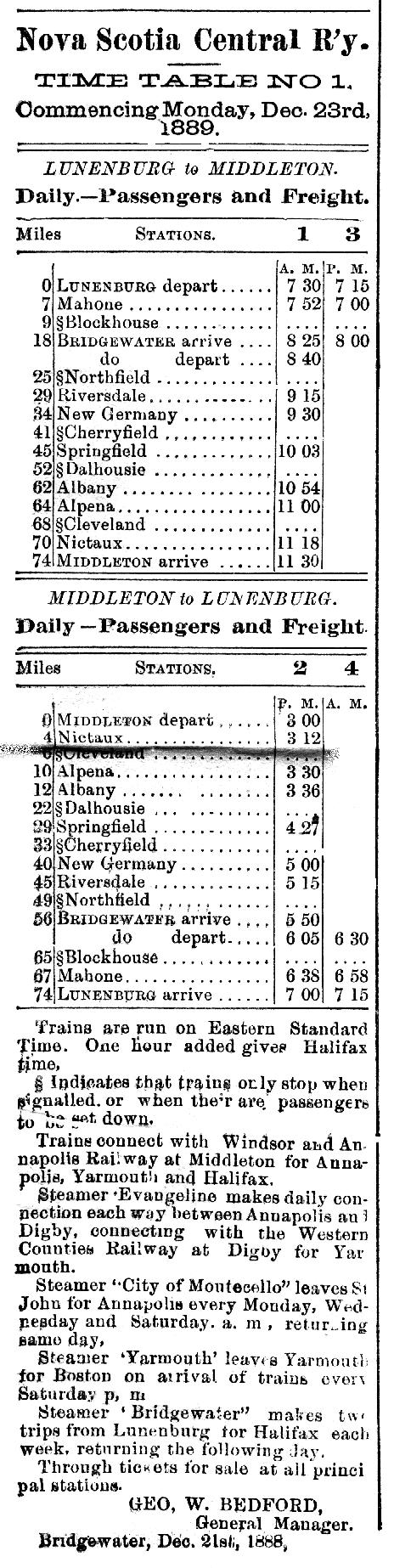
As a result of the completion of the Nova Scotia Central Railway (NSCR) in October of 1889, connecting Bridgewater with Middleton, Bridgewater became a critical stopping point along the rail corridor, serving as a connector point for any travelers coming from Liverpool by stage coach who wished to journey to local ports such as Mahone Bay or Lunenburg, or across the province to Middleton. The completion of the Dominion Atlantic Railway line from Halifax through the Annapolis Valley to Yarmouth in October of 1891 extended the range of a traveler from Lunenburg County even further; a passenger out of Bridgewater could ride the NSCR as far as Middleton and, from there, continue on to Halifax or travel by train to Yarmouth, then by ferry to Boston and the rest of New England. Residents could have their breakfast in Bridgewater and step off a train onto a platform in Boston by the next afternoon, rather than have to rely on a lengthy, arduous carriage journey over land, or an extended and unpredictable voyage on the water. In its first year of operation (1889-90), some 53,705* passengers travelled across the province on the Nova Scotia Central...
*NOTE: There were two trains a day (one each way), six days a week.
53,705 passengers works out to an average of 86 passengers on each train.
Source: page 41 of
Going Against the Grain: The Rise of Bridgewater, Nova Scotia, 1812-1899
by Patrick R. Hirtle
A Thesis submitted in partial fulfillment of the
requirements for the degree of Master of Arts
in the Graduate Academic Unit of History,
the University of New Brunswick, May 2007
|
The Wayback Machine has archived copies of this document:
Archived: 2002 February 9
Archived: 2002 September 12
Archived: 2002 November 22
Archived: 2003 May 02
Archived: 2003 July 17
Archived: 2003 October 13
Archived: 2004 February 28
Archived: 2004 August 11
Archived: 2005 April 03
Archived: 2005 November 02
Archived: 2006 May 21
Archived: 2006 October 21
Archived: 2006 December 09
These links were accessed and found to be valid 13 September 2010. |
  Hits per calendar month
       2015 Jun    101
       2015 May     72
       2015 Apr    111
       2015 Mar    111
       2015 Feb    151
       2015 Jan    128

       2014 Dec    117
       2014 Nov    132
       2014 Oct    131
       2014 Sep     96
       2014 Aug     98
       2014 Jul    108
       2014 Jun    122
       2014 May     88
       2014 Apr     96
       2014 Mar    114
       2014 Feb    133
       2014 Jan    161

       2013 Dec     80
       2013 Nov     92
       2013 Oct     71
       2013 Sep     55
       2013 Aug     61
       2013 Jul     52
       2013 Jun     72
       2013 May     66
       2013 Apr     90
       2013 Mar    113
       2013 Feb     82
       2013 Jan     85

       2012 Dec     68
       2012 Nov     91
       2012 Oct     88
       2012 Sep     79
       2012 Aug     72
       2012 Jul     47
       2012 Jun     50
       2012 May     73
       2012 Apr     84
       2012 Mar     69
       2012 Feb     77
       2012 Jan     56

       2011 Dec     53
       2011 Nov     74
       2011 Oct     53
       2011 Sep     34
       2011 Aug     36
       2011 Jul     38
       2011 Jun     35
       2011 May     58
       2011 Apr     62
 |

W3C CSS Validation Service |
First uploaded to the WWW: 1998 August 13
Script upgraded to HTML 4.01: 2003 March 09
Latest update: 2015 July 12