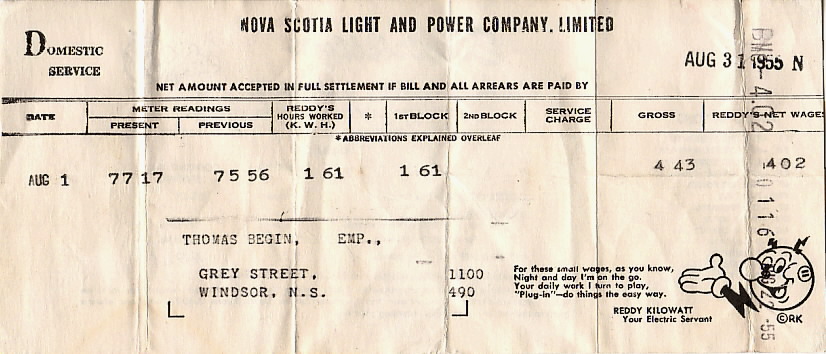
Nova Scotia Light and Power Company bill, August 1955 front (above) back (below)

Original size: 20.8cm × 8.9cm
The story of Nova Scotia Light and Power Company Limited starts with the incorporation of the Halifax Gas, Light and Water Company in 1840. By January of 1843 the company was ready with six miles [ten km] of gas mains and lights for 281 stores and dwellings, along with sixty street lights. Operations continued with variable success until 1897 when the People's Heat and Light Company, a second gas business formed in 1893, absorbed the first gas company.
Another ancestral company was the Halifax City Railroad Company, a horsedrawn public transit system organized in 1863. It began operations on 11 June 1866, and for ten years served Halifax with what eventually became nine miles [15 km] of track laid in the streets. This system was taken over by the Halifax Street Railway Company Limited and its successor, the Nova Scotia Power Company Limited, which carried on until 1896 when electric trams replaced the horse cars.
The third and most important strand of the company's history is traceable to April 1881 – a year and four months before Thomas Edison opened his Pearl Street electric generating station in New York – when three Haligonians formed the Halifax Electric Light Company Limited. It never operated. Possibly the technical problems associated with taming this untried and unknown force – electricity – were too awesome at that time for Halifax knowledge and technology.
Three years and seven months later, John Starr and his associates incorporated the Halifax Electric Light Company (limited). It is the same name except in the way "limited" is written, with a lowercase "l" and in parentheses. The second electric company built a 100 horsepower [70 kW] generating plant driven by a steam engine, and began operations from Black's Wharf, Water Street, in February 1885.
On 20 December 1887, the Halifax Electric Light Company (limited) was taken over by the Halifax Gas Light Company Limited, which had dropped "Water" and added "Limited" to its name.
It was left for the Halifax Electric Tramway Company Limited, formed in 1895, to bring order out of the corporate chaos by buying the Nova Scotia Power Company, the Halifax Street Railway Company, and the Halifax Illuminating and Motor Company. Then, in 1902, it bought the People's Heat and Light Company and from then on gas was under the electric wing until the old gas works was shut down in 1953.
See: Halifax: Birney Stronghold
A new company, the Nova Scotia Tramways and Power Company Limited, had been formed in 1914. In January 1917, it bought the properties and legal powers of the Halifax Electric Tramway Company Limited. In the great Halifax Explosion of 6 December 1917, the company's electric generation station received only superficial damage, but all the rolling stock was hit, some of the trams were demolished, and the property damage in the service area was extensive.
The above is excerpted and adapted from an essay Nova Scotia Light & Power Company published in the May 1967 "Centennial Issue" of Industrial Canada — a copy is held in the Western Libraries at the University of Western Ontario.
|
The Wayback Machine has archived copies of this document:
Archived: 2005 December 20
Archived: 2006 January 11
Archived: 2007 August 23
|
From 1919 to 1924, Nova Scotia Tramways & Power Company was under the management of Stone & Webster Inc., Boston.
In 1924, Isaac Walton Killam, through the Royal Securities Corporation, bought control of Nova Scotia Tramways & Power Company.
In 1928, Nova Scotia Tramways & Power Company Limited changed its name to Nova Scotia Light & Power Company Limited.
In November 1925, The Avon River Power Company bought the Windsor Electric Light & Power Company.
In 1926, The Avon River Power Company bought the Gaspereaux River Light, Heat & Power Company.
In April 1929, the Nova Scotia Light & Power Company bought the Avon River Power Company and thereafter operated it as a wholly-owned subsidiary.
During 1931, the Avon River Power Company bought six small electric utilities in the Annapolis Valley:
Centreville Electric Light & Power Company,
Gaspereaux Valley Electric Light Company,
Lower Horton Electric Company,
Kingston Electric Light Commission,
the Town of Middleton's electric power system, and
Sheffield Mills Light & Power Company.
In 1935, Nova Scotia Light & Power Company Limited took over the Dartmouth Gas, Electric Light, Heating & Power Company and the Sackville River Electric Company.
In August 1941, the Avon River Power Company bought the electric power distribution system owned and operated by the Canning Water Commissioners in Kings County.
In January 1972, the Nova Scotia Light & Power Company was taken over by the Nova Scotia Power Commission, an agency of the Nova Scotia Government. At that time, the Nova Scotia Power Commission acquired 99.65% of the common shares and approximately 98% of the preferred shares of Nova Scotia Light & Power Company Limited. That gave the NSPC complete control of the NSL&P Company; the first step was the replacement of the entire board of directors. The balance of the shares were acquired a year or so later.
Source: Canada v. Nova Scotia Power Inc., 2003 Federal Court of Appeal 33
Background information contained in the judgment delivered at Ottawa, Ontario, on 23 January 2003
http://www.canlii.org/ca/cas/fca/2003/2003fca33.html
On 27 January 1972, the entire Board of Directors and the President of Nova Scotia Light & Power Company resigned, and were replaced by a new Board of Directors and President named by the new owner, the Nova Scotia Power Commission. On this date, the former shareholders formally and legally relinquished management control of the company; from this date all management decisions were made by the new owner.
In 1973, the Nova Scotia Power Commission was legally and financially reorganized as the Nova Scotia Power Corporation, a provincial crown corporation.
On 12 August 1992, all the electric utility assets of the Nova Scotia Power Corporation were sold to Nova Scotia Power Inc., a private (non-government) corporation.
On 1 January 1999, ownership of Nova Scotia Power Inc. (NSPI) was transferred to NS Power Holdings Inc. (NSPH). On that date, all NSPI common shares were transferred from the previous owners (individuals, pension funds, etc.) to NSPH — which issued to the former NSPI shareholders, one NSPH share for each NSPI share. Thus Nova Scotia Power Inc. became a wholly-owned subsidiary of NS Power Holdings Inc.
On 17 July 2000, the company name was changed to Emera Inc. from NS Power Holdings Inc. After this name change, Nova Scotia Power Inc. continued as a wholly-owned subsidiary of Emera Inc.
In March 2012, the Nova Scotia Light & Power Company Limited [RJSC ID#1001082] still exists as a legal entity, complete with a President and a Board of Directors, with its registered office at 1723 Hollis Street, Halifax. The RJSC records show its date of incorporation to have been 1 January 1914, with it having been "in business since" 23 February 1917 as Nova Sotia Tramways & Power Company Limited, with the name changed to Nova Scotia Light & Power Company Limited on 1 January 1928.
As of 28 December 2011 the company's directors were:
A.L. Bruce, Truro, Nova Scotia;
Barbara Walker, Halifax, Nova Scotia;
G.J. McCulloch, Windsor Junction, Nova Scotia;
J.G. MacDonald, Sydney, Nova Scotia;
George Perrin, Halifax, Nova Scotia;
A.G. Manuel, Halifax, Nova Scotia; President
C.H. Loveless, Halifax, Nova Scotia; Vice President Finance
H.W.V. Matthews, Halifax, Nova Scotia; Treasurer
James G. Spurr, Halifax, Nova Scotia; Secretary
— Source: Nova Scotia Registry of Joint Stock Companies [RJSC]
https://rjsc.gov.ns.ca/rjsc/
On 11 January 2012, in response to a query, I received an e-mail from David Rodenhiser, Senior Communications Advisor at Nova Scotia Power, with the following information about what happened to the Nova Scotia Light and Power Company after January 1972:
Below is an explanation from Rick Smith, Emera's Vice President of Corporate Insurance, Assets and Legal, who was around at the time of privatization (August 1992).
In the late 1960s and early 70s the Crown utility Nova Scotia Power Commission acquired a number of other utilities including Eastern Light and Power and Nova Scotia Light and Power. In each case there were potential significant tax issues with the acquisitions which meant the best way for the Commission to acquire the assets of these companies was through long term lease arrangements. In order to allow this to happen, both Eastern Light and NSL&P were continued as companies and leased all of the assets held at the time to NSP Commission, although all of the assets so acquired were under the total control of NSPC (which had its name changed to Nova Scotia Power Corporation as I recall at the time of the NSL&P acquisition in 1972).
Both Eastern and NSL&P continued as companies, albeit no more than shell companies [see note below], and at the time of the privatization in 1992, all assets of NSPC, including those leased by Eastern and NSL&P, were sold to NSPI.
NSPC, Eastern and NSL&P all remained under the ownership of the Province.
While Nova Scotia Power administered NSL&P etc. prior to privatization, the administration of all of those companies fell to the Province upon privatization. I do not know why the Province has continued to maintain NSL&P nor do I now know if it could be wound up. Obviously the Province has allowed it to continue to exist.
In any event that company and its name continue to be on the Registry of Joint Stock Companies, although nothing appears to have been done for some time as far as filings etc are concerned.
The individuals listed as directors and officers are a combination of backgrounds. A.L. Bruce, Barbara Walker, G.J. McCulloch and J.G. MacDonald were directors of NSPC and if I remember correctly NSL&P and Eastern at the time of the privatization. The province retained them as directors on these companies upon Privatization.
The others were all officials of the Department of Finance or the then Attorney General's department assigned to Finance.
|
Note (by ICS, 20 January 2012):— “Shell company” is a recognized legal term commonly used to describe a company that exists but does not actually do any business or have any assets. Security regulatory authorities in many countries have formal definitions of “shell companies”. For example, a shell company, as defined in Rule 405 of the United States Securities Act, is a registrant with no or nominal operations and either no or nominal assets, assets consisting solely of cash and cash equivalents, or assets consisting of any amount of cash and cash equivalents and nominal other assets.
In each jurisdiction, there are minimum requirements that must be maintained in order for a company to continue existing as a legal entity. • Each company must have a board of directors. The number of directors is determined by the bylaws of the particular company. The directors are paid by the company; when and how much is decided by the company and the company must make its own arrangements about where this money comes from. The company is responsible for keeping proper accounting records of these payments. • To maintain its legal registration, each registered company must pay an annual fee to a government office that registers companies and maintains a list of companies with currently valid legally registrations. In Nova Scotia this record is maintained by the Registry of Joint Stock Companies. |
Source: 1935 Annual Report of the Nova Scotia Public Utilities Board
On 28 December 2012, I received an e-mail message
from a retired NSL&P employee. He wrote:
I was wondering if by chance you might have a picture of that old Crossley truck that the power company used from the end of the war up to the 1960's as a snowplow mostly. The best I can make out is that it was a Q model used as a crash truck in Britain. I understand that it came over to Canada carrying a radar station for training purposes. It had a 4 cylinder engine and when that got bad, they fitted a 6 cylinder Chev in its place. It had a big v plow with a hand pump to raise the hydraulic cylinder. There was no power steering. Ronald Schofield and Ernie Bezanson both drove it. Ernie did most of the repairs.
A younger man in Hantsport acquired the old truck with an idea of restoring it some years ago. I must stop around some day and see how he ever made out.
C------ J---
I do not have any photograph of this machine,
but it could be that someone with an old photo album does.
Original size: 20.8cm × 8.9cm


Original size: 25.1cm × 8.5cm
Nova Scotia Light and Power Company paycheque stub, 31 July 1959 (below)
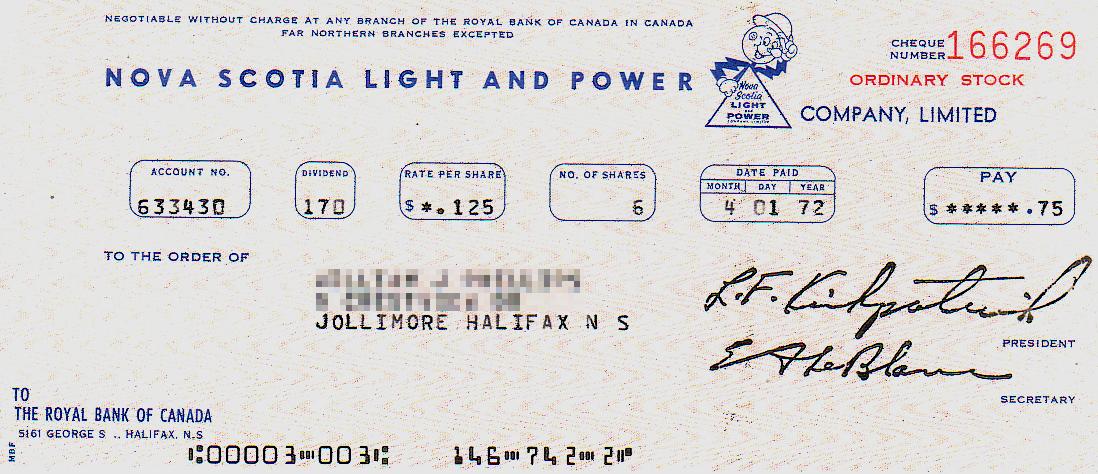
This cheque was signed by L.F. Kirkpatrick, President, and E.A. LeBlanc, Secretary. Les Kirkpatrick was General Manager of the Nova Scotia Power Commission for many years, and was named President of the Nova Scotia Light & Power Company after that Company was bought by the Nova Scotia Power Commission. Ted LeBlanc was Secretary of the Nova Scotia Light & Power Company for many years before the 1972 takeover, and remained as Secretary afterward. The position of Secretary was an important job within the legal structure of the Company.
This cheque was printed on a standard
Hollerith punch card.
In the 1960s and 1970s, mass-produced cheques – such as paycheques,
dividend cheques and pension cheques – often were printed on Hollerith cards,
to facilitate the handling of the cashed cheques by banks and clearing houses.
Original size: 7 3/8 × 3 1/4 inches 18.7cm × 8.3cm
|
The Wayback Machine has archived copies
Archived: 1998 December 7
Archived: 1999 April 17
Archived: 1999 November 22
Archived: 2000 January 27
Archived: 2000 August 17
Archived: 2001 April 20
Archived: 2002 October 18
Archived: 2003 June 26
Archived: 2004 August 11
Archived: 2005 December 11
Archived: 2006 December 06
Archived: 2007 October 09
Archived: 2008 May 12
Archived: 2010 December 07
Archived: 2012 February 25
|
  Hits per calendar month
       2014 May   522
       2014 Apr   274
       2014 Mar   242
       2014 Feb   301
       2014 Jan   433

       2013 Dec   426
       2013 Nov   254
       2013 Oct   227
       2013 Sep   228
       2013 Aug   139
       2013 Jul   141
       2013 Jun   183
       2013 May   247
       2013 Apr   288
       2013 Mar  1047
       2013 Feb  1173
       2013 Jan   889

       2012 Dec   600
       2012 Nov   431
       2012 Oct   252
       2012 Sep   199
       2012 Aug   131
       2012 Jul   114
       2012 Jun    94
       2012 May   118
       2012 Apr    82
       2012 Mar   103
       2012 Feb   107
       2012 Jan    92

       2011 Dec   108
       2011 Nov    74
       2011 Oct    76
       2011 Sep    75
       2011 Aug    52
       2011 Jul    77
       2011 Jun    95
       2011 May    68
       2011 Apr   104
       2011 Mar    70
       2011 Feb    87
       2011 Jan   110

       2010 Dec   103
       2010 Nov    66
 W3C HTML Validation Service http://validator.w3.org/ |
 W3C CSS Validation Service http://jigsaw.w3.org/css-validator/ |
First uploaded to the WWW: 1997 October 14
Script upgraded to HTML 4.01: 2002 September 10
Moved to new hosting service: 2010 October 15
Latest update: 2014 June 16