History of Nova Scotia
with special attention given to
Communications and Transportation
Chapter 72
2000 November 20-30
Index with links to the other chapters
2000 November 20
Intel's Pentium 4 Chip Arrives
Pentium 4 chip ready to ship — includes faster audio, video
Toronto — Intel Corp., the world's dominant maker of microprocessors for personal computers, said Monday, November 20th, its next-generation Pentium 4 chips are ready for the market.
The new chip is designed to process video and audio data faster, a feature that has grown in importance with the rise of music and video files that can be downloaded from the Internet. "The Pentium 4 processor is designed to give users performance where they can appreciate it most," Paul Otellini, Intel executive vice-president, said Monday.
Intel, which accounts for about 80 per cent of the market for personal computer microprocessors, has recently been challenged by Advanced Micro Devices Corporation, makers of the Athlon line of microprocessors, and Transmeta Corporation, maker of the Crusoe line of chips.
 Graphics software developer Corel Corporation of Ottawa and ATI Technologies Incorporated of Thornhill, Ontario, one of the world's biggest makers of specialized graphics hardware for computers, also say they hope the Pentium 4 will spur demand for the latest versions of their core products. "We like to think it provides our users an incentive to move up to CorelDraw 10," said Rob Hayami, business development manager for Corel, the Ottawa software company that is attempting to return to profitability after three quarters of losses. Professionals like graphics artists and computer-aided designers could do their work faster with CorelDraw 10 and a Pentium 4 computer because the software and hardware have been designed to work together, Hayami said.
David Nalasco, technical marketing manager for ATI Technologies, also said his company's products should get a boost from the latest Intel chip because of its ability to process video data quicker than previous Pentiums. "With some of new video cards we offer a kind of digital VCR feature," Nalasco said. "You can take a video input from cable, or whatever, plug it into the back of your video card and then you can both watch TV on the screen or record it to your hard drive and use your computer like a VCR," Nalasco said.
The older Pentium 3 chip didn't provide as good quality images, he said.
But industry watchers said Monday that the new Pentium 4 won't likely have much impact on the market this year, in part because the chip was announced so late in the year and because of an unexpected slowdown in the last half of 2000 has left a backlog of Pentium 3 products that must be cleared.
"It's going to take 12 months or even longer to ship in volume," predicted John Stanisc, who monitors the personal computer industry for market research company IDC Canada in Toronto.
The biggest importance of the Pentium 4, Stanisc said, is that it restores Intel's reputation as the king of chip makers — which had been challenged by smaller rivals such as Advanced Micro Devices, maker of the Athlon chips.
The two new Pentium 4 chips announced Monday have clock speeds of 1.4 and 1.5 gigahertz — about double the speed of a 733 megahertz chip. "In terms of end users, there are only a few groups that need this faster processing speed," Stanisc said. "In terms of the average user, they probably don't need that speed."
Fears of a glut of various technology products have hurt a wide range of companies in recent weeks, including Intel. The company's shares have fallen about 42 per cent since Aug. 31 when they closed at US$74.88 on the Nasdaq stock market. They closed at US$41.13 on Monday, down about 38 cents from Friday's close.
[The Halifax Chronicle-Herald, 21 November 2000]
[The Halifax Daily News, 21 November 2000]
[The National Post, 21 November 2000]
http://ca.dailynews.yahoo.com/ca/headlines/cpress/bs/story.html?s=v/
ca/cpress/20001121/bs/business_1173035_2.html
Intel Introduces the Pentium® 4 Processor
SANTA CLARA, California, Nov. 20, 2000 — Intel Corporation today introduced the Intel® Pentium® 4 processor, its newest microprocessor for high-performance desktop computers.
The Pentium 4 processor delivers a new generation of performance for processing video and audio, exploiting modern Internet technologies, and displaying 3-D graphics. Its foundation is the new Intel® NetBurst® micro-architecture, a collection of unique technologies that will power Intel's most advanced 32-bit processors for consumer and business users over the next several years of computing.
"The Pentium 4 processor is designed to give users performance where they can appreciate it most," said Paul Otellini, executive vice president and general manager, Intel Architecture Group. "Whether streaming content, playing interactive games, encoding video and MP3 files, or creating Internet content — the Pentium 4 processor is designed to meet the needs of today's most demanding computer users."
Major computer makers and software suppliers around the world have spent months readying products based upon the Pentium 4 processor. All major desktop PC (personal computer) makers have Pentium 4 processor-based PCs or workstations under development. Many manufacturers are expected to start taking orders today and will begin delivery of PCs based on the Pentium 4 processor.
The Intel® NetBurst® Micro-Architecture
and Intel® 850 Chipset
The Pentium 4 processor with Intel NetBurst technology is the first completely new desktop processor design from Intel since the Pentium Pro processor, with its P6 micro-architecture, was introduced in 1995. Highlights include Hyper Pipelined Technology, which enables the Pentium 4 processor to execute software instructions in a 20-stage pipeline, as compared to the 10-stage pipeline of the Pentium III processor. Hyper Pipelined Technology supports a new range of clock speeds, beginning today with 1.5 and 1.4 GHz, with plenty of headroom for the future.
Faster processing of video and audio
For higher performance, the Rapid Execution Engine allows frequently used Arithmetic Logic Unit instructions to be executed at double the core clock. The industry's first 400 MHz system bus speeds the transfer of data between the processor and main memory. In addition, 144 new instructions have been added to further speed the processing of video, audio and 3-D applications. These and other technical innovations make Pentium 4 processor-based PCs the ideal machines for creating and experiencing Internet media.
The Pentium 4 processor platform is based on the high-performance Intel® 850 chipset. The Intel 850 chipset's dual RDRAM memory banks complement the Pentium 4 processor's 400 MHz system bus, providing up to 3.2 gigabytes of data per second. Intel also announced availability of the Intel Desktop Board D850GB, which supports the new Pentium 4 processor in the ATX form factor.
The Pentium 4 processor is Intel's highest performance desktop processor as measured by the SPEC CPU 2000 benchmark. The Pentium 4 processor at 1.5 GHz earned a SPECint2000 score of 535 and a SPECfp2000 score of 558. For more information on Pentium 4 processor performance, visit www.intel.com/procs/perf/pentium4/.
Pricing
The Pentium 4 processor is being introduced today at 1.5 and 1.4 GHz speeds. The Pentium 4 processor is manufactured on Intel's high-volume, 0.18-micron process technology and is available now. Pricing in 1,000 unit quantities is US$819 and US$644 each for the 1.5 and 1.4 GHz parts, respectively.
Intel is also shipping boxed Pentium 4 processors with 128 megabytes of RDRAM, the boxed desktop board D850GB, and a platform integration kit. These Pentium 4 processor platform building blocks are available through authorized distributors to members of the Intel Premier Providers program, enabling them to build and ship Pentium 4 processor-based systems immediately. Additional information about Pentium 4 processor is available at www.intel.com/pentium4, with launch information available at www.intel.com/pentium4/launch.
Source: Intel's official P4 launch release
http://www.intel.com/pressroom/archive/releases/dp112000.htm?iid=intel_p4+press&
References:
Intel Corporation
http://www.intel.com/
Additional information about Intel
http://www.intel.com/pressroom
2000 November 22
Aboriginal Peoples' Television Network
Nova Scotia Legislature
Resolution No. 3462
From
Page 9061, Hansard's report of proceedings
in the Nova Scotia Legislature
on 22 November 2000:
MR. SPEAKER: The honourable Minister of Justice.
HON. MICHAEL BAKER: Mr. Speaker, I rise with respect to my responsibilities as Minister responsible for Aboriginal Affairs.
Mr. Speaker, I hereby give notice that on a future day I shall move the adoption of the following resolution:
Whereas the Aboriginal Peoples' Television Network recently opened a new Halifax bureau; and
Whereas correspondent Maureen Googoo will be sharing news and information about Nova Scotia Mi'kmaq communities with the rest of Canada; and
Whereas the national network recently celebrated its 1st Anniversary;
Therefore be it resolved that this House of Assembly congratulate the local and national staff for including Nova Scotia in its programming.
Mr. Speaker, I request waiver of notice.
MR. SPEAKER: There has been a request for waiver.
Is it agreed?
It is agreed.
Would all those in favour of the motion please say Aye. Contrary minded, Nay.
The motion is carried.
Source: Nova Scotia Hansard, 22 November 2000, page 9061
2000 November 22
EMO Gets Backup Generator
Sansom Equipment Ltd. of Truro will supply, deliver and install a new generator for the Emergency Measures Organization's emergency operations centre at the Lunenburg Municipality's office in Bridgewater. The cost will be $41,745. The Town of Bridgewater will share the cost of the 80 kW diesel generator, complete with an automatic transfer switch, 24-hour double-hull fuel tank, weatherproof and sound-attenuating enclosure. "That will supply power to this whole building," said acting chief administrative officer Pierre Breau. The generator will be installed next to the garage across the parking lot from the municipal building with an underground electrical conduit. The Sansom proposal was about $5,500 lower than the next lowest bid and $12,000 less than the highest tender.
[The Bridgewater Bulletin, 29 November 2000]
2000 November 27
Federal General Election
On The Internet
Federal Party Campaign Websites
Election Day: November 27
Liberal Party of Canada
http://web1.liberal.ca/
http://www.liberal.ca/
Canadian Alliance Party of Canada
http://www.canadianalliance.ca/index_e.cfm
Progressive-Conservative Party of Canada
http://www.pcparty.ca/
New Democratic Party of Canada
http://www.ndp.ca/
Other Registered Political Parties
(listed alphabetically)
all of these URLs were valid as of 27 November 2000
Bloc Quebecois
http://www.blocquebecois.parl.gc.ca/
Canadian Action Party
http://www.norat.com/steve/cap.htm
Canadian Clean Start Party
http://www.geocities.com/CapitolHill/2823/
Christian Heritage Party of Canada
http://www.chp.ca/
Communist Party of Canada
http://www.communist-party.ca/
Communist Party of Canada (Marxist-Leninist)
Registered for elections purposes as the Marxist-Leninist Party of Canada
http://www.cpcml.ca/
Green Party of Canada
http://green.ca/
Libertarian Party of Canada
http://www.libertarian.ca/
Marijuana Party
http://www.marijuanaparty.org/
Natural Law Party
http://www.natural-law.ca/nlp_index.html
Rest of Canada (ROC) Party
http://www.rocparty.ca/
Socialist Party of Canada
http://www.tcel.com/~sp/index.htm
Western Canada Concept Party
http://www.westcan.org/
Websites by/for Federal Party Constituency Associations
in Nova Scotia
Pictou-Antigonish-Guysborough Liberal Association
http://pagliberals.tripod.com/pagliberals/index.html
Progressive Conservative Youth Association of Pictou-Antigonish-Guysborough
http://www.angelfire.com/ma/rmhamilton/index.html
Canadian Alliance — Bras d'Or Constituency Association
http://www.canadian-alliance.ns.ca/brasdor.htm
Canadian Alliance — Cumberland-Colchester Contstituency Association
http://www.canadian-alliance.ns.ca/cumberland-colchester.htm
Canadian Alliance — Dartmouth Constituency Association
http://www.canadian-alliance.ns.ca/dartmouth.htm
Canadian Alliance — Halifax Constituency Association
http://www.canadian-alliance.ns.ca/halifax.htm
Canadian Alliance — Halifax West Constituency Association
http://www.canadian-alliance.ns.ca/halifax-west.htm
Canadian Alliance — Kings-Hants Constituency Association
http://www.canadian-alliance.ns.ca/kings-hants.htm
Canadian Alliance — Pictou-Antigonish-Guysborough Constituency Association
http://www3.ns.sympatico.ca/ipublish/alliance/
Canadian Alliance — Sackville-Musquodoboit Valley-Eastern Shore Riding Association
http://www.canadian-alliance.ns.ca/sackville-musquodoboit-easternshore.htm
Canadian Alliance — South Shore Riding Constituency Association
http://www.reformsouthshore.ns.ca/
http://www.canadianalliancesouthshore.ns.ca/
Canadian Alliance — Sydney Victoria Constituency Association
http://www.canadian-alliance.ns.ca/sydney-victoria.htm
Canadian Alliance — West Nova Constituency Association
http://www.canadian-alliance.ns.ca/westnova.htm
Candidates Nominated in Nova Scotia
Liberal Party of Canada
http://web1.liberal.ca/
|
27 November 2000
Liberal Candidates in Nova Scotia
Candidates nominated in all eleven ridings.
http://web1.liberal.ca/site/microsite/default.asp?provinceID=7&
provinceName_eng=Nova+Scotia&provinceName_fr=
Nouvelle%2D%C9cosse&provinceShort=NS&language=eng
|
| Bras d'Or-Cape Breton |
Rodger Cuzner |
|
|
| Cumberland-Colchester |
Dianne Brushett
brushett.liberal@auracom.com |
|
|
| Dartmouth |
Bernie Boudreau |
|
|
| Halifax |
Kevin Little
cleetus@chebucto.ns.ca |
|
|
| Halifax West |
Geoff Regan
electgeoff@geoffregan.com |
G. Regan campaign website
http://users.andara.com/~electgeoff/index.htm
|
| Kings-Hants |
Claude O'Hara
claudeohara@ns.sympatico.ca |
C. O'Hara campaign website
http://www.ohara-liberal.org/ (regular version)
http://www.ohara-liberal.org/maintext.html (text-only version)
|
| Pictou-Antigonish-Guysborough |
Raymond Mason |
|
|
| Sackville-Musquodoboit Valley-Eastern Shore |
Bruce Stephen |
B. Stephen campaign website
http://www3.ns.sympatico.ca/shelleyfraser/bruce-stephen/1main.htm
|
| South Shore |
Derek Wells
derekwells@ns.sympatico.ca |
|
|
| Sydney-Victoria |
Mark Eyking |
|
|
| West Nova |
Robert Thibault |
|
|
|
|
|
Progressive-Conservative Party of Canada
http://www.pcparty.ca/
|
27 November 2000
Progressive Conservative Candidates in Nova Scotia
Candidates nominated in all eleven ridings.
http://www.pcparty.ca/election2001-e/candidates.asp
|
| Bras d'Or-Cape Breton |
Alfie McLeod |
A. McLeod campaign website (all three URLs point to the same site)
http://www.alfiemacleod.com/
http://www.angelfire.com/ns/alfiemacleod/
http://angelfire.lycos.com/ns/alfiemacleod/
|
| Cumberland-Colchester |
Bill Casey
bcasey@pcparty.ca
caseyb@parl.gc.ca |
B. Casey campaign websites
http://bcasey.pcparty.ca/index.htm
http://www.bill-casey.com/index.html
|
| Dartmouth |
Tom McInnis |
|
|
| Halifax |
Paul Fitzgibbons
paulfitz@navnet.net
hfxpchq@navnet.net |
P. Fitzgibbons campaign website
http://www.paulfitzgibbons.com/index.html
|
| Halifax West |
Charles Cirtwill
elect.cirtwill@ns.sympatico.ca |
|
|
| Kings-Hants |
Scott Brison
sbrison@yorkton.com
sbrison@pcparty.ca
kings.hants@ns.sympatico.ca |
S. Brison campaign website
http://sbrison.pcparty.ca/
|
| Pictou-Antigonish-Guysborough |
Peter MacKay
pmackay@pcparty.ca
mackap@parl.gc.ca |
P. MacKay campaign website
http://pmackay.pcparty.ca/
|
| Sackville-Musquodoboit Valley-Eastern Shore |
Wade Marshall |
W. Marshall campaign website
http://wmarshall.pcparty.ca/index.htm
|
| South Shore |
Gerald Keddy
gkeddy@pcparty.ca
keddyg@parl.gc.ca |
G. Keddy campaign website
http://gkeddy.pcparty.ca/
G. Keddy campaign video online 3:20
http://www.pcparty.ca/vidasf-e.asp?vod=keddy
|
| Sydney-Victoria |
Anna Curtis-Steele |
A. Curtis-Steele campaign website
http://acurtis-steele.pcparty.ca/
|
| West Nova |
Mark Muise
muisem@parl.gc.ca |
M. Muise campaign website
http://mmuise.pcparty.ca/index.htm
|
|
New Democratic Party of Canada
http://www.ndp.ca/
|
27 November 2000
NDP Candidates in Nova Scotia
Candidates nominated in all eleven ridings.
http://www.ndp.ca/candidates/
|
| Bras d'Or-Cape Breton |
Michelle Dockrill
michelle_dockrill@hotmail.com |
M. Dockrill campaign website
http://www.ndp.ca/candidates/default.asp?load=dockrill
|
| Cumberland-Colchester |
Jim Harpell
jimharpell@ca.inter.net |
J. Harpell campaign website
http://www.ndp.ca/candidates/default.asp?load=harpell
|
| Dartmouth |
Wendy Lill
wendy@wendylill.ca |
W. Lill campaign website
http://www.wendylill.ca/
|
| Halifax |
Alexa McDonough
alexa-mp@istar.ca
alexa2000@ns.sympatico.ca |
A. McDonough campaign website
http://www.ndp.ca/meet_alexa/
|
| Halifax West |
Gordon Earle
|
|
|
| Kings-Hants |
Kaye Johnson
kaye.johnson@ns.sympatico.ca |
K. Johnson campaign website
http://www.geocities.com/kayejohnsonndp/
|
| Pictou-Antigonish-Guysborough |
Wendy Panagopolus
|
W. Panagopolus campaign website
http://www.ant.auracom.com/~cwest/wendy.htm
|
| Sackville-Musquodoboit Valley-Eastern Shore |
Peter Stoffer
|
P. Stoffer campaign website
http://www.ndp.ca/candidates/default.asp?load=stoffer
|
| South Shore |
Bill Zimmerman
ndpsouth@istar.ca |
B. Zimmerman campaign website
http://www.ndp.ca/candidates/default.asp?load=zimmerman
|
| Sydney-Victoria |
Peter Mancini
|
P. Mancini campaign website
http://www.ndp.ca/candidates/default.asp?load=mancini
|
| West Nova |
Phil Roberts
|
|
|
|
|
|
Canadian Alliance Party of Canada
http://www.canadianalliance.ca/index_e.cfm
|
27 November 2000
Canadian Alliance Candidates in Nova Scotia
Candidates nominated in all eleven ridings.
http://www.canadianalliance.ca/campaign/candidates.html
|
| Bras d'Or-Cape Breton |
John Curry |
John Curry campaign website
http://www.canadian-alliance.ns.ca/johncurry.htm
|
| Cumberland-Colchester |
Bryden Ryan
sunshine@ns.sympatico.ca |
B. Ryan campaign website
http://www.canadian-alliance.ns.ca/brydonryan.htm
|
| Dartmouth |
Jordi Morgan
a.schwartz@ns.sympatico.ca |
J. Morgan campaign websites
http://www.jordimorgan.com/index.htm
http://www.canadian-alliance.ns.ca/jordimorgan.htm
J. Morgan biography (PDF, requires proprietary reader software)
http://www.canadianalliance.ca/campaign/bios/morgan.pdf
|
| Halifax |
Amery Boyer
amery@fox.nstn.ca |
A. Boyer campaign website
http://www.canadian-alliance.ns.ca/ameryboyer.htm
A. Boyer biography (PDF, requires proprietary reader software)
http://www.canadianalliance.ca/campaign/bios/boyer.pdf
|
| Halifax West |
Hilda Stevens
hildastevens@ns.sympatico.ca |
H. Stevens campaign website
http://www.canadian-alliance.ns.ca/hildastevens.htm
H. Stevens biography (PDF, requires proprietary reader software)
http://www.canadianalliance.ca/campaign/bios/stevensHilda.pdf
|
| Kings-Hants |
Gerry Fulton
ca.kingshants@ns.sympatico.ca |
G. Fulton campaign website
http://www.canadian-alliance.ns.ca/gerryfulton.htm
G. Fulton biography (PDF, requires proprietary reader software)
http://www.canadianalliance.ca/campaign/bios/fulton.pdf
|
| Pictou-Antigonish-Guysborough |
Harvey Henderson |
|
|
| Sackville-Musquodoboit Valley-Eastern Shore |
Bill Stevens
bstevens@accesscable.net
calliance@excite.com |
B. Stevens campaign website
http://www.canadian-alliance.ns.ca/billstevens.htm
B. Stevens biography (PDF, requires proprietary reader software)
http://www.canadianalliance.ca/campaign/bios/stevensB.pdf
|
| South Shore |
Evan Walters
democracy@canadianalliancesouthshore.ns.ca |
E. Walters campaign website
http://www.canadianalliancesouthshore.ns.ca/index.html
E. Walters biography (PDF, requires proprietary reader software)
http://www.canadianalliance.ca/campaign/bios/waltersE.pdf
|
| Sydney-Victoria |
Rod Farrell |
R. Farrell campaign website
http://www.rodfarrell.com/rodfarrell.htm
|
| West Nova |
Mike Donaldson
famlife@ns.sympatico.ca
vicefam.life@ns.sympatico.ca |
Mike Donaldson campaign website
http://www.canadian-alliance.ns.ca/mikedonaldson.htm
|
|
|
|
Green Party of Canada
http://green.ca/
|
27 November 2000
Green Party Candidates in Nova Scotia
Candidate nominated in one riding.
http://green.ca/english/ridings/Ridings-NS.shtml
|
| Halifax |
Michael Oddy
fernythicket@ns.sympatico.ca |
M. Oddy campaign website
http://green.ca/english/ridings/candidates/michael_oddy.shtml
|
|
Marijuana Party
http://www.marijuanaparty.org/
|
27 November 2000
Marijuana Party Candidates in Nova Scotia
Candidates nominated in three ridings.
http://www.marijuanaparty.org/eng/elections/ns.html
|
| Halifax |
Mike Patriquen
ppat@ns.sympatico.ca |
| Kings-Hants |
Jim King |
| Sackville-Musquodoboit Valley-Eastern Shore |
Melanie Patriquen
candidat@marijuanaparty.org |
|
|
|
Marxist-Leninist Party of Canada
http://www.cpcml.ca/
|
27 November 2000
Marxist-Leninist Party Candidates in Nova Scotia
Candidates nominated in three ridings.
http://www.cpcml.ca/mlpc/Candidates.html
|
| Dartmouth |
Charles Spurr |
| Halifax |
Kevin Corkill |
| Halifax West |
Tony Seed
mlpcatlantic@yahoo.com |
T. Seed campaign website
http://www.cpcml.ca/mlpc/CANDtseed.html
T. Seed interview
http://www.mikmaq.net/english/issues/19991118a.html
|
|
|
|
Communist Party of Canada
http://www.communist-party.ca/
|
27 November 2000
Communist Party Candidates in Nova Scotia
Candidate nominated in one riding.
http://www.communist-party.ca/election/candidat.htm
|
| Kings-Hants |
Jake MacDonald
barb.m@ns.sympatico.ca |
|
|
|
Natural Law Party of Canada
http://www.natural-law.ca/nlp_index.html
|
27 November 2000
Natural Law Party Candidates in Nova Scotia
Candidate nominated in one riding.
http://www.natural-law.ca/nlp_candidates/nlp_candidates.htm
|
| Kings-Hants |
Richard Hennigar
hennigar@ns.sympatico.ca |
|
|
|
27 November 2000
Independent Candidates in Nova Scotia
Independent candidates nominated in two ridings.
|
| Kings-Hants |
Kenneth MacEachern
|
| Pictou-Antigonish-Guysborough |
Darryl Gallivan
|
|
|
|
2000 November 27
Nova Scotia Radio Station
Breaks Web Blackout Rule
By Mistake
CIGO Says World-Wide Broadcast Was Accidental
The Internet blackout on election results wasn't as dark as Elections Canada wanted on Monday evening, November 27th, as vote counts were being reported for the general election.
Two websites illegally reported results in Atlantic Canada before polls closed elsewhere.
A British Columbia site remains unrepentant, while a Cape Breton radio station says its leak was accidental. Posting election results online before all polls are closed is illegal, since results in the east could influence voters in the west.
That law didn't stop B.C. software developer Paul Bryan from posting election results on his website ElectionResultsCanada.com shortly after 8:00pm Atlantic Standard Time, three hours before the polls closed in British Columbia. "The Internet is a global and international resource, and not under the sole jurisdiction of Canada," he said. Mr. Bryan said he agrees publicizing results could influence voters but thinks there are better solutions than an Internet blackout. "If you believe in the suppression of information to ensure the integrity of democracy then prevent disclosure of information to everybody until all the polls close," he said.
Bob MacEachern, manager of CIGO-FM in Port Hawkesbury, said the radio station planned to end its live online Internet broadcast but accidentally continued to broadcast on its website www.cigo.com/live.html. "It was a technical thing — a miscommunication internally," Mr. MacEachern said.
Mr. MacEachern said the station didn't realize what was happening until someone called the newsroom. "My first thought was 'Oh my God, we're breaking the law.' " The station shut down the Internet broadcast immediately and Mr. MacEachern doesn't think much harm was done. "I don't think we can take credit for the Liberal sweep across the country," he said with a laugh.
Election officials havn't called the radio station or Mr. Bryan in B.C., but he expects they will. "If their reaction is anything like what happened to Ivan Smith, I have to think they will," he said, referring to the retired Nova Scotian teacher who illegally posted the results of the September 11th Kings-Hants byelection. Election officials seized Mr. Smith's computer, and he could face a $25,000 fine but he has not been charged.
Mr. Bryan says he'd break the law again but hopes he won't have to. "The point is to challenge the law." he said. "I hope this law will not be on the books next time" But Mr. Bryan might be better off contacting his MP. Eelections Canada spokesman Dana Doiron says it's up to Parliament to make changes to the law, not Elections Canada. "We only enforce and enact the law set up by Parliament," he said. "We have a brand-new law set up in September and that's what we're using."
[The Halifax Chronicle-Herald, 29 November 2000]
Reference:
CIGO 101.5 MHz FM Port Hawkesbury for MS IE browsers
http://streams.localwave.com/hawk/hawk.asx
Web Sites Defy Broadcast Ban, Others Crash
Globe and Mail Update
by Jack Kapica
Posted 11:13pm, 27 November 2000
While major media respected the law and kept silent about the election results, at least two Internet sources started publishing them before the 10pm EST time limit set by Elections Canada.
In British Columbia, computer programmer Paul Bryan, who had announced he was intentionally challenging the law by posting results before 10pm EST at his Web site (http://www.electionresultscanada.com/), started posting the earliest vote tabulations from the Atlantic provinces almost three hours before polls closed in British Columbia.
And in Cape Breton, Nova Scotia, radio station CIGO, which calls itself The Hawk 101.5, also broadcasts on the Internet (http://www.cigo.com/live.html). Monday night it failed to pull its broadcast from the Internet.
The major TV networks, which have the resources to project winners earlier than most media, had problems despite the obvious trend toward the Liberals. CTV News, which broadcasts simultaneously on the air and on the Internet, called for a Liberal majority at 10:04pm, minutes after polls closed in British Columbia, while the CBC National News held back until 10:22, saying too many of the races were too close to call until that time.
The man who beat both networks to the punch with raw results, the 30-year-old Paul Bryan, owner of In-Touch Software of Burnaby, B.C., had publicized his intention to defy the law as soon as the election was called. Elections Canada lawyer Johanne Massicotte wrote to Mr. Bryan last week "to ensure you are aware of the prohibition" against publishing results in an area where voting is still under way.
Undeterred, Mr. Bryan started posting the results as soon as polls closed in Atlantic Canada and started sending out e-mailed results to those who had signed up at his Web site before the election.
In September, retired Nova Scotia teacher Ivan Smith posted results of the Sept. 11 by-elections on the Internet. Acting on a request by Elections Canada, federal authorities seized Mr. Smith's computer equipment a few days later, but have yet to charge him.
Mr. Smith faces a $25,000 fine.
A spokeswoman for Elections Canada said the agency was aware of Mr. Bryan's plans, but could do nothing to prevent him from posting the results.
"You can't stop a criminal act before it's taken," Susan Clancy said.
CIGO Unaware of Legal Ban
Meanwhile, in Cape Breton, Scott Landry in The Hawk's newsroom told a Globe and Mail reporter that his broadcast was "Good stuff — we're having a lot of fun doing it."
But when he was told it was being heard across the country in violation of the law, he said, "What? I wasn't aware of it."
Minutes later, at 9:10pm, The Hawk pulled the plug on its Internet feed.
The election taxed the Internet's abilities to the limit. At the height of the ballot counting, between 10:00pm and 10:30pm, most Internet sites posting election results experienced major problems. The CBC results page took three to four minutes to load completely, and even at one point appeared to have crashed, but recovered soon after. And the CTV Web site crashed completely shortly after 10:15pm.
Among other Web sites publishing results, the National Post crashed several times after 10:30pm, and was completely off-line at 10:50pm, while CANOE was slow all night long.
The Globe and Mail's Web site, globeandmail.com, was the only Web site not to crash in the hour and a quarter after it started posting results.
Elections Canada, which supplies news media with the results and posts them on its Web site as well, was agonizingly slow, but the results were complete.
Source:
http://www.globeandmail.com/servlet/RTGAMArticleHTMLTemplate/
B/20001127/winternet_radioel?tf=RT/fullstory_Eve.html&cf=RT/
config-neutral&slug=winternet_radioel&date=20001127
&archive=RTGAM&site=SpecialEvents
Burnaby man breaks election rules on Net
Site with eastern results records half-million hits in two hours
Internet surfers got a sneak peek at the Liberal revival in Atlantic Canada Monday, thanks to a Burnaby software developer who defied election law by posting results on the Web.
While most British Columbians had to wait until 7pm to learn that many NDP and PC seats in the East had fallen to the Liberals, Paul Bryan's Web site posted preliminary election results from Newfoundland shortly after 5pm local time, two hours before polls closed here.
Later in the afternoon, results streamed in from Nova Scotia, New Brunswick and P.E.I. — making clear the Liberal resurgence in the East.
Bryan's site, ElectionResultsCanada.com, was extremely popular. By 7pm, only two hours after the first results were posted, the site had registered more than half a million hits.
Results on Bryan's site tended to lag about a half-hour to an hour behind breaking results on the Canadian Press newswire.
And the exercise was not without glitches.
At one point in the evening, the site reported that — with almost all polls reporting — former Newfoundland premier Brian Tobin was running last in his riding of Bonavista-Trinity-Conception with only five per cent of the vote. But within minutes, the site was changed to show that Tobin had won his riding handily.
Bryan said the mistake was the result of a typing error, since he was posting all the results on his site himself.
In all, by the time polls closed in B.C., Bryan's site had results for 29 of the 32 Atlantic ridings. (He was unable to get any information on three of the 10 ridings in New Brunswick.)
Since polls in Ontario and Quebec closed only a half-hour before those in B.C., thanks to staggered voting times introduced in 1997, results from those provinces were not on Bryan's Web site early enough to make a difference to B.C. voters.
Bryan's primary source of information was a team of about a dozen volunteers scattered across the country who watched local news coverage and e-mailed results to him.
Radio Stations Inadvertently Broadcast Results
But Bryan also monitored the Web sites of local radio stations in Atlantic Canada that — while technically not supposed to make results available Canada-wide — had forgotten to shut off their Internet broadcasts.
"This whole system has more holes in it than Swiss cheese," Bryan said. "This law is crazy."
Broadcasting election results to the west before polls close is a violation of Section 329 of the Elections Act and carries a maximum fine of $25,000.
Bryan has for weeks been publicly vowing to defy the election law — and for most of that time he did not hear from Elections Canada.
However, last week he received a letter warning him of the prohibition — and of the fine. "It's certainly given me pause," he said, but he decided to soldier on.
It is not clear to what extent Canadians used the Internet to get information during the election campaign. But for expatriate Canadians, the Internet has been a vital source of information. Susan Chung, originally from Victoria, moved to California's Silicon Valley with her husband a year ago. "Canadian news never appears in the Valley," she said. Web sites for Canadian newspapers have become a staple of Chung's daily Web surfing, and Monday night she was monitoring the results online at Elections Canada's official Web site.
[The Vancouver Sun, 28 November 2000]
B.C. man flouts election rules
Posts election results on Web before polls close
VANCOUVER — A B.C. resident defied the federal Elections Act last night and began posting election results from Atlantic Canada on his Web site before polls closed in British Columbia.
"If federal-election results are available somewhere in Canada, I will make them available to anyone anywhere on the net," Paul Bryan, an Internet software developer, said on his Web site. "Welcome to the information age."
The Web site — www.electionresultscanada.com — began publishing the unofficial results from New Brunswick, Newfoundland, Prince Edward Island and Nova Scotia two hours before the polls closed in British Columbia.
The polls in the Atlantic provinces closed at 4:30pm Pacific time.
Mr. Bryan said he lined up volunteers in Eastern Canada to provide him with results through the night.
In constrast to the United States, Canadian voters are officially shielded from knowing who's ahead until after the polls close in their provinces. This is meant to keep voters from being influenced by early returns.
Publicly broadcasting these results to British Columbia before the polls close is a violation of Section 329 of the Elections Act, and carries a maximum fine of $25,000. "If you are prematurely broadcasting results, you are breaking the law. That's the bottom line," Susan Clancy of Elections Canada said yesterday.
Mr. Bryan posted a letter on his Web site from Johanne Massicotte, counsel to the Commissioner of Canada Elections, stating: "We trust that, as you are now aware of the prohibition, you will comply with the Canada Elections Act by refraining to publish the results until all polls across Canada have closed on election day."
Ms. Clancy said charges may be brought against Mr. Bryan, or the commissioner may investigate the Internet broadcast.
But Mr. Bryan said that election gag laws have no place in a free and democratic society. "Ordinary citizens must step up and challenge such laws or else face losing their rights altogether," he wrote on his Web site.
[The Globe and Mail, 28 November 2000]
2000 November 27
Rising Sea Level
Online Exploration of the World-Wide Impact
of Global Warming on Coastline Communities
Conference of Commonwealth Education Ministers
in Halifax, 26-29 November
Using the Web for collaboration, research, discussion,
and analysis, journalists will work through a process
to understand and present the issue
HALIFAX, Nova Scotia, Nov. 27 /CNW/ — Knowledge House Inc. (TSE:KHI) today
launched Rising Seas, an international, Internet-based demonstration of collaborative, problem-based learning (CPBL), for a gathering of 700
international education leaders attending the 14th Conference of Commonwealth
Education Ministers (14CCEM) in Halifax November 26-29, 2000.
Over the course of the next three days, two virtual teams of high school
students based in Halifax, Ottawa and Bermuda will work together
collaboratively and online to explore the world-wide impact of the rising sea
level.
The participating Nova Scotia students will actually be on-site at the
Commonwealth Conference in Halifax, and both teams will include students from Warwick
Academy in Bermuda, Gloucester High School in Ontario, and Parrsboro Regional
High School in Nova Scotia.
Communication and interaction among all three locations will occur through a suite of online collaboration tools (including voice and text chat, Web cameras and Web-based document sharing software) Knowledge House is integrating in its recently announced SmarterTeams® e-learning platform.
"At Knowledge House, we believe that a collaborative, problem-based
approach to learning is key to creating expert learners," said Louisa Horne,
Senior Vice President, Knowledge House Inc. "CPBL programs combine the power
of the Internet and related technologies with customized, authentic scenarios
to actively engage learners, and ultimately advance learning outcomes for all
participants. Rising Seas is just one example of how Knowledge House
effectively integrates technology with curriculum to surpass established
learning outcomes and provide a solid foundation for lifelong learning."
"Rising Seas" is a multi-disciplinary challenge, integrating learning from global geography, biology, mathematics, English and computer-related studies (see description below). The curriculum included in the demonstration meets learning outcomes of the Atlantic Provinces Education Foundation (APEF) and the Ontario Ministry of Education. Web-based research and Geographic Information System (GIS) technology will also be an integral part of the learning experience. In addition to addressing specific learning objectives, the interactive program will help learners develop the critical skills they need to live and work in the knowledge economy: problem solving, critical thinking, consensus building, conflict resolution and effective online and team communication.
The teams will share their work with interested delegates throughout the Commonwealth Conference, and will publish their research results on the final day of the conference. Their report will be posted on the 14CCEM web site (www.14CCEM.com), making it available to the global community. Rising Seas is one module in a suite of CPBL learning programs developed by Knowledge House, designed to be accessed from home and school settings.
Knowledge House is an education services company. Knowledge House was recently named New Business of the Year by the Metropolitan Halifax Chamber of Commerce and ranked by Atlantic Progress Magazine as the company with the largest year-over-year growth in sales and employees among the Top 101 Businesses in Atlantic Canada.
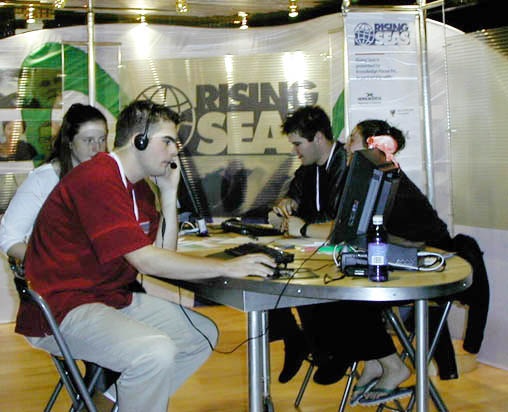
Students from Parrsboro Regional High School
(L-R) Travis Anderson, Erin McCarthy,
Justin Gilbert and Robin Roeslen,
at work on the Rising Seas project.
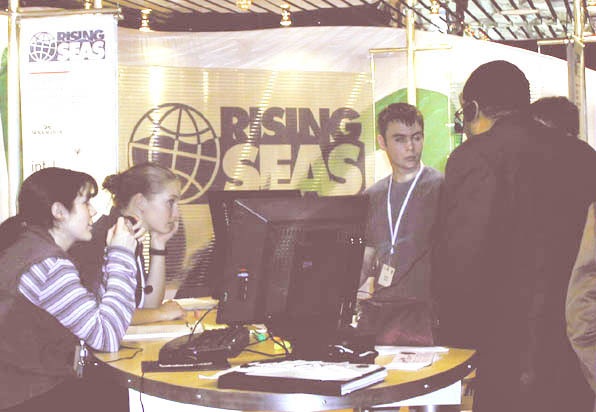
Students from Parrsboro Regional High School
(L-R) Bridget Harroun, Tricia Boland, and Bradley Forbes,
talk to the students at Warwick Academy in Bermuda
with Senator The Honourable L. Milton Scott,
Minister of Education for Bermuda.
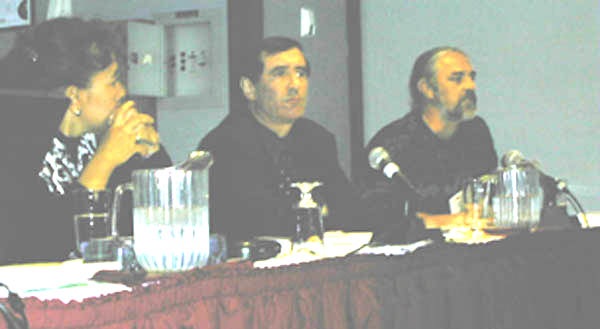
(L-R) Moderator: Dr. Esther Williams, University Librarian,
Laucala Campus, University of the South Pacific, Fiji
Dr. David Nostbakken, President and CEO, WETV Foundation, Canada
Peter Holt, National Operations Manager,
Outback Digital Network, Australia
Rising Seas Description
The program begins with a scenario inviting participating student teams to assume the roles of investigative journalists for a contemporary e-zine — Planet at Risk. They will be asked to prepare an article for a well-informed, environmentally conscious audience on a topic of major global concern — rising sea levels.
After viewing a video that establishes the atmosphere and setting for the problem, the aspiring journalists meet their virtual editor. The editor explains, through the use of instant messaging and e-mail, how the journalists will work as e-zine teams to assess the issue of rising sea levels.
Using the Web for collaboration, research, discussion, and analysis, the journalists will work through a process for problem solving to understand and present the issue. They will also work with Geographic Information Systems (GIS) software. Throughout their learning, students will be energized and motivated by ongoing messages from their editor. They will file progress reports and share their work with interested delegates throughout the 14CCEM. They will apply all of the knowledge and skills acquired through the project, to analyze their findings and publish their final e-zine articles to the e-zine Web site. Their report will also be posted on the 14CCEM web site (www.14CCEM.com), making it publicly-available all over the world.
Source:
Knowledge House Inc. news release, 27 November 2000
http://www.newswire.ca/releases/November2000/27/c8262.html
References:
14CCEM website — The purpose of this website is to provide information about the 14th Conference of Commonwealth Education Ministers (14CCEM) taking place in Halifax, Nova Scotia, Canada, November 27-30, 2000...
http://www.14CCEM.com/
Rising Seas
http://www.14CCEM.com/RisingSeas.html
Knowledge House Inc. website
http://www.knowledgehouse.net/
Rising Seas
http://www.knowledgehouse.net/RisingSeas/index.html
Gloucester High School, 2060 Ogilvie Road, Gloucester, Ontario
http://www3.sympatico.ca/gloucester.hs/schoolprofile/
http://www.octranspo.com/pi/Students_info/Gloucester.htm
Warwick Academy, 117 Middle Road, Warwick, Bermuda (founded 1662)
http://www.warwickacad.bm/

IBM Computer Bus at the 14th Conference
of Commonwealth Education Ministers in Halifax.
(L-R) J. Robert Renouf, Director of Finance,
Chignecto-Central Regional School Board,
(which operates the Parrsboro Regional High School)
and Ron Donnelly, Computer Bus Driver, IBM

Conference delegates inside the IBM Computer School Bus.
References:
Chignecto-Central Regional School Board, Truro, Nova Scotia
http://www.ccrsb.ednet.ns.ca/
1-800-66LEARN, IBM Canada K-12 Educational Software
http://www.can.ibm.com/k12/software/order.html
2000 November 28
Nova Scotia and Newfoundland Cut Off
from North American Telecommunications Network
Water Main Contractor Digs Into Fibre-Optic Cable
Amherst residents lost that long-distance feeling Tuesday, November 28th. They also lost Internet connections and couldn't use bank machines or debit cards after an excavator involved in installing a water line sliced Maritime Tel and Tel's main fibre-optic line linking Nova Scotia's and Newfoundland's phone systems with those across Canada.
 The incident occurred just outside Amherst near an entrance to the Trans-Canada Highway, only a few kilometres from the New Brunswick border. Cellphones were useless unless people travelled to New Brunswick, calling 911 was impossible and people couldn't even reach MTT's 811 or 1-800 service numbers.
The line was cut about 11am, interrupting long-distance calls from Nova Scotia and Newfoundland to the rest of the country for about an hour.
MTT supervisor Bob Sutherland said most Nova Scotians didn't notice a disruption in data, Internet or cellphone services because the company was able to quickly divert the calls of all but 25,000 Amherst-area customers through other lines. Those in Amherst were left unable to make any but local calls.
But the loss of 911 service didn't prompt the town's emergency measures co-ordinator, Ed Childs, to declare an emergency. He did issue a warning, repeated
several times on the radio, urging residents to call the fire station, police department or hospital if they needed emergency help. The three services were in constant contact through a radio dispatcher. Those who couldn't use their phones at all were advised to go to the fire or police stations or to the hospital. Extra police patrols were arranged, but officers didn't report any incidents related to the disruption in service.
People suddenly can't get money they need
For many Amherst residents, shopping was the biggest challenge — especially for those who wanted to use credit or debit cards.
Most businesses put up signs warning customers they were unable to offer either service.
"Not having access to debit cards slowed us down, but most customers seemed to take it in stride and were very co-operative and understanding," said Doris Smith, Atlantic Superstore's customer service manager. Most shoppers used cheques instead of cards, but some had to set their groceries aside and travel to a bank to get some cash for their purchases.
At the bank, it was service the old-fashioned way — through a live teller. "I can't believe it, but the bank machines are out all over town," a frustrated Mike Kelley said, as he put his debit card back into his wallet. "This really is a setback, because I was getting ready to buy some things I needed — like food — and now I can't because I can't get access to my money anywhere." But his annoyance eased when he found out why he couldn't get at his money. "I guess it's really not a big deal," Mr. Kelly said.
But it was a big deal to Debbie Lowe. She'd been trying all day by the telephone and over the Internet to find out whether her husband's paycheque, which is deposited electronically, was in their bank account. "Because I don't carry cash anymore, I've had to make an extra trip into the bank, and even now I don't know if my husband's cheque is there or not," Ms. Lowe said. "It means I can't get the money I need to get my groceries today."
Mr. Sutherland said crews and equipment had to be brought in from Truro and New Glasgow to fix the break. Service was restored around suppertime on Tuesday.
[The Halifax Chronicle-Herald, 29 November 2000]
2000 November 29
SPM Line Gets Big New Ship
A larger and faster vessel will be plying the waters in the feeder service of SPM Container Line early in the new year. Philippe Paturel, SPM's president and chief executive officer, said Tuesday the MV Shamrock will begin sea trials in the Black Sea next week.
SPM Container Line, part of the Armement Paturel-Dagort/SPM Group of St-Pierre-Miquelon, operates a weekly feeder service between St-Pierre, Halifax, Boston and Portland. An increase in business prompted the construction of the new ship, built in Romania.
SPM has about 36,000 container lifts per year through the Port of Halifax.
"This growth in volume is bringing Armement Paturel-Dagort closer to the level of major shipping lines and will represent about 10 per cent of the total container traffic of the Port of Halifax," the company said in a release.
SPM Container Line has contracts with such major lines as P&O Nedlloyd and Orient Overseas Container Line to carry containers that are loaded or discharged from the major lines' vessels in Halifax.
SPM Container Line is presently negotiating with Maersk-SeaLand to carry its import business to Boston. Maersk-SeaLand is revising its service to Boston in the transatlantic trade. It plans to serve Boston with a fixed-day weekly feeder service from Halifax.
The 4,800-tonne Shamrock, with a crew of 11, will replace the MV Lisbeth C, which has been on the feeder service since 1995. The new ship has 5,800 horsepower and bowthrusters that will allow better manoeuvrability than Lisbeth. Shamrock, 119 metres in length and built at a cost of $33,000,000, is about 30 per cent larger than the Lisbeth C. It will carry roll-on/roll-off and break bulk cargo, as well as containers. The vessel also has 100 plugs for refrigerated containers.
Armement Paturel-Dagort began roll-on/roll-off service, including small container capacity on the ship, in 1980 between Halifax and St-Pierre-Miquelon. In 1994 the service expanded to Boston and Portland. It was the first feeder service from St-Pierre and Halifax to the U.S. Mr. Paturel said if the business continues to grow, SPM will be able to add vessels.
Shamrock will become part of the Armement Paturel-Dagort fleet, which also includes three recently built 30,000-tonne multi-purpose vessels involved in a global trade. Shamrock was named for a French trawler that fished around St-Pierre before new territorial rules were set. SPM Marine International of Halifax is the line's agent.
[The Halifax Chronicle-Herald, 29 November 2000]
References:
SPM's regular feeder service to St. Pierre and Miquelon, New England and other U.S. ports provides customers in these areas with reliable connections to more than 20 mainline overseas carriers — including Hapag-Lloyd, Maersk-Sealand, NYK Line, OOCL, P&O Nedlloyd and Zim Container Service — offering complete global service via Halifax...
http://portofhalifaxmagazine.com/00jul-aug/carrier1.htm
SPM Container Line of St. Pierre will build and operate a new larger 5,000-ton container ship for service from Halifax to Boston and Portland. The new ship, to be built in Constantsa, Romania, will be in service by October 2000. The new vessel will be handled at the International Marine Terminal in Portland...
http://www.portofportlandmaine.org/news.html#spm
St. Pierre Ro\Ro Service
http://www.portofhalifax.ca/inter.htm#StPierreRoRoService
A weekly vessel operated by SPM Container Lines serves Halifax, Portland, and Boston...
http://www.massport.com/ports/conle_liner.html
2000 November 29
Independent Film Channel Canada
Salter Street gets set to go digital
Specialty channel aims for fall launch
A Halifax film company that was awarded a coveted CRTC licence last week plans to launch its new digital channel by September 2001.
Salter Street Films Limited intends to broadcast from its building at the foot of Citadel Hill with an initial staff of 20 to 25, said Catherine Tait, the company's president and chief operating officer.
"It is absolutely our intention to build the facility in Halifax and currently we are focused on the Academy building... as a home base for the station," Ms. Tait said Tuesday. The Academy building is the former school board building at Brunswick and Sackville streets in downtown Halifax.
Salter Street beat out some industry heavyweights last Friday to grab Independent Film Channel Canada, a "must-carry" operation that cable networks will broadcast. It is a sought-after Category One licence.
Licence worth about $20,000,000
Ms. Tait confirmed Salter will likely sink about $6,000,000 into launching the specialty English-language digital channel, adding the licence could be worth much more to her company. "I think that the evaluations are somewhere between $20,000,000 and $25,000,000 for the licence itself," she said.
"Obviously the proof will be in how successful the satellite and cable distributors are in rolling out digital television across the country, and when we see that, the value of those channels may in fact be significantly higher. "It's very hard to know because we don't know what the digital universe will be, and the value of the channel is related to the number of subscribers."
Important to Salter Street's future
The licence award is important to Salter Street's future, Ms. Tait said. "(With) this decision, our company takes a first step into the world of broadcasting, which is a whole new area for us, and offers us an extremely important growth opportunity. For a company our size, this is perhaps more significant than for some of the larger companies who are already incumbent."
An analyst with Yorkton Securities in Toronto agrees. "We think that the licence award is very positive news and it will definitely lead to improved value," Roger Dent said in an interview on Monday. "We'll really have to see how Salter's plans unfold; how do they actually operate the station."
Salter was up against big contenders such as CHUM and Alliance Atlantis in vying for the Independent Film Channel Canada licence, Ms. Tait said. The spinoffs will benefit Atlantic Canada, she said. "This is the first licensed specialty broadcasting business in all of the four Atlantic provinces, so it's very important."
Specialty channels lose money at first but then rebound, Mr. Dent said, citing Teletoon as an example of a channel that does very well. "The typical specialty channel start-up does lose money initially," he said. "Historically (it) moves into the black in quite short order."
Ms. Tait said Salter has the money to launch the channel but will "pursue any opportunity that opens up in the capital markets. We're looking at all our options, obviously. We had to have sufficient financing in place in order to even apply for these licences... but it's not absolutely a requirement in order to get this business off the ground. We're in constant discussions with investors."
Many details have yet to be decided as Salter is awaiting more specifics from the Canadian Radio-television and Telecommunications Commission, including specifics on Canadian content, she said.
Marketing the 20 channels Salter was awarded in the Category Two division is also on the company's agenda. "It's the obvious next priority," Ms. Tait said. "Obviously the other piece of the equation is whether or not we are able to secure carriage for any of our Category Two licences. "Which of those licences are we also going to be able to turn into operating channels. That's subject to cable and satellite distribution."
Mr. Dent said analysts don't put value on the Category Two licences because they're not yet a reality. "The Category Two licences across the board, it's still not entirely clear what the economic model for these licences will be," he said. "At this stage we don't attach... particular value to those awards."
Ms. Tait said a relationship with Independent Film Channel in the U.S. gives her company an "enormous leg up" when it comes to branding and marketing. "They are going to share with us all of the learning experiences they had in launching that channel there."
[The Halifax Chronicle-Herald, 29 November 2000]
CRTC Decision 2000-459
24 November 2000
Salter Street Films Limited
The Independent Film Channel Canada
The Commission approves the above application for a new English-language Category One specialty television service. The reasons for approval, as well as the terms and conditions of the new licence will be issued at a later date.
Source:
CRTC Decision 2000-459, 24 November 2000
http://www.crtc.gc.ca/archive/Decisions/2000/DB2000-449%20to%20469.htm
24 November 2000
CRTC Approves New Digital Television Services
OTTAWA-HULL — The Canadian Radio-television and Telecommunications Commission (CRTC) is issuing abridged decisions on the approval of applications for new digital pay and specialty television services. The Commission is convinced that these high quality and varied services will help drive the penetration of digital technology in Canada and provide new windows for Canadian talent while offering Canadian viewers a wide array of new choices... Digital technology allows for new and imaginative ways for distributors to offer services. But the most attractive aspect of the new technology is the chance for consumers to be in the driver's seat in terms of what services they choose to pay for and view.
More than 450 applications for licences
The Commission received over 450 applications for licences and approved 16 English- and 5 French-language Category One applications, 262 Category Two applications, as well as the 2 pay-per-view (PPV) and 4 video-on-demand (VOD) applications. The Commission denied 66 Category One applications and 99 Category Two applications. Consistent with the licensing framework issued last January, applications were denied mainly because they competed with an approved Category One licence or an already existing conventional service.
To offer Category One services to the greatest number of potential digital subscribers, distributors who use digital technology will be required to carry all the approved Category One services appropriate to their markets. In contrast, Category Two licensees must negotiate with distributors for access. "The new world is both digital and diverse. But in that challenging world, the final choice will be the consumer's," said Madame Franois Bertrand, CRTC chairperson.
Source:
CRTC news release, 24 November 2000
http://www.crtc.gc.ca/ENG/NEWS/RELEASES/2000/R001124_e2.htm
Categories One and Two Defined by the CRTC
Category One
Ensuring a Canadian digital presence
To foster the development of a number of new, high quality specialty services with strong commitments to the development, diversity and distribution of Canadian programming, the Commission has created Category One. Canadian distributors employing digital technology will be required to distribute Category One services appropriate to their markets. The Commission will license approximately ten of these services using a competitive process on a one-per-genre basis. Priority will be given to commitments made to Canadian programming, and the innovative use of the digital medium.
Basic Category One licensing requirements:
- Ramp up to minimum 50% Canadian content by last year of licence term
- 7 year licence term
- Canadian ownership, while encouraging international participation
- One-per-genre basis (Category One services may not compete directly with each other or existing pay or specialty services)
- Business plan must demonstrate ability to meet commitments
- Competitive licensing process
Category Two
A wider choice of programming services for Canadians
The Commission aims to encourage choice and diversity of programming services in the digital system. As there will be services prepared to take on the risks of launching on a digital-only basis, the Commission will license an unlimited number of the Category Two services on an open-entry basis as long as they meet certain basic criteria. These services will not have guaranteed distribution rights. The Commission expects Category Two services to include premium services geared to niche audiences and repackaged channels.
Basic Category Two licensing requirements:
- A minimum 35% Canadian content (15% Canadian content for ethnic services)
- 7 year licence term
- Canadian ownership, while encouraging international participation
- May be directly competitive with other Category Two services
- Not competitive with any Category One licensee or existing pay or specialty service
- Streamlined licensing process
Source:
CRTC news release, 11 April 2000
http://www.crtc.gc.ca/ENG/NEWS/RELEASES/2000/I000411ea.htm
Salter Street Films Limited
http://www.salter.com/
On 4 April 2000, Salter Street Films applied to the Canadian Radio-television and Telecommunications Commission (CRTC) for 30 digital television channels, in two categories. Salter Street Films applied for six Category One licences and participated as a minority partner on one other Category One licence. These channels, if licensed in Category One, will have guaranteed carriage or 'must carry' status for launch in September, 2001. The company also filed 24 digital TV applications in Category Two, which if licensed will have to negotiate distribution.
Online Video — available on demand
Salter Street Films' Digital Television Channel Applications
http://www.salter.com/special/index.htm
Presentations to the CRTC
streaming video in RealVideo format [running time]
recorded at CRTC public hearing, 23 August 2000
CRTC — Introduction by Catherine Tait [3:11]
http://www.salter.com/special/docu/1.smil
Michael Donovan's Statement to the CRTC [6:11]
http://www.salter.com/special/docu/2.smil
Catherine Tait's Statement to the CRTC [3:50]
http://www.salter.com/special/docu/3.smil
Channels
Presentation to the CRTC: Independent Film Channel Canada Channel [7:13]
http://www.salter.com/special/docu/4.smil
Presentation to the CRTC: Girls TV Channel [5:30]
http://www.salter.com/special/docu/5.smil
Presentation to the CRTC: Comedy for Kids Channel [3:58]
http://www.salter.com/special/docu/6.smil
Presentation to the CRTC: ZTV Channel [4:22]
http://www.salter.com/special/docu/7.smil
Presentation to the CRTC: Play TV Channel [3:23]
http://www.salter.com/special/docu/8.smil
Presentation to the CRTC: Nature TV Channel [3:44]
http://www.salter.com/special/docu/9.smil
Michael Donovan's Closing Statement to the CRTC [2:35]
http://www.salter.com/special/docu/10.smil
Catherine Tait's Wrap Up Statement to the CRTC [2:25]
http://www.salter.com/special/docu/11.smil
Michael Donovan's Wrap Up Statement to the CRTC [2:23]
http://www.salter.com/special/docu/12.smil
Transcript of the Presentations
Script of Salter Street Films' presentation to the CRTC in PDF format
http://www.salter.com/special/docu/crtc_presentation_script.pdf
New Digital TV Channels
Salter Street Gets to Work
One in Category One,
Twenty in Category Two
Salter Street Films has already been inundated with resumes for its new Independent Film Channel Canada (indie), though the Category One digital TV license just became official last Friday, November 24th.
"People who are interested obviously should let us know, but we'll be putting that team together over the next month. It's not going to be something done hastily," Salter's president Catherine Tait said yesterday.
The Halifax-based company is still waiting for licensing details and conditions from the Canadian Radio Television and Telecommunications Commission (CRTC), but Tait tentatively expects to hire a core team of 20 to 25 people in Halifax, while most advertising sales will be handled through Salter's Toronto office.
In opening 16 new Category One (must-carry) channels to be distributed digitally, federal regulators chose Salter's proposal for the indie film network over formidable competition from Alliance Atlantis, Astral and CHUM. Salter also won 20 licenses in the Category Two arena, for networks devoted to everything from addiction recovery to horror flicks, but those have no guarantee of being carried.
Salter's new Category Two channels
- Aviation TV
- Classics TV
- Comedy for Kids
- Corporate TV
- Girls TV
- Jobs TV
- Martial Arts TV
- Nature TV
- Ocean Life TV
- Play TV (games and gameshows for the converged computer and television set)
- Recovery TV
- Relationships TV
- Scream TV
- Skating TV
- The Canadian Consumer Channel
- The Collectors Network
- Wheels
- World Cinema, for contemporary and classic foreign films
- World News TV
- ZTV, an internet TV service for 20-somethings
Salter aims to launch the Indie film channel by September 2001. Not only will it be Atlantic Canada's first specialty TV broadcaster, it's the country's first English-language TV service dedicated to independent film, the filmmaking process and the world of filmmakers. It will be aligned with the Independent Film Channel, owned by Cablevision in the United States, mostly to tap into marketing and promotion expertise, said Tait. "The American content is only a small portion of the channel because we have made clear commitments to Canadian content. Over the next month, we'll be looking at the Canadian film library and original programming for the channel," she said. Digital technology has transformed filmmaking dramatically, and the new network will help lower-budget, non-Hollywood projects find an audience.
"We're looking at films with a point of view," said Tait. "We'll include non-fiction features in the schedule, and there's a fantastic library of Canadian short films that have never been seen. Programmed intelligently, we believe that audiences will really be thrilled to see new works by Canadian filmmakers."
In March 2000, only 1,100,000 cable customers could receive a digital TV signal, and the new channels are expected to give Canadians an incentive to switch.
[The Halifax Daily News, 30 November 2000]
Antigonish Roots
Michael and Paul Donovan, the principals of Salter Street Films, have roots in Antigonish, Nova Scotia, being the sons of Bob and Gerri Donovan of Hawthorne Street. Their grandfather, Michael Donovan, was the publisher of the Antigonish Casket, the local weekly newspaper, between 1890 and 1919.
[The Antigonish Casket, 13 December 2000]
Little Salter Street Gets Big Loot Bag From CRTC
Salter seen as being an unexpected winner
When it comes to winners and losers in the sweepstakes for digital television licences, most applicants can say they got something, but the smaller players will probably see the most impact from the CRTC decisions announced last week.
Megan Anderson, a Yorkton Securities Inc. analyst, says major media players were awarded at least a partial interest in channels, but did not necessarily get what they wanted. "It appears as though the CRTC has held true to its form by trying to be equally unfair to everyone," she says in a recent report.
But while the big players, such as CTV/BCE and CanWest Global, can all claim they got something from the Canadian Radio-television and Telecommunications Commission, it is smaller players — especially Salter Street Films Ltd. — that will likely have the most to gain in how the goodies were doled out.
"The award of a specialty digital channel is a positive development for [the bigger players]... but immaterial given the scale of the companies themselves," says Ms. Anderson. She notes that while some speculate a digital licence is worth $20-million from day one, she feels the real value is closer to $5-million to $10-million.
When all is said and done, there will likely be one or two digital services that are major hits while the rest are average or marginal, she says, noting that the television dial is crowded now and few of the digital licences "represent a truly unique genre."
Still, Halifax-based Salter is seen by most industry watchers as being an unexpected winner in the digital licence awards. Not only did it get the much-coveted licence for an independent film channel in the "must carry" Category One classification (meaning the cable companies have no choice but to), it won almost 20 licences in Category Two, where carriage must be negotiated.
For Salter, perhaps the greatest importance of the licence awards is that it puts the company — which until now had been a producer of films and shows such as Lexx and This Hour Has 22 Minutes — on the map as a broadcaster, a nod perhaps to its Atlantic Canada roots and providing a better regional balance.
"We had not expected to see Salter win in the independent film category," says Roger Dent, a Yorkton analyst, adding this category is among the most commercially attractive of the new licences.
Mr. Dent raised his 12-month target for Salter shares (SSF/TSE) to $7.50 from $6.00, reflecting a $12,000,000 value for the independent film channel licence.
Adam Shine, an analyst with CIBC World Markets, raised his target to $4.75 from $3.50, changing his recommendation from "underperform" to "hold."
Sue Reid, an analyst at Research Capital Corp., says Salter's entry into the broadcasting game also makes it more attractive as a potential partner, or even as a takeover target. "It just gives the company a lot more balance and opportunity." She recently raised her target on Salter to $6.50 from $3.00. She also notes that while Salter shares traded as high as $6.25 after the digital licences were announced, they have fallen back and closed yesterday at $4.20.
Alliance Atlantis Communications Inc., after submitting five applications, was given approval for just one — Health Network Canada. Alliance Atlantis shares (AACb/TSE) fell to $18.00 after the digital licences were announced but have rebounded since to close yesterday at $20.65. "Although we would have preferred seeing Alliance Atlantis get approval for its documentary, biography-style or independent film submissions [in Category One], the Health Network serves as a good complement to the company's existing Life Network," says CIBC's Mr. Shine, who rates Alliance Atlantis a "strong buy" with a target of $31.00.
Yorkton's Mr. Dent says: "We would have liked to see two licence wins, one of which we hoped would have been for independent film." Regardless, says Mr. Dent, the Health licence adds another channel to Alliance Atlantis's roster, and the licensing of an independent film channel should provide an important new window for the company's library. He maintains a "strong buy" recommendation, with a $35.00 target.
[The National Post, 1 December 2000]
Independent Film Channel Canada
30 November 2000
MR. SPEAKER: The honourable member for Cole Harbour-Eastern Passage.
Nova Scotia Legislature
RESOLUTION NO. 3675
MR. KEVIN DEVEAUX: Mr. Speaker, I hereby give notice that on a future day I shall move the adoption of the following resolution:
Whereas Salter Street Films Ltd. plans to launch its new digital channel, the Independent Film Channel Canada, by next September after being awarded a CRTC licence; and
Whereas Salter Street intends to build their facility here in Halifax; and
Whereas with this licence Salter Street is taking its first steps into the world of broadcasting;
Therefore be it resolved that all members congratulate Salter Street Films Ltd. and wish them success with their endeavour.
Mr. Speaker, I ask for waiver of notice.
MR. SPEAKER: There has been a request for waiver.
Is it agreed?
It is agreed.
Would all those in favour of the motion please say Aye. Contrary minded, Nay.
The motion is carried.
Source:
Nova Scotia Hansard, page 9550, 30 November 2000
http://www.gov.ns.ca/legi/hansard/han58-1/h00nov30.htm#[Page 9550]
2000 November 30
Knowledge House to Run Local Intel Teaching Program
Knowledge House Inc. has been named Canadian training agency for Intel of Canada's Teach to the Future program. The program is designed to reduce barriers teachers face in integrating technology to enhance learning. Knowledge House, as part of its agreement with Intel, has reviewed and updated Intel's American curriculum to meet Canadian education requirements. In addition, Knowledge House has agreed to coordinate and deliver training to 40 "master teachers" in Nova Scotia, 40 in Ontario and 20 in Alberta. Intel will pay Knowledge House about $165,000 for these services.
[The Halifax Daily News, 30 November 2000]
Intel Donates Computers, Training to Teachers
Nova Scotia teachers are the first in Canada to receive computer training and equipment, thanks to a new program launched by Intel of Canada. The company announced Wednesday, November 29th, in Halifax, that its international teacher training program, Teach to the Future, is expanding to Canada this year. The $10,000,000 program, designed to help teachers use technology in the classroom, was launched during the Conference of Commonwealth Education Ministers.
Twenty teachers from the Halifax and Chignecto Central school boards finished training in November. Another 20 Nova Scotia teachers will be trained over the next year.
Halifax-based Knowledge House will train up to 100 master teachers in Nova Scotia, Ontario and Alberta over the next three years. Other provinces are expected to join the program in the future.
The teachers, who each receive a free laptop computer, CD burner and software, are expected to each train at least 20 of their peers annually for the next three years.
Intel is donating $1,500,000 to the program while Microsoft Canada is supplying $8,800,000 in equipment and support. Worldwide, the two companies will donate nearly $450,000,000 to train 400,000 teachers in 20 countries.
[The Halifax Chronicle-Herald, 2 December 2000]
2000 November 30
First Seamless, Coast-To-Coast Canadian Fibre Optic Network
Halifax, Quebec City, Toronto, Winnipeg, Edmonton, Victoria
20 gigabits per second
Vancouver, British Columbia — 360networks announced today that it is now providing broadband services on the first seamless coast-to-coast Canadian fibre optic network. The network was recently lit by 360networks' Canadian affiliate. Spanning 11,500 kilometres (7,000 miles), the network connects 13 major cities across Canada, including Victoria, Edmonton, Winnipeg, Toronto, Quebec City and Halifax.
"This national network offers the most bandwidth capacity ever available in Canada," said Ron Stevenson, vice-chairman of 360networks. "It is a powerful, scalable network that can connect Canadians coast-to-coast faster and more efficiently, and change the way companies and individuals in Canada move data and other high-capacity information."
The network provides initial bandwidth capacity of 20 gigabits per second with the potential to be quadrupled in about two years. In some segments of the network, bandwidth capacity of up to 60 gigabits per second is already available.
Commercial traffic is already moving across the entire network. 360networks has customer orders and commitments spanning the country from a variety of service providers, including telecommunications and Internet service providers such as Big Pipe Inc. (a subsidiary of Shaw Communications) and Peer1.net (formerly known as Colo Brokers).
This cross-Canada route is an important component of 360networks' North American network which spans 43,000 kilometres (26,700 miles). It is one of the largest on the continent. About 18,000 kilometres (11,100 miles), including the coast-to-coast Canadian segment, are lit and ready for commercial service. From Halifax, 360networks' Canadian route will connect with 360atlantic, the companys transatlantic cable that will soon link North America and Europe.
Upon scheduled completion in early 2001, 360networks' North American network will connect 50 major cities in the United States and Canada.
Source:
360networks news release, November 30
http://www.360.net/
http://www.lightreading.com/opticalintellect/document.asp?doc_id=62
Cable-Landing Station Set In Lynn
360 Networks, a British Columbia telecommunications company developing a global fibre-optic network, formally opened its $25,000,000 trans-Atlantic cable landing station in Lynn, Massachusetts. When put in service this winter, the fibre line landing will be capable of handling 1.92 trillion bits of data per second or about twice the current traffic of the whole Internet. The station links Boston directly to Halifax, Nova Scotia, and Dublin as well as England.
[The Boston Globe, 16 November 2000]
360networks Completes Final Cable Landing Station
For Transatlantic Crossing
Connects Massachusetts directly with Halifax
and then on to Ireland and England
Lynn becomes home to the only
transatlantic fibre optic cable
landing site in Massachusetts
1.92 terabits per second
Lynn, Massachusetts November 15, 2000 — 360networks announced today the official opening of the fourth and final cable landing station for its transatlantic fibre optic network. Located northeast of Boston in Lynn, the station will be the U.S. entry point for data traffic travelling across 360atlantic, 360networks' transatlantic fibre optic cable.
The 11,700-kilometre (7,300-mile) cable will be among the first transatlantic submarine cables to support 10 gigabits per second of data on a single channel, and offer total system capacity of 1.92 terabits per second. This is sufficient capacity to send two million digital photographs per second.
To date, Lynn is the only landing site in Massachusetts for a transatlantic fibre optic network. The $25,000,000, 1100 square metre cable landing station is located off the Lynnway. The facility features the highest level of security available, has around-the-clock network monitoring and standby electrical generator power.
"This cable landing station is the key gateway between our networks in the United States and Europe," said Scott Lyons, vice-president of the marine division at 360networks. "We are on schedule to complete 360atlantic, and as of today, all the landing stations are ready to connect the submarine cable with our terrestrial networks in Europe and North America."
"Lynn was chosen as the U.S. landing site for 360atlantic because it offered the best beach landing site on the northeast coast and a diverse route from all other transatlantic cable systems," continued Lyons. "The community was very receptive, and especially pleased that our network will provide a direct link between Boston and Dublin."
When 360atlantic enters commercial service in the first quarter of 2001, it will connect Lynn directly with Halifax, Nova Scotia, and then on to Dublin, Ireland and Southport, United Kingdom on a self-healing network ring.
The Lynn cable landing station will also connect with 360networks' city ring around downtown Boston and its North American fibre optic network, one of the largest on the continent. Upon completion, this network will cover 43,000 kilometres (26,700 miles) of the United States and Canada. More than 16,000 kilometres (10,000 miles) of this network are lit and ready for commercial service. The full network is scheduled to enter commercial service in the first quarter of 2001, and will provide seamless connectivity between 50 major cities.
Source:
360Networks Inc. news release, 15 November 2000
http://www.360.net/
2000 November 30
360networks Deploys The World's
Most Extensive Optical Mesh Network
Uses Sycamore Networks' intelligent optical switching
and network management equipment
VANCOUVER, British Columbia Nov. 30 /CNW/ — 360networks announced today it is now deploying the most extensive optical mesh network in the world with the installation of Sycamore Networks' optical switching and network management equipment in Europe and North America.
360networks plans to install more than 100 intelligent optical switches in major cities around the world by mid-2002. It is expected the switches will be installed in the majority of cities in North America and Europe where 360networks has large points of presence (POP) facilities by mid-2001, followed by South America in the second half of 2001 and Asia in early 2002.
"An optical mesh network provides us major competitive advantages," said Greg Maffei, president and chief executive officer of 360networks. "We can
create and provision a variety of broadband services to customers in minutes,
versus weeks with a traditional ring network architecture. "We can provide our customers greater choice and flexibility, such as bandwidth on demand, variable protection options, and the ability to self-monitor and self-manage their network traffic."
Maffei added: "In addition, because we can introduce new services more quickly, we will be able to generate new revenue streams more quickly. No other carrier can do this on a global basis."
"The size and scope of 360networks' global network deployment is yet another proof point for the flexible, scalable power of the intelligent optical network," said Dan Smith, president and chief executive officer of Sycamore Networks. "We are pleased that 360networks is extending the range and reach of its network with Sycamore's innovative switching, transport and network management solutions."
360network's architecture will include the SN 16000 intelligent optical switch, SN 8000 intelligent optical transport products and SILVX(TM) optical network management system.
At the heart of 360networks' intelligent optical architecture is Sycamore's Broadleaf Network Operating System, extending the service range and reach of Sycamore's optical switching platforms. Using a combination of optical routing and signaling protocols, such as Open Shortest Path First (OSPF) and Multi-Protocol Label Switching (MPLS), Broadleaf enables Sycamore's switches to create and provision quickly optical light paths to deliver high-speed, customized services.
About Sycamore
Sycamore Networks develops and markets intelligent optical networking products that transport voice and data traffic over wavelengths of light. The Company combines significant experience in data networking with expertise in optics to develop intelligent optical networking solutions for network service providers. Sycamore's products are based on a common software foundation, enabling concentration on the delivery of services and end-to-end optical networking. Sycamore's products and product plans include optical transport, access and switching systems and end-to-end optical network management solutions. Contact Sycamore Networks at www.sycamorenet.com. Sycamore shares trade on the NASDAQ stock market under the symbol SCMR.
About 360networks
360networks offers broadband network and co-location services to telecommunications and data-centric organizations. 360networks is developing one of the largest and most technologically advanced fibre optic mesh networks in the world. By mid-2002, the planned network will span 142,000 kilometres (88,000 miles) and link more than 100 major cities with terrestrial routes and submarine cables joining North America, South America, Asia and Europe. 360networks is also developing nearly 340,000 square metres of network co-location space. More information is available at www.360.net. 360networks shares trade on the NASDAQ stock market under the symbol TSIX and on the Toronto stock exchange under the symbol TSX.
Source:
360Networks Inc. and Sycamore Networks news release, 30 Nov. 2000
http://www.newswire.ca/releases/November2000/30/c9586.html
http://www.lightreading.com/opticalintellect/document.asp?doc_id=64
References:
360networks Inc., 1066 West Hastings Street, Vancouver, British Columbia
http://www.360.net/
SEDAR's profile for 360networks Inc. (incorporated 5 Feb. 1998)
http://www.sedar.com/
Sycamore Networks
http://www.sycamorenet.com/
Intelligent Optical Networks
http://www.lightreading.com/opticalintellect/
2000 November 30
CRTC Alters Telephone Policy
The CRTC has changed the way it collects money to subsidize local phone service and that means more telecom service companies will help pay the subsidies and some consumers could see an increase in their local phone rates. In a ruling released November 30th, the Canadian Radio-television and Telecommunications Commission (CRTC) announced its former subsidy collection system — which took funds only from long-distance providers on a per-minute usage basis — will change.
Now all telecom companies will contribute a percentage of their eligible revenues to a national subsidy fund. That means that current and new local carriers, alternate long-distance service providers, resellers, wireless service providers, international licensees, satellite service providers, payphone providers, data and private line service providers will contribute a portion of their revenues to the fund.
The system, which starts 1 January 2001, — considered a transition year because of the complexity of the arrangement — is expected to be fully in place across the country by 2002.
The rate set for 2001 is 4.5 per cent of eligible revenues from telecom companies, which is expected to decrease in following years, the commission said.
However, as a result of the changes, there may be increases in some consumers' local phone rates, the commission said. "Although the new revenue-based contribution mechanism may result in local rate increases for some consumers, the commission estimates that the potential local increases will be lower than increases that could have been expected under" the other systems proposed by some carriers.
[The Halifax Daily News, 1 December 2000]
Cost of Local Phone Service May Rise
CRTC ruling changes important subsidies
Toronto — Basic telephone rates could increase and much of the Canadian telecommunications sector faces a new tax now that the federal telecommunications regulator has changed the way rural phone services are subsidized.
The decision means more telecom service companies will help to cover subsidies for out-of-the-way local services — although some analysts question why there needs to be a rural phone subsidy at all.
The Canadian Radio-television and Telecommunications Commission announced Thursday that its subsidy collection system — which until now has taken funds only from long-distance services on a per-minute basis — will change.
With long-distance charges shrinking toward a vanishing point, the CRTC has decided that all telecommunications companies must contribute a percentage of their gross revenues to the national subsidy fund. The fund at present collects a billion dollars a year to offset the high costs of providing phone service far from population centres.
The CRTC's new levy is tentatively set at 4.5 per cent of revenues, a rate that is to be revised retroactively in mid-2001 and is expected to decrease in future years.
It will be collected effective January 1st from local voice carriers, alternative long-distance service providers, resellers, wireless service providers, international telecom licensees, satellite services, payphone operators, and data and private line service providers.
Some services exempt
Paging services, phone rentals and retail Internet providers are excluded from the collection system, as are any service providers with annual revenues of less than $10 million.
As a result of the change, "basic local telephone service rates may be affected," the commission said. However, the new system is "sustainable, technology-neutral and competitively fair to all players," David Colville, CRTC vice-chairman of telecommunications, said in a statement.
The old system's dependence on long-distance telephone revenue was seen as threatened by the increasing popularity of long-distance voice service over the Internet.
Good news for the Internet
"A lot of it is good news for the Internet," Jay Thomson, president of the Canadian Association of Internet Providers, said of the CRTC's decision. "It certainly is good news that retail Internet revenues are exempt from the contribution regime."
However, Eamon Hoey, president of Hoey Associates Telecommunications Consulting Services, was disappointed with the commission's decision.
"They didn't ask the fundamental question — Should we have a contribution regime? — and the answer is no," Hoey said. "At the end of the day, it's a tax on urban areas for people who have chosen to live outside of urban areas," he said. "They're getting away with a huge break on telephone service. It's a bad decision."
The CRTC's Colville defended the system, saying the cost of rural phone service has to be kept in a reasonable range. "We're trying to keep the price of basic telephone service affordable right across the country, particularly in rural or remote areas," he said.
The new levy is fairer than the old one because all telecom companies have to pay, not just long-distance service providers, Colville said.
[The Halifax Chronicle-Herald, 1 December 2000]
CRTC Ruling May Boost Cost of Local Calls
A landmark CRTC decision on the last day of November, that changes the way the telecommunications regulator collects subsidies for a $1,000,000,000 fund that helps pay for local phone service, is unfair, critics say, and will increase the cost of local phone service.
"The inevitable consequence is going to be that the prices are going to go up for our customers so they can help pay for services in other parts of Canada," said Robert Farmer, vice-president of regulatory matters for Bell Canada, the dominant local telephone service provider to the 19,000,000 residents of Ontario and Quebec.
The Canadian Radio-television and Telecommunications Commission ruled on November 30th that Canada's telecommunications companies must contribute 4.5% of their gross revenues toward the $1,000,000,000 fund.
Formerly, only long-distance services paid.
Now, both long-distance and local services contribute.
At present, only providers of long-distance telephone services contribute to the subsidy fund. Now, providers of local phone service, wireless phone service, data communications services, and most other telecommunications services must contribute toward the fund.
The net effect, say critics, amounts to an unfair tax on one group of consumers to pay for services used by another group of consumers.
"This is a tax on urban areas," said Eamon Hoey, a senior partner at Hoey Associates Telecommunications Consulting Services Inc. of Toronto"[The CRTC] never asked the right question, which is should we have a subsidy from one area of consumers to another area of consumers?"
Still, it is unclear which telecommunications services will cost more.
"I don't think we know yet," said Lis Angus, vice-president of Angus Telemanagement Group Inc., a telecommunications consulting firm in Pickering, Ont. "I think we'll have to hear what the carriers say. The impact of this will be on them."
The total amount of money coming out of the system — a billion dollars a year — remains the same. What changes is the number and kinds of companies who will contribute to that. Long-distance providers will pay significantly less but wireless telephone service providers and providers of local phone service will now have to contribute to the fund.
This is a Significant Decision
"This is a significant decision. Those who were paying wanted to pay less and those who weren't paying anything didn't want to pay but, on balance, I think we'll see some complaints from some but I think the judgment will be that this is probably fair," said Ms. Angus.
Under the current subsidy system, only those companies providing a long-distance telephone service had to chip in to the fund and those companies contributed to the fund based on the number of long-distance minutes their customers used.
"By moving to a revenue tax, the CRTC is ensuring a fair and transparent approach to funding universality," said William Linton, chief executive of Call-Net Enterprises Inc. of Toronto. "The tax will not have to be modified as technology changes. In resolving contribution reform, we expect that all consumers, including local residential customers will benefit from a more competitive telecommunications industry that will come as the CRTC turns its focus now to other regulatory problems."
Retail ISPs Exempt
The CRTC exempted some companies from contribution to the subsidy fund. Revenues from paging services, terminal equipment, and retail Internet service providers are excluded. That means, for example, that Bell Canada will not have to contribute 4.5% of the revenue it earns from selling telephones or from selling its Sympatico-Lycos Internet service. Companies with revenues of less than $10,000,000 a year are also exempt.
[The National Post, 1 December 2000]
CRTC Ruling May Boost Phone Bills
OTTAWA — Phone bills might rise up to $1 a month as a result of a CRTC decision that hands long-distance phone companies a major victory at the expense of cellular phone companies and established providers such as Bell Canada.
Bell Canada said it will now have to shoulder a larger part of the burden of subsidizing local, remote phone service, and customers in Ontario and Quebec will have to pay.
The Canadian Radio-television and Telecommunications Commission decision changes the way that long-distance phone companies, such as Sprint Canada Inc. and AT&T Canada Inc., subsidize the high cost of providing local phone service, especially in rural and remote areas.
Sprint, AT&T and other new entrants to the long-distance market had long complained they were paying too much money to subsidize the monopolists in the market, such as Bell and Telus Corp.
Until now, the subsidies were based on the number of long-distance minutes consumers spent on the phone. But with the advent of marketing plans that give consumers flat rates for long distance, the new competitors saw their payments skyrocketing.
Fundamental change in method of calculating payments
On November 30th the CRTC decided to change the way it collects subsidies for local service. Starting next April, all telecommunications service providers will pay one flat rate of 4.5 per cent of their total revenue.
"I am confident that this new collection method will overcome many of the concerns industry players have voiced. It is sustainable, technology-neutral and competitively fair to all players," said David Colville, the CRTC's vice-chairman of telecommunications.
In the past, the phone companies would put together a pot of about $1,000,000,000 a year for subsidizing high-cost local phone services. The pot, for now, will stay about the same size.
But under the new formula, companies such as Sprint and AT&T will likely pay less, Mr. Colville said. Bell and Telus will have to pay a bit more.
And wireless phone companies, which had been paying very little into the subsidy pot, will have to start contributing at the same 4.5 per cent of revenue that the other companies have to pay. "All the companies are going to have to pay this charge," Mr. Colville explained in an interview.
As for consumers, traditional full-service phone companies such as Bell and Telus may end up charging a bit more to cover the new costs, he said. Their prices have been capped, but the CRTC yesterday decided to allow them to add the extra cost of subsidization, beyond the cap.
Mr. Colville estimates that the extra cost probably won't amount to more than a dollar a month.
Bell Canada said the burden of the ruling will be on its customers.
"Our customers now are going to have to pay higher prices to subsidize services in other parts of Canada," said Bob Farmer, vice-president of regulatory matters for Bell Canada. "It puts it [the burden] on Bell Canada customers."
That's because, while Bell has worked hard at bringing down the cost of its services in remote areas, other companies haven't.
And now, with one flat tax for all parts of the country, the more efficient Bell will end up paying for less efficient companies in the East and in the West, Mr. Farmer said.
[The Globe and Mail, 1 December 2000]
Index with links to the other chapters
Go To: History of Telegraph and Telephone Companies in Nova Scotia
http://ns1758.ca/tele/telephone.html
Go To: History of Railway Companies in Nova Scotia
http://ns1758.ca/rail/railways.html
Go To: History of Electric Power Companies in Nova Scotia
http://ns1758.ca/electric/electric.html
Go To: History of Automobiles in Nova Scotia
http://ns1758.ca/auto/automobiles.html
Go To: Nova Scotia History, Chapter One
http://newscotland1398.ca/hist/nshistory01.html
Go To: Nova Scotia in the War of 1812
http://ns1758.ca/1812war/war1812-atlantic.html#war1812-novascot
Go To: Nova Scotia Historical Biographies
http://newscotland1398.ca/hist/nshistory00.html#ns-historical-biog
Go To: Proclamations: Land Grants in Nova Scotia 1757, '58, '59
http://planter2010.ca/proc/proclamations-ndx.html
Go To: Statutes of Nova Scotia, 1805, edited by Richard John Uniacke
http://ns1763.ca/law/ns-statutes1805-titlepg.html
Go To: Home Page
http://newscotland1398.ca/index.html
Moved to new hosting company: 2011 June 07
Latest update: 2011 June 09

